Nifty 50
- Apollo Hospitals₹8,027.50361.50 (4.72%)
- BSE₹3,287.20-47.60 (-1.43%)
- ITC₹26611.00 (4.31%)
- Reliance Industries₹1,170.30-7.70 (-0.65%)
- Eicher Motors₹7,050282.50 (4.17%)
- JSW Steel₹1,168-7.20 (-0.61%)
- TCS₹2,15680.00 (3.85%)
- Cipla₹1,301-5.80 (-0.44%)
- HCL Technologies₹1,216.7039.80 (3.38%)
- Adani Ports₹1,76153.00 (3.10%)
- Infosys₹1,023.4026.40 (2.65%)
- Shriram Finance₹940.4523.20 (2.53%)
- Tata Motors PV₹279.906.90 (2.53%)
- UltraTech Cement₹10,675249.00 (2.39%)

- Offerings
- Tools & Platforms
Tools & Calculators
- Open API
- Calculators
- SIP Calculator
- CAGR Calculator
- Compound Interest Calculator
- FD Calculator
- RD Calculator
- EPF Calculator
- Retirement Calculator
- HDFC SIP Calculator
- Mutual Fund Return Calculator
- Lumpsum Calculator
- Step Up SIP Calculator
- ETF SIP Calculator
- Brokerage Calculator
- Equity Margin Calculator
- SWP Calculator
- EMI Calculator
- MTF Calculator
- Margin Pledge Calculator
- Algo Strategy
- Markets
Stocks
F&O
Mutual Funds
- More
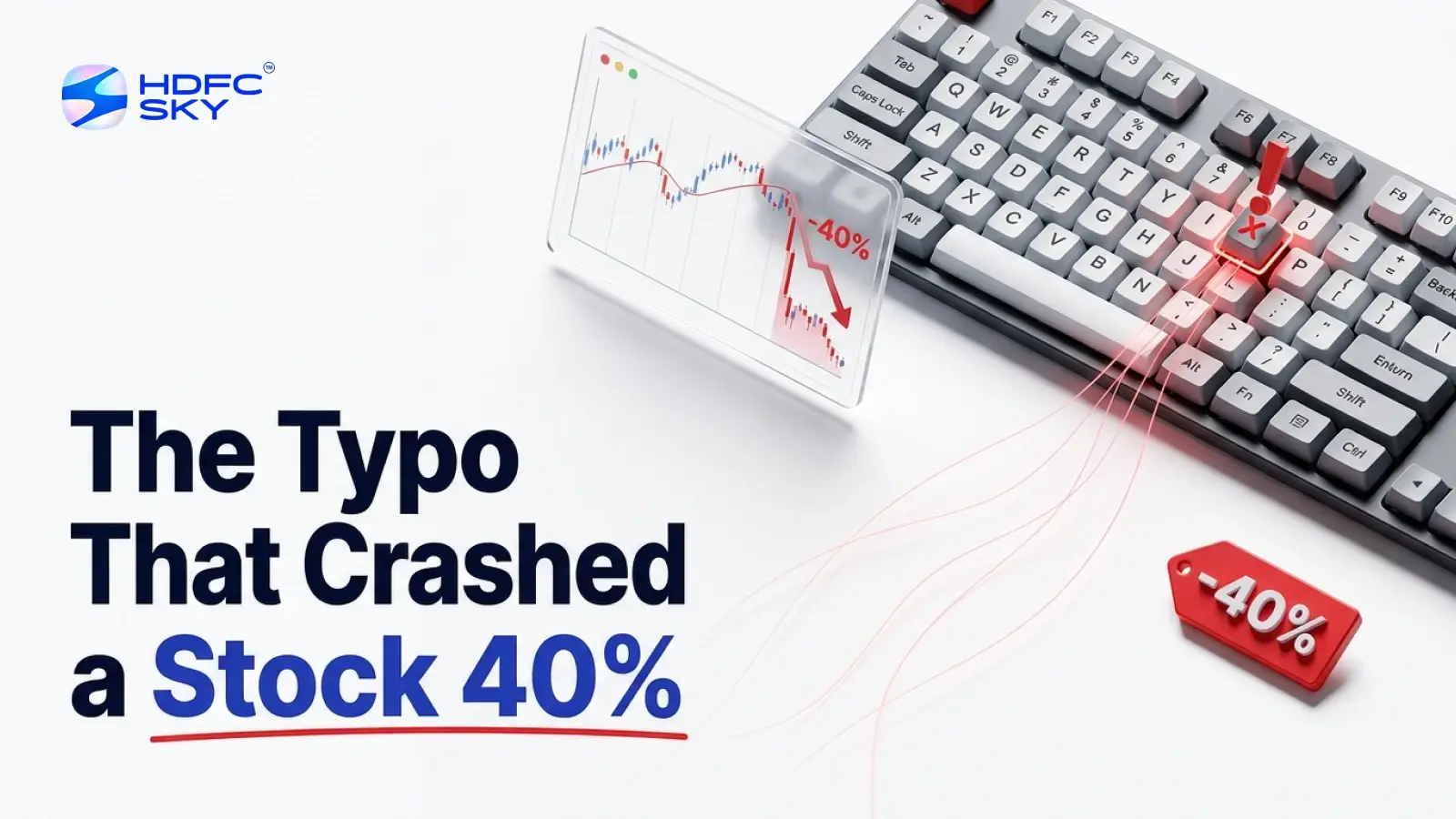
The Day a Typo in a Large-Cap Order Crashed a Stock 40% in Four Minutes
By Aseem Shrivastava | Updated at: May 27, 2026 06:26 PM IST
Open Free Demat Account
Open Free Demat Account
Markets run on speed and accuracy. But sometimes, a small typing mistake can shake the entire system. In rare cases, one wrong order can trigger a sharp fall in prices within minutes. This is called a fat finger error, where a trader enters the wrong number while placing a trade. In this blog, we first look at a major Indian incident that shook the market in 2012. Then we explore global cases where similar mistakes caused huge losses. Finally, we understand what first time investors should learn from these sudden events.
What is a Fat Finger Error?
A fat finger error (a colloquialism for a typing mistake) happens when a trader enters the wrong value while placing an order. It can be a wrong price, wrong quantity, or both. In fast electronic markets, orders move in seconds. So even a small typing mistake can lead to large damage.
Computers do not check intention. They only follow instructions. That is why a simple human error can turn into a major market move.
Modern exchanges try to reduce this risk using safety checks, but they cannot remove it completely.
Also Read: Red flags in IPO subscription scams that most retail investors ignore
The Emkay Global Flash Crash (2012)
On October 5, 2012, India saw a major fat finger event involving Emkay Global Financial Services. A dealer mistakenly placed a large sell order linked to the Nifty index. The error likely came from entering the wrong value while placing the order.
The system treated it as a real market order. It immediately pushed the trade into the National Stock Exchange of India. Automated trading systems reacted within seconds and started selling aggressively. This created a chain reaction in the market.
The Nifty index fell nearly 900 points in a very short time, which is around 15 to 16 percent. Prices moved so fast that investors could not react. Panic spread across the market.
The fall triggered circuit breakers on the exchange. These are safety rules that pause trading when prices move too fast. After trading stopped, the exchange reviewed the activity and cancelled the wrong trades. The market then stabilized. This event showed how one typing mistake can impact the entire system in minutes.
Mizuho Securities (Japan, 2005)
In 2005, Mizuho Securities faced one of the most famous fat finger errors in history. A trader intended to sell one share of J-Com at a high price of 610000 yen. Instead, the trader entered 610000 shares at one yen.
This mistake flooded the market with a huge sell order. The Tokyo Stock Exchange could not stop the trade quickly. The stock price collapsed within minutes. Traders who noticed the error bought shares at very low prices and made profits.
Mizuho later suffered losses of over 200 million dollars. The incident forced exchanges in Japan to improve order checks and safety systems.
Knight Capital (United States, 2012)
Knight Capital experienced a major trading failure due to a software error. A system update activated old code that should have been removed. This caused wrong orders to enter the market repeatedly.
Within minutes, the system placed uncontrolled trades across many stocks. The firm could not stop the flow quickly. In about 45 minutes, Knight Capital lost nearly 440 million dollars.
This was not a simple typing mistake, but it acted like one in impact. It showed how dangerous system errors can be in automated trading.
Citigroup Flash Crash (Europe, 2022)
In 2022, Citigroup faced a sudden flash crash in European markets. A trader entered incorrect values that triggered automated selling. The system reacted immediately and prices dropped sharply within minutes.
The market recovered quickly once the error was identified. The incident showed that even small input mistakes can move large markets when automation is involved.
What These Events Teach Investors
These incidents are rare, but they carry simple lessons for every investor. The main idea is that markets can move fast for reasons that have nothing to do with business or news.
- Markets Can Move Sharply Due to Small Mistakes
A small typing error can create a big market move. This happens because trading systems react instantly to every order. So even one wrong entry can trigger a chain reaction in prices. - Most Crashes Recover, But Panic Causes Damage
Most of these sudden drops do not last long. Once the mistake is found, prices usually recover. But many investors panic during the fall and sell at the wrong time, which leads to real losses. - Systems Reduce Risk, But Cannot Remove Human Error
Exchanges use safety tools like price limits and circuit breakers. These help control extreme moves. But they cannot stop human mistakes completely, so careful order entry is still important. - Not Every Sharp Fall Is Real News
A sudden fall does not always mean bad news for a company. Sometimes it is just a technical error in trading. Investors should stay calm and check the reason before reacting.
Final Thoughts
Fat finger errors show how a small typing mistake can shake entire markets within minutes. The Emkay Global incident and global cases prove how fast systems react to wrong inputs. For investors, the lesson is simple. Stay calm during sudden moves, avoid panic selling, and always double check orders before trading. Discipline matters more than speed in investing.



Open Free Demat Account
Open Free Demat Account
Popular Posts
- 10 Interesting Facts About NSE You Probably Didn’t KnowLast Updated: Sep 30, 2026
- 8-4-3 Rule of SIP - How Does That Work?Last Updated: Jul 30, 2025
- Let's view more exciting Post!
Popular Post from Market WTF by Sky
- Why Q4 Results "Beat Estimates" But Stocks FellLast Updated: May 27, 2026
- Why Oil Falling Is Sometimes Bad For Markets: The Counterintuitive Logic ExplainedLast Updated: May 27, 2026
- Why Did Adani Stocks Drop 60% After a 106-Page Research Report Nobody Paid for?Last Updated: May 27, 2026
- The VIX Spike Nobody Saw Coming: Decoding What Caused The 2024 India Volatility ShockLast Updated: May 27, 2026
- The F&O Expiry Rally: Why Markets Often Move Up on Thursdays and What Drives ItLast Updated: May 27, 2026
- Let's view more exciting Post!
Popular Post from Blogs
- “Bounce Back” Theme Gains Traction in 2026Last Updated: Apr 8, 2026
- 5 Takeaways for Tax Payers from the Budget 2025Last Updated: Jan 29, 2026
- Let’s view more exciting Posts


Invest Anytime, Anywhere


By signing up I certify terms, conditions & privacy policy