Nifty 50
- Eternal₹317.4012.95 (4.25%)
- Shriram Finance₹865-35.90 (-3.98%)
- Apollo Hospitals₹7,730125.50 (1.65%)
- Adani Enterprises₹2,477-73.00 (-2.86%)
- ONGC₹227.502.50 (1.11%)
- JSW Steel₹1,185.50-34.50 (-2.83%)
- Asian Paints₹2,30722.20 (0.97%)
- Jio Financial ₹205.03-5.77 (-2.74%)
- TCS₹2,53023.10 (0.92%)
- Tata Steel₹167.67-4.66 (-2.70%)
- UltraTech Cement₹11,05092.00 (0.84%)
- Adani Ports₹1,702.70-47.30 (-2.70%)
- Maruti Suzuki₹11,23060.00 (0.54%)
- Tech Mahindra₹1,790-39.10 (-2.14%)
- Cipla₹1,3387.10 (0.53%)
- Tata Motors PV₹264.60-5.40 (-2.00%)
- Reliance Industries₹1,1905.50 (0.46%)
- Hindalco Industries₹869.85-15.75 (-1.78%)
- Axis Bank₹1,217.505.50 (0.45%)
- Trent₹2,727.50-48.30 (-1.74%)

- Offerings
- Tools & Platforms
Tools & Calculators
- Open API
- Calculators
- SIP Calculator
- CAGR Calculator
- Compound Interest Calculator
- FD Calculator
- RD Calculator
- EPF Calculator
- Retirement Calculator
- HDFC SIP Calculator
- Mutual Fund Return Calculator
- Lumpsum Calculator
- Step Up SIP Calculator
- ETF SIP Calculator
- Brokerage Calculator
- Equity Margin Calculator
- SWP Calculator
- EMI Calculator
- MTF Calculator
- Margin Pledge Calculator
- Algo Strategy
- Markets
Stocks
F&O
Mutual Funds
- More
Oil Prices Today, September 7, 2026: Crude Rises As US-Iran Strikes Raise Supply Concerns; Brent Near $97
Authored By HDFC SKY | Last Modified: Sep 7, 2026 10:40 AM IST

Open Free Demat Account
Open Free Demat Account
Mumbai, September 7: Oil prices extended gains on Monday as fresh attacks between the United States and Iran involving vessels in and around the Strait of Hormuz heightened concerns over prolonged disruptions to crude supplies from the Middle East.
Brent crude futures rose 0.54% to $96.80 a barrel, while U.S. West Texas Intermediate crude gained 0.7% to $92.12 a barrel. The latest gains come after a sharp rally last week, with Brent advancing 7.8% and WTI gaining nearly 10% as renewed U.S.-Iran hostilities disrupted oil flows through the Strait of Hormuz.
The Strait is one of the world’s most important oil shipping routes, with roughly a fifth of global oil supplies previously moving through the waterway. Concerns over its accessibility have therefore become a key driver of crude prices, with markets increasingly pricing in the possibility that supply disruptions could persist for an extended period.

US, Iran strikes raise shipping risks
The latest escalation came after U.S. forces struck three Iranian oil tankers on Saturday, including one near Kharg Island, an important Iranian oil export hub, according to U.S. Central Command.
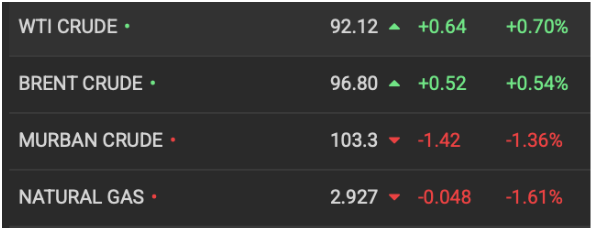
Contracts extended gains as US, Iran continued to trade attacks. Source: oilprice.com
Iran’s Islamic Revolutionary Guard Corps said it had targeted three oil tankers travelling through what it described as unauthorised routes in the Strait of Hormuz, along with three additional U.S. vessels in other areas.
The attacks have raised concerns that commercial shipping could increasingly become part of the confrontation. Maritime intelligence firm Marisks described the weekend attacks as a major escalation, saying commercial tankers were being used as instruments of economic pressure.
Shipping activity through the Strait has already fallen sharply. Data from analytics firm Kpler showed that an average of just 10 commodity ships a day passed through the waterway over the past 10 days, the lowest level since May.
Iran is also expected to announce a restricted zone outside the Strait of Hormuz in the coming days, according to Iranian state media, adding another layer of uncertainty for tanker operators and oil traders.
Also Read: How To Invest In Crude Oil
OPEC+ keeps October policy unchanged
The supply concerns come even as OPEC+ opted to leave its oil output policy unchanged for October at its meeting on Sunday.
The producer group is still working on new production quotas before deciding on its next output steps. However, the ability of OPEC+ to offset disruptions in Middle Eastern supplies remains constrained as physical shipments through key routes are being affected by the conflict.
Analysts said a prolonged standoff involving calibrated military action by the U.S. and Iran appeared to be the most likely scenario. They expect Middle Eastern oil exports to remain constrained through the rest of 2026, with a gradual reopening possible towards the end of the fourth quarter.
A return to pre-conflict levels of oil throughput is not expected until late in the first quarter or early second quarter of 2027, according to the analysts.
What higher oil prices mean for India
For India, the sustained rise in crude prices is an important concern because the country is heavily dependent on imports to meet its oil requirements. Brent approaching the $100-a-barrel mark could increase pressure on the country’s import bill and the rupee while complicating the inflation outlook.
Higher crude prices can also weigh on corporate margins across fuel-intensive sectors, including aviation, paints, chemicals, logistics and transportation. At the same time, oil marketing companies, refiners and upstream energy producers could see different effects depending on how domestic fuel prices and refining margins respond.
Markets remain wary
The oil rally also complicates the outlook for global financial markets. Higher energy prices could reinforce inflationary pressures just as investors are reassessing the path of interest rates in major economies.
For Indian equities, elevated crude prices are likely to remain a key risk even as Asian stocks start the week on a stronger footing. A prolonged period of oil above $90 a barrel could weigh on the rupee, foreign flows and inflation expectations, limiting the upside for domestic benchmarks.
With Brent now close to $97 a barrel, investors will closely monitor developments around the Strait of Hormuz, tanker traffic and any signs of a broader disruption to Middle Eastern oil exports.
Source
- oilprice.com
Disclaimer
If you have any concerns, questions, or wish to point out any discrepancies in our content, please feel free to write to us at content@hdfcsec.com.
Please Note: The information shared is intended solely for informational purposes and does not make any investment recommendations
HDFC SKY, one of India’s most trusted trading platforms, has been recognized with the Next-Gen Digi Content Awards 2025–26.
Disclaimer
At HDFC SKY*, we take utmost care and due diligence in curating and presenting news and market-related content. However, inadvertent errors or omissions may occasionally occur.
If you have any concerns, questions, or wish to point out any discrepancies in our content, please feel free to write to us at content@hdfcsec.com.
Please Note: The information shared is intended solely for informational purposes and does not make any investment recommendations.
HDFC SKY from HDFC Securities, one of most trusted trading platforms in India, has been recognized with the *Next-Gen Digi Content Awards 2025-26.
 Join Us
 Add as preferred source on Google


More Business News










Open Free Demat Account
Open Free Demat Account












Invest Anytime, Anywhere


By signing up I certify terms, conditions & privacy policy