Nifty 50
- TCS₹2,555.5048.60 (1.94%)
- Tata Steel₹166-6.33 (-3.67%)
- Eternal₹309.955.50 (1.81%)
- Hindalco Industries₹854.60-31.00 (-3.50%)
- Infosys₹1,162.359.00 (0.78%)
- Tata Motors PV₹261.95-8.05 (-2.98%)
- HCL Technologies₹1,428.306.60 (0.46%)
- Jio Financial ₹205.04-5.76 (-2.73%)
- Adani Enterprises₹2,483-67.00 (-2.63%)
- NTPC₹295-7.60 (-2.51%)
- Adani Ports₹1,706.60-43.40 (-2.48%)
- Trent₹2,707-68.80 (-2.48%)
- Shriram Finance₹879.45-21.45 (-2.38%)
- HDFC Life Insurance ₹516.15-12.20 (-2.31%)

- Offerings
- Tools & Platforms
Tools & Calculators
- Open API
- Calculators
- SIP Calculator
- CAGR Calculator
- Compound Interest Calculator
- FD Calculator
- RD Calculator
- EPF Calculator
- Retirement Calculator
- HDFC SIP Calculator
- Mutual Fund Return Calculator
- Lumpsum Calculator
- Step Up SIP Calculator
- ETF SIP Calculator
- Brokerage Calculator
- Equity Margin Calculator
- SWP Calculator
- EMI Calculator
- MTF Calculator
- Margin Pledge Calculator
- Algo Strategy
- Markets
Stocks
F&O
Mutual Funds
- More
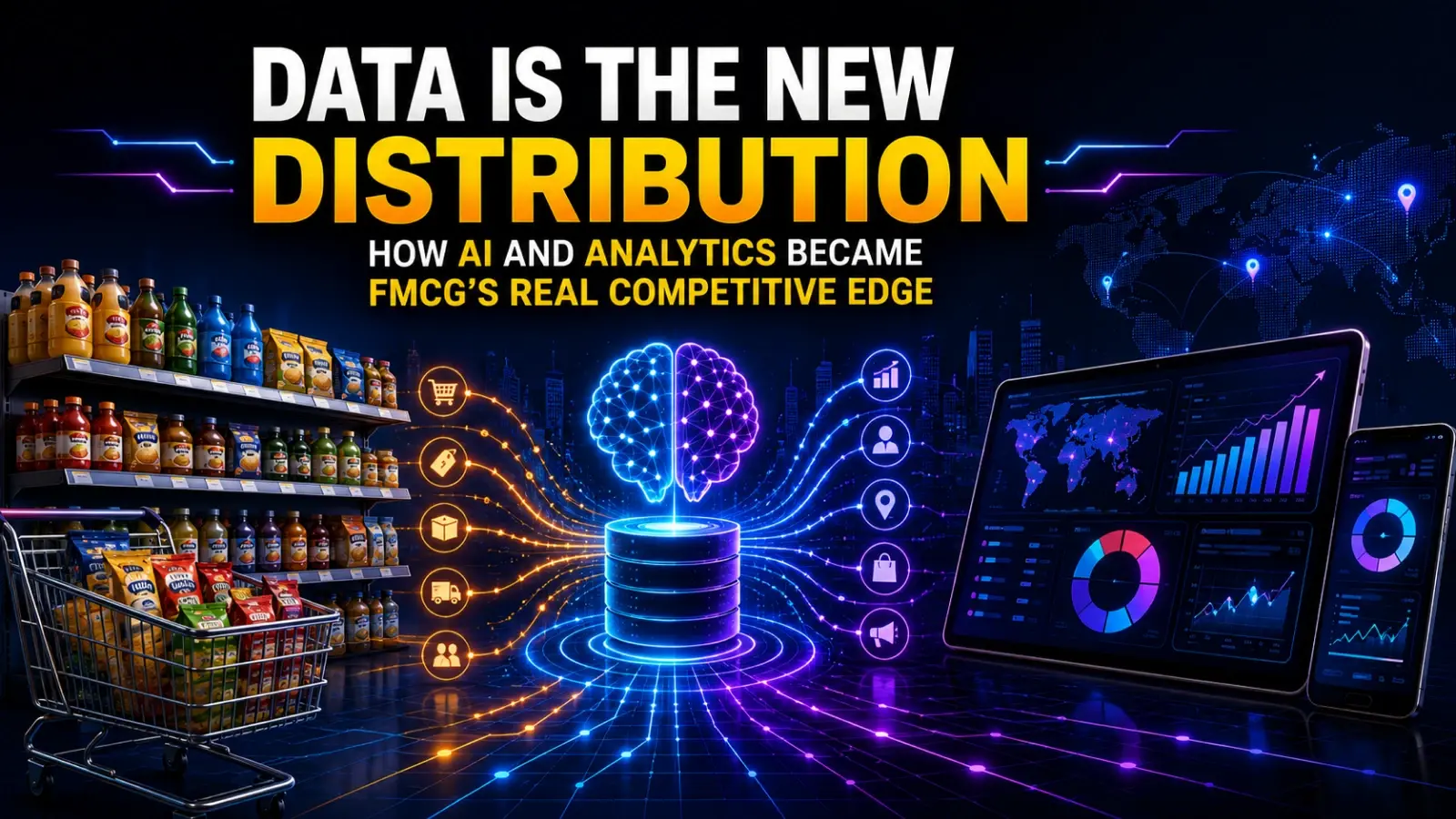
Data Is the New Distribution: How AI and Analytics Became FMCG's Real Competitive Edge
Authored By HDFC SKY | Published at: Sep 3, 2026 12:56 PM IST
Open Free Demat Account
Open Free Demat Account
Mumbai, Sept 3: For decades, distribution was the ultimate moat in Indian FMCG. The company with the widest retail network won. Today, that advantage is shrinking, and a new competitive edge is emerging in its place. Wider consumer data access through proprietary sales data, channel joint planning exercises, and data repositories is strengthening sector fundamentals. But traditional players have struggled to leverage this data effectively, constrained by their legacy general trade operations. That is now changing, according to a HDFC Securities report on FMCG sector.

Growth Divergence Highlights Data-Driven Advantage
The sector growth trend reveals a clear correlation between company size and growth momentum. In Q3FY26, giants with annual revenue exceeding INR 50 billion reported value growth of only 4.2%, compared to 8.6% for large companies (INR 10-50 billion), 11.4% for mid-sized companies (INR 1-10 billion), and 13.3% for small companies (under INR 1 billion). Volume growth followed a similar pattern, with giants reporting 0.9%, large companies 8.7%, mid-sized companies 3.6%, and small companies 7.1%.
FMCG Sector Growth Trend Across Different Companies, by Size (Q3FY26)
| Company Size | MAT Revenue | Value Growth | Volume Growth | Price Growth |
| Giants | >INR50bn | 4.2% | 0.9% | 3.3% |
| Large | INR10-50bn | 8.6% | 8.7% | -0.1% |
| Mid | INR1-10bn | 11.4% | 3.6% | 7.5% |
| Small | <INR1bn | 13.3% | 7.1% | 5.8% |
Source: Nielsen, HSIE Research
This growth divergence reflects the ability of smaller, more agile players to leverage data and digital channels more effectively. The report notes that new-age brands with a focus on specific consumer segments are addressing needs better and winning with consumers. Traditional players, operating through general trade, have not been able to leverage data effectively—until now.
HUL Embeds AI Across Enterprise Operations
HUL has been building an interconnected ecosystem that integrates consumer, customer, and operations spaces with data, technology, and analytics. The company’s Sangam platform is an AI-powered system that uses market-mix modelling to optimise media campaigns, crunching terabytes of internal and external data to identify the right audience, channel, frequency, and creative.
Shikhar, HUL’s eB2B platform, enables kirana stores to place orders directly, contributing to more than a third of total sales and providing real-time visibility into demand patterns across millions of retail touchpoints. Samarth, the supply chain nerve centre, integrates over 90 terabytes of data with 30+ AI solutions, digital twins, and advanced analytics to enable predictive, self-healing operations.
The Samadhan model is transforming distribution in metros, with HUL directly managing warehousing and delivery logistics to reduce delivery times from three days to under 24 hours. The Nano DC initiative, launched in FY26, introduces compact, channel-focused distribution units enabling high-frequency replenishment for fast-growing channels like quick commerce. Approximately 15% of volumes in key pack formats already run through dark operations supported by AI-powered controls.
HUL’s AI-Enabled Supply Chain Initiatives
| Initiative | Description | Impact |
| Sangam | AI-powered market-mix modelling | Optimises media campaigns, identifies right audience and channel |
| Shikhar | eB2B platform for kirana stores | Contributes >1/3 of total sales, real-time demand visibility |
| Samarth | Supply chain nerve centre | 90+ terabytes data, 30+ AI solutions, predictive operations |
| Samadhan | Metro distribution transformation | Reduces delivery time from 3 days to <24 hours |
| Nano DC | Compact channel-focused units | ~15% volumes run through dark operations |
Source: Company, HSIE Research
Honasa Consumer Builds Proprietary Intelligence System
Honasa Consumer has developed a proprietary consumer intelligence system called ResearchOS that reduces traditional FMCG product development timelines from 12-15 months to just 4-5 months. The system is built on three integrated tools.
Prophet detects emerging trends before they reach virality by analysing data from social media, search engines, reviews, video comments, and marketplaces. Unlike third-party tools that are mere data repositories, Prophet predicts trends by identifying inflection points in real time. CIA (Consumer Insight Agent) identifies unmet consumer needs and gaps in existing product categories. In the acne face wash segment, for example, it reveals issues such as poor sensorial experience, oily residue, and low efficacy. Vani validates these insights by engaging real consumers through AI-powered one-on-one voice calls and surveys.
Honasa Consumer’s ResearchOS System
| Tool | Function | Key Capability |
| Prophet | Trend detection | Analyses social media, search, reviews to identify emerging trends |
| CIA | Consumer insight | Identifies unmet needs and product gaps |
| Vani | Insight validation | AI-powered consumer engagement and surveys |
Source: Company, HSIE Research
Tesseract uses AI-simulated consumer environments, described as a “living city” of AI clones, to predict which consumer cohorts will respond to a product and the winning message for each cohort. A case study highlights that Tesseract predicted a “3-day pimple challenge” message would drive high purchase intent in a specific cohort, increasing conversion from 88% to 90%.
Honasa Consumer’s Tesseract and Optimus Prime Capabilities
| Tool | Function | Key Capability |
| Tesseract | AI-simulated consumer testing | Predicts cohort response and winning message |
| Optimus Prime | Content generation | Ideation, script generation, visuals, video creation |
| Curator | Compliance check | Ensures copyright and ASCI guideline compliance |
| Vibe Check | Performance prediction | ML model scores retention, attention, persuasion |
Source: Company, HSIE Research
Once messaging is validated, Optimus Prime generates marketing content end-to-end, from ideation and script generation to visuals and video. The system analyses thousands of competitor and influencer videos, creates scripts aligned with the brief, and generates AI-produced content with consistent characters and scenes. A Curator ensures compliance with copyright and Advertising Standards Council of India guidelines, while a Vibe Check uses a machine learning model trained on four years of performance data to score retention, attention, and persuasion before launch.
ITC, Nestlé India, and Colgate Accelerate Digital Transformation
ITC’s Mission DigiArc leverages AI across its ecosystem, enhancing execution and improving visibility across the organisation. The company’s digital-first brands have an annual recurring revenue of INR 13.5 billion. Nestlé India is leveraging a unified data layer to enhance decision-making and business outcomes, with a focus on delighting consumers and customers.
Colgate-Palmolive notes that AI is integral to innovation, enabling sharper demand fulfilment, trend creation, and consumer influence. Tata Consumer Products has deployed multiple digital enablers to transform frontline execution, with AI enhancing decision-making across the organisation. The role of data has been enhanced in decision-making, making it more insightful, data-driven, and impactful.
Digital Transformation Initiatives Across FMCG Companies
| Company | Initiative | Focus Area |
| ITC | Mission DigiArc | AI across ecosystem, execution enhancement |
| Nestlé India | Unified Data Layer | Consumer and customer delight, decision-making |
| Colgate-Palmolive | AI in Innovation | Demand fulfilment, trend creation |
| Tata Consumer | Digital Enablers | Frontline execution transformation |
Source: Company, HSIE Research
Valuation Impact and the Path Forward
Sector de-rating reflects both earnings slowdown and the erosion of traditional moats. Arresting this trend requires earnings acceleration, but re-rating will demand creation of new moats anchored in data, consumer intimacy, and executional agility. Barring Marico and Nestlé India, most companies in coverage are trading at a discount to their historical average forward valuations. Until new moats emerge, valuations are expected to remain stressed, even with regulatory support.
Current 12M Forward P/E vs Historical Averages
| Company | 10Yr Avg | 5Yr Avg | 3Yr Avg | Current | vs 3Y Avg | vs 5Y Avg | vs 10Y Avg |
| Britannia | 48 | 49 | 51 | 44 | (12%) | (10%) | (7%) |
| Colgate | 41 | 42 | 46 | 37 | (20%) | (14%) | (12%) |
| Dabur India | 44 | 45 | 44 | 36 | (18%) | (21%) | (18%) |
| Emami | 30 | 27 | 27 | 21 | (21%) | (20%) | (28%) |
| HUL | 51 | 52 | 50 | 43 | (14%) | (17%) | (16%) |
| ITC | 21 | 21 | 23 | 17 | (24%) | (18%) | (19%) |
| GCPL | 43 | 47 | 49 | 43 | (12%) | (8%) | (1%) |
| Marico | 43 | 46 | 46 | 49 | 6% | 8% | 14% |
| Nestlé India | 61 | 66 | 66 | 67 | 1% | 1% | 9% |
Source: Company, Bloomberg, HSIE Research
Data analytics and AI are emerging as the new competitive moats in FMCG. Companies that fail to leverage data risk continued de-rating, while nimble insurgents are scaling into investable opportunities. The winners of the next decade will be those with the deepest understanding of their consumers—powered by data, accelerated by AI, and executed with agility. Building new moats is crucial to winning with consumers and strengthening competitive edges.
Source
- https://www.hdfcsec.com/hsl.docs/FMCG%20-%20Sector%20Thematic%20-%20Jul26%20-%20HSIE%20Signed-202607201504440528661.pdf?t=207202615157888
Disclaimer
If you have any concerns, questions, or wish to point out any discrepancies in our content, please feel free to write to us at content@hdfcsec.com.
Please Note: The information shared is intended solely for informational purposes and does not make any investment recommendations
HDFC SKY, one of India’s most trusted trading platforms, has been recognized with the Next-Gen Digi Content Awards 2025–26.
Disclaimer
At HDFC SKY*, we take utmost care and due diligence in curating and presenting news and market-related content. However, inadvertent errors or omissions may occasionally occur.
If you have any concerns, questions, or wish to point out any discrepancies in our content, please feel free to write to us at content@hdfcsec.com.
Please Note: The information shared is intended solely for informational purposes and does not make any investment recommendations.
HDFC SKY from HDFC Securities, one of most trusted trading platforms in India, has been recognized with the *Next-Gen Digi Content Awards 2025-26.
 Join Us
 Add as preferred source on Google


More BRITANNIA News







Open Free Demat Account
Open Free Demat Account
₹4,564.10










Invest Anytime, Anywhere


By signing up I certify terms, conditions & privacy policy