Nifty 50
- Tech Mahindra₹1,790140.00 (8.48%)
- InterGlobe Aviation₹4,686.90-91.40 (-1.91%)
- TCS₹2,465115.00 (4.89%)
- BSE₹3,363-65.00 (-1.90%)
- Infosys₹1,161.2051.20 (4.61%)
- Max Healthcare₹846-12.00 (-1.40%)
- Bharti Airtel₹1,90551.00 (2.75%)
- Tata Consumer ₹978.90-12.55 (-1.27%)
- Mahindra & Mahindra₹2,920.9059.20 (2.07%)
- Jio Financial ₹216.25-2.76 (-1.26%)
- Bajaj Finance₹98115.75 (1.63%)
- ONGC₹222-2.64 (-1.18%)
- Hindalco Industries₹90814.15 (1.58%)
- Bharat Electronics₹376.85-3.55 (-0.93%)
- HCL Technologies₹1,38020.00 (1.47%)
- Nestle₹1,265.50-10.30 (-0.81%)
- JSW Steel₹1,216.4016.00 (1.33%)
- Adani Enterprises₹2,680.90-19.10 (-0.71%)
- Grasim Industries₹2,92034.10 (1.18%)
- Bajaj Finserv₹1,720-12.00 (-0.69%)

- Offerings
- Tools & Platforms
Tools & Calculators
- Open API
- Calculators
- SIP Calculator
- CAGR Calculator
- Compound Interest Calculator
- FD Calculator
- RD Calculator
- EPF Calculator
- Retirement Calculator
- HDFC SIP Calculator
- Mutual Fund Return Calculator
- Lumpsum Calculator
- Step Up SIP Calculator
- ETF SIP Calculator
- Brokerage Calculator
- Equity Margin Calculator
- SWP Calculator
- EMI Calculator
- MTF Calculator
- Margin Pledge Calculator
- Algo Strategy
- Markets
Stocks
F&O
Mutual Funds
- More
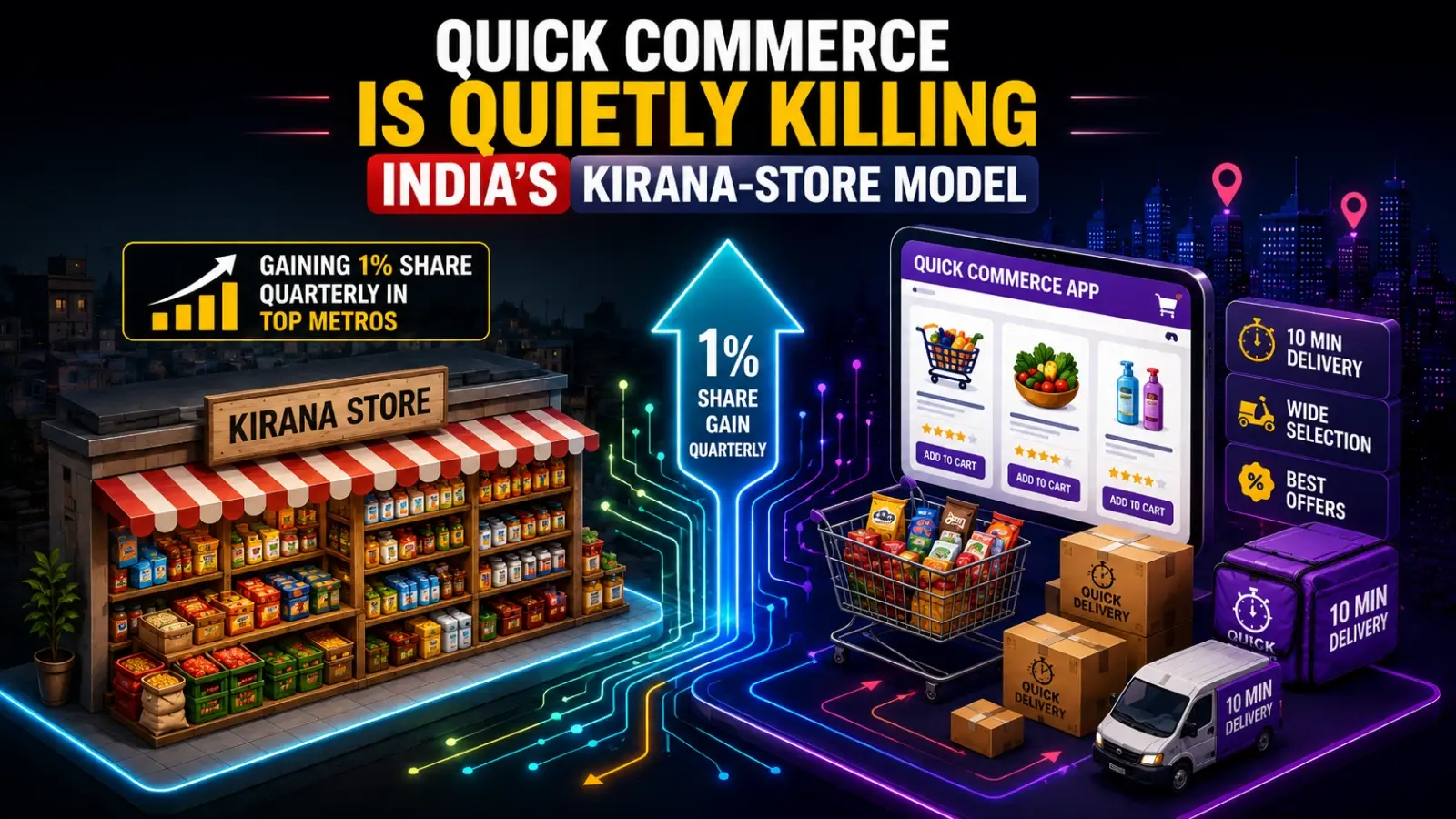
Quick Commerce Is Quietly Killing India's Kirana-Store Model Gaining 1% Share Quarterly in Top Me
Authored By HDFC SKY | Published at: Sep 2, 2026 04:58 PM IST
Open Free Demat Account
Open Free Demat Account
Mumbai, Sept 2: The neighbourhood kirana store, long considered the unshakeable backbone of India’s FMCG supply chain, is facing an existential threat. For decades, this network served as more than just a distribution channel—it was a formidable competitive moat. The bargaining power retained by corporates, efficient product distribution, cash transactions enabling negative working capital, and the sheer barrier to entry for new competition all rested on this network. That foundation is now rapidly crumbling, according to a HDFC Securities thematic report on FMCG sector.

General Trade Cedes Ground to Modern Retail Formats
The shift is structural, not cyclical. Modern trade emerged first, followed by e-commerce, and now quick commerce is aggressively gaining share from general trade incumbents. The transformation is most visible in the channel mix evolution of leading FMCG companies. For listed players, e-commerce now accounts for 8-15% of domestic revenue, with 50-70% of that flowing through quick commerce.
India Grocery Market Split by Channel
| Channel | Share of Grocery Market |
| General Trade | Declining steadily |
| Modern Trade | Gaining share |
| E-commerce | 7% (All India Urban) |
| E-commerce | 16% (All India Metros) |
| E-commerce | 19% (Top 8 Metros) |
Source: Nielsen, HSIE Research
Nielsen data reveals that e-commerce share stands at 7% for all-India urban markets, 16% for all-India metros, and 19% in the top eight metros. The channel is gaining approximately 1% in share quarterly in top metros. The geographic skew is telling: e-commerce salience is at 22.5% in South metros and 16% in West metros. In North and East metros, where salience stands at approximately 18%, e-commerce has already overtaken modern trade to become the second-largest channel.
Domestic Business FMCG Supply-Chain Reach and Sales Contribution for Key Incumbents
| Company | Overall Outlet Reach (mn) | General Trade – Direct (mn) | General Trade % Direct | General Trade – Direct | General Trade – Wholesale | General Trade Total | Modern Trade | E-commerce | Quick Commerce | Institutional |
| HUL | 9.0 | 3.0 | 33% | 44% | 26% | 70% | 20% | 4% | 4% | 2% |
| ITC | 7.0 | 2.5 | 36% | 41% | 30% | 71% | 14% | 6% | 8% | 2% |
| Dabur | 8.5 | 1.5 | 18% | 40% | 28% | 68% | 12% | 4% | 7% | 9% |
| GCPL | 6.1 | 1.0 | 16% | 45% | 30% | 75% | 12% | 6% | 4% | 3% |
| Colgate | 6.5 | 1.7 | 26% | 50% | 35% | 85% | 9% | 5% | 5% | 1% |
| Britannia | 6.7 | 3.0 | 45% | 50% | 34% | 84% | 13% | 2% | 4% | 1% |
| Marico | 5.8 | 1.2 | 21% | 36% | 25% | 62% | 18% | 5% | 8% | 7% |
| Nestlé India | 5.3 | 1.6 | 30% | 50% | 21% | 71% | 11% | 6% | 9% | 3% |
| Emami | 4.9 | 1.0 | 20% | 43% | 27% | 70% | 13% | 8% | 5% | 4% |
Source: Company, HSIE Research
As Nielsen notes, this growth is not incremental—it is largely substituting traditional trade, signalling a permanent channel rebalancing within FMCG.
Quick Commerce Economics Disrupt Traditional Retail
The economics of quick commerce versus traditional retail paint a stark picture. A typical kirana store, occupying approximately 200 square feet, generates annual revenue of about INR 3 million from roughly 600 SKUs. The revenue per square foot stands at INR 15,400. A quick commerce dark store, by contrast, occupies approximately 4,000 square feet but generates INR 493 million in annual revenue with 15,000 SKUs. The revenue per square foot reaches INR 123,240—an eight-fold advantage.
Key Metrics Comparison Across Channels
| Metric | Units | Kirana | Modern Trade | Quick Commerce |
| Three Key Consumer Needs | ||||
| Pricing Indexed | % | 106% (buying price high) | 97% | 100% (index) |
| SKU Count | Number | 600 | 4,000-5,000 | 15,000 |
| Experience Comment | – | Expensive | Cheaper, but need to visit | Faster |
| Delivery Min | Minutes | 10 min | Instant | 10 min |
| Delivery fees % of AOV | % | nil | nil | 0-4% of AOV |
| Visit to store Comment | – | Yes | Yes | No |
| Key Metrics Comparison | ||||
| Space | Sq. Ft. | 200 | 30,000 | 4,000 |
| Revenue (annual) | INR mn | 3 | 1,924 | 493 |
| Revenue per Sq ft | INR | 15,400 | 64,142 | 123,240 |
| Order number / month | Number | 3,950 | 69,720 | 63,200 |
| AOV | INR/Order | 65 | 2,300 | 650 |
Source: HSIE Research
Order metrics further illustrate the disruption. A kirana store processes approximately 3,950 orders per month at an average order value of INR 65. A quick commerce dark store handles 63,200 orders per month at an average order value of INR 650. Modern trade falls between these extremes, generating INR 1,924 million in annual revenue from 30,000 square feet with 69,720 orders per month at an average order value of INR 2,300.
The channel-specific traits reveal key consumer preferences. Quick commerce offers fast delivery convenience, product pricing, expanding assortment, faster resolution of product issues, and cold storage infrastructure for fresh products. Its limitations include fresh products not being addressed well and consumer reviews being limited to star ratings.
Incumbents Accelerate Modern Retail Shift as Traditional Trade Weakens
FMCG companies are relooking their urban market strategies as the realisation dawns that quick commerce represents a cultural shift in shopping behaviour. The channel is increasingly viewed as an opportunity to refine business operations rather than merely a threat.
Channel Mix Evolution for Key FMCG Companies
| Company | Year | General Trade | Modern Trade | E-commerce |
| Marico | FY18 | 87% | 13% | 1% |
| Marico | FY26 | 69% | 18% | 13% |
| HUL | FY18 | 89% | 11% | 2% |
| HUL | FY26 | 72% | 20% | 8% |
| Britannia | FY18 | 92% | 8% | 0% |
| Britannia | FY26 | 81% | 13% | 6% |
| Nestlé India | FY18 | 90% | 9% | 1% |
| Nestlé India | FY26 | 74% | 11% | 15% |
Source: Company, HSIE Research
Marico’s domestic revenue dependence on modern retail channels expanded from 13% in FY18 to 31% in FY26, while general trade dependence contracted from 87% to 69%. HUL’s modern trade share grew from 11% to an estimated 28% during the same period, with general trade declining from 89% to 72%. Britannia, historically a laggard in modern retail due to its high share of low-unit packs in biscuits, saw e-commerce contribution rise from near-zero in FY18 to 6% in FY26.
Nestlé India, which had been slow to embrace modern retail, saw its general trade dependence drop from 90% in FY18 to 74% in FY26, while e-commerce surged from 1% to 15%. The company’s modern trade share remained relatively stable at approximately 11% during this period.
New-Age Channels Create Level Playing Field for Insurgent Brands
The surge in quick commerce is enabling direct-to-consumer brands to address niche consumer needs more effectively than ever before. Unlike traditional FMCG companies, which continue to adopt a top-down approach shaped by legacy general trade operations, new-age brands are leveraging these platforms for targeted consumer engagement.
In the home and personal care space, competition from new-age brands is particularly high in categories representing approximately one-third of the category size. These include skin care, male grooming, colour cosmetics, shampoo, baby care, fragrance, shower gel, and intimate hygiene. For approximately 55% of the category size, competition from new-age brands remains limited.
The food and beverage sector is witnessing similar disruption. Quick commerce is accelerating formalisation, where unorganised participation is restricted. However, category incumbents face challenges as multiple regional players emerge, happy to operate with lower margins given large formalisation benefits. Additionally, given their size, such players are well-prepared to address cohort needs.
The kirana-store model’s dominance is being quietly dismantled as quick commerce reshapes urban retail economics. FMCG companies must rethink channel strategies with sharper assortments, trial-friendly SKUs, and propositions tailored to differentiated consumer needs. Companies that have transformed their general trade execution while simultaneously building modern retail capabilities are better positioned to navigate this structural shift.
Source
- https://www.hdfcsec.com/hsl.docs/FMCG%20-%20Sector%20Thematic%20-%20Jul26%20-%20HSIE%20Signed-202607201504440528661.pdf?t=207202615157888
Disclaimer
If you have any concerns, questions, or wish to point out any discrepancies in our content, please feel free to write to us at content@hdfcsec.com.
Please Note: The information shared is intended solely for informational purposes and does not make any investment recommendations
HDFC SKY, one of India’s most trusted trading platforms, has been recognized with the Next-Gen Digi Content Awards 2025–26.
Disclaimer
At HDFC SKY*, we take utmost care and due diligence in curating and presenting news and market-related content. However, inadvertent errors or omissions may occasionally occur.
If you have any concerns, questions, or wish to point out any discrepancies in our content, please feel free to write to us at content@hdfcsec.com.
Please Note: The information shared is intended solely for informational purposes and does not make any investment recommendations.
HDFC SKY from HDFC Securities, one of most trusted trading platforms in India, has been recognized with the *Next-Gen Digi Content Awards 2025-26.
 Join Us
 Add as preferred source on Google


More EMAMILTD News






Open Free Demat Account
Open Free Demat Account
₹375.50











Invest Anytime, Anywhere


By signing up I certify terms, conditions & privacy policy