Nifty 50
- Eternal₹317.4012.95 (4.25%)
- Shriram Finance₹865-35.90 (-3.98%)
- Apollo Hospitals₹7,730125.50 (1.65%)
- Adani Enterprises₹2,477-73.00 (-2.86%)
- ONGC₹227.502.50 (1.11%)
- JSW Steel₹1,185.50-34.50 (-2.83%)
- Asian Paints₹2,30722.20 (0.97%)
- Jio Financial ₹205.03-5.77 (-2.74%)
- TCS₹2,53023.10 (0.92%)
- Tata Steel₹167.67-4.66 (-2.70%)
- UltraTech Cement₹11,05092.00 (0.84%)
- Adani Ports₹1,702.70-47.30 (-2.70%)
- Maruti Suzuki₹11,23060.00 (0.54%)
- Tech Mahindra₹1,790-39.10 (-2.14%)
- Cipla₹1,3387.10 (0.53%)
- Tata Motors PV₹264.60-5.40 (-2.00%)
- Reliance Industries₹1,1905.50 (0.46%)
- Hindalco Industries₹869.85-15.75 (-1.78%)
- Axis Bank₹1,217.505.50 (0.45%)
- Trent₹2,727.50-48.30 (-1.74%)

- Offerings
- Tools & Platforms
Tools & Calculators
- Open API
- Calculators
- SIP Calculator
- CAGR Calculator
- Compound Interest Calculator
- FD Calculator
- RD Calculator
- EPF Calculator
- Retirement Calculator
- HDFC SIP Calculator
- Mutual Fund Return Calculator
- Lumpsum Calculator
- Step Up SIP Calculator
- ETF SIP Calculator
- Brokerage Calculator
- Equity Margin Calculator
- SWP Calculator
- EMI Calculator
- MTF Calculator
- Margin Pledge Calculator
- Algo Strategy
- Markets
Stocks
F&O
Mutual Funds
- More
Dow Plunges 464 Points as Oil Surges on Strait of Hormuz Tensions; S&P 500 Snaps Record Run
Authored By HDFC SKY | Last Modified: Aug 7, 2026 08:40 AM IST
Open Free Demat Account
Open Free Demat Account
Mumbai, Aug 7: The Dow Jones Industrial Average snapped a five-session winning streak on Thursday, shedding over 464 points as a sharp rally in crude oil prices revived geopolitical risk premiums. The broader S&P 500 retreated from record territory, while the Nasdaq Composite ended marginally lower, as investors weighed escalating Middle East tensions against a backdrop of resilient labour market data and mixed signals from the Federal Reserve.
The primary catalyst for Thursday’s sell-off was a renewed spike in energy prices after Iranian state media reported that a parliamentary committee was reviewing draft legislation to ban U.S. and Israeli vessels from the strategic Strait of Hormuz. Brent crude surged nearly 4% to settle above $82 per barrel, while West Texas Intermediate advanced more than 3% to $77.29. The prospect of restricted shipping through the world’s most critical oil chokepoint reignited supply concerns, offsetting earlier optimism over potential diplomatic progress.
Market participants also digested a steady stream of labour data, with initial jobless claims ticking up marginally to 199,000 for the week ended August 1, below the 205,000 consensus forecast. The four-week moving average fell to its lowest level since September 2022, reinforcing the narrative of a tight labour market. Attention now turns to Friday’s July employment report, with economists projecting 83,000 new jobs and an unemployment rate holding at 4.2%.

Dow Jones Industrial Average: Blue-Chip Index Sheds 464 Points as Energy Gains Offset by Broad-Based Weakness
The Dow Jones Industrial Average closed at 53,885.10, down 464.02 points or 0.85% from the previous session’s record close of 54,349.12. The index opened at 54,426.85 and traded within a daily range of 53,835.02 to 54,502.87, with the intraday low marking a significant retreat from Wednesday’s all-time highs.
The blue-chip benchmark’s decline was broad-based, with only nine of the 30 components finishing in positive territory. Salesforce (CRM) emerged as the biggest decliner, shedding nearly 4% following a leadership shuffle announcement. Boeing (BA) dropped 3.34%, while Honeywell (HON) declined 2.97% and Goldman Sachs (GS) fell 2.62%. Chevron (CVX) provided some insulation, gaining 1.51% as the energy sector benefited from rising oil prices, while Disney (DIS) advanced 2.87% and Microsoft (MSFT) added 2.54%.
The Dow’s decline was exacerbated by profit-taking after the index had posted three consecutive record-high closes. The pullback reflected a rotation away from cyclical and industrial names as energy costs threatened to weigh on corporate margins and consumer spending.
S&P 500: Broad Benchmark Retreats from Record Highs as Nine of 11 Sectors Close in the Red
The S&P 500 ended Thursday at 7,709.96, losing 13.59 points or 0.18% from the previous close of 7,723.55. The index opened at 7,713.79 and traded between an intraday high of 7,742.85 and a low of 7,698.15. The session marked a pause following Tuesday’s record close, with the benchmark failing to sustain momentum above the 7,740 level.
Energy and Information Technology emerged as the only two sectors in positive territory, rising 1% and 0.3% respectively. The other nine sectors traded lower, with Real Estate, Materials, and Industrials each declining approximately 1%. Within Energy, ExxonMobil (XOM) gained nearly 2% and Chevron (CVX) added more than 1%, tracking the rebound in crude prices.
Notable laggards included Western Digital (WDC) which tumbled 5.38%, and Sandisk (SNDK) which dropped 6.81%, as both memory-chip companies failed to impress investors despite beating quarterly estimates. AppLovin (APP) cratered 19.66% on mixed quarterly results and soft guidance, while Datadog (DDOG) plunged 19.03% after its third-quarter revenue outlook narrowly surpassed consensus.
Nasdaq Composite: Tech-Heavy Index Holds Near Flat as Software Stocks Tumble
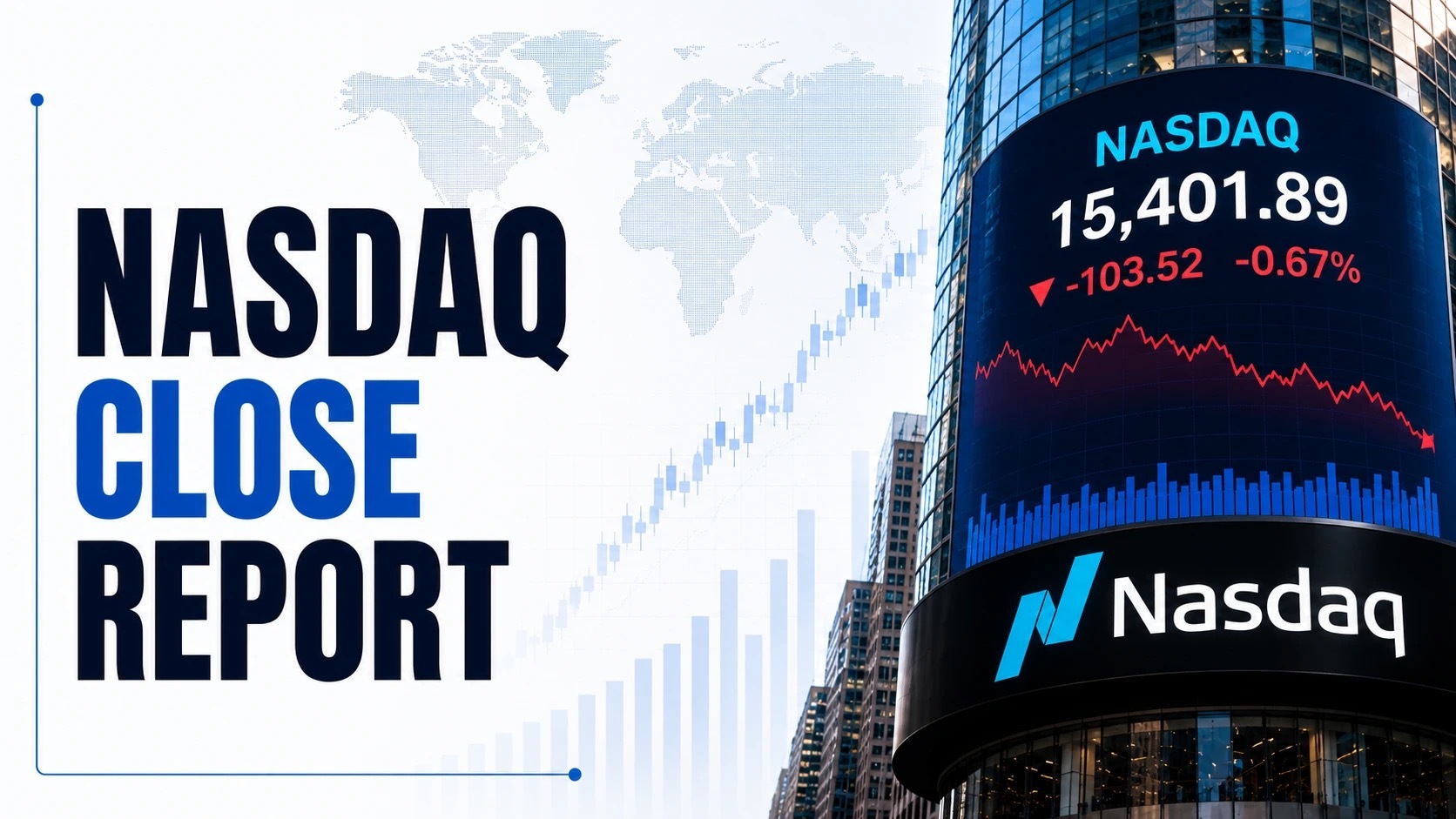
The Nasdaq Composite closed at 26,348.35, down a marginal 15.09 points or 0.06% from the previous session’s close of 26,363.44. The index opened at 26,268.84 and traded within a range of 26,208.43 to 26,499.42. The tech-heavy benchmark demonstrated relative resilience compared to the Dow, though underlying weakness in software and semiconductor names kept pressure on the index.
Microsoft (MSFT) provided significant support, surging 2.54% as investors warmed to the company’s AI monetisation trajectory. ARM Holdings (ARM) advanced 4.41%, while Shopify (SHOP) gained 2.22% and Qualcomm (QCOM) rose 1.78%. However, these gains were offset by sharp declines in software names: AppLovin (APP) tumbled 19.64%, Datadog (DDOG) plunged 19.03%, and HubSpot (HUBS) slid 19.10%.
Semiconductor stocks traded mixed, with Advanced Micro Devices (AMD) gaining 1.51% and ASML rising 1.56%, while Micron Technology (MU) declined 1.31% and Intel (INTC) fell 1.24%. The Magnificent Seven mega-cap tech stocks ended mixed, with Microsoft’s gain standing as the largest move in either direction.
Russell 2000, S&P 100, and Sector Benchmarks Reflect Broad-Based Weakness
The Russell 2000 small-cap index closed at 3,001.58, down 17.61 points or 0.58% from the previous close of 3,019.19. The index opened at 3,016.30 and traded between 2,999.50 and 3,032.22. Small-cap underperformance reflected broader concerns about rising energy costs and their disproportionate impact on domestic-focused companies.
The S&P 100 index closed at 3,815.23, gaining a marginal 0.75 points or 0.02%. The index opened at 3,816.34 and traded between 3,806.96 and 3,831.41. The relative outperformance of the S&P 100 highlighted the divergence between mega-cap leaders and the broader market.
The Dow Jones Composite Average fell 130.74 points or 0.76% to 16,974.46. The Dow Jones Transportation Average declined 153.23 points or 0.71% to 21,424.10, reflecting concerns over higher fuel costs. The Dow Jones Utility Average slipped 3.61 points or 0.33% to 1,097.40, tracking the rise in Treasury yields.
The PHLX Semiconductor Sector (SOX) bucked the broader trend, gaining 39.81 points or 0.33% to close at 12,048.69. The index opened at 11,825.86 and traded between 11,707.78 and 12,288.56, demonstrating resilience despite weakness in select memory-chip names.
The NYSE Composite declined 29.75 points or 0.12% to 24,484.06, while the S&P MidCap 400 fell 12.94 points or 0.34% to 3,834.39 and the S&P SmallCap 600 dropped 14.34 points or 0.79% to 1,797.50.
Also Read: How to Invest in S&P 500 Stocks Through Index Funds
VIX Rises as Geopolitical Uncertainty Resurfaces
The CBOE Volatility Index (VIX) rose 0.54 points or 3.8% to close at 14.72, reflecting increased demand for portfolio protection as geopolitical tensions escalated. The VIX had been trading near multi-month lows earlier in the week but spiked intraday as oil prices surged and investors reassessed Middle East risks. The index remains below its long-term average, suggesting that while anxiety has increased, markets have not priced in a severe dislocation.
Energy and Technology Stand Alone as Nine Sectors Decline
Energy emerged as the best-performing sector, rallying approximately 1.2% as crude oil prices surged on Strait of Hormuz concerns. Major oil producers ExxonMobil (XOM) and Chevron (CVX) led the advance, gaining 2.11% and 1.51% respectively. The Energy Select Sector SPDR Fund (XLE) advanced 1.13%, with oil services and exploration stocks outperforming as investors priced in a sustained supply risk premium.
Information Technology was the only other sector in positive territory, gaining approximately 0.3%. Strength in Microsoft (MSFT) and semiconductor names including Broadcom (AVGO) and AMD provided support, though software stocks including Datadog (DDOG) and AppLovin (APP) weighed on the sector.
Real Estate was the worst-performing sector, declining approximately 1% as rising Treasury yields pressured real estate investment trusts. The 10-year Treasury yield rose 5.67 basis points to 4.674%, making dividend-paying real estate stocks less attractive relative to risk-free alternatives. Materials and Industrials also underperformed, each falling around 1% on concerns that higher energy costs could weigh on manufacturing activity and input margins. Consumer Discretionary declined 0.7% as rising fuel prices threatened to constrain consumer spending, while Financials fell 0.6% on the prospect of higher borrowing costs potentially slowing economic activity.
Insmed Soars 34%, UWM Holdings Slumps 35% in Sharp Stock Moves
Insmed Incorporated (INSM) was the standout gainer, soaring 33.86% after reporting strong second-quarter revenue for its BRINSUPRI drug and raising peak sales estimates. SiTime Corporation (SITM) surged 26.58% after quarterly revenue more than doubled on surging AI inference timing demand. Paycom Software (PAYC) jumped 23.55% after crushing second-quarter earnings estimates. CACI International (CACI) gained 21.38% following strong fiscal fourth-quarter results and upbeat guidance. Frontdoor (FTDR) advanced 17.73% and Praxis Precision Medicines (PRAX) rose 15.95%.
UWM Holdings (UWMC) was the biggest loser, collapsing 34.78% after posting a second-quarter loss, suspending its dividend, and announcing a rights offering. AppLovin (APP) tumbled 19.66% on mixed results and soft guidance. Datadog (DDOG) plunged 19.03% as third-quarter revenue guidance narrowly beat consensus. HubSpot (HUBS) slid 19.10% despite beating earnings estimates. Honeywell Aerospace (HONA) sank 23.16% after missing estimates and cutting guidance on supply chain constraints. Western Digital (WDC) dropped 5.38% and Sandisk (SNDK) fell 6.81% despite beating quarterly estimates.
The Magnificent Seven mega-cap stocks traded mixed. Microsoft (MSFT) surged 2.54% as investors embraced its AI growth narrative. Apple (AAPL) gained 0.47%, while Meta Platforms (META) added 0.20%. Alphabet (GOOGL) declined 1.29%, Tesla (TSLA) fell 0.66%, and Amazon (AMZN) slipped 0.14%. NVIDIA (NVDA) edged lower by 0.22%.
Chip Stocks Mixed on AI Optimism; Energy Outperforms, Banks Under Pressure
Semiconductor stocks traded mixed, with the PHLX Semiconductor Sector (SOX) gaining 0.33%. SiTime (SITM) surged 26.58% on AI demand, while Broadcom (AVGO) added 0.55% and AMD rose 1.51%. However, Sandisk (SNDK) dropped 6.81% and Western Digital (WDC) fell 5.38% as investors focused on soft guidance rather than strong quarterly results. Micron (MU) declined 1.31% and Intel (INTC) fell 1.24%.
Financial stocks broadly underperformed, with the Financials sector declining approximately 0.6%. Goldman Sachs (GS) fell 2.62%, JPMorgan Chase (JPM) declined 0.82%, and Citigroup (C) dropped 2.76%. Rising bond yields and concerns over a potential economic slowdown weighed on bank shares.
Energy stocks were the day’s standout performers, with the sector gaining approximately 1.2%. ExxonMobil (XOM) rose 2.11% and Chevron (CVX) gained 1.51% as crude prices surged. ConocoPhillips (COP) added 1.50% after announcing CEO Ryan Lance’s retirement and reporting better-than-expected earnings.
AI and growth stocks demonstrated sharp divergence. Microsoft (MSFT) surged on AI monetisation optimism, while software names including Datadog (DDOG) and AppLovin (APP) were punished for results that failed to meet elevated expectations. SpaceX (SPCX) rebounded 2.5% after plunging nearly 14% on Wednesday, as retail investors continued to accumulate shares despite the expiration of lock-up restrictions.
Also Read: How to Invest in the US Stocks From India
Labour Market Shows Resilience Ahead of Friday’s Jobs Report
Initial jobless claims for the week ended August 1 totalled a seasonally adjusted 199,000, up marginally from the prior week’s revised 198,000 and below the Dow Jones consensus estimate of 205,000. The four-week moving average declined to 198,750, its lowest level since September 2022, reflecting continued stability in the labour market. Continuing claims rose to 1.801 million for the week ended July 25, slightly above economists’ expectations of 1.789 million.
Second-quarter productivity increased 1.4% , better than the 0.8% recorded in the prior quarter and above the 0.6% forecast. Unit labour costs rose 1.3% , below the 2.1% estimate, indicating that wage pressures remain contained despite tight labour market conditions. The so-called labour share of nominal GDP fell to 52.9% in the second quarter, the lowest since records began in 1947, as productivity gains outpaced wage growth.
A Challenger, Gray & Christmas report showed July layoffs plunged 46.1% year-on-year to 33,429, the lowest monthly total in two years. Hiring plans soared to the highest level for July since 2022, suggesting that employers remain confident in the economic outlook despite geopolitical uncertainties.
Federal Reserve, Bond Market, and Commodities
Federal Reserve Chair Kevin Warsh is reportedly prepared to raise rates at the September meeting if upcoming inflation readings run hot, according to a Financial Times report. Markets currently price roughly a 55% chance of a quarter-point rate hike in September. St. Louis Fed President Alberto Musalem is scheduled to speak on monetary policy later in the day, with investors seeking clarity on the central bank’s reaction function amid elevated energy costs.
The 2-year Treasury yield rose 7.26 basis points to 4.252% , while the benchmark 10-year Treasury yield advanced 5.67 basis points to 4.674% . The 30-year Treasury yield climbed above 5.2% , its highest since 2007, as investors demanded a higher term premium amid inflation concerns. The yield curve between 2-year and 10-year notes steepened to 42 basis points.
Brent crude futures settled up $3.04 or 3.83% at $82.49 per barrel. WTI crude futures gained $2.07 or 2.75% to close at $77.29 per barrel. The rally was triggered by Iranian state media reports that a parliamentary committee was reviewing draft legislation to ban U.S. and Israeli vessels from the Strait of Hormuz.
Gold rallied for a fourth consecutive session, reaching a seven-week high as easing concerns over Fed rate hikes boosted demand for the precious metal. Spot gold gained 0.6% to $4,271.33 per ounce after earlier touching $4,300. Silver advanced 0.29% to $62.21, while copper hit a six-month high at $14,258 per metric ton on supply worries from the Democratic Republic of Congo.
Also Read : US Stock Market Timings
Commodities and Currency Markets
Brent crude settled at $82.49 per barrel, up 3.83% . WTI crude closed at $77.29 per barrel, gaining 2.75% . Natural gas futures slid 1.8% to settle at $2.64 per million British thermal units, their lowest close since April 28, on a bearish storage report.
Gold futures declined marginally by 0.07% to $4,302.30 per ounce, while silver traded at $62.21, up 0.29% . Copper futures jumped to $14,258 per metric ton, a six-month high.
The US Dollar Index (DXY) traded at 99.78, up 0.11% on the day. The dollar found support from safe-haven positioning amid Middle East uncertainty. EUR/USD traded at 1.1553, USD/JPY at 157.67, and GBP/USD at 1.3469.
Thursday’s session underscored the market’s vulnerability to geopolitical shocks, with the Strait of Hormuz development quickly reversing a week-long slide in energy prices and weighing on equity valuations. The resilience of labour market data, with jobless claims remaining below 200,000, suggests the economic backdrop remains supportive, though rising bond yields and elevated oil prices present headwinds. Friday’s employment report will be pivotal in shaping expectations for the Federal Reserve’s September policy decision, with markets closely watching wage growth and payroll figures for clues on inflationary pressures.
Source
- https://www.nasdaq.com/
- spglobal.com/spdji/en/indices/equity/sp-500/
- https://www.dowjones.com/
- https://www.spglobal.com/spdji/en/indices/equity/dow-jones-industrial-average/
- https://www.spglobal.com/spdji/en/indices/equity/sp-500/
- https://www.nasdaq.com/market-activity/index/comp
- https://www.nasdaq.com/market-activity/quotes/nasdaq-ndx-index
- https://www.spglobal.com/spdji/en/indices/equity/sp-100/
- https://www.lseg.com/en/ftse-russell/indices/russell-us
- https://www.nyse.com/index
- https://www.nyse.com/index
- https://www.spglobal.com/spdji/en/indices/equity/dow-jones-transportation-average/
- https://www.spglobal.com/spdji/en/indices/equity/dow-jones-utility-average/
- https://www.spglobal.com/spdji/en/indices/equity/dow-jones-composite-average/
- https://www.nasdaq.com/market-activity/index/sox
- https://www.cboe.com/tradable_products/vix/
Disclaimer
If you have any concerns, questions, or wish to point out any discrepancies in our content, please feel free to write to us at content@hdfcsec.com.
Please Note: The information shared is intended solely for informational purposes and does not make any investment recommendations
Disclaimer
At HDFC SKY*, we take utmost care and due diligence in curating and presenting news and market-related content. However, inadvertent errors or omissions may occasionally occur.
If you have any concerns, questions, or wish to point out any discrepancies in our content, please feel free to write to us at content@hdfcsec.com.
Please Note: The information shared is intended solely for informational purposes and does not make any investment recommendations.
HDFC SKY from HDFC Securities, one of most trusted trading platforms in India, has been recognized with the *Next-Gen Digi Content Awards 2025-26.
 Join Us
 Add as preferred source on Google


More International News






Open Free Demat Account
Open Free Demat Account










Invest Anytime, Anywhere


By signing up I certify terms, conditions & privacy policy