Nifty 50
- Bajaj Auto₹10,071293.00 (3.00%)
- Tech Mahindra₹1,468.90-45.20 (-2.99%)
- Dr. Reddy's Labs₹1,225.8028.80 (2.41%)
- ITC₹258.95-7.05 (-2.65%)
- BSE₹3,344.8057.60 (1.75%)
- Coal India₹403.20-8.35 (-2.03%)
- Bharat Electronics₹373.255.10 (1.39%)
- Bharti Airtel₹1,772.80-32.30 (-1.79%)
- Eicher Motors₹7,114.5064.50 (0.91%)
- SBI₹942.70-16.40 (-1.71%)
- Mahindra & Mahindra₹2,81720.80 (0.74%)
- L&T₹3,641-62.30 (-1.68%)
- HDFC Life Insurance ₹559.653.00 (0.54%)
- NTPC₹307.10-4.90 (-1.57%)
- Trent₹2,93112.80 (0.44%)
- Hindustan Unilever₹1,828.50-28.20 (-1.52%)
- Tata Consumer ₹9583.00 (0.31%)
- ICICI Bank₹1,339.10-15.90 (-1.17%)
- Adani Enterprises₹2,641.907.50 (0.28%)
- Reliance Industries₹1,157.90-12.40 (-1.06%)

- Offerings
- Tools & Platforms
Tools & Calculators
- Open API
- Calculators
- SIP Calculator
- CAGR Calculator
- Compound Interest Calculator
- FD Calculator
- RD Calculator
- EPF Calculator
- Retirement Calculator
- HDFC SIP Calculator
- Mutual Fund Return Calculator
- Lumpsum Calculator
- Step Up SIP Calculator
- ETF SIP Calculator
- Brokerage Calculator
- Equity Margin Calculator
- SWP Calculator
- EMI Calculator
- MTF Calculator
- Margin Pledge Calculator
- Algo Strategy
- Markets
Stocks
F&O
Mutual Funds
- More
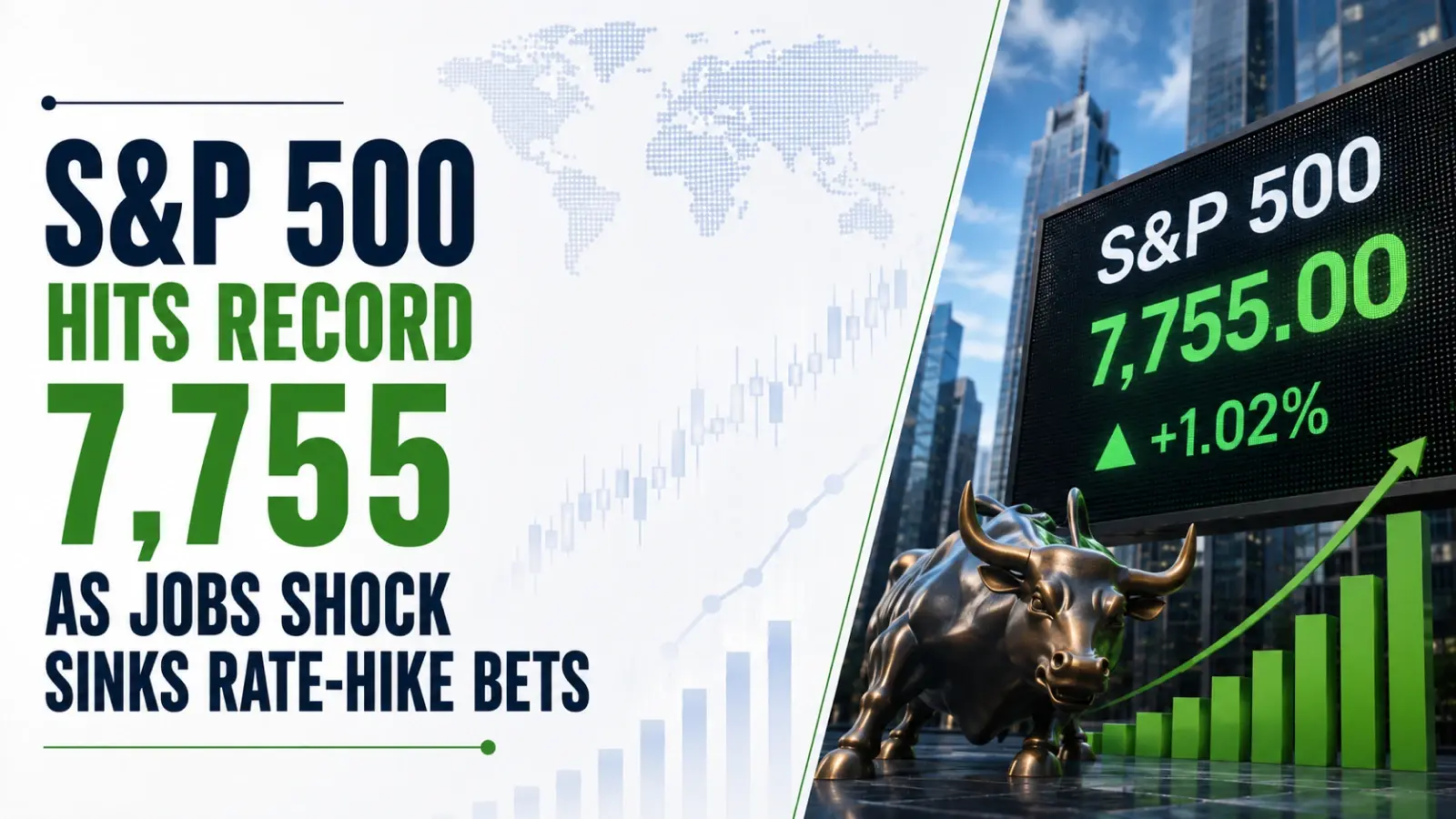
S&P 500 Hits Record 7,755 as Jobs Shock Sinks Rate-Hike Bets, While Oil Plunge and Iran Peace Hopes Drive 907-Point Dow Surge
Authored By HDFC SKY | Last Modified: Aug 10, 2026 10:25 AM IST
Open Free Demat Account
Open Free Demat Account
Mumbai, Aug 8: US stock markets navigated a week of dramatic swings, beginning with a powerful three-day rally driven by collapsing oil prices and hopes of a US-Iran peace deal, only to surrender some gains by mid-week as geopolitical tensions resurfaced and investors digested a weaker-than-expected July jobs report.
The Dow Jones Industrial Average surged to consecutive record closing highs, breaching the 54,000 level for the first time as crude oil prices tumbled over 7% following President Donald Trump’s announcement that he had called off a planned strike on Iran and would pursue fresh negotiations to reopen the Strait of Hormuz. The S&P 500 secured its first closing record since July 2, while the Nasdaq Composite posted strong gains driven by technology stocks.
However, the rally lost momentum by mid-week, with the Nasdaq reversing morning gains to end firmly in negative territory. The final trading session brought further declines across all three major indices as oil prices rebounded, but the S&P 500 managed to close at a record high on Friday after the jobs report scaled back rate-hike expectations.

Dow Gains 693 Points on Monday, Climbs 907 Points on Tuesday to Breach 54,000 for First Time
The Dow Jones Industrial Average (DJI) opened the week at 52,485.03 on Friday, July 31. On Monday, August 3, the index surged 693.38 points (1.32%) to close at a record high of 53,178.41. The intraday high touched 53,230.08 and the intraday low was 52,469.93.
On Tuesday, August 4, the Dow climbed another 907.47 points (1.71%) to close at 54,085.88, marking the first time the index had settled above the 54,000 level. The index touched an intraday high of 54,272.60 and a low of 53,427.87 during the session.
On Wednesday, August 5, the Dow added 263.24 points (0.49%) to close at 54,349.12, its third consecutive record closing high. The index opened at 54,085.88 and touched an intraday high of 54,522 during the session.
On Thursday, August 6, the Dow slumped by 464.02 points (0.85%) to close at 53,885.10, snapping a five-day winning streak. Over the week, the Dow gained approximately 2.7% from the previous Friday’s close of 52,485.03.
Boeing surged 8.03% on Monday after receiving FAA certification for its 737 MAX-7 aircraft, making it the biggest gainer among Dow components. Amazon rose over 4.5% on Monday to reach a $3 trillion market capitalisation for the first time. Meta Platforms soared 6.02%, Microsoft gained 4.93%, Alphabet rose over 4.5%, and Nvidia climbed 2.93%. On the losing side, Apple declined 1.78% on Monday.
S&P 500 Surges 110 Points to 7,600, Climbs 136 Points to Record 7,736 as It Tops 7,700
The S&P 500 (SPX) began the week at 7,489.72 on Friday, July 31. On Monday, August 3, the index surged 110.78 points (1.48%) to close at 7,600.50. The intraday high touched 7,612.34 and the intraday low was 7,498.27.
On Tuesday, August 4, the S&P 500 climbed 136.02 points (1.79%) to close at a record 7,736.52. This marked the index’s first closing record since July 2. The index broke above the 7,700 level for the first time, touching an intraday high of 7,744.51.
On Wednesday, August 5, the S&P 500 reversed course, falling 13.00 points (0.17%) to close at 7,723.55. On Thursday, August 6, the S&P 500 lost 13.59 points (0.18%) to close at 7,709.96. Of the 503 components, 299 closed lower.
On Friday, August 7, following the weaker-than-expected jobs report, the S&P 500 rose 0.6% to close at a record 7,755.49. Over the week, the S&P 500 gained approximately 2.9% from the previous Friday’s close of 7,489.72.
Eight of the 11 primary S&P 500 sectors finished Monday in positive territory. Communication Services surged 4.30% led by Meta Platforms and Alphabet, while Consumer Discretionary added 2.7% driven by Amazon. Energy was the worst-performing sector on Monday, dropping 1.23% as crude oil prices tumbled. Information Technology rose 1.5% on Monday.
Nasdaq Composite Jumps 540 Points (2.13%) on Monday, Adds 671 Points (2.59%) on Tuesday
The tech-heavy Nasdaq Composite (IXIC) opened the week at 25,373.85 on Friday, July 31. On Monday, August 3, the index surged 540.04 points (2.13%) to close at 25,913.90. The intraday high touched 25,967.44 and the intraday low was 25,420.35. On Tuesday, August 4, the Nasdaq continued its ascent, climbing 671.10 points (2.59%) to close at 26,584.99.
On Wednesday, August 5, the Nasdaq dropped 221.55 points (0.83%) to close at 26,363.44. On Thursday, August 6, the Nasdaq slipped 15.09 points (0.06%) to close at 26,348.35. Over the week, the Nasdaq gained approximately 3.8% from the previous Friday’s close, outperforming the other major indices.
The index was driven by strong performances from technology giants including Meta Platforms (up 6.02% on Monday), Microsoft (up 4.93%), Alphabet and Amazon (both over 4.5%), and Nvidia (up 2.93%). Palantir Technologies rallied 29% on Tuesday after blowout results. However, Apple declined 1.78% on Monday. Advanced Micro Devices fell over 7% on Wednesday after reporting earnings that beat estimates but failed to offset in-line guidance.
Russell 2000 Rises 1.7% to 2,981; S&P 100 Advances 1.65% to 3,751
The Russell 2000 (RUT) small-cap index opened the week at 2,935.26 on Monday, August 3. The index closed at 2,981.91, up 50.57 points (1.7%), with an intraday high of 2,985.68 and an intraday low of 2,935.26. On Tuesday, August 4, the Russell 2000 climbed 55 points (1.85%) to close at 3,036.
The S&P 100 (OEX) opened at 3,701.60 on Monday, August 3. The index closed at 3,751.99, up 1.65%. The intraday range was 3,701.60 to 3,755.10. The previous close was 3,690.98 (July 31).
Dow Jones Transportation Average Gains 0.91% to 21,231; Utility Average Dips to 1,119
The Dow Jones Transportation Average (DJT) opened at 21,084.58 on Monday, August 3. The index closed at 21,231.19, up 0.91%. The intraday range was 21,071.31 to 21,289.59. The Dow Jones Utility Average (DJU) closed at 1,119.86 on Monday, August 3. The previous close was 1,121.64, with an intraday range of 1,111.41 to 1,129.95.
The Transportation index benefited from the sharp decline in oil prices early in the week, as lower fuel costs are a significant positive for transportation companies. The Utility index underperformed early in the week as investors rotated into riskier assets but found some support from declining Treasury yields.
Philadelphia Semiconductor Index (SOX) Gains 1.05% to 11,430, Surges 5% Intraday on Tuesday
The Philadelphia Semiconductor Index (SOX) opened at 11,046.09 on Monday, August 3. The index closed at 11,430.35, up 119.28 points (1.05%). The intraday high touched 11,495.28 and the intraday low was 10,922.31.
On Tuesday, August 4, the SOX opened 4% higher and surged as much as 5% to 12,006 during intra-day trading. Chip stocks rallied broadly, with ARM surging 11.67%, Intel rising 7.59%, AMD gaining 6.18%, and Micron climbing 6.01%. On Wednesday, August 5, the SOX rose over 6%, marking its fourth consecutive trading day of gains. On Thursday, August 6, the SOX opened lower, falling 2% to 11,760.04 at one point, before recovering to turn positive.
The semiconductor sector was a key beneficiary of the AI boom, with demand for accelerated computing remaining well above supply. The index had fallen 20.6% in July, making the August rebound a significant reversal.
Also Read: How to Invest in S&P 500 Stocks Through Index Funds
NYSE Composite Index Declines 0.12% to 24,484; S&P MidCap 400 and SmallCap 600 Post Mixed Performance
The NYSE Composite Index (NYA) declined 29.75 points (0.12%) on Friday, August 7, to close at 24,484.06. The index was supported by strength across multiple sectors early in the week but gave back some gains mid-week as geopolitical uncertainties resurfaced and oil prices rebounded. The S&P MidCap 400 (MID) advanced 1.1% on Monday and fell 12.94 points (0.34%) on Friday, August 7, to close at 3,834.39. The S&P SmallCap 600 dropped 14.34 points (0.79%) on Friday, August 7, to close at 1,797.50. These indices are typically more sensitive to domestic economic conditions and interest rate expectations.
Iran Peace Hopes, Oil Plunge and Jobs Data Shape Weekly Market Moves
The primary catalyst for the week’s rally was the easing of geopolitical tensions between the US and Iran. President Donald Trump announced on Sunday that he had called off a planned military strike on Iran and would pursue fresh negotiations to reopen the Strait of Hormuz. Treasury Secretary Scott Bessent said in an interview on CNBC that “we are in talks with the Iranians” and that “there is a chance we may have a deal today or tomorrow to open the Strait”.
This led to a sharp decline in crude oil prices. Brent crude futures fell $6.35, or 7%, to settle at $83.77 a barrel, while US West Texas Intermediate (WTI) crude declined $4.33, or 5.1%, to settle at $80.34. During intra-day trading, Brent sank as much as 7.3% to $81.55 a barrel.
The drop in oil prices helped push US Treasury yields lower. The 10-year Treasury yield declined nearly 6 basis points to 4.68% on Monday, down from Friday’s close at its highest level since January 2025.
However, the optimism proved short-lived. By mid-week, reports emerged that Iran was reviewing legislation to ban US and Israeli vessels from the Strait of Hormuz, reviving concerns about the security of the critical waterway. Oil prices rebounded, and the rally lost momentum.
The weaker-than-expected July jobs report on Friday added to the cautious sentiment. US nonfarm payrolls fell by a seasonally adjusted 23,000 in July, missing market expectations for an increase of 88,000. The unemployment rate dipped to 4.1% from 4.2% in the previous month. Average hourly earnings ticked up 2 cents to $37.62.
CBOE Volatility Index (VIX) Falls 6.4% to 15.99 on Monday, Closes Week at 15.86
The CBOE Volatility Index (VIX) closed at 15.86 on Monday, August 3. The intraday range was 15.54 to 16.30. The VIX fell 6.4% on Monday to 15.99. On Tuesday, August 4, the VIX rose 3.85% to 16.47. On Wednesday, August 5, the VIX gained 4.0% to 16.50. On Thursday, August 6, the VIX fell 4.2% to 15.81. On Friday, August 7, the VIX closed at 15.15, down 4.17%.
The VIX remained elevated during the week, reflecting ongoing uncertainty about geopolitical developments and the economic outlook. The index declined on Monday and Tuesday as risk appetite improved but rose mid-week as geopolitical tensions resurfaced.
Communication Services Surges 4.3% as Best-Performing Sector; Energy Drops 1.23% as Worst
Communication services led all 11 S&P 500 sectors on Monday, climbing 4.3% as Meta Platforms surged 6.02% to $590.24 and Alphabet gained 4.88% to $373.51. The sector’s rally was driven by easing geopolitical tensions and falling Treasury yields, which benefited growth-oriented technology and communication stocks. Morgan Stanley’s reassurance on Meta’s spending outlook further bolstered investor confidence.
Consumer discretionary followed with a 2.68% gain, led by Amazon’s 4.58% rise to $284.02, pushing its market capitalisation past $3 trillion for the first time. Tesla also contributed with a gain of over 3% . Information technology advanced 1.62%, supported by strength in semiconductor and cloud stocks, with the Information Technology Select Sector SPDR (XLK) rising 5.5% on the session. Industrials gained 1.86% as Boeing rallied 8.03% following FAA certification for its 737 MAX-7 aircraft.
Energy was the worst-performing sector, dropping 1.23% as crude oil prices tumbled over 7% following President Trump’s announcement of fresh US-Iran talks to reopen the Strait of Hormuz. Brent crude fell 7% to $83.77 a barrel, while WTI crude dropped 5.1% to $80.34. Healthcare and consumer staples also declined, while financials faced headwinds as the 10-year Treasury yield fell to 4.68% [0†L11】. Eight of the 11 sectors finished in positive territory.
Also Read: How to Invest in the US Stocks From India
Palantir Soars 40%, AppLovin and Datadog Plunge 20% as Earnings Drive Weekly Movers
The week ending August 7, 2026, saw a strong market rally, with the S&P 500 reaching its first record close since July 2 and the Dow crossing 54,000 for the first time. However, earnings and company-specific developments led to sharp differences among individual stocks.
In the S&P 500, Paycom Software (PAYC) gained 23.82% after better-than-expected results, while Airbnb (ABNB) rose 15.82% after Q2 EPS of $1.37 and revenue of $3.61 billion beat forecasts. Amazon (AMZN) jumped 15.3%, crossing the $3 trillion market-capitalisation mark after adjusted EPS of $1.97 beat estimates. Motorola Solutions (MSI) and Leidos Holdings (LDOS) gained 8.24% and 6.56%, respectively. On the downside, AppLovin (APP) fell 19.87%, Datadog (DDOG) dropped 19.03%, and Trade Desk (TTD) declined 20.03% after disappointing results. Honeywell Aerospace (HONA) slid 23.16%.
In the Dow, Boeing (BA) rose 8.03% after FAA certification for its 737 MAX-7, while Microsoft (MSFT) gained 5.21% and Alphabet (GOOGL) advanced 3.98%. Apple (AAPL) fell 7.13% after disappointing fourth-quarter guidance.
In the Nasdaq Composite, Palantir Technologies (PLTR) surged 39.78% after strong Q2 results, with EPS of $0.41 and revenue of $1.94 billion beating estimates. Shopify (SHOP) jumped 29.38%, while Rocket Lab (RKLB) gained 27.53% after securing a $397 million US Space Force contract. CoreWeave (CRWV) rose 26.33%, and Lumentum Holdings (LITE) advanced 24.68%. Western Digital (WDC) fell more than 20% despite beating Q2 estimates.
Magnificent Seven Stocks Post Mixed Performance; Semiconductors Rally, Financials and Energy Rebound
The Magnificent Seven stocks — Apple, Microsoft, Alphabet, Amazon, Nvidia, Meta Platforms, and Tesla — posted mixed performance during the week. Amazon, Microsoft, Alphabet, and Meta Platforms all posted strong gains on Monday, with Meta surging 6.02%, Microsoft rising 4.93%, and Alphabet and Amazon both gaining over 4.5%. Nvidia rose approximately 2.93%. However, Apple declined 1.78% on Monday.
Semiconductor stocks posted strong gains early in the week, driven by continued optimism about AI demand. Chip stocks rallied broadly on Tuesday, with ARM surging 11.67%, Intel rising 7.59%, AMD gaining 6.18%, and Micron climbing 6.01%. The SOX index surged as much as 5% to 12,006.
Financial stocks benefited from the steepening yield curve early in the week but faced headwinds as yields declined. Goldman Sachs gained more than 2% on Tuesday. Energy stocks rebounded mid-week as oil prices recovered from Monday’s sharp decline.
July Jobs Report Shows 23,000 Job Loss, Missing 88,000 Estimate
The most significant economic data release of the week was the July jobs report, released on Friday, August 7. US nonfarm payrolls fell by a seasonally adjusted 23,000 in July, missing market expectations for an increase of 88,000. The unemployment rate dipped to 4.1% from 4.2% in the previous month. Average hourly earnings ticked up 2 cents to $37.62, while the average work week fell to 34.3 hours from 34.6 hours in June.
The report signalled potential weakness in the labour market after months of steady growth. The weaker-than-expected data scaled back bets on Federal Reserve rate hikes and pushed Treasury yields lower. The US 10-year Treasury yield fell sharply following the report.
Also Read : US Stock Market Timings
Fed Holds Rates at 3.50%-3.75%; 10-Year Yield Falls to 4.68%; Brent Drops 7%; USD Steadies Near 100
The Federal Reserve’s policy outlook remained a key focus for investors. The Fed had maintained the federal funds rate target range at 3.50% to 3.75% at its July meeting. The weaker jobs report scaled back bets on Federal Reserve rate hikes.
US Treasury yields moved lower early in the week as geopolitical tensions eased and oil prices declined. The 10-year Treasury yield declined nearly 6 basis points to 4.68% on Monday, down from Friday’s close. The yield on the US 10-year Treasury note fell to 4.67% on Monday. The 2-year Treasury yield stood at approximately 4.2431%.
Brent crude fell 7% on Monday to $83.77 a barrel. WTI crude dropped 5.1% to $80.34. During intra-day trading, Brent sank as much as 7.3% to $81.55 a barrel. Oil prices moved lower after Treasury Secretary Scott Bessent said “we are in talks with the Iranians”.
The US Dollar Index (DXY) traded around 99.89 on Monday. The dollar steadied after early selling took the Dollar Index down to a near seven-week low at 99.41. The dollar weakened against the yen, with USD/JPY trading at 156.74 on Monday, down about 1.35%. On Friday, the US Dollar Index held near 100 as markets digested the weaker-than-expected jobs report.
The week’s trading was characterised by significant swings driven by geopolitical developments and economic data. The Dow surged to consecutive record highs on Iran peace hopes and falling oil prices before snapping its winning streak as Hormuz tensions resurfaced. The S&P 500 secured a record close at 7,755.49 on Friday after the weaker-than-expected July jobs report, which showed a loss of 23,000 jobs, scaled back rate hike expectations and pushed Treasury yields lower. The Nasdaq outperformed with a 3.8% weekly gain, while the Russell 2000 advanced 1.7% on Monday. The US Dollar Index held near 100, while oil prices remained volatile amid ongoing Middle East uncertainties.
Source
- https://www.nasdaq.com/
- spglobal.com/spdji/en/indices/equity/sp-500/
- https://www.dowjones.com/
- https://www.spglobal.com/spdji/en/indices/equity/dow-jones-industrial-average/
- https://www.spglobal.com/spdji/en/indices/equity/sp-500/
- https://www.nasdaq.com/market-activity/index/comp
- https://www.nasdaq.com/market-activity/quotes/nasdaq-ndx-index
- https://www.spglobal.com/spdji/en/indices/equity/sp-100/
- https://www.lseg.com/en/ftse-russell/indices/russell-us
- https://www.nyse.com/index
- https://www.nyse.com/index
- https://www.spglobal.com/spdji/en/indices/equity/dow-jones-transportation-average/
- https://www.spglobal.com/spdji/en/indices/equity/dow-jones-utility-average/
- https://www.spglobal.com/spdji/en/indices/equity/dow-jones-composite-average/
- https://www.nasdaq.com/market-activity/index/sox
- https://www.cboe.com/tradable_products/vix/
Disclaimer
If you have any concerns, questions, or wish to point out any discrepancies in our content, please feel free to write to us at content@hdfcsec.com.
Please Note: The information shared is intended solely for informational purposes and does not make any investment recommendations
Disclaimer
At HDFC SKY*, we take utmost care and due diligence in curating and presenting news and market-related content. However, inadvertent errors or omissions may occasionally occur.
If you have any concerns, questions, or wish to point out any discrepancies in our content, please feel free to write to us at content@hdfcsec.com.
Please Note: The information shared is intended solely for informational purposes and does not make any investment recommendations.
HDFC SKY from HDFC Securities, one of most trusted trading platforms in India, has been recognized with the *Next-Gen Digi Content Awards 2025-26.
 Join Us
 Add as preferred source on Google


More Business News








Open Free Demat Account
Open Free Demat Account











Invest Anytime, Anywhere


By signing up I certify terms, conditions & privacy policy