Nifty 50
- Apollo Hospitals₹8,027.50361.50 (4.72%)
- BSE₹3,287.20-47.60 (-1.43%)
- ITC₹26611.00 (4.31%)
- Reliance Industries₹1,170.30-7.70 (-0.65%)
- Eicher Motors₹7,050282.50 (4.17%)
- JSW Steel₹1,168-7.20 (-0.61%)
- TCS₹2,15680.00 (3.85%)
- Cipla₹1,301-5.80 (-0.44%)
- HCL Technologies₹1,216.7039.80 (3.38%)
- Adani Ports₹1,76153.00 (3.10%)
- Infosys₹1,023.4026.40 (2.65%)
- Shriram Finance₹940.4523.20 (2.53%)
- Tata Motors PV₹279.906.90 (2.53%)
- UltraTech Cement₹10,675249.00 (2.39%)

- Offerings
- Tools & Platforms
Tools & Calculators
- Open API
- Calculators
- SIP Calculator
- CAGR Calculator
- Compound Interest Calculator
- FD Calculator
- RD Calculator
- EPF Calculator
- Retirement Calculator
- HDFC SIP Calculator
- Mutual Fund Return Calculator
- Lumpsum Calculator
- Step Up SIP Calculator
- ETF SIP Calculator
- Brokerage Calculator
- Equity Margin Calculator
- SWP Calculator
- EMI Calculator
- MTF Calculator
- Margin Pledge Calculator
- Algo Strategy
- Markets
Stocks
F&O
Mutual Funds
- More
Dow Plunges 704 Points, Nasdaq Drops 1% as Treasury Buyback Fails and Oil Surges
Authored By HDFC SKY | Last Modified: Aug 21, 2026 09:13 AM IST
Open Free Demat Account
Open Free Demat Account
Mumbai, Aug 21: US stock markets closed sharply lower on Thursday as the Treasury Department’s surprise intervention in the bond market proved short-lived, with long-dated government yields resuming their climb. The resurgence in borrowing costs, coupled with escalating geopolitical tensions that pushed crude oil prices higher, erased the previous session’s gains and dragged all three major indices into negative territory.
The broader market experienced a decisive downturn, with all three major indices closing in the red. The primary catalyst for the selloff was the failure of the Treasury’s expanded buyback programme to sustainably lower long-term yields, which rebounded sharply.
Additionally, President Trump’s threat of “economic warfare” against Iran sent oil prices surging, adding to inflationary concerns and weighing on investor sentiment. The Dow Jones Industrial Average led the declines, falling 1.32%, while the S&P 500 dropped 0.87% and the Nasdaq Composite slid 1.00%.

Dow Jones Plunges 704 Points as Walmart 9.15% Drop and Boeing Slide Drag Blue-Chips
The Dow Jones Industrial Average tumbled 703.84 points, or 1.32%, to close at 52,759.21. The blue-chip index opened at 53,381.22 and traded within a day’s range of 52,754.90 to 53,381.22.
The decline was driven primarily by weakness in consumer and industrial stocks. Walmart Inc. (WMT) was the worst performer, plunging 9.15% after reporting disappointing US comparable sales growth of 2.6% against an expected 3.5% and issuing soft third-quarter EPS guidance of $0.62-$0.64 versus a consensus of $0.68.
Boeing (BA) dropped 3.18%, while Goldman Sachs (GS) declined 1.92% and JPMorgan Chase (JPM) fell 1.51%. On the positive side, Deere & Co. (DE) surged 6.93% following strong quarterly results, while McDonald’s (MCD) gained 0.66% and Visa (V) added 0.13%.
S&P 500 Sheds 66 Points as Consumer Discretionary and Industrials Lead Broad Decline
The S&P 500 shed 66.82 points, or 0.87%, ending the session at 7,641.16. The benchmark opened at 7,690.49 and moved between 7,639.01 and 7,699.96 during the day. Nine of the 11 sectors closed lower.
The Consumer Discretionary sector was the worst performer, falling 1.3%, weighed down by Amazon (AMZN) down 2.16% and Tesla (TSLA) off 1.71%. The Industrials sector also faced significant pressure, dropping as aerospace and defence names sold off amid the jump in long-dated Treasury yields.
Among top gainers, Deere & Co. (DE) led with a 6.93% surge, while Thermo Fisher Scientific (TMO) gained 2.31% and Danaher (DHR) advanced 2.13%. The largest losers included Walmart (WMT) down 9.15%, Moderna (MRNA) plunging 23.55% after its prior day’s 177% rally, and CrowdStrike (CRWD) declining 5.64%.
Nasdaq Composite Declines 1% as Mega-Cap Tech Stocks Falter but Semiconductors Show Resilience
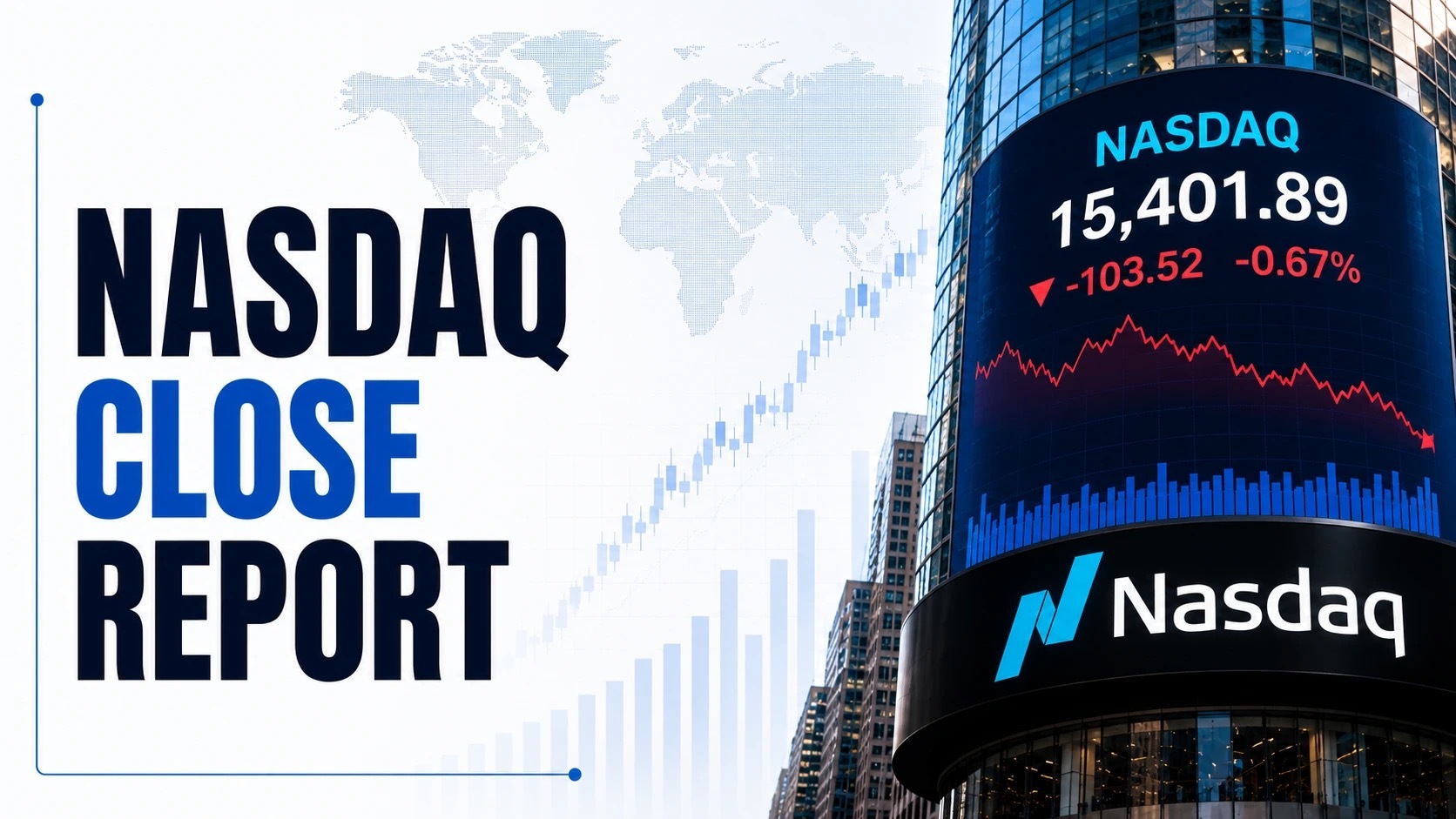
The Nasdaq Composite declined 263.92 points, or 1.00%, closing at 26,067.17. The tech-heavy index opened at 26,211.52 and recorded an intraday low of 26,023.12 and a high of 26,263.47.
The decline was driven by weakness in mega-cap technology stocks: Amazon (AMZN) fell 2.16%, Apple (AAPL) dropped 1.75%, and Tesla (TSLA) declined 1.71%. Alphabet (GOOGL) lost 1.19% and Microsoft (MSFT) slipped 0.47%.
However, semiconductor names outperformed, with Marvell Technology (MRVL) surging 5.85% and Micron Technology (MU) gaining 3.99%, helping to limit the index’s losses.
S&P 100 Falls 0.93% as Largest Constituents Weigh on Blue-Chip Barometer
The S&P 100 fell 0.93%, or 35.37 points, to close at 3,765.18. The index opened at 3,793.02 and traded between 3,763.95 and 3,795.55. The decline was largely in line with the broader market, with consumer and technology giants driving the move lower. Walmart (WMT) and Amazon (AMZN) were among the top detractors, while Deere (DE) provided a partial offset.
Also Read: How to Invest in the US Stocks From India
Dow Jones Composite, Transportation and Utility Averages All End Lower as Rate Fears Hit Cyclicals
The Dow Jones Composite Average dropped 1.01%, or 170.21 points, to 16,744.55. It opened at 16,885.41 and ranged between 16,743.29 and 16,889.58. The Dow Jones Transportation Average slipped 0.37%, or 78.59 points, to 21,382.25 (open 21,410.72, high 21,592.07, low 21,272.59), reflecting weakness in shipping and logistics names amid rising fuel costs.
The Dow Jones Utility Average declined 0.57%, or 6.37 points, to 1,103.50 (open 1,108.08, high 1,114.74, low 1,103.21), as higher bond yields made dividend-paying utilities less attractive.
PHLX Semiconductor Index Defies Gravity with 0.53% Gain as Storage Chips Shine
The Philadelphia Semiconductor Index (SOX) advanced 0.53%, or 61.79 points, closing at 11,800.02. The index opened at 11,762.11 and traded within a range of 11,649.47 to 11,863.72. The resilience came despite broader market weakness, driven by strength in storage and memory names.
Marvell Technology (MRVL) surged 5.85%, Micron Technology (MU) gained 3.99%, Seagate Technology (STX) rose 2.17%, and Western Digital (WDC) advanced 1.51%. However, cybersecurity names weighed, with CrowdStrike (CRWD) tumbling 5.64% and Palo Alto Networks (PANW) dropping 2.87%, highlighting selective pressure within the tech sector.
NYSE Composite Declines 0.64% as Broad Market Selloff Hits All Sectors
The NYSE Composite Index fell 0.64%, or 159.01 points, to 24,548.26. It opened at 24,707.27 and traded between 24,551.10 and 24,753.26. The decline was broad-based, with energy being the only sector to post gains, while consumer and industrial stocks led the losses.
S&P MidCap 400 and SmallCap 600 Underperform as Rising Yields Hit Smaller Companies
The S&P MidCap 400 declined 0.86%, or 33.10 points, closing at 3,810.89 (open 3,843.99, high 3,844.40, low 3,810.64). The S&P SmallCap 600 dropped 1.09%, or 19.53 points, to 1,777.69 (open 1,791.75, high 1,791.75, low 1,777.07). The underperformance of smaller-capitalisation indices reflects their greater sensitivity to rising borrowing costs and economic uncertainty, as investors rotated toward larger, more liquid names.
10-Year Treasury Yield Hits 4.706% as Iran Sanctions Push Oil Above $86 and $93, Deepening Market Pressure
The primary drivers of Thursday’s decline were twofold. First, the Treasury Department’s announcement on Wednesday that it would “at least double” its buybacks of longer-dated debt provided only temporary relief.
On Thursday, yields resumed their upward march, with the 10-year Treasury yield climbing more than 5 basis points to 4.706% and the 30-year yield surging over 5 basis points to 5.247%. Treasury Secretary Scott Bessent told CNBC that the buyback could exceed the $4 billion announced, but market participants remained sceptical, with EP Wealth Advisors’ Adam Phillips stating, “This is not the cure to what ails the bond market. There are structural forces here at play that are really beyond the Treasury and the administration’s control”.
Second, geopolitical tensions escalated as President Trump vowed “economic warfare” against Iran, promising the “toughest sanctions in history.” This sent WTI crude up 2% to above $86 per barrel and Brent crude up 2% to above $93 a barrel, stoking inflation fears and weighing on risk assets.
Volatility Indices Spike as VIX Jumps 7.19% on Renewed Market Anxiety
The CBOE Volatility Index (VIX) surged 7.19%, or 1.07 points, to close at 15.96. The VIX opened at 14.91 and traded as high as 16.14 during the session. This sharp increase indicates heightened expectations of near-term market turbulence, reflecting investor anxiety over the sustainability of the bond market rally and the potential for further monetary policy tightening.
Energy Gains 0.6% as Consumer Discretionary Slides 1.3% and Defence Stocks Drop 3% on Rising Yields
All but one of the 11 S&P 500 sectors ended in negative territory. The Energy sector was the sole gainer, rising 0.6%, supported by surging crude oil prices. Top performers included ConocoPhillips (COP) up 3%, Occidental Petroleum (OXY) and Devon Energy (DVN) each gaining more than 2%.
The Consumer Discretionary sector was the worst performer, falling 1.3%, weighed down by Amazon (AMZN) and Tesla (TSLA). The Industrials sector also faced significant pressure, declining as aerospace and defence names, Boeing (BA), Lockheed Martin (LMT), Northrop Grumman (NOC), all fell around 3% amid the jump in long-dated yields.
Real Estate managed a modest gain, while Information Technology, Communication Services, Financials, Health Care, Consumer Staples, Utilities, and Materials all finished lower.
Also Read: How to Invest in S&P 500 Stocks Through Index Funds
Deere Surges 6.93% on Strong Results While Advance Auto Parts Plunges 24.55% on Sales Miss
Among the top gainers in the S&P 500, Deere & Co. (DE) led with a 6.93% advance after reporting strong quarterly results and raising the lower end of its full-year profit outlook. Other notable gainers included Thermo Fisher Scientific (TMO) up 2.31%, Danaher (DHR) up 2.13%, and Seagate Technology (STX) up 2.17%.
The largest losers were Moderna (MRNA) plummeting 23.55% after its historic 177% rally on Wednesday, Advance Auto Parts (AAP) plunging 24.55% on a sales miss, and Walmart (WMT) down 9.15% on disappointing comparable sales and guidance.
Among the Magnificent Seven, Amazon (AMZN) fell 2.16%, Apple (AAPL) dropped 1.75%, Tesla (TSLA) declined 1.71%, Alphabet (GOOGL) lost 1.19%, Microsoft (MSFT) slipped 0.47%, Nvidia (NVDA) fell 0.34%, and Meta Platforms (META) was nearly flat, down just 0.06%.
Energy Stocks Gain 3% as Cybersecurity Falls 5.64% and Financials Slide Over 2% on Rising Yields
Within the semiconductor space, storage and memory names outperformed, with Western Digital (WDC) up 1.51% and Seagate (STX) up 2.17%, while Advanced Micro Devices (AMD) rose 0.66% and Broadcom (AVGO) added 0.39%. However, cybersecurity stocks dragged, with CrowdStrike (CRWD) down 5.64% and Palo Alto Networks (PANW) off 2.87%.
Financial stocks were broadly lower, with JPMorgan (JPM) down 1.51%, Goldman Sachs (GS) down 1.92%, and Bank of America (BAC) off 2.05%, as rising yields weighed on interest-rate sensitive names.
Energy stocks were the bright spot, with ConocoPhillips (COP) up 3%, Exxon Mobil (XOM) up 0.80%, and Chevron (CVX) gaining 0.04%, benefiting from higher oil prices. AI-related growth stocks underperformed, with Palantir (PLTR) down 0.73% and CrowdStrike (CRWD) falling sharply, reflecting the broader risk-off sentiment.
Jobless Claims Fall to 206,000 as Philadelphia Fed Manufacturing Surges to 47.4
On the economic front, initial jobless claims for the week ending 15 August fell by 6,000 to 206,000, below the economists’ estimate of 210,000. Continuing claims also decreased to 1.83 million. The four-week moving average for jobless claims ticked up to 204,000.
The Philadelphia Federal Reserve’s manufacturing index jumped to 47.4, up 6 points from July and well ahead of the Dow Jones consensus forecast of 25. This marked the highest reading since April 2021. The employment index surged to 27.9, its highest level since April 2022, while gauges for prices paid and received hit their lowest levels since February.
Federal Reserve Minutes Reveal Hawkish Tilt with Three Dissents for Rate Hike
The Federal Open Market Committee (FOMC) minutes from the July 28-29 meeting, released on Wednesday, revealed a growing divide among policymakers. The committee voted 9-3 to hold the benchmark federal funds rate in a range of 3.5% to 3.75%. Three officials—Beth Hammack, Neel Kashkari, and Lori Logan—dissented in favour of a quarter-percentage point hike.
The minutes showed that “several participants” favoured a rate hike and “many” assessed that rate hikes would likely be needed if inflation did not decline. Most participants anticipated that inflation would step down over the rest of the year as the effects of tariffs and earlier energy price increases wane.
However, the hawkish tone of the minutes added to market anxiety, particularly as bond yields continued to rise. The minutes also confirmed reports that Fed Chair Kevin Warsh is considering reducing the frequency of Fed meetings to six a year from eight.
Also Read : US Stock Market Timings
Yield Curve Steepens as 30-Year Yield Hits 5.247% Near Two-Decade High
The bond market remained under pressure despite the Treasury’s intervention. The 2-Year Treasury yield held steady at 4.187%, while the 5-Year Treasury yield rose to 4.696%. The 10-Year Treasury yield surged to 4.706%, and the 30-Year Treasury yield climbed to 5.247%, its highest level in nearly 20 years. The steepening yield curve reflected investor concerns over long-term fiscal sustainability and inflation persistence. The yield on the 30-year Treasury had spiked to its highest level in nearly two decades earlier this week, and despite the buyback announcement, it remained elevated.
Dollar Hits 3-Month Low as Gold Holds Above $4,500 and Oil Surges 2% on Iran Tensions
The US Dollar Index (DXY) fell to a three-month low, trading at 98.938, as the Treasury’s bond buyback announcement weighed on the greenback. The EUR/USD pair rose to 1.1678, while USD/JPY weakened amid the dollar’s broader decline.
In commodities, gold prices slipped 0.3% to $4,511 per ounce after surging more than 4% in the previous session. Silver outperformed, climbing 3.49% to $68.026 per ounce. Copper held above $14,000 per tonne, rising 0.64% to $14,051.5.
Natural gas fell 2.88% to $2.7330 per million British thermal units. Brent crude futures rose 2% to above $93 a barrel, while WTI crude for October delivery rose 2% to above $86 per barrel, driven by escalating tensions between the US and Iran and the UAE’s suspension of trade with Tehran.
Treasury buybacks have failed to sustainably lower long-term yields amid fiscal deficit concerns and inflation pressures. Higher oil prices and hawkish FOMC signals add uncertainty. Markets should monitor Treasury yields, Middle East tensions and inflation data for policy direction.
Source
- https://www.nasdaq.com/
- spglobal.com/spdji/en/indices/equity/sp-500/
- https://www.dowjones.com/
- https://www.spglobal.com/spdji/en/indices/equity/dow-jones-industrial-average/
- https://www.spglobal.com/spdji/en/indices/equity/sp-500/
- https://www.nasdaq.com/market-activity/index/comp
- https://www.nasdaq.com/market-activity/quotes/nasdaq-ndx-index
- https://www.spglobal.com/spdji/en/indices/equity/sp-100/
- https://www.lseg.com/en/ftse-russell/indices/russell-us
- https://www.nyse.com/index
- https://www.nyse.com/index
- https://www.spglobal.com/spdji/en/indices/equity/dow-jones-transportation-average/
- https://www.spglobal.com/spdji/en/indices/equity/dow-jones-utility-average/
- https://www.spglobal.com/spdji/en/indices/equity/dow-jones-composite-average/
- https://www.nasdaq.com/market-activity/index/sox
- https://www.cboe.com/tradable_products/vix/
Disclaimer
If you have any concerns, questions, or wish to point out any discrepancies in our content, please feel free to write to us at content@hdfcsec.com.
Please Note: The information shared is intended solely for informational purposes and does not make any investment recommendations
HDFC SKY, one of India’s most trusted trading platforms, has been recognized with the Next-Gen Digi Content Awards 2025–26.
Disclaimer
At HDFC SKY*, we take utmost care and due diligence in curating and presenting news and market-related content. However, inadvertent errors or omissions may occasionally occur.
If you have any concerns, questions, or wish to point out any discrepancies in our content, please feel free to write to us at content@hdfcsec.com.
Please Note: The information shared is intended solely for informational purposes and does not make any investment recommendations.
HDFC SKY from HDFC Securities, one of most trusted trading platforms in India, has been recognized with the *Next-Gen Digi Content Awards 2025-26.
 Join Us
 Add as preferred source on Google


More International News




Open Free Demat Account
Open Free Demat Account












Invest Anytime, Anywhere


By signing up I certify terms, conditions & privacy policy