Nifty 50
- Tech Mahindra₹1,779.100.00 (0.00%)-
- BSE₹3,3360.00 (0.00%)-
- Bajaj Finance₹957.350.00 (0.00%)-
- Bharat Electronics₹377.200.00 (0.00%)-
- Cipla₹1,324.100.00 (0.00%)-
- SBI₹973.700.00 (0.00%)-
- Titan Company₹4,424.200.00 (0.00%)-
- Dr. Reddy's Labs₹1,242.500.00 (0.00%)-
- HDFC Bank₹7120.00 (0.00%)-
- Infosys₹1,130.700.00 (0.00%)-

- Offerings
- Tools & Platforms
Tools & Calculators
- Open API
- Calculators
- SIP Calculator
- CAGR Calculator
- Compound Interest Calculator
- FD Calculator
- RD Calculator
- EPF Calculator
- Retirement Calculator
- HDFC SIP Calculator
- Mutual Fund Return Calculator
- Lumpsum Calculator
- Step Up SIP Calculator
- ETF SIP Calculator
- Brokerage Calculator
- Equity Margin Calculator
- SWP Calculator
- EMI Calculator
- MTF Calculator
- Margin Pledge Calculator
- Algo Strategy
- Markets
Stocks
F&O
Mutual Funds
- More
Dow Surges 529 Points as Oil Retreat and Earnings Optimism Outweigh AI Jitters
Authored By HDFC SKY | Published at: Oct 21, 2026 08:29 AM IST
Open Free Demat Account
Open Free Demat Account
Mumbai, 20 October 2026: US equities closed mixed on Tuesday, with the Dow Jones Industrial Average surging 1.02% while the Nasdaq Composite slipped 0.02%, as a sharp retreat in crude oil prices and a wave of upbeat corporate earnings overshadowed lingering concerns about the sustainability of the artificial intelligence trade. The S&P 500 added 0.28%, while small-cap stocks outperformed sharply, with the Russell 2000 climbing 1.65%.
Trading activity reflected a pronounced rotation away from megacap technology names and into healthcare, real estate, utilities and value-oriented sectors, a shift that lifted the Dow to a decisive gain even as the technology-heavy Nasdaq ended fractionally below the flatline.
The session’s dominant catalyst was the pullback in oil prices from multi-month highs, which eased immediate inflation anxiety and provided room for equity benchmarks to advance, while a record-high close for the S&P 500 healthcare sector underscored the defensive character of the day’s market leadership.

Dow Jones Gains 529 Points as Oil Retreat and Earnings Lift Blue-Chip Index
The Dow Jones Industrial Average opened at 51,959.21 and closed at 52,495.88, gaining 529.85 points or 1.02%. The index touched an intraday high of 52,689.81 and a low of 51,910.92 during the session, reflecting a broad advance that saw the blue-chip benchmark outperform both the S&P 500 and the Nasdaq Composite. Movements in industrial, healthcare and consumer discretionary constituents drove the index’s performance, with 3M rising 5.78% to lead the Dow’s gainers after the industrial conglomerate reported better-than-expected quarterly results and raised its full-year profit forecast.
Merck advanced 3.25%, Amgen added 3.29% and UnitedHealth gained 3.04%, as healthcare names collectively powered the index higher. McDonald’s rose 1.59% and Nike climbed 1.80%, while Home Depot added 1.69%, extending gains across consumer-facing constituents.
On the downside, GE Aerospace fell 3.67% and Caterpillar slipped 0.08%, while Boeing lost 0.50% and Salesforce eased 0.01%. The session followed a wave of corporate earnings releases that tilted sentiment toward value and cyclicals, and the decision by oil prices to reverse from earlier highs provided an additional tailwind for transport and industrial names within the average. The Dow’s advance came even as megacap technology constituents within the index, including Apple and Microsoft, posted modest declines, underscoring the breadth of the rotation into non-technology sectors.
S&P 500 Rises 0.28% as Healthcare Record and Oil Pullback Support Broader Market
The S&P 500 opened at 7,679.01 and ended at 7,712.57, gaining 21.84 points or 0.28%. During the session, the index reached a high of 7,748.42 and a low of 7,668.03. Movements across healthcare, real estate, utilities and financials influenced the broader benchmark, while energy and communication services lagged. Eli Lilly surged 3.49% and was the single largest boost to the benchmark, while Moderna gained more than 5% and reached its highest level since 2022.
UnitedHealth added 3.04%, Merck rose 3.25% and Amgen climbed 3.29%, consolidating the healthcare sector’s record-high close. Equifax surged 11.33% after reporting third-quarter profit above analysts’ estimates, and Hasbro jumped 11.20% after the toymaker raised its full-year revenue outlook. On the downside, General Motors plunged 6.84% and was the S&P 500’s biggest laggard, while GE Aerospace fell 3.67% and Howmet Aerospace dropped 3.82%.
The index’s closing performance came as oil prices retreated from five-month highs and as investors weighed a heavy slate of earnings against persistent concerns about AI-related financing costs. The S&P 500 value index outperformed its growth counterpart, mirroring the session’s rotation into defensive and cyclical names.
Also Read: What Is the New York Stock Exchange (NYSE)?
Nasdaq Composite Slips 0.02% as Megacap Technology Shares Stall
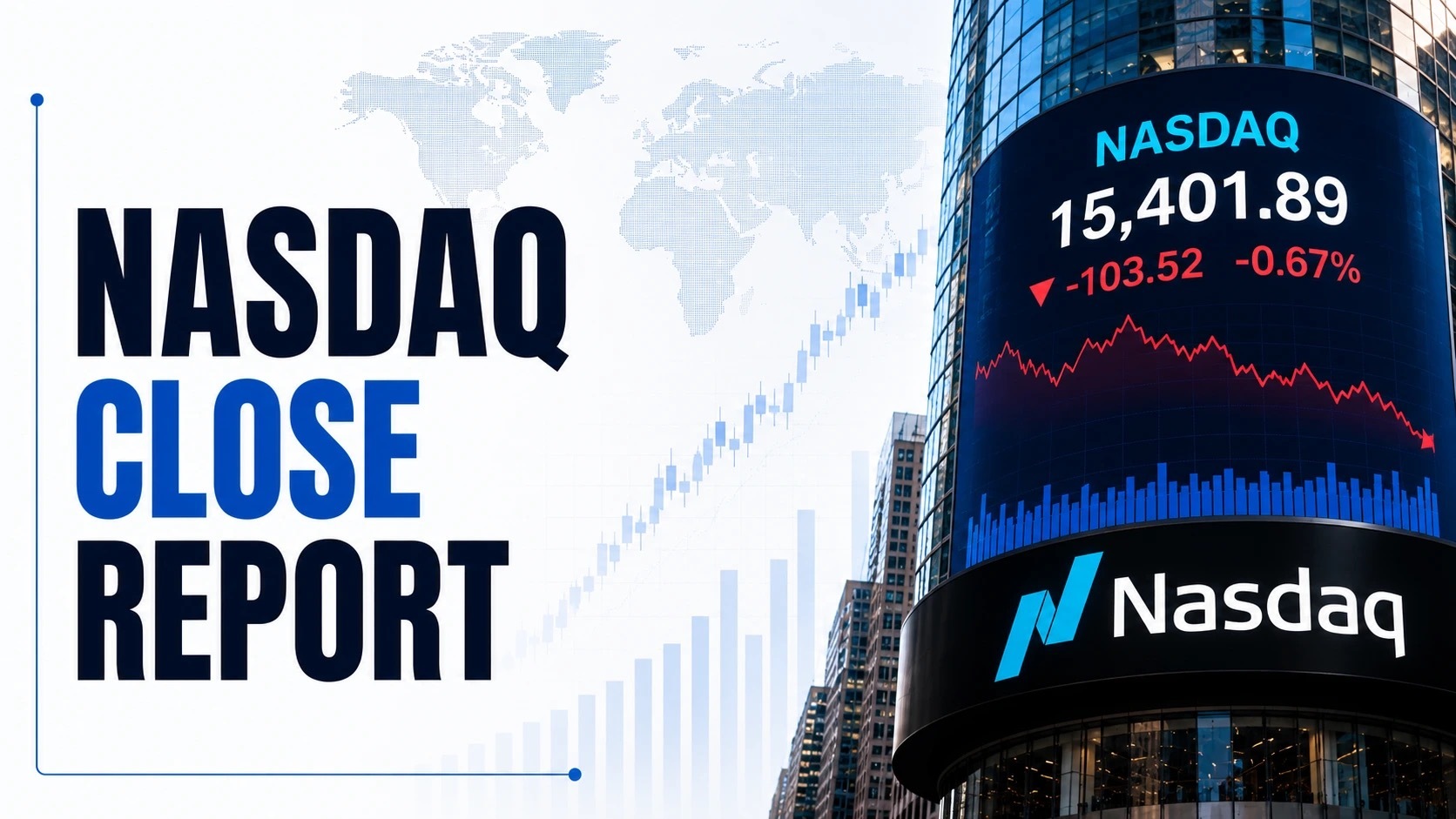
The Nasdaq Composite opened at 26,332.92 and closed at 26,424.82, marking a loss of 6.07 points or 0.02%. Its intraday high stood at 26,601.71, while the low was 26,179.74. Technology and growth-oriented shares delivered a mixed performance, with Tesla rising 1.51% and Amazon adding 0.04%, while Apple fell 1.00%, Microsoft slipped 0.31% and Nvidia eased 0.29%.
Meta Platforms dropped 1.59% and Alphabet lost 1.13%, pulling the communication services sector lower and offsetting gains elsewhere in the index. Among other Nasdaq constituents, Western Digital gained 3.44% and Seagate Technology added 2.17%, while Marvell Technology rose 1.40% and Qualcomm advanced 1.26%. Adobe climbed 3.90% and Intuit added 2.97%, providing some support to the software segment, while Lam Research fell 3.21% and Applied Materials lost 1.97%.
The technology-heavy benchmark responded to a session in which investors rotated away from megacap growth names and toward value and defensive sectors, while the memory-chip segment staged a partial rebound following recent weakness. The index’s fractional decline contrasted with the Dow’s strong advance, reflecting the divergent performance of technology and non-technology constituents during the closing session.
Russell 2000 Gains 1.65% as Smaller Stocks Outperform on Sector Rotation
The Russell 2000 opened at 2,728.56 and closed at 2,773.42, gaining 45.12 points or 1.65%. It recorded an intraday high of 2,783.54 and a low of 2,728.56. Movements among smaller-cap companies reflected the session’s rotation into value and cyclical names, with the small-cap benchmark outperforming both the S&P 500 and the Nasdaq Composite by a wide margin.
Braze surged 51.70% after agreeing to be acquired by Salesforce in an all-cash deal, while Lionsgate Studios jumped 14.41% and SELLAS Life Sciences gained 14.20%. Klaviyo rose 11.93% and EquipmentShare.com added 11.83%, while Heartflow advanced 8.96% and Casella Waste Systems climbed 7.55%. On the downside, Mueller Industries fell 6.59% and MaxLinear dropped 4.67%, while Sanmina lost 3.81% and Semtech declined 4.23%.
The benchmark’s performance came as investors sought opportunities outside megacap technology, with healthcare, real estate and financial small-cap names attracting particular attention during the session.
S&P 100 Adds 0.04% as Large-Cap Shares Track Defensive Rotation
The S&P 100 opened at 3,823.10 and finished at 3,832.40, recording a gain of 1.45 points or 0.04%. The index traded between 3,814.01 and 3,856.76 during the session. Movements in major large-cap constituents reflected the day’s rotation, with Eli Lilly rising 3.49% and UnitedHealth gaining 3.04%, while Merck added 3.25% and Amgen climbed 3.29%.
Walmart slipped 0.72% and Apple fell 1.00%, while Microsoft eased 0.31% and Meta Platforms dropped 1.59%, weighing on the large-cap benchmark’s technology component. JPMorgan Chase added 0.52% and Visa rose 0.91%, providing modest support from the financial segment.
The index’s marginal advance came as markets responded to the pullback in oil prices and the continued rotation into healthcare and defensive sectors, which offset weakness in megacap technology and communication services names.
Dow Composite Slips 0.33% as Transport and Utility Averages Diverge
The Dow Jones Composite Average opened at 16,202.88 and closed at 16,362.39, gaining 168.83 points or 1.04%, after moving between a high of 16,443.10 and a low of 16,185.36. The Dow Jones Transportation Average ended at 19,885.50, compared with an opening level of 19,700.23, representing a gain of 0.94% or 184.31 points.
The Dow Jones Utility Average closed at 1,078.40, changing 1.42% from its opening level of 1,070.04. Movements in relevant constituents reflected the session’s broader rotation, with utility names benefiting from the decline in Treasury yields and transportation stocks drawing support from the retreat in crude oil prices. The divergence between the composite’s advance and the mixed performance of its component averages underscored the selective nature of the day’s market leadership.
Also Read: How to invest in US stocks
Philadelphia Semiconductor Index Slips 0.29% as Chip Stocks End Lower
The Philadelphia Semiconductor Index (SOX) opened at 11,170.58 and closed at 11,283.81, losing 32.53 points or 0.29%. Its intraday high was 11,460.13, while the low was 11,043.24.
Semiconductor-related constituents delivered a mixed performance, with Western Digital gaining 3.44% and Seagate Technology rising 2.17%, while Marvell Technology added 1.40% and Qualcomm advanced 1.26%. Lam Research fell 3.21% and Applied Materials dropped 1.97%, while Arm Holdings lost 3.07% and KLA Corporation declined 2.80%.
Nvidia eased 0.29% and Broadcom slipped 0.07%, while Intel lost 0.53% and Advanced Micro Devices fell 0.62%. The sector benchmark’s daily performance came amid continued scrutiny of AI-related financing costs and following a sharp rebound in the previous session, with the index unable to sustain its early advance as megacap technology names lost momentum.
NYSE Composite Advances 0.93% as Broader Shares Track Value Rotation
The NYSE Composite Index opened at 23,987.54 and closed at 24,190.62, recording a gain of 223.55 points or 0.93%. The index traded between 23,987.54 and 24,249.92 during the session.
Movements across healthcare, financials and industrial segments contributed to its performance, as the value-oriented character of the NYSE-listed universe benefited from the rotation away from technology growth names. The advance came as investors favoured defensive and cyclical sectors, with the benchmark’s breadth reflecting the broad participation that lifted more than three of every four S&P 500 constituents during the session.
S&P MidCap 400 and SmallCap 600 Advance as Mid and Small Shares Outperform
The S&P MidCap 400 opened at 3,615.14 and closed at 3,651.35, moving 35.53 points or 0.98%, with an intraday range of 3,612.55 to 3,664.97. The S&P SmallCap 600 opened at 1,652.86 and ended at 1,674.28, gaining 22.19 points or 1.34%, after trading between 1,652.86 and 1,680.30. The two benchmarks reflected movements among mid- and small-cap shares as the session’s rotation into value and cyclical names supported broader market participation, with both indices outperforming the large-cap S&P 500 and the technology-heavy Nasdaq Composite.
Oil Retreat and Earnings Optimism Drive the Session’s Market Direction
The principal market catalyst was the reversal in crude oil prices after Brent crude touched a five-month high above $110 a barrel earlier in the session before pulling back. West Texas Intermediate crude futures settled at $101.79, down 1.8%, while Brent crude declined 0.7% to $108.79 a barrel.
The retreat in oil eased immediate concerns about inflation pressures and provided room for equity benchmarks to advance, with the move coming as traders weighed a meeting between the Iranian president and Pakistan’s army chief against reports of vessel attacks in the Gulf. Treasury yields moved lower alongside the oil pullback, with the 10-year Treasury yield falling to 5.088% and the 30-year yield easing to 5.419%, removing some of the valuation pressure that had weighed on equities in recent sessions.
A second catalyst was the heavy slate of corporate earnings, which tilted sentiment toward value and cyclical names. 3M rose 5.78% after reporting adjusted earnings of $2.50 per share on revenue of $6.6 billion, exceeding estimates, and raising its full-year profit forecast.
General Motors beat top- and bottom-line expectations but fell 6.84% after narrowing its full-year guidance and signalling pressure from higher commodity costs. Hasbro jumped 11.20% after lifting its revenue outlook, while Equifax gained 11.33% on better-than-expected quarterly profit. The session’s trading remained focused on whether earnings strength could sustain equity valuations amid elevated borrowing costs, with movements across healthcare, real estate and utilities reflecting the day’s defensive tilt.
Also Read: US Stock Market Timings
VIX Falls 7.75% to 18.44 as Volatility Expectations Ease
The CBOE Volatility Index (VIX) fell 7.75% to 18.44, compared with its previous close of 19.99. The index measures expected volatility in the S&P 500 over the coming 30 days. Its decline during the session coincided with the equity benchmarks’ advance and the pullback in oil prices, which reduced immediate demand for portfolio protection. The CBOE Nasdaq Volatility Index (VXN) moved 4.53% higher to 23.33, while the CBOE S&P 500 3-Month Volatility Index (VIX3M) stood at 19.60, with near-term volatility expectations remaining below the three-month measure.
S&P 500 Sectors Show Broad Gains Led by Healthcare’s 2.3% Advance
Performance across the 11 S&P 500 sectors was broadly higher, with eight groups advancing and three declining. Healthcare recorded the strongest move at 2.3%, closing at a record high, while Real Estate and Utilities each gained more than 1%.
Financials added 1.1%, Consumer Discretionary rose 0.7% and Consumer Staples advanced 0.5%. Information Technology ended roughly flat, while Communication Services declined as megacap names including Meta Platforms and Alphabet lost ground. Energy was the weakest sector, reflecting the pullback in crude oil prices after their earlier advance to multi-month highs.
The sector movements followed the session’s rotation into defensive and value-oriented groups, with healthcare’s record close underscoring the defensive character of the day’s leadership.
Magnificent Seven Deliver Mixed Performance as Tesla Gains and Meta Declines
Among the Magnificent Seven, Tesla moved 1.51% higher and Amazon added 0.04%, while Nvidia slipped 0.29% and Microsoft eased 0.31%. Apple fell 1.00%, Alphabet declined 1.13% and Meta Platforms dropped 1.59%. Their daily movements contributed to the divergence between the Dow’s strong advance and the Nasdaq Composite’s fractional decline, with the megacap technology cohort’s weakness offsetting gains in healthcare and industrial constituents.
Semiconductor, Financial and Energy Stocks Reflect Divergent Daily Trends
Semiconductor stocks ended lower, with the Philadelphia Semiconductor Index falling 0.29% as Lam Research and Applied Materials declined while memory-chip names including Western Digital and Seagate Technology advanced. Financial stocks recorded gains, with the financial sector adding 1.1% as JPMorgan Chase rose 0.52% and Visa gained 0.91%.
Energy stocks moved lower alongside the decline in crude oil prices, with the energy sector standing as the weakest of the 11 S&P 500 groups. AI and growth stocks were mixed, with CoreWeave advancing 1.65% while other AI-linked names remained under pressure, contributing to the technology-heavy indices’ subdued performance.
Economic Data Shows Housing Weakness as Markets Assess Residential Slowdown
The latest economic data showed housing starts at 1.22 million at a seasonally adjusted annualised rate, down 5.2% from the August level and below the 1.3 million consensus. Single-family starts weakened to 859,000, off 4.6% from the prior month, while building permits totalled 1.4 million, slightly better than expected but 0.2% below August.
Pending home sales fell 7.3% month-over-month in September to an index level of 66.0, a far larger decline than the 0.5% fall economists had anticipated. The releases provided the latest information on residential construction and housing demand during the session, with the weakness in housing activity coinciding with elevated mortgage rates and contributing to the broader narrative of a slowing interest-rate-sensitive segment of the economy.
Also Read: What Are Fractional Shares?
Federal Reserve and Treasury Yields Set Rate Backdrop as 10-Year Eases to 5.088%
The Federal Reserve remained a key focus as markets assessed the trajectory of monetary policy amid elevated inflation and persistent concerns about borrowing costs. The 2-year US Treasury yield stood at 4.740%, while the 5-year yield was 4.893%. The 10-year Treasury yield stood at 5.088%, and the 30-year yield was 5.419%.
Yields moved lower across the curve during the session, with the 10-year falling 5.8 basis points and the 30-year declining 5.4 basis points, as the pullback in oil prices and the soft housing data tempered immediate inflation expectations. The yield curve steepened modestly as long-end yields declined alongside the drop in crude, reflecting the session’s broader easing in inflation-related pressures.
Crude Oil Retreats from Five-Month High as Gold and Metals Trade Mixed
Brent crude traded at $108.79, changing -0.7%, while WTI crude stood at $101.79, moving -1.8%. Gold traded at $4,140 an ounce, changing -0.5%, while silver moved -0.13% to $57.23. Copper changed -0.07% to $6.498 per pound, and natural gas moved -1.11% to $3.024 per million British thermal units. The commodity moves followed the reversal in crude prices from their earlier advance to a five-month high above $110 a barrel, with the pullback reflecting shifting assessments of Middle East supply risks as traders weighed diplomatic developments against reported attacks on shipping in the Gulf.
Dollar Index Slips 0.45% as Major Currencies Trade Mixed Against the Greenback
The US Dollar Index (DXY) moved -0.45% to 101.516. EUR/USD stood at 1.1216, USD/JPY traded at 158.54, and GBP/USD was at 1.3313. USD/CNY traded at 6.6811. Currency movements followed the easing in Treasury yields and the pullback in oil prices, with the dollar’s decline reflecting reduced demand for the greenback as inflation-related concerns moderated and risk appetite improved modestly across asset classes.
The closing session was shaped by the retreat in crude oil prices from five-month highs and a wave of corporate earnings that tilted sentiment toward value and cyclical shares. The Dow gained 1.02% while the Nasdaq ended fractionally lower, with healthcare, real estate and small-cap stocks outperforming. These figures provide a factual summary of the session’s key market developments.
Disclaimer
The information shared here is intended solely for informational and educational purposes and does not constitute investment recommendations. While we practice strict due diligence in curating daily market data, readers must perform independent research before trading. To flag any real-time data discrepancies or content concerns, please write to us at content@hdfcsec.com.
 Join Us
 Add as preferred source on Google


More International News







Open Free Demat Account
Open Free Demat Account












Invest Anytime, Anywhere


By signing up I certify terms, conditions & privacy policy