Nifty 50
- Apollo Hospitals₹9,106.50368.50 (4.22%)
- Titan Company₹4,574.90-125.10 (-2.66%)
- Max Healthcare₹1,07736.35 (3.49%)
- Tata Steel₹176.29-4.60 (-2.54%)
- TCS₹2,40461.30 (2.62%)
- JSW Steel₹1,308.10-28.70 (-2.15%)
- Tech Mahindra₹1,765.5042.50 (2.47%)
- Shriram Finance₹956.30-17.00 (-1.75%)
- Maruti Suzuki₹13,846257.00 (1.89%)
- BSE₹3,702-63.00 (-1.67%)
- Infosys₹1,108.1016.20 (1.48%)
- Hindustan Unilever₹2,044-30.20 (-1.46%)
- HCL Technologies₹1,349.4016.50 (1.24%)
- Reliance Industries₹1,359.10-16.50 (-1.20%)
- Tata Consumer ₹1,156.5012.50 (1.09%)
- Grasim Industries₹3,074.10-37.00 (-1.19%)
- HDFC Bank₹830.258.45 (1.03%)
- Jio Financial ₹224.12-2.68 (-1.18%)
- Axis Bank₹1,394.7013.90 (1.01%)
- NTPC₹321.75-3.25 (-1.00%)

- Offerings
- Tools & Platforms
Tools & Calculators
- Open API
- Calculators
- SIP Calculator
- CAGR Calculator
- Compound Interest Calculator
- FD Calculator
- RD Calculator
- EPF Calculator
- Retirement Calculator
- HDFC SIP Calculator
- Mutual Fund Return Calculator
- Lumpsum Calculator
- Step Up SIP Calculator
- ETF SIP Calculator
- Brokerage Calculator
- Equity Margin Calculator
- SWP Calculator
- EMI Calculator
- MTF Calculator
- Margin Pledge Calculator
- Algo Strategy
- Markets
Stocks
F&O
Mutual Funds
- More
Dow Sinks 1,101 Points as Anthropic IPO Debut Triggers Broad AI-Led Selloff
Authored By HDFC SKY | Published at: Nov 20, 2026 08:29 AM IST
Open Free Demat Account
Mumbai, 20 November 2026: US equities closed sharply lower on Thursday, 19 November 2026, as the record-breaking public debut of artificial intelligence laboratory Anthropic failed to sustain earlier enthusiasm and instead coincided with a broad reversal across the major indices. The Dow Jones Industrial Average fell 1,101.11 points, or 2.19%, to 49,097.06, while the S&P 500 lost 147.80 points, or 2.02%, to close at 7,175.83.
The Nasdaq Composite dropped 550.69 points, or 2.25%, to 23,879.20, and the Russell 2000 declined 1.97% to 2,660.85. The session’s dominant catalyst was Anthropic’s listing under the ticker ANT, which opened at $111.50, 34.3% above its $83 IPO price, before selling pressure across technology and growth shares intensified.

Dow Jones Sinks 1,101 Points as Anthropic Debut Sparks Broad Profit-Taking
The Dow Jones Industrial Average opened at 50,432.32 and closed at 49,097.06, registering a loss of 1,101.11 points, or 2.19%. The index traded within an intraday range of 49,091.92 to 50,454.81, with selling accelerating after Anthropic began trading shortly before noon. Movements in key constituents reflected the session’s broad risk-off tone: UnitedHealth Group dropped 5.80%, Amazon declined 4.06%, Merck fell 4.20%, and Caterpillar lost 3.85%.
Chevron was the sole Dow component in positive territory, gaining 0.30%, as energy shares found marginal support from crude oil holding above $83 per barrel. The index’s decline followed the culmination of the Anthropic IPO, which investors appeared to use as a trigger to reduce exposure across existing technology and AI-linked holdings.
S&P 500 Falls 2% as Technology and Consumer Shares Lead Market-Wide Decline
The S&P 500 opened at 7,389.26, reached an intraday high of 7,415.64, and ended at 7,175.83, a loss of 147.80 points, or 2.02%. The benchmark’s intraday low was 7,173.63. The decline was broad-based, with all 11 S&P 500 sectors finishing lower. The consumer discretionary sector recorded the steepest decline at 2.5%, followed by health care, which fell more than 2%.
Within the index, Advanced Micro Devices (AMD) plunged 8.05% after a short-seller report questioned its supply-chain ties to China, while Intuitive Surgical dropped 3.26% and Booking Holdings fell 3.89%. Intel was a notable outlier, gaining 1.56%, and Palo Alto Networks surged 7.13% after raising revenue guidance. The index closed below its 200-day moving average of 7,348.54 for a second consecutive session, a technical development that coincided with the post-IPO selling wave.
Also Read: What Is the New York Stock Exchange (NYSE)?
Nasdaq Composite Drops 2.25% as AI and Chip Shares Reverse Early Gains
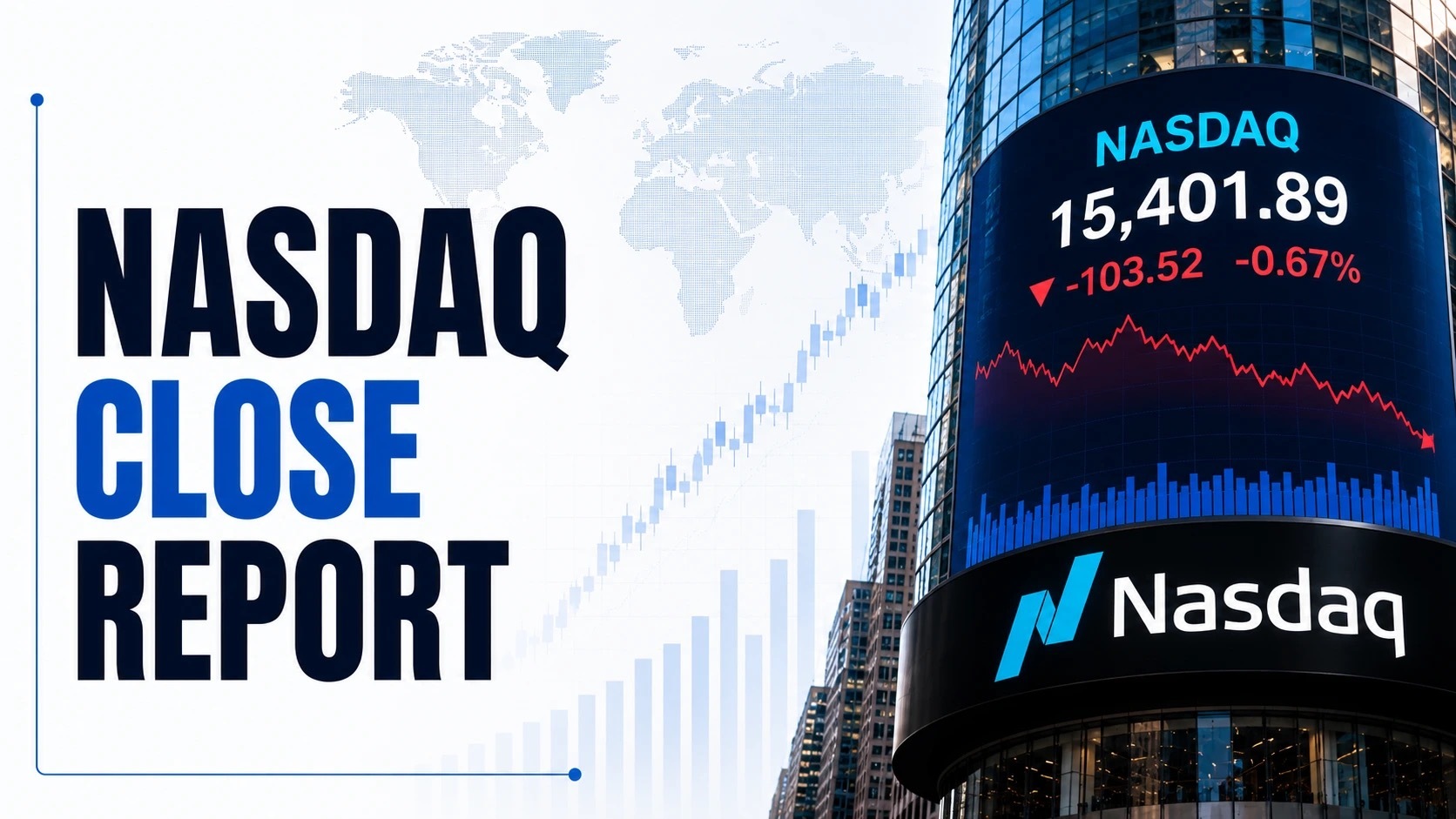
The Nasdaq Composite opened at 24,809.05 and closed at 23,879.20, a loss of 550.69 points, or 2.25%. The technology-heavy benchmark traded between 23,870.70 and 24,939.62 during the session, completing a reversal from an early gain of as much as 2% to a loss exceeding 2%.
Nvidia fell 3.57%, Broadcom lost 2.09%, and Micron Technology declined 2.22%, while AMD’s 8.15% drop weighed heavily on semiconductor sentiment. Intuit suffered the sharpest large-cap decline in the Nasdaq-100, falling 14.18%, and Shopify dropped 5.34%. PDD Holdings was a prominent gainer, rising 11.09%, and CrowdStrike added 2.71%. The index’s swing from a morning advance to a sharp afternoon decline reflected a rapid reassessment of AI-related exposure following Anthropic’s first trade.
Russell 2000 Falls 1.97% as Smaller Shares Track Broader Market Weakness
The Russell 2000 opened at 2,720.26 and closed at 2,660.85, a decline of 53.45 points, or 1.97%. The small-cap benchmark recorded an intraday high of 2,730.01 and a low of 2,658.56. Selling among smaller companies was broad, with Cushman & Wakefield falling 1.75% and BTSG losing 6.32%. Among the few gainers, GKOS rose 2.15% and SRRK added 4.94%. The index’s decline occurred alongside the wider equity selloff, as the post-Anthropic risk reduction extended beyond large-cap technology into smaller-cap segments of the market.
S&P 100 Slides as Large-Cap Shares Mirror Technology and Consumer Weakness
The S&P 100 closed at 3,635.84, down 1.57 points, or 0.04%, after trading between 3,632.98 and 3,674.58. The index had opened at 3,634.27. Movements in large-cap constituents reflected the session’s dominant trends: Amazon fell 4.06%, Alphabet declined 3.30%, and Nvidia dropped 3.56%, while Chevron gained 0.30% and Intel rose 1.56%.
The S&P 100’s relatively smaller percentage decline compared with the Nasdaq reflected its lower concentration in pure technology and semiconductor shares, but the index still closed near its intraday low as selling pressure persisted into the afternoon.
Dow Composite, Transport and Utility Indices Reflect Broad Risk Reduction
The Dow Jones Composite Average moved lower alongside the industrial benchmark, while the Dow Jones Transportation Average ended at 20,605.57, reflecting weakness across freight and logistics shares. The Dow Jones Utility Average closed at 1,119.59, a modest decline of 0.51%, as defensive sectors provided limited downside cushion.
Within transportation, CSX fell 3.41% and Union Pacific declined 3.41%, while utility names such as Duke Energy and AEP recorded smaller losses. The divergence between the transport index’s sharper decline and the utility average’s relative resilience aligned with the session’s rotation away from economically sensitive shares and toward defensive positioning.
Also Read: How to invest in US stocks
Philadelphia Semiconductor Index Dips 1.5% as AMD Short Report Weighs
The Philadelphia Semiconductor Index (SOX) fell approximately 1.5%, as chip stocks reversed earlier gains that had been driven by optimism ahead of Anthropic’s listing. AMD was the weakest major component, tumbling 8.15% after Hunterbrook Capital disclosed a short position and raised questions about the company’s China exposure.
Nvidia declined 3.57%, Broadcom lost 2.09%, and Micron fell 2.22%, while Intel gained 1.77% and Qualcomm added 1.38%. The SOX’s decline came despite Anthropic’s strong opening print, indicating that the IPO did not translate into sustained demand for the broader semiconductor group and instead coincided with profit-taking in AI-adjacent chip names.
NYSE Composite Declines as Breadth Turns Negative Across Listed Shares
The NYSE Composite ended lower, with declining issues outnumbering advancers by a ratio of approximately 4-to-1. The exchange recorded 16 new highs and 668 new lows, a breadth reading that underscored the session’s broad selling pressure. Movements in energy shares provided a modest offset, with Chevron and ConocoPhillips gaining 0.30% and 0.44% respectively, while financials and industrials recorded widespread declines.
JPMorgan Chase fell 1.20%, Goldman Sachs lost 2.94%, and Caterpillar dropped 3.99%. The NYSE’s weak breadth profile aligned with the index-level declines across the Dow, S&P 500, and Nasdaq, confirming that the selling was not confined to a single sector or market segment.
S&P MidCap 400 and SmallCap 600 Decline as Smaller Shares Follow Broad Selloff
The S&P MidCap 400 and S&P SmallCap 600 both moved lower, in line with the Russell 2000’s 1.97% decline. The mid-cap benchmark’s components reflected weakness in industrial and consumer shares, while the small-cap index’s losses were led by PACS (-7.26%), BTSG (-6.32%), and HIMS (-6.04%).
Gainers included SRRK (+4.94%) and ERAS (+4.72%). The two benchmarks’ declines occurred as the post-Anthropic selling wave extended beyond the largest technology names, though the absence of a specific mid-cap or small-cap catalyst meant their movements largely mirrored the broader market’s direction.
Anthropic’s $83 IPO and $111.50 Opening Print Drive Session’s Risk Repricing
The principal catalyst for the session was Anthropic’s initial public offering, which priced at $83 per share and opened at $111.50, a 34.3% premium, giving the company a fully diluted market capitalisation of approximately $2 trillion. The first trade was valued at approximately $12 billion, with 108 million shares changing hands. The IPO raised $81.3 billion, making it the largest US listing on record.
The stock subsequently retreated from its opening level, trading as low as $97 within the first 30 minutes, a 13% decline from the first trade that erased nearly $200 billion in market value based on implied shares outstanding. The reversal in ANT shares coincided with the broader market’s move to session lows, as investors appeared to sell existing AI-linked holdings to fund or rebalance around the new listing.
VIX Jumps 15.3% to 28.32 as Volatility Spikes on Anthropic Debut
The CBOE Volatility Index (VIX) rose 15.3% to 28.32, reaching an intraday high close to 29, its highest level since March. The index had closed the previous session at 24.56. The volatility spike occurred shortly after Anthropic began trading, as investors moved out of technology stocks and demand for downside protection increased.
The VIX’s move above 28 placed it at the upper end of its recent range and coincided with the S&P 500’s break below its 200-day moving average. The magnitude of the VIX increase—approximately 15% in a single session—reflected a rapid repricing of near-term risk following the AI IPO’s initial pop and subsequent fade.
Also Read: US Stock Market Timings
All 11 S&P 500 Sectors Close Lower as Consumer Discretionary Leads Decline
Every S&P 500 sector finished in negative territory, with consumer discretionary recording the steepest loss at 2.5%. Health care declined more than 2%, while industrials, financials, materials, communication services, utilities, technology, consumer staples, and real estate each dropped more than 1%.
Energy was the relative outperformer, falling less than 1%, supported by Chevron’s 0.30% gain. The uniformity of the sector declines indicated that selling pressure was not confined to AI or semiconductor shares but instead reflected a market-wide reduction in equity exposure following the Anthropic listing. The sector performance underscored the breadth of the risk-off move, with only energy avoiding a decline of 1% or more.
Magnificent Seven Retreat as Amazon and Alphabet Lead Large-Cap Losses
Among the Magnificent Seven, Amazon fell 4.06%, Alphabet declined 3.30%, Meta Platforms dropped 3.02%, and Nvidia lost 3.56%. Microsoft fell 1.87%, Apple declined 1.04%, and Tesla dropped 2.72%. The group’s collective weakness contributed materially to the Nasdaq Composite’s 2.25% decline and the S&P 500’s 2.02% loss. Amazon and Alphabet, both of which hold disclosed stakes in Anthropic, had initially benefited from pre-IPO enthusiasm but reversed course as the broader AI trade came under pressure. The Magnificent Seven’s losses were consistent with the session’s pattern of profit-taking in the largest technology and growth names.
Semiconductor, Financial and Energy Shares Diverge as AI Trade Reverses
Semiconductor shares ended mixed, with the Philadelphia Semiconductor Index down approximately 1.5%. AMD’s 8.15% decline and Nvidia’s 3.57% loss weighed on the group, while Intel gained 1.77% and Qualcomm added 1.38%. Financial stocks were broadly lower, with JPMorgan Chase falling 1.20%, Goldman Sachs losing 2.94%, and Morgan Stanley dropping 3.42%.
Energy shares were the session’s relative bright spot, as Chevron added 0.30% and ConocoPhillips rose 0.44%, supported by WTI crude holding above $83 per barrel. AI and growth stocks were lower, with Intuit’s 14.18% decline and Shopify’s 5.34% drop illustrating the pressure on high-multiple software and e-commerce names.
The divergence between energy’s modest gains and technology’s sharp losses highlighted the selective nature of the selling, which spared commodity-linked shares while concentrating on AI-adjacent growth names.
Jobless Claims Rise to 203,000 as Manufacturing Gauge Falls to 6.3
The latest US economic data showed initial jobless claims at 203,000 for the week ending 14 November, an increase of 1,000 from the prior period and above the consensus estimate of 197,000. Continuing claims rose 70,000 to 1.76 million. Separately, the Philadelphia Fed manufacturing index fell to 6.3 in November, down more than 14 points from October and well below the expected reading of 18.
Within the survey, the employment index rose 3 points to 11.6, while the prices received index surged 7 points to 47, its highest level since June 2022. The data releases provided a mixed picture of labour-market resilience and slowing factory activity, but they were largely overshadowed by the Anthropic IPO and the subsequent equity selloff.
Treasury Yields Slip as 10-Year Settles at 5.06% Amid Risk-Off Tone
The 2-year US Treasury yield stood at 4.79%, the 5-year yield at 4.88%, the 10-year yield at 5.06%, and the 30-year yield at 5.41%, with yields declining across the curve as investors sought the relative safety of government debt. The 10-year yield fell approximately 2 basis points, while the 30-year yield declined about 1.5 basis points. The yield curve maintained its upward slope, with the 2s10s spread at approximately 27 basis points. The decline in yields occurred alongside the equity selloff and reflected increased demand for fixed-income assets as the VIX spiked above 28. The move lower in yields provided a modest offset to the valuation pressure on growth stocks, though it was insufficient to prevent the major indices from closing sharply lower.
Also Read: What Are Fractional Shares?
Brent Holds Above $92 as WTI Settles Near $83; Gold Slumps to $3,675
Brent crude traded at $92.25 per barrel and WTI around $83.46 in one session snapshot, after front-month Brent had earlier risen 0.5% to $92.43 and WTI 0.6% to $83.74. The moves followed a prior session in which Brent fell 1.3% and WTI dropped 3.2% to its lowest since 26 August, as expectations of a supply surplus and higher US interest rates weighed on sentiment.
Reports indicated that crude shipments through the Strait of Hormuz had returned to roughly pre-war levels, reinforcing supply-surplus expectations. At the same time, attacks on shipping in the Strait of Hormuz amid the lingering Iran war provided support, and a US government report showed commercial crude stocks rose 3.4 million barrels.
Higher US interest rate expectations were also cited as a factor that could slow economic growth and demand, while strengthening the dollar and raising costs for non-US buyers of dollar-denominated crude. Concerns about escalation resurged following reports of strikes across the Gulf, including a missile hitting the PIF Tower in Riyadh’s financial district, according to reports, while Saudi Arabia has been targeted by Houthi strikes and Iran reportedly targeted a US air base in Kuwait and launched attacks on Bahrain.
Gold spot traded at $3,686.80 per troy ounce at 12:21 p.m. New York time, down $37.30, or 1%, with an ask price of $3,688.80. Gold futures for December delivery were down 1.7% at $3,675 an ounce, extending a decline that took the metal to its lowest level since September 2025. Gold was down 4.4% on the week and tracking for its second straight weekly loss and the fifth negative week in six. The VanEck Gold Miners ETF was down 1% in premarket trading.
Silver prices reversed earlier gains alongside gold, while the broader metals complex weakened as the equity selloff and a VIX spike above 28 coincided with a move into US Treasuries. The commodity moves followed the session’s risk-off tone, with gold’s decline reflecting reduced safe-haven demand relative to US Treasuries.
Dollar Index Rises to 103.83 as EUR/USD and GBP/USD Slip
The US Dollar Index (DXY) rose 0.31% to 103.83, supported by the risk-off tone and the modest decline in Treasury yields. EUR/USD traded near 1.101, while GBP/USD held around 1.27, and USD/JPY was approximately 151.50. The dollar’s advance occurred alongside the equity selloff and the VIX spike, as investors sought the relative safety of the US currency. The currency moves followed the session’s broader pattern of risk reduction, with the dollar strengthening against most major peers as the Anthropic IPO’s initial enthusiasm gave way to a market-wide decline.
The closing session was shaped by Anthropic’s $83 IPO and $111.50 opening print, which coincided with a broad equity selloff rather than a sustained AI rally. The Dow fell 2.19%, the S&P 500 lost 2.02%, and the Nasdaq dropped 2.25%, while the VIX jumped 15.3% to 28.32. Treasury yields declined, Brent held above $92, and gold slumped to $3,675. These figures provide a factual summary of the session’s key market developments.
Disclaimer
The information shared here is intended solely for informational and educational purposes and does not constitute investment recommendations. While we practice strict due diligence in curating daily market data, readers must perform independent research before trading. To flag any real-time data discrepancies or content concerns, please write to us at content@hdfcsec.com.
 Join Us
 Add as preferred source on Google


More International News


















Invest Anytime, Anywhere


By signing up I certify terms, conditions & privacy policy