Nifty 50
- Dr. Reddy's Labs₹1,229.4032.40 (2.71%)
- Apollo Hospitals₹7,775-252.50 (-3.15%)
- Bajaj Auto₹10,034256.00 (2.62%)
- ITC₹257.90-8.10 (-3.05%)
- Tata Motors PV₹284.454.55 (1.63%)
- Tech Mahindra₹1,471-43.10 (-2.85%)
- Bharat Electronics₹373.905.75 (1.56%)
- L&T₹3,627.50-75.80 (-2.05%)
- BSE₹3,330.2043.00 (1.31%)
- Max Healthcare₹865.95-17.85 (-2.02%)
- Cipla₹1,317.4016.40 (1.26%)
- Hindalco Industries₹882.50-17.85 (-1.98%)
- Eicher Motors₹7,11969.00 (0.98%)
- Hindustan Unilever₹1,820.70-36.00 (-1.94%)
- Mahindra & Mahindra₹2,81316.80 (0.60%)
- SBI₹941-18.10 (-1.89%)
- Kotak Mahindra Bank₹443.402.40 (0.54%)
- Coal India₹404.80-6.75 (-1.64%)
- HCL Technologies₹1,2236.30 (0.52%)
- Bharti Airtel₹1,778.70-26.40 (-1.46%)

- Offerings
- Tools & Platforms
Tools & Calculators
- Open API
- Calculators
- SIP Calculator
- CAGR Calculator
- Compound Interest Calculator
- FD Calculator
- RD Calculator
- EPF Calculator
- Retirement Calculator
- HDFC SIP Calculator
- Mutual Fund Return Calculator
- Lumpsum Calculator
- Step Up SIP Calculator
- ETF SIP Calculator
- Brokerage Calculator
- Equity Margin Calculator
- SWP Calculator
- EMI Calculator
- MTF Calculator
- Margin Pledge Calculator
- Algo Strategy
- Markets
Stocks
F&O
Mutual Funds
- More
India-EU Trade Pact Nears the Finish Line, Puts Spotlight on Pure Europe-Export Stocks
Authored By HDFC SKY | Last Modified: Jul 20, 2026 09:38 AM IST
Open Free Demat Account
Open Free Demat Account
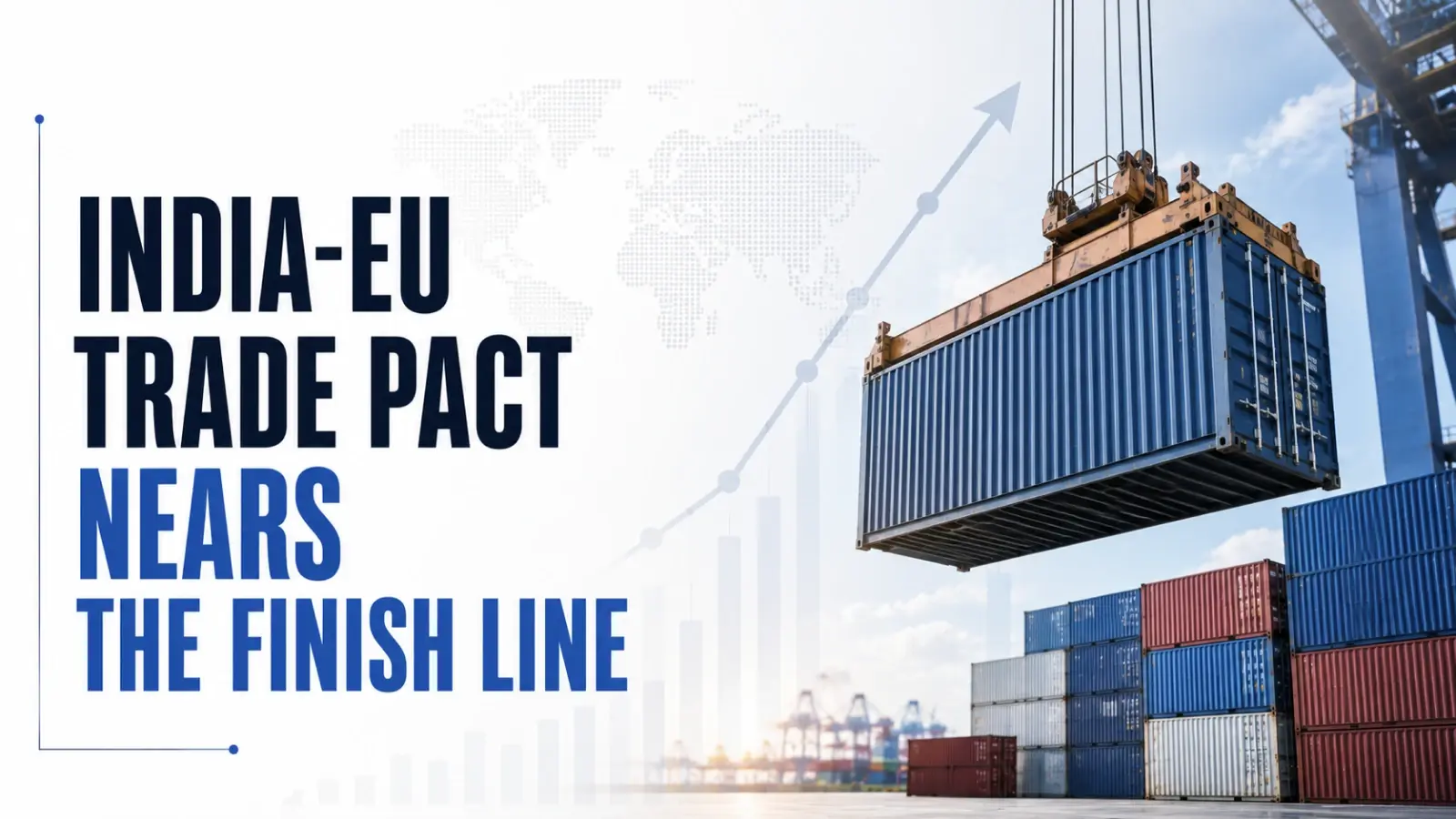
New Delhi, July 18: India and the European Union moved a step closer to sealing their long-negotiated Free Trade Agreement this week, with Commerce and Industry Minister Piyush Goyal announcing that the pact will be formally signed by the end of calendar 2026 and come into force in the first quarter of 2027.
Addressing the India-Finland Business Round Table in Helsinki on Thursday, at the tail end of a business delegation tour through Spain, Belgium and Finland, Goyal said the timeline had been firmed up during his meetings in Brussels with Maros Sefcovic, the European Union’s Commissioner for Trade and Economic Security, who has been his primary counterpart through years of negotiations.
“We have agreed to sign before the end of calendar 2026, the final legal document, and bring it into effect in the first quarter of 2027, sometime in February-March next year,” Goyal said, adding that the deal would open a wide range of opportunities for businesses on both sides.
The substantive negotiations for the 27-nation agreement were concluded earlier this year, on January 27, 2026, following a meeting between Prime Minister Narendra Modi and the President of the European Commission. Goyal had then called it the “mother of all deals,” noting it was India’s eighth Free Trade Agreement and marked a breakthrough in EU-India trade relations after two decades of on-and-off talks. He has since described the European Union as a $10-trillion market opportunity for Indian exporters, given the bloc’s combined goods and services import bill.
With the finish line now in sight, investor attention is turning to which listed Indian companies stand to benefit most directly from deeper access to the European market.

What Is a Pure EU-Export Play?
A pure EU-export play is a listed company whose revenue is meaningfully or predominantly derived from exports to the European Union specifically, rather than a broad, evenly-spread international footprint. Genuine pure plays are rare among Indian exporters, since most diversify across the US, Middle East and Asia; the closest matches typically disclose Europe as their single largest geography, even if not an outright majority.
Leather and Leather Products
Superhouse Ltd builds its leather gloves and safety footwear business around EN 345 European safety-certification standards, positioning itself specifically toward European importers. Mirza International Ltd historically built its footwear exports around European and UK brands such as Hush Puppies, Clarks and Oliver Timpson, though its EU-specific revenue share isn’t separately disclosed.
Iron and Steel
Tata Steel Ltd once earned the majority of its revenue from European operations following the 2007 Corus acquisition. That exposure was primarily UK-based, however, and with Britain no longer part of the EU post-Brexit, it no longer counts as a clean EU play.
Auto Components
Samvardhana Motherson International Ltd owns several European auto-component makers, including Germany’s SMR, Finland’s PKC and France’s Reydel, giving it one of the highest European revenue concentrations among Indian auto-component exporters, though its global diversification across Asia and the Americas keeps it short of a majority-EU play.
Marine Products
Apex Frozen Foods Ltd drew 39 per cent of FY25 revenue from the EU, its fastest-growing market as it diversifies away from the US amid tariff pressure. Avanti Feeds Ltd drew a smaller 17.4 per cent from the EU, though exposure is rising after the bloc cleared 102 additional Indian marine-product units for export in September 2025.
Rubber and Plastic Products
Balkrishna Industries Ltd (BKT) stands out as the strongest genuine match on this list. Europe alone reportedly accounts for roughly 42-50 per cent of its revenue, making it India’s closest equivalent to a true pure-EU export play; the company exports about 80 per cent of its off-highway tyre production overall, with Europe its single largest market, ahead of India and North America.
None of these names are pure plays in the strictest sense, and all carry currency, tariff and demand risks tied to European growth. As the FTA moves from concluded text to signed treaty over the coming months, tariff reductions could sharpen these companies’ EU dependence further, for better or worse.
Disclaimer
If you have any concerns, questions, or wish to point out any discrepancies in our content, please feel free to write to us at content@hdfcsec.com.
Please Note: The information shared is intended solely for informational purposes and does not make any investment recommendations
Disclaimer
At HDFC SKY*, we take utmost care and due diligence in curating and presenting news and market-related content. However, inadvertent errors or omissions may occasionally occur.
If you have any concerns, questions, or wish to point out any discrepancies in our content, please feel free to write to us at content@hdfcsec.com.
Please Note: The information shared is intended solely for informational purposes and does not make any investment recommendations.
HDFC SKY from HDFC Securities, one of most trusted trading platforms in India, has been recognized with the *Next-Gen Digi Content Awards 2025-26.
 Join Us
 Add as preferred source on Google


More Business News





Open Free Demat Account
Open Free Demat Account











Invest Anytime, Anywhere


By signing up I certify terms, conditions & privacy policy