Nifty 50
- Dr. Reddy's Labs₹1,229.4032.40 (2.71%)
- Apollo Hospitals₹7,775-252.50 (-3.15%)
- Bajaj Auto₹10,034256.00 (2.62%)
- ITC₹257.90-8.10 (-3.05%)
- Tata Motors PV₹284.454.55 (1.63%)
- Tech Mahindra₹1,471-43.10 (-2.85%)
- Bharat Electronics₹373.905.75 (1.56%)
- L&T₹3,627.50-75.80 (-2.05%)
- BSE₹3,330.2043.00 (1.31%)
- Max Healthcare₹865.95-17.85 (-2.02%)
- Cipla₹1,317.4016.40 (1.26%)
- Hindalco Industries₹882.50-17.85 (-1.98%)
- Eicher Motors₹7,11969.00 (0.98%)
- Hindustan Unilever₹1,820.70-36.00 (-1.94%)
- Mahindra & Mahindra₹2,81316.80 (0.60%)
- SBI₹941-18.10 (-1.89%)
- Kotak Mahindra Bank₹443.402.40 (0.54%)
- Coal India₹404.80-6.75 (-1.64%)
- HCL Technologies₹1,2236.30 (0.52%)
- Bharti Airtel₹1,778.70-26.40 (-1.46%)

- Offerings
- Tools & Platforms
Tools & Calculators
- Open API
- Calculators
- SIP Calculator
- CAGR Calculator
- Compound Interest Calculator
- FD Calculator
- RD Calculator
- EPF Calculator
- Retirement Calculator
- HDFC SIP Calculator
- Mutual Fund Return Calculator
- Lumpsum Calculator
- Step Up SIP Calculator
- ETF SIP Calculator
- Brokerage Calculator
- Equity Margin Calculator
- SWP Calculator
- EMI Calculator
- MTF Calculator
- Margin Pledge Calculator
- Algo Strategy
- Markets
Stocks
F&O
Mutual Funds
- More
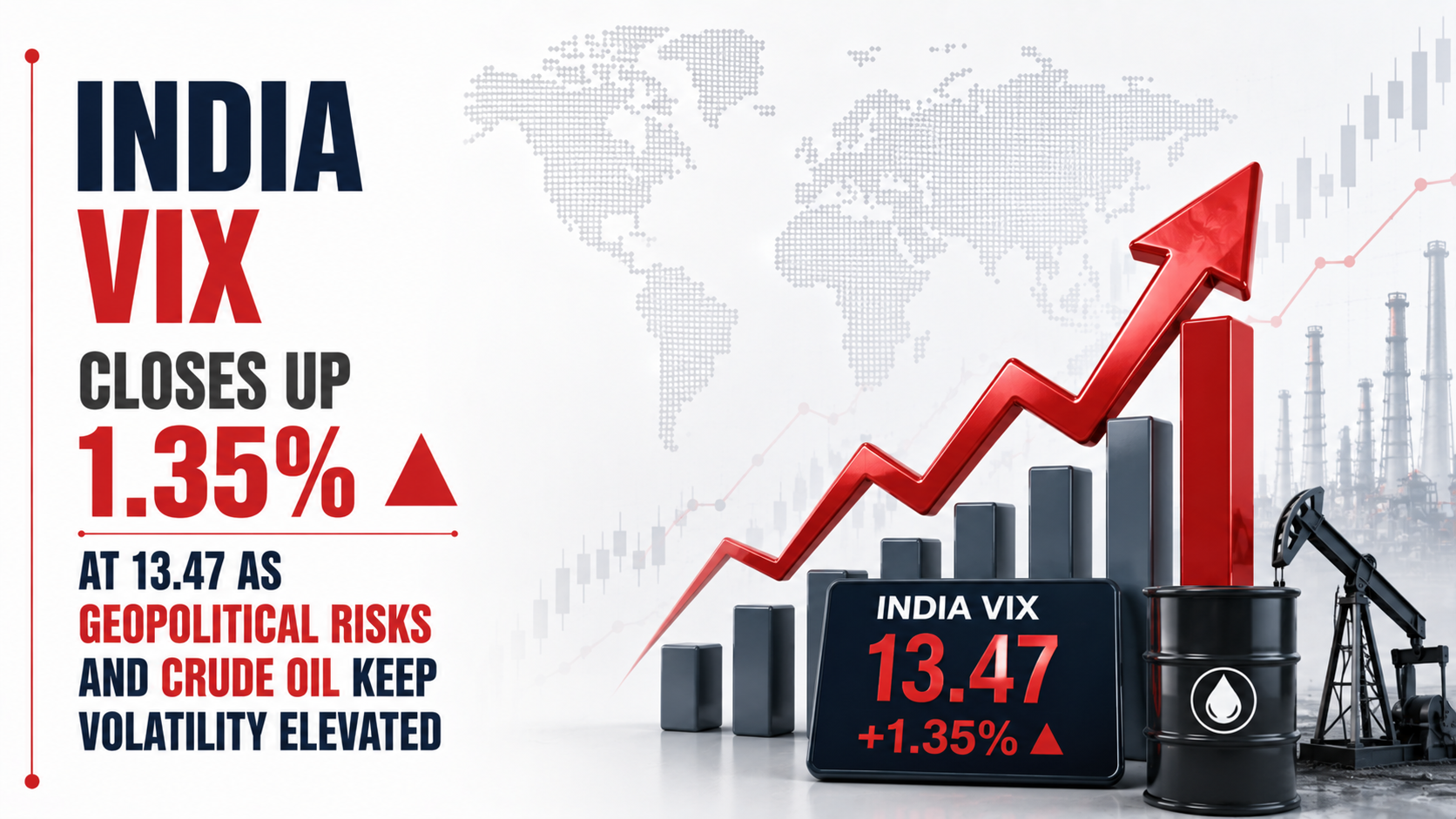
India VIX Closes Up 1.35% at 13.47 as Geopolitical Risks and Crude Oil Keep Volatility Elevated
Authored By HDFC SKY | Last Modified: Jul 23, 2026 04:31 PM IST
Open Free Demat Account
Open Free Demat Account
Mumbai, July 23: India VIX ended the trading session on Thursday at 13.47, up 0.18 points (1.35%), reflecting continued market volatility amid geopolitical developments in West Asia, elevated crude oil prices and the ongoing Q1 FY27 corporate earnings season. Although the volatility index remained well below the panic levels witnessed earlier in March 2026, it stayed significantly above the subdued readings seen at the beginning of the month, indicating that uncertainty continued to influence trading conditions.
The volatility index opened at 13.29, the same as the previous close, moved between an intraday low of 12.91 and a high of 13.74, before settling at 13.47. Its 52-week range remained between 8.72 and 28.90, while its year-to-date return stood at 42.09%. Technical indicators continued to classify the trend as Neutral, with the daily pivot point at 12.81, resistance levels at 13.90, 14.51 and 15.60, and support levels at 12.20, 11.11 and 10.50.

India VIX Ends Above 13 After Trading Between 12.91 and 13.74
The latest session extended the elevated volatility witnessed during the previous trading day, although intraday movements were less pronounced. India VIX briefly eased during the morning after touching its session high before recovering during afternoon trade and finishing higher than the previous close.
The index had surged sharply on 22 July 2026, rising by around 5% to 5.6% and closing near 13.29, following a broad decline in domestic equities. Against that backdrop, Thursday’s close at 13.47 indicated that volatility remained elevated despite some moderation in intraday swings. The movement suggested that traders continued pricing in relatively larger fluctuations in benchmark indices over the coming month compared with the calmer conditions recorded earlier in July.
Iran Conflict and $95 Oil Sustain Higher Volatility Levels
The principal drivers behind the elevated India VIX remained external developments affecting global financial markets. Fresh geopolitical tensions involving Iran and the broader West Asia region continued to dominate market attention following reports of renewed military action and attacks affecting energy supply routes in the Red Sea.
At the same time, Brent crude oil traded above $95 per barrel, reaching a five-week high. As India remains one of the world’s largest crude importers, higher oil prices renewed concerns surrounding imported inflation, corporate operating costs and broader macroeconomic conditions. These developments also increased hedging activity in the derivatives market, contributing to firmer option premiums and supporting higher volatility readings.
Global market conditions also remained cautious amid weaker overseas cues, continued uncertainty surrounding international trade policies and persistent foreign institutional outflows. Alongside these developments, the ongoing Q1 FY27 earnings season continued to add stock-specific uncertainty across sectors, contributing to wider day-to-day market movements.
Benchmark Indices Extend Losses Despite Partial Recovery
The rise in India VIX coincided with another weak trading session for domestic equity benchmarks. During the day, the Sensex traded around 76,304.93, declining approximately 0.59%, or about 450 points, while the Nifty 50 traded near 23,829.60, down around 0.69%, extending its losing streak to a fourth consecutive session.
The Nifty Bank index declined 1.22%, reflecting continued weakness across financial stocks. Sector-specific pressure was particularly visible in banking, financial services and real estate, with the Nifty Realty Index falling 1.88% during the session. The Nifty PSU Bank Index also extended losses for a third straight trading day, taking its cumulative decline over the period to 3.49%.
Despite the broader weakness, both benchmark indices recovered more than 300 points from their intraday lows before the market closed. The rebound came alongside stronger performances across several Asian markets, while the Indian rupee also recovered modestly during the session, appreciating by 5 paise to 96.48 against the US dollar after touching a two-month low earlier.
Technical Levels Highlight Key Support and Resistance Zones
Technical indicators continued to point towards a neutral near-term trend for India VIX. The exchange’s technical rating remained Neutral, while the daily pivot point stood at 12.81 under the classical calculation method.
For the session, the classical resistance levels were placed at 13.90, 14.51 and 15.60, while support levels were identified at 12.20, 11.11 and 10.50. Fibonacci pivot calculations showed resistance levels at 13.46, 13.86 and 14.51, with corresponding supports at 12.16, 11.76 and 11.11. Camarilla calculations indicated resistance levels at 13.45, 13.60 and 13.76, while supports were placed at 13.13, 12.98 and 12.82.
In the derivatives market, option positioning continued to identify the 24,000 level as a significant zone, with the highest open interest recorded for both call and put options at that strike price. The Nifty futures contract for the 28 July expiry traded at 23,930.60, representing a premium of 45.15 points over the spot index.
Seasonality Shows July Usually Records Negative Returns
Historical data continued to highlight July as a relatively weaker month for India VIX. According to the seasonality analysis, the volatility index has delivered negative returns in 15 out of the past 18 years during July.
The highest positive July movement recorded was 7.39% in 2011, while the strongest decline reached 24.22% in 2022. The average positive July gain stands at 4.47%, whereas the average negative decline is 10.72%, resulting in an overall average July change of -8.19%. Despite the month’s historical tendency towards weaker performance, India VIX has generated a 42.09% year-to-date return, reflecting the heightened volatility experienced during several episodes in 2026, including the sharp spikes recorded in March, late March and June.
India VIX closed at 13.47, up 1.35%, remaining above recent lows following the previous day’s sharp rise. Geopolitical developments, crude oil prices above $95 per barrel, foreign fund outflows and the ongoing Q1 FY27 earnings season continued to shape market volatility, while the index remained well below the significantly higher levels recorded during March 2026.
Top of Form
Bottom of Form
Source
- https://www.nseindia.com/reports-indices-historical-vix
Disclaimer
If you have any concerns, questions, or wish to point out any discrepancies in our content, please feel free to write to us at content@hdfcsec.com.
Please Note: The information shared is intended solely for informational purposes and does not make any investment recommendations
Disclaimer
At HDFC SKY*, we take utmost care and due diligence in curating and presenting news and market-related content. However, inadvertent errors or omissions may occasionally occur.
If you have any concerns, questions, or wish to point out any discrepancies in our content, please feel free to write to us at content@hdfcsec.com.
Please Note: The information shared is intended solely for informational purposes and does not make any investment recommendations.
HDFC SKY from HDFC Securities, one of most trusted trading platforms in India, has been recognized with the *Next-Gen Digi Content Awards 2025-26.
 Join Us
 Add as preferred source on Google


More Business News










Open Free Demat Account
Open Free Demat Account












Invest Anytime, Anywhere


By signing up I certify terms, conditions & privacy policy