Nifty 50
- Tata Consumer ₹986.4049.90 (5.33%)
- Hindustan Unilever₹1,766-52.60 (-2.89%)
- Trent₹2,81561.00 (2.21%)
- Infosys₹1,140.50-25.50 (-2.19%)
- Bharat Electronics₹3718.00 (2.20%)
- TCS₹2,480.60-54.40 (-2.15%)
- Bharti Airtel₹1,958.8041.30 (2.15%)
- HCL Technologies₹1,400-17.00 (-1.20%)
- Maruti Suzuki₹11,411191.00 (1.70%)
- Grasim Industries₹2,915-35.00 (-1.19%)
- BSE₹3,41455.00 (1.64%)
- Asian Paints₹2,298-24.00 (-1.03%)
- Bajaj Auto₹10,226155.00 (1.54%)
- Tech Mahindra₹1,776.50-18.50 (-1.03%)
- Power Grid Corp₹250.803.80 (1.54%)
- Reliance Industries₹1,191.40-10.40 (-0.87%)
- Max Healthcare₹847.6512.65 (1.51%)
- Adani Enterprises₹2,486.50-21.50 (-0.86%)
- Shriram Finance₹836.2511.25 (1.36%)
- UltraTech Cement₹11,086-94.00 (-0.84%)

- Offerings
- Tools & Platforms
Tools & Calculators
- Open API
- Calculators
- SIP Calculator
- CAGR Calculator
- Compound Interest Calculator
- FD Calculator
- RD Calculator
- EPF Calculator
- Retirement Calculator
- HDFC SIP Calculator
- Mutual Fund Return Calculator
- Lumpsum Calculator
- Step Up SIP Calculator
- ETF SIP Calculator
- Brokerage Calculator
- Equity Margin Calculator
- SWP Calculator
- EMI Calculator
- MTF Calculator
- Margin Pledge Calculator
- Algo Strategy
- Markets
Stocks
F&O
Mutual Funds
- More
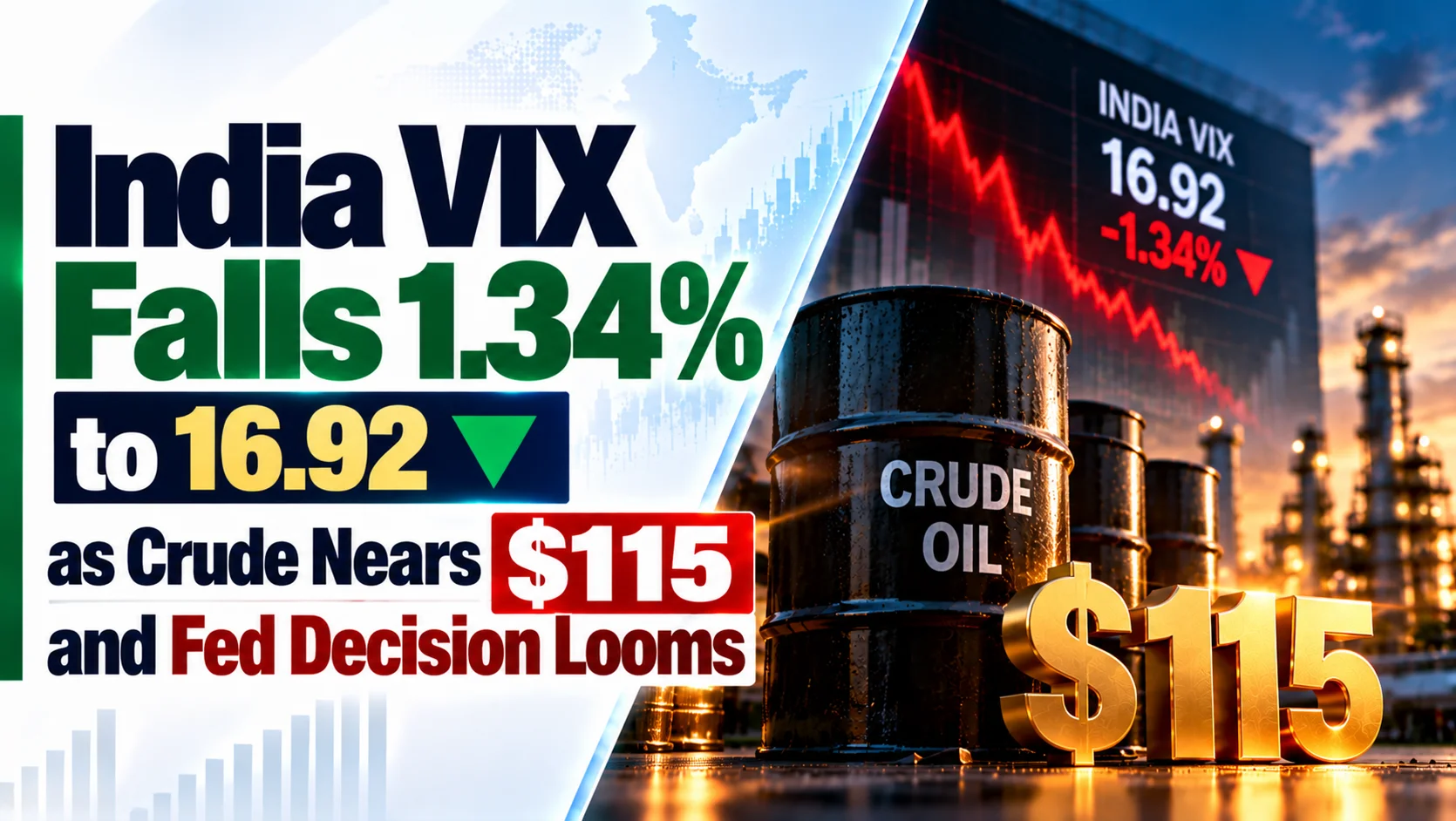
India VIX Falls 1.34% to 16.92 as Crude Nears $115 and Fed Decision Looms
Authored By HDFC SKY | Published at: Oct 27, 2026 10:20 AM IST
Open Free Demat Account
Open Free Demat Account
Mumbai, 27 October 2026: India VIX stood at 16.92, down 0.23 points or 1.34%, at 10:08 am IST, even as elevated crude oil prices, continuing Middle East tensions and uncertainty ahead of the US Federal Reserve’s policy decision shaped the Indian market’s opening session. The Nifty 50 opened at 22,708.8, down 0.20%, while the Sensex began trading at 73,484.38, lower by 0.17%. Brent crude was near $115 per barrel, close to a six-month high, adding to concerns about India’s import costs and the wider economic outlook.

India VIX At 16.92 as Markets Open Lower
India VIX was quoted at 16.92 at 10:08 am, declining by 0.23 points or 1.34%. The index opened at 17.16, matching its previous close of 17.16, before touching an early-session high of 17.48 and a low of 16.87. Its reported 52-week range stood between 8.72 and 28.90.
The index’s early movement came as domestic equities opened marginally lower. The Nifty 50 started at 22,708.8, down 0.20%, while the Sensex opened at 73,484.38, declining 0.17%. However, the opening weakness was not uniform across the market. Eight of the 16 major sectors traded lower, while small-cap stocks gained 0.5% and mid-cap stocks rose 0.1%.
India VIX measures the volatility implied by Nifty options prices, reflecting expectations of potential market fluctuations over the near term. It does not simply track whether the Nifty rises or falls. The available figures establish that India VIX declined during the reported early session, although the exact opening-minute changes in options-implied volatility were not independently established.
Brent Near $115 as Saudi Risks Sustain Oil Concerns
Brent crude traded near $115 per barrel around the Indian market opening, close to its highest level in six months. Continuing geopolitical tensions involving Saudi Arabia remained a significant part of the international backdrop, with reports describing attacks attributed to Yemen’s Iran-aligned Houthis on Saudi oil-pipeline pumping stations and Riyadh airport. Saudi Arabia also reported intercepting missiles and drones.
The developments kept attention on the possibility of disruptions to oil supplies. India’s substantial dependence on imported crude makes international oil prices relevant to domestic inflation, the current account, currency movements and business costs. Industries including aviation, paints, chemicals, transport and consumer-facing businesses can also be affected by changes in energy costs.
Oil-market signals were not entirely one-sided. Separate reporting pointed to prices edging lower on renewed diplomatic hopes, even as continuing attacks sustained supply concerns and Brent remained near elevated levels. The competing developments meant that the crude market was responding both to the possibility of diplomatic progress and to continuing geopolitical risks.
For India VIX, the oil-related backdrop was relevant because uncertainty surrounding supply, inflation and the domestic economic outlook formed part of the risks present at the opening. However, the available information does not establish that any single geopolitical headline directly caused the index’s movement to 16.92.
Fed Decision on 28 October Keeps Global Uncertainty Elevated
The US Federal Reserve’s policy decision, scheduled for 28 October 2026, remained an important event ahead of the Indian market opening on Tuesday. The decision had not yet been announced during the session covered by the available information. Expectations were that the central bank would leave interest rates unchanged, although the possibility of further policy tightening in December remained a concern.
The pending decision placed attention on US Treasury yields, the dollar and the potential implications for emerging-market currencies and equity valuations. Changes in expectations about US monetary policy can affect global borrowing costs and the relative attractiveness of financial assets across markets.
For Indian equities, these developments were relevant alongside existing pressure on the rupee and elevated crude prices. The approaching announcement also represented an upcoming event around which market participants could reassess the potential range of index movements. Nevertheless, no specific change in Nifty options pricing attributable to the Federal Reserve announcement was established for the opening minutes of 27 October.
Also Read: Jio Platforms IPO Shares Allotted; To List on BSE, NSE on October 28; Check Key Details
Asian Markets Send Mixed Signals as Indian Equities Decline
International equity indicators provided a mixed picture during the morning. One pre-market assessment showed Asia-Pacific equities down by approximately 0.47% on average, with weakness in Japan, South Korea and Taiwan. US index futures were also modestly negative in that snapshot.
Other reports described Asian markets as mostly higher following gains on Wall Street. These differences highlighted that regional performance varied according to the market and observation time, rather than reflecting a uniform global sell-off.
The contrasting signals formed part of the environment in which Indian equities began trading lower. Regional weakness could contribute to caution, while stronger markets elsewhere offered a counterpoint. The available reports did not establish a single global-market development as the direct cause of the early movement in India VIX.
Uncertainty surrounding major US technology-company earnings also remained in the background. Investors were monitoring questions about artificial intelligence investment costs, profitability and borrowing expenses ahead of results expected later in the week. These issues were relevant to global technology valuations, although no specific technology-sector shock during India’s opening minutes was established.
Monthly Derivatives Expiry Adds Another Layer of Market Activity
Monthly derivatives expiry was another focus for the 27 October trading session, with Nifty and Bank Nifty contracts among the instruments under observation. Expiry can involve the closing or rolling over of positions, changes in hedging requirements and adjustments to options pricing as underlying index levels move.
Such activity can influence India VIX because the index is derived from Nifty options prices. Changes in demand for calls and puts, alongside market-makers’ hedging adjustments, can affect implied volatility. The direction of the effect depends on the composition of positions and the balance between demand for protection and other options activity.
However, expiry does not automatically cause India VIX to rise. The removal of expiring contracts, time decay and changes in demand can affect options prices in different directions. No verified option-chain snapshots were available to establish whether put buying, call writing or dealer hedging increased implied volatility during the opening session.
The previous trading session had ended with a recovery following an early sell-off, but the domestic benchmarks opened lower on Tuesday. The combination of the new session’s price movements and derivatives activity provided relevant market context without establishing a direct causal link to the index’s early decline.
Rupee Below ₹95 and Earnings Add Domestic Market Context
The rupee’s recent weakness remained another consideration on 27 October. Reports described the currency falling below ₹95 per US dollar on Monday, 26 October, with elevated oil prices and foreign capital outflows identified as contributing factors. This was a carryover development rather than a verified new currency shock at Tuesday’s opening.
Currency weakness can affect the domestic economic outlook through imported inflation, particularly when crude prices are high. It can also influence assessments of foreign investment flows and the cost of imports. However, the available information did not establish that fresh foreign selling during the opening minutes caused a specific movement in India VIX.
Corporate earnings provided a separate, stock-specific development. Tata Consumer Products gained approximately 3% after reporting better-than-expected second-quarter profits. The broader market was also monitoring company results across several sectors.
Individual earnings announcements can affect the pricing of stock options, while substantial movements in heavyweight Nifty constituents can influence index options. The index-level effect depends on factors including constituent weights and relationships between stocks. The gain in Tata Consumer Products was a company-specific development and did not, by itself, establish a broad change in market risk.
India VIX Technical Levels Show 16.68 Support and 17.82 Resistance
India VIX’s daily technical rating was Neutral. The reported pivot point stood at 17.34, with the day’s calculated support and resistance levels offering additional reference points for tracking the index’s trading range.
Under the classic calculation, resistance levels were 17.82, 18.48 and 18.96, while support levels were 16.68, 16.20 and 15.54. The Fibonacci calculation placed resistance at 17.78, 18.04 and 18.48, with support at 16.90, 16.64 and 16.20.
The Camarilla method showed resistance at 17.26, 17.37 and 17.47, while support levels stood at 17.06, 16.95 and 16.85. These levels were calculated using the previous trading day’s price range and represent technical reference points rather than confirmed future trading levels.
Historical seasonality data showed that India VIX recorded positive October returns in 9 out of 18 years. October’s maximum positive change was 26.73% in 2020, while the average positive change was 13.54%. The maximum negative change was 30.99% in 2013, with an average negative change of 13.66%. The reported average October change was -0.06%.
As of 10:08 am IST on 27 October 2026, India VIX stood at 16.92, down 1.34% from its previous close. Brent crude near $115 per barrel, the pending Federal Reserve decision and mixed global market conditions defined the opening backdrop. The exact opening-minute options data remained unverified, limiting precise attribution of the index’s movement.
Disclaimer
The information shared here is intended solely for informational and educational purposes and does not constitute investment recommendations. While we practice strict due diligence in curating daily market data, readers must perform independent research before trading. To flag any real-time data discrepancies or content concerns, please write to us at content@hdfcsec.com.
 Join Us
 Add as preferred source on Google


More Markets News










Open Free Demat Account
Open Free Demat Account












Invest Anytime, Anywhere


By signing up I certify terms, conditions & privacy policy