Nifty 50
- Bajaj Auto₹9,994216.00 (2.21%)
- Tech Mahindra₹1,482.20-31.90 (-2.11%)
- Bharat Electronics₹374.606.45 (1.75%)
- Hindalco Industries₹896.70-3.65 (-0.41%)
- Asian Paints₹2,370.9031.80 (1.36%)
- ITC₹265.05-0.95 (-0.36%)
- Jio Financial ₹217.502.88 (1.34%)
- Axis Bank₹1,254.70-4.40 (-0.35%)
- TCS₹2,18327.00 (1.25%)
- Bharti Airtel₹1,801.90-3.20 (-0.18%)
- Trent₹2,95435.80 (1.23%)
- SBI₹958.20-0.90 (-0.09%)
- Reliance Industries₹1,183.3013.00 (1.11%)
- Mahindra & Mahindra₹2,826.9030.70 (1.10%)
- Adani Enterprises₹2,661.9027.50 (1.04%)
- HCL Technologies₹1,229.3012.60 (1.04%)

- Offerings
- Tools & Platforms
Tools & Calculators
- Open API
- Calculators
- SIP Calculator
- CAGR Calculator
- Compound Interest Calculator
- FD Calculator
- RD Calculator
- EPF Calculator
- Retirement Calculator
- HDFC SIP Calculator
- Mutual Fund Return Calculator
- Lumpsum Calculator
- Step Up SIP Calculator
- ETF SIP Calculator
- Brokerage Calculator
- Equity Margin Calculator
- SWP Calculator
- EMI Calculator
- MTF Calculator
- Margin Pledge Calculator
- Algo Strategy
- Markets
Stocks
F&O
Mutual Funds
- More
India VIX Holds at 11.29 as Oil, Rupee and West Asia Risks Persist
Authored By HDFC SKY | Last Modified: Aug 17, 2026 04:51 PM IST
Open Free Demat Account
Open Free Demat Account
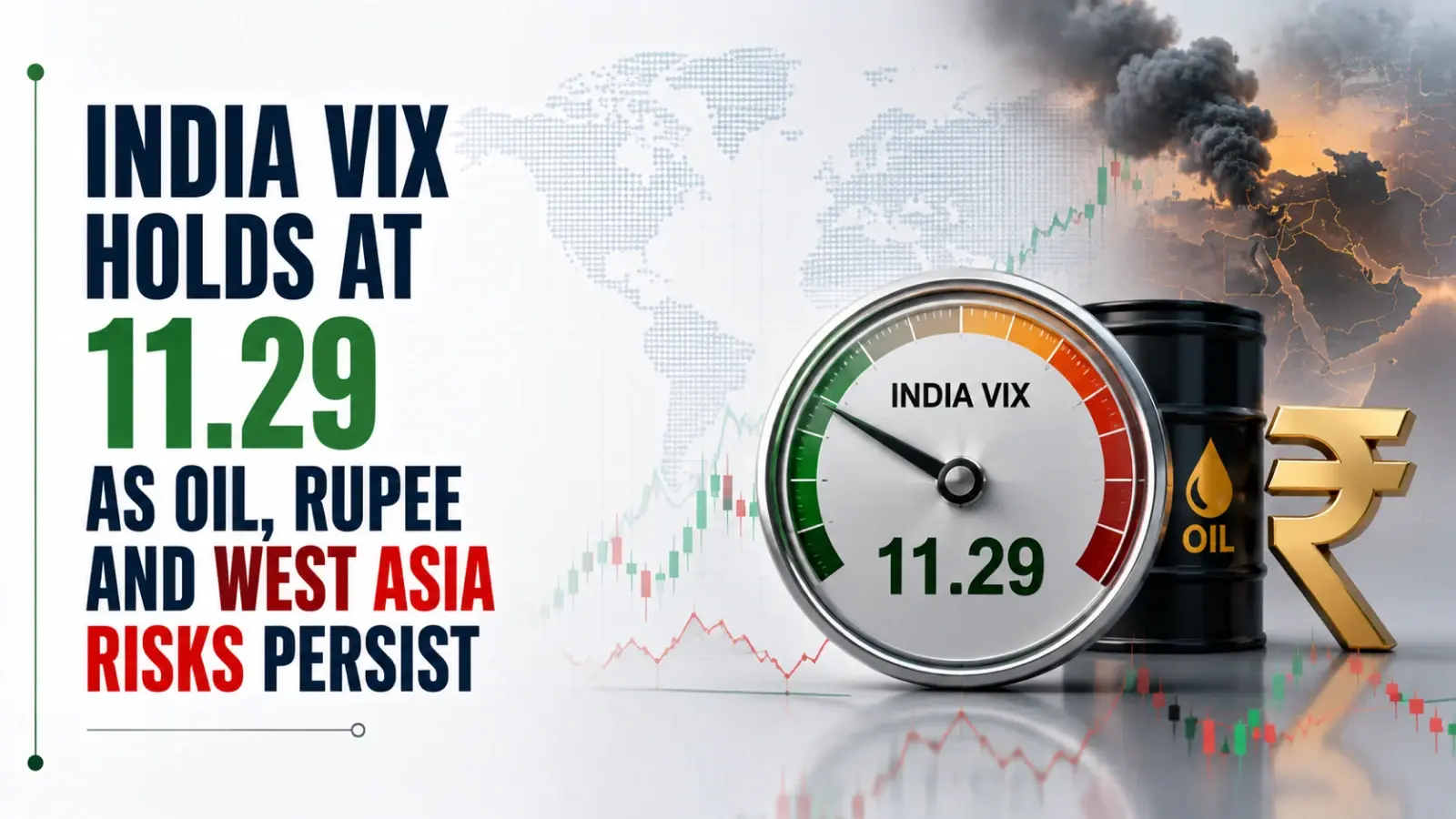
Mumbai, Aug 17: India VIX ended Monday’s session at 11.29, almost unchanged from Friday’s close of 11.31, even as geopolitical tensions, elevated crude oil prices and rupee weakness continued to weigh on Indian equities. During the session, the volatility index moved between 11.09 and 11.77, highlighting a contained trading range despite several external and domestic risk factors.

India VIX At 11.29 Stays Near the Lower End
India VIX opened at 11.30 on Monday, compared with the previous close of 11.31, before touching a day high of 11.77 and a low of 11.09. The index ultimately closed at 11.29, a marginal decline of 0.01 points or 0.09%.
The latest level remains well below its 52-week high of 28.90, while the 52-week low stands at 8.72. The technical rating remains NEUTRAL. Classic pivot levels for the session placed resistance at 11.64, 11.97 and 12.38, with support at 10.90, 10.49 and 10.16, while the pivot point was 11.23.
11.31 to 11.29 Shows Continued Volatility Compression
The recent trajectory indicates that India VIX has been moving lower after a brief rise earlier in August. It closed at 12.16 on August 7 and increased to 12.25 on August 10. It then declined to 11.86 on August 11, 11.69 on August 12, 11.42 on August 13 and 11.31 on August 14.
Monday’s 11.29 close therefore extends the period of subdued volatility. From 12.25 on August 10 to 11.29 on August 17, India VIX has declined by nearly one point, even though the market continues to face geopolitical, currency and crude-related uncertainties.
$88–89 Crude Keeps West Asia Risk in Focus
Continuing tensions involving the US and Iran remained a major external factor for Indian markets on Monday. Brent crude was around $88–89 a barrel, keeping the potential impact of higher energy costs on the Indian economy in focus.
The Strait of Hormuz remains particularly important because developments affecting oil supply can influence India’s import bill, inflation, the rupee and corporate costs. Higher crude prices therefore remain a potential source of volatility for Indian equities and, consequently, India VIX.
However, Monday’s data shows that elevated crude prices have not translated into a corresponding spike in implied volatility. India VIX remained close to 11.3, indicating that the existing geopolitical and oil risks have not produced a sharp repricing of expected near-term market volatility.
₹95.60 Rupee Weakness Adds Another Risk Channel
The rupee weakened to around ₹95.60 per US dollar on Monday, its weakest level in approximately two weeks. Currency weakness is relevant to India VIX because a weaker rupee can increase the domestic impact of elevated crude prices and influence foreign capital flows.
The Reserve Bank of India (RBI) has also been intervening in the foreign-exchange market. State-owned banks have been selling dollars at various levels, apparently on behalf of the RBI, helping contain excessive currency volatility.
This creates two opposing forces. Higher crude and rupee weakness can add to market uncertainty, while RBI intervention can limit the extent of currency volatility. The combination has so far coincided with India VIX remaining close to 11.29 rather than moving sharply higher.
RBI FX-Swap Change Adds Fresh Currency Uncertainty
The RBI unexpectedly shortened the deadline for its discounted foreign-exchange swap facility for non-resident deposits on Monday, adding another development to the currency market.
The facility had attracted more than $50 billion in inflows in under two months, while India’s foreign-exchange reserves moved above $700 billion. The change indicates that the RBI has become more comfortable with the reserve position and has curtailed the programme earlier than initially expected.
The development adds another layer of uncertainty around the rupee, although it has not resulted in a significant India VIX move during Monday’s session.
5.25% Repo Rate Keeps August Policy Risk Contained
The RBI’s August monetary policy decision has already removed one major scheduled source of uncertainty. On August 5, 2026, the central bank retained the repo rate at 5.25% and maintained a neutral stance. It also raised its FY27 gross domestic product growth projection to 6.7% and lowered its inflation forecast to around 5.0%.
India VIX closed at approximately 12.01 on August 5, down 3.12%, following the policy decision. With the decision now behind the market, attention has shifted towards the August 19 release of the RBI’s policy minutes.
August 19 RBI Minutes Add the Next Policy Trigger
The RBI policy minutes scheduled for August 19 are among the key upcoming events that could influence rates, the rupee and equity-market volatility.
The minutes will provide further detail on the considerations behind the August policy decision. Alongside the RBI minutes, markets are also watching the Federal Open Market Committee (FOMC) minutes, US weekly jobs data, Chinese economic releases and flash purchasing managers’ indices (PMIs).
These events can influence global interest-rate expectations, currency movements and cross-border capital flows, creating potential channels for changes in India VIX.
Q1 FY27 Earnings Uncertainty is Gradually Easing
The Q1 FY27 earnings season is also moving towards completion, reducing one source of company-specific event risk. Market attention has focused on earnings, margins, raw-material costs, crude prices, information technology performance and financial-sector results.
Although individual stocks continue to experience sharp movements following company-specific developments, the aggregate impact on India VIX has remained limited. This distinction is important because India VIX reflects expected volatility for the broader Nifty market rather than the movement of every individual stock.
IT Weakness Adds Pressure Without a VIX Breakout
The information technology sector was under pressure on Monday, with the Nifty IT index falling around 2%. TCS, Infosys and Mphasis were among the stocks weighing on the sector.
Other stocks also recorded company-specific moves. Orchid Pharma declined following weak profits, while Dr Reddy’s Laboratories fell amid regulatory concerns. Ahluwalia Contracts, Borosil and Jupiter Wagons were also pressured by quarterly results, while PTC Industries and Hindustan Aeronautics moved higher on company-specific developments.
Despite these individual-stock movements, India VIX remained near 11.29, showing no comparable breakout in broader expected volatility.
3 August Closing Auction Changes Market Structure
The new Closing Auction Session (CAS) for eligible F&O stocks began on August 3, 2026, introducing a change to closing-price formation. The mechanism can influence final-minute liquidity, closing prices and trading behaviour around the end of the session.
The new structure is therefore an additional consideration when interpreting closing movements and volatility during August. It represents a market-structure change rather than a direct geopolitical or macroeconomic trigger for India VIX.
20–25% Lower F&O Activity Changes Volatility Dynamics
Stricter RBI margin and funding requirements have also altered derivatives-market conditions. F&O volumes fell around 20–25% in the early July sessions, as tighter requirements affected proprietary trading activity and increased collateral requirements.
The Securities and Exchange Board of India (SEBI) has also implemented wider derivatives-market reforms, while the higher Securities Transaction Tax (STT) introduced from April 2026 has increased trading costs. Government data showed that retail investor losses in equity derivatives declined nearly 18% to ₹91,685 crore in FY26, while the number of individual derivatives traders fell nearly 20% to 7.86 million.
These changes have reduced speculative derivatives participation and altered the structure of options-market activity.
August Seasonality Shows a 10.23% Average Gain
Historical data provides a contrasting backdrop. India VIX has recorded positive returns in 12 of 18 days in August. The month’s maximum positive change was 68.84% in 2015, while the average positive change was 18.10%. The maximum negative change was -11.26% in 2016, with an average negative change of -5.52%. The historical average August change stands at 10.23%.
The figures show that August has historically produced varied volatility outcomes.
11.29 VIX Shows Risk Without a Panic Signal
Monday’s closing data presents a clear contrast: crude remained around $88–89, the rupee weakened towards ₹95.60, West Asia tensions persisted and Indian equities remained under pressure, yet India VIX closed at only 11.29.
The immediate picture is therefore one of contained expected volatility despite continuing macroeconomic and geopolitical risks. The principal developments being monitored include the Strait of Hormuz, crude prices, the rupee, FII flows, RBI policy minutes, FOMC minutes, US jobs data, Chinese economic releases and the remaining earnings calendar.
India VIX closed at 11.29 on August 17, remaining close to the lower portion of its 52-week range despite crude near $88–89, rupee weakness and continuing West Asia tensions. Upcoming RBI and FOMC minutes, US jobs data, Chinese releases, crude movements and currency developments remain key events for monitoring volatility conditions.
Source
- https://www.nseindia.com/reports-indices-historical-vix
Disclaimer
If you have any concerns, questions, or wish to point out any discrepancies in our content, please feel free to write to us at content@hdfcsec.com.
Please Note: The information shared is intended solely for informational purposes and does not make any investment recommendations
Disclaimer
At HDFC SKY*, we take utmost care and due diligence in curating and presenting news and market-related content. However, inadvertent errors or omissions may occasionally occur.
If you have any concerns, questions, or wish to point out any discrepancies in our content, please feel free to write to us at content@hdfcsec.com.
Please Note: The information shared is intended solely for informational purposes and does not make any investment recommendations.
HDFC SKY from HDFC Securities, one of most trusted trading platforms in India, has been recognized with the *Next-Gen Digi Content Awards 2025-26.
 Join Us
 Add as preferred source on Google


More Business News








Open Free Demat Account
Open Free Demat Account











Invest Anytime, Anywhere


By signing up I certify terms, conditions & privacy policy