Nifty 50
- JSW Steel₹1,241.3025.00 (2.06%)
- Axis Bank₹1,236-54.00 (-4.19%)
- ONGC₹2253.00 (1.35%)
- Tata Motors PV₹278-8.85 (-3.09%)
- SBI₹973.7011.10 (1.15%)
- Infosys₹1,130.70-30.50 (-2.63%)
- L&T₹3,661.9034.80 (0.96%)
- Bajaj Finance₹957.35-24.75 (-2.52%)
- Eicher Motors₹7,34964.50 (0.89%)
- Apollo Hospitals₹7,700-190.00 (-2.41%)
- Adani Ports₹1,76615.20 (0.87%)
- UltraTech Cement₹10,650-257.00 (-2.36%)
- Dr. Reddy's Labs₹1,242.509.50 (0.77%)
- HDFC Bank₹712-16.85 (-2.31%)
- InterGlobe Aviation₹4,70013.10 (0.28%)
- Trent₹2,891.60-67.10 (-2.27%)
- Bharat Electronics₹377.200.35 (0.09%)
- Hindustan Unilever₹1,853.20-40.60 (-2.14%)
- NTPC₹309-6.15 (-1.95%)

- Offerings
- Tools & Platforms
Tools & Calculators
- Open API
- Calculators
- SIP Calculator
- CAGR Calculator
- Compound Interest Calculator
- FD Calculator
- RD Calculator
- EPF Calculator
- Retirement Calculator
- HDFC SIP Calculator
- Mutual Fund Return Calculator
- Lumpsum Calculator
- Step Up SIP Calculator
- ETF SIP Calculator
- Brokerage Calculator
- Equity Margin Calculator
- SWP Calculator
- EMI Calculator
- MTF Calculator
- Margin Pledge Calculator
- Algo Strategy
- Markets
Stocks
F&O
Mutual Funds
- More
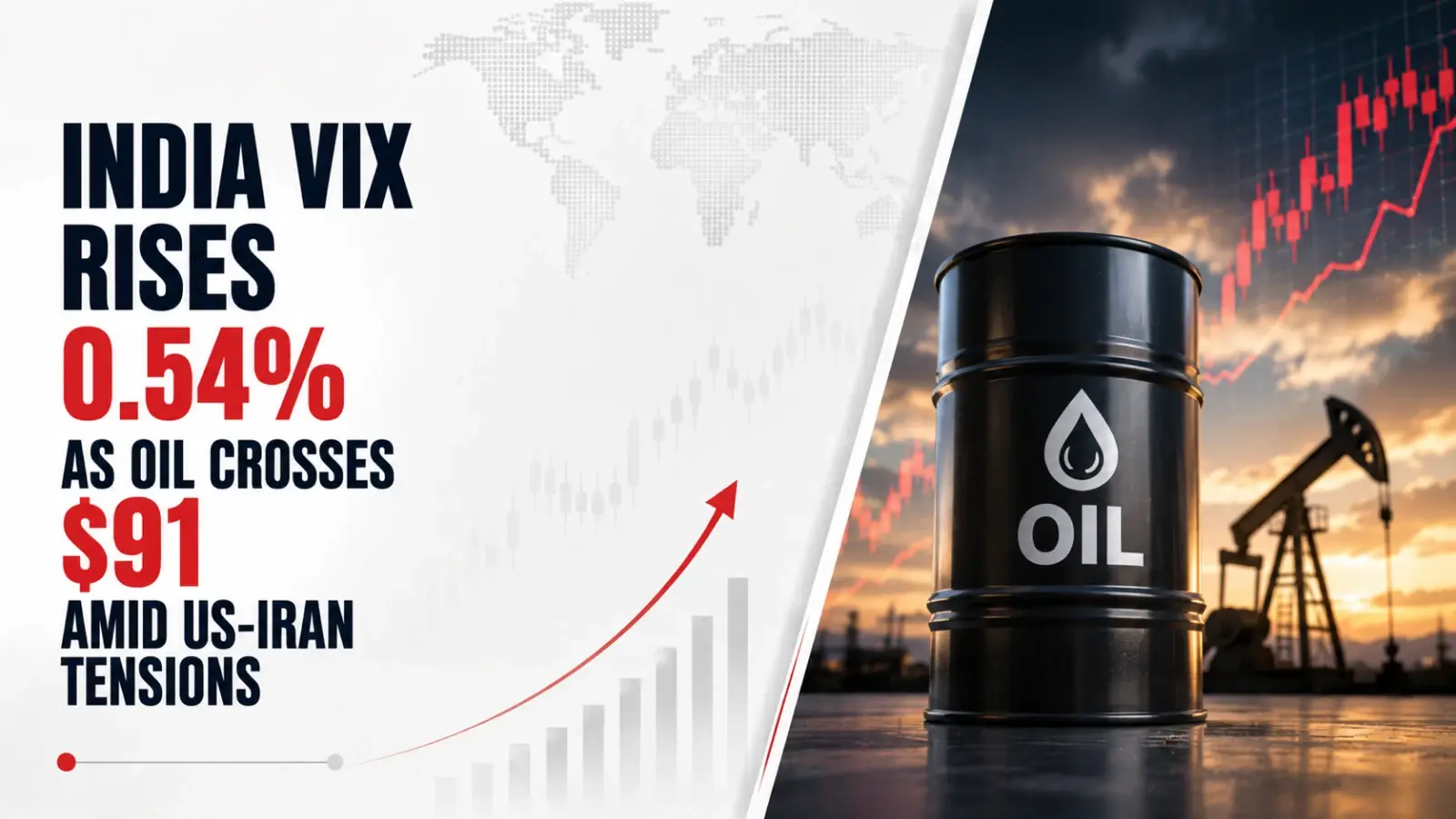
India VIX Rises 0.54% as Oil Crosses $91 Amid US-Iran Tensions
Authored By HDFC Sky | Last Modified: Sep 1, 2026 11:04 AM IST
Open Free Demat Account
Open Free Demat Account
Mumbai, Sept 1: India VIX stood at 11.25, up 0.06 points or 0.54%, as of 9:59 IST on Tuesday, after opening at 11.19, the same as Monday’s close. The volatility index moved between 9.24 and 11.57 in the early session, keeping volatility expectations relatively contained despite renewed geopolitical tensions, higher crude prices, rising global bond yields and a weaker regional market backdrop.

India VIX Holds 11.25 As Oil and Geopolitical Risks Rise
India VIX had closed Monday at 11.19, up 4.78% from 10.68, leaving the market with a higher volatility base before Tuesday’s opening. In the early session, the index remained around 11.2–11.6, with the day’s high at 11.57.
The index’s 52-week range is 8.72–28.90, while its technical rating remains NEUTRAL. The early-session movement therefore reflected a measured increase in volatility expectations rather than a sharp escalation.
The immediate backdrop was dominated by renewed US-Iran hostilities, rising crude prices and pressure across global bond markets. These developments arrived alongside a weaker Asian market opening and a negative indication from GIFT Nifty.
US-Iran Fighting Sends Brent Above $91 and Raises Risks
Renewed US-Iran hostilities emerged as the most significant overnight global development affecting the market opening. Fighting resumed in the Middle East, pushing oil prices higher and reviving concerns over potential disruption to oil-supply routes, particularly the Strait of Hormuz.
Brent crude traded around $91.05 a barrel, while West Texas Intermediate (WTI) stood at about $86.59. The renewed supply concerns were particularly relevant for India because higher crude prices can affect the country’s import bill and broader economic conditions.
The market’s opening risk backdrop therefore combined geopolitical uncertainty with a direct commodity-price shock, adding to the factors surrounding India VIX.
Brent at $91.19 Adds Pressure to India’s Market Risks
Brent crude was also recorded around $91.19, up approximately 0.77% from the previous session. The move above $91 a barrel added another source of uncertainty for Indian markets at the start of September.
Higher crude prices were accompanied by concerns around India’s inflation trajectory, trade deficit, rupee, corporate input costs, transportation expenses, aviation and logistics costs, monetary-policy expectations and the earnings environment.
The increase in crude therefore formed a central part of the early-session risk backdrop, alongside the renewed geopolitical tensions.
US 10-Year Yield Near 4.78% Adds Global Market Pressure
The rise in crude prices was accompanied by a global bond-market sell-off. The US 10-year Treasury yield climbed to around 4.78%, close to a 20-month high, while Japan’s benchmark yield approached 3%. European bond yields also remained under pressure.
Higher oil prices and rising bond yields created simultaneous concerns around inflation and interest rates. The move in global yields also added uncertainty around equity valuations, international capital flows and the broader interest-rate environment.
For Indian markets, the combination of elevated crude prices and higher global yields formed an important part of the early-session volatility backdrop.
Fed Hike Probability Rises to 65% from 41%
US monetary-policy expectations also shifted. Markets were pricing around a 65% probability of a Federal Reserve rate hike, compared with approximately 41% a week earlier.
Comments from Federal Reserve Chair Kevin Warsh were interpreted as leaving the possibility of higher rates open if inflation remained persistent. This added another layer to the global market environment already affected by oil prices, geopolitical tensions and higher Treasury yields.
The changing rate expectations also brought global liquidity, foreign portfolio flows, emerging-market valuations and the rupee into focus as Indian markets opened.
Asian Markets Fall as Nikkei and Hang Seng Weaken
The regional market opening reflected the broader risk-off backdrop. The Nikkei 225 fell about 0.2%, while the Hang Seng declined around 0.7%. Asian bonds also sold off as markets absorbed higher yields and geopolitical concerns.
The weaker Asian handover added to the pressure from crude and global bond markets. It also meant the Indian market was opening against a broadly weaker regional backdrop rather than facing an isolated domestic development.
GIFT Nifty Falls 61 Points Before Indian Markets Open
GIFT Nifty futures were down around 61 points at 24,184, while another market reading placed the contract at approximately 24,193. The negative pre-opening indication pointed to a weaker start for Indian benchmark indices.
The GIFT Nifty move came alongside Brent crude remaining above $91 and Asian markets trading lower. This combination provided a negative external setup before regular Indian trading began and coincided with India VIX holding above Monday’s close.
Nifty Near 24,000 Keeps Downside Risk In Focus
Nifty 50 closed Monday at 24,080.40, down 0.39%, leaving the index close to the psychologically important 24,000 level. Analysts identified 24,000 as a critical support level, with approximately 23,800 as the next downside zone and 24,200–24,300 as the immediate resistance region.
The proximity to 24,000 was significant for the opening session because Monday had already produced a 4.78% rise in India VIX. A break below the level could coincide with greater demand for downside protection through Nifty options, although the early-session VIX data did not indicate a broad volatility shock.
FII Selling Adds to the Existing Domestic Risk Backdrop
Foreign institutional activity remained another part of the market setup entering Tuesday. Foreign investors had been sellers, while domestic institutions provided some buying support.
The flow backdrop coincided with weaker equities, higher crude prices, geopolitical uncertainty, currency considerations and rising global bond yields. The combination added to the range of factors being reflected in the market’s opening volatility conditions.
RBI Support Moves Rupee to ₹95.025 Against Dollar
The rupee provided a partial counterweight to the external pressures. The Reserve Bank of India (RBI) was reported to have intervened before the spot market opened by selling dollars, helping the currency strengthen.
The rupee moved to around ₹95.025 per US dollar, compared with Monday’s close of ₹95.1625. The currency stabilisation came as oil prices and geopolitical developments created pressure on the broader external-risk backdrop.
Yen Near 160 and BOJ Expectations Add Global Rate Uncertainty
The Japanese yen remained near 160 per dollar, while markets continued to monitor expectations for potential Bank of Japan tightening. The probability of a BOJ rate hike later this month was around 73%.
The combination of US rate expectations, Japanese monetary-policy expectations, higher crude prices, elevated global bond yields and geopolitical tensions added to the broader global rates and liquidity uncertainty surrounding the opening session.
Ukraine Conflict Adds to the Broader Geopolitical Risk
Continuing fighting in Ukraine also remained part of the international market backdrop on Tuesday. Alongside renewed US-Iran hostilities, the developments added to wider concerns around commodities and global risk conditions.
The Ukraine conflict was therefore another geopolitical factor present as markets assessed oil prices and broader international market conditions at the beginning of September.
Weekly F&O Expiry Puts Focus On Nifty Options
Tuesday’s session also coincided with the weekly Futures and Options (F&O) expiry, increasing the relevance of Nifty option positioning to India VIX movements. Analysts highlighted significant open interest around the 24,000–24,500 range.
Because India VIX is derived from Nifty option prices, changes in option positioning, hedging, open interest, put-call demand and implied volatility can influence the index during the session.
September Seasonality Shows 9 Negative Years in 17
Historical data shows that India VIX has recorded negative returns in 9 of 17 years during September. The month’s maximum positive change was 34.92% in 2018, while the average positive change was 19.02%. The maximum negative change was -26.10% in 2009, with an average negative change of -9.93%. Overall, September has recorded an average change of 3.69%.
India VIX Remains Low Despite Multiple External Risks
Despite the accumulation of global and domestic risk factors, India VIX at around 11–12 remained below a level associated with a major volatility shock. The index was also noted to remain below its short-term moving averages.
The early-session picture was therefore one of volatility expectations remaining relatively contained while several external factors were simultaneously influencing the market. Monday’s increase from 10.68 to 11.19 had already established a higher starting point for Tuesday.
India VIX stood at 11.25 at 9:59 IST after opening at 11.19, with a 9.24–11.57 early-session range. Renewed US-Iran hostilities, Brent above $91, higher global yields and changing rate expectations formed the key external backdrop, while Nifty near 24,000, F&O expiry and FII flows shaped domestic market conditions.
Source
- https://www.nseindia.com/reports-indices-historical-vix
Disclaimer
If you have any concerns, questions, or wish to point out any discrepancies in our content, please feel free to write to us at content@hdfcsec.com.
Please Note: The information shared is intended solely for informational purposes and does not make any investment recommendations
HDFC SKY, one of India’s most trusted trading platforms, has been recognized with the Next-Gen Digi Content Awards 2025–26.
Disclaimer
At HDFC SKY*, we take utmost care and due diligence in curating and presenting news and market-related content. However, inadvertent errors or omissions may occasionally occur.
If you have any concerns, questions, or wish to point out any discrepancies in our content, please feel free to write to us at content@hdfcsec.com.
Please Note: The information shared is intended solely for informational purposes and does not make any investment recommendations.
HDFC SKY from HDFC Securities, one of most trusted trading platforms in India, has been recognized with the *Next-Gen Digi Content Awards 2025-26.
 Join Us
 Add as preferred source on Google


More Uncategorized News



1 min read




Open Free Demat Account
Open Free Demat Account












Invest Anytime, Anywhere


By signing up I certify terms, conditions & privacy policy