Nifty 50
- Kotak Mahindra Bank₹4408.10 (1.88%)
- Titan Company₹4,377-173.00 (-3.80%)
- BSE₹3,35651.00 (1.54%)
- Adani Enterprises₹2,743-106.90 (-3.75%)
- Bharti Airtel₹1,833.9023.40 (1.29%)
- Hindalco Industries₹910.85-29.65 (-3.15%)
- ICICI Bank₹1,357.5014.70 (1.09%)
- JSW Steel₹1,230-29.60 (-2.35%)
- Coal India₹414.502.85 (0.69%)
- Bharat Electronics₹378.30-9.10 (-2.35%)
- Max Healthcare₹9085.50 (0.61%)
- Infosys₹992-21.85 (-2.16%)
- HDFC Life Insurance ₹546.052.10 (0.39%)
- Asian Paints₹2,372.10-52.10 (-2.15%)
- Bajaj Finance₹963.850.75 (0.08%)
- Mahindra & Mahindra₹2,800-55.00 (-1.93%)
- Apollo Hospitals₹7,9172.50 (0.03%)
- Adani Ports₹1,750.10-33.30 (-1.87%)
- L&T₹3,701.50-68.50 (-1.82%)

- Offerings
- Tools & Platforms
Tools & Calculators
- Open API
- Calculators
- SIP Calculator
- CAGR Calculator
- Compound Interest Calculator
- FD Calculator
- RD Calculator
- EPF Calculator
- Retirement Calculator
- HDFC SIP Calculator
- Mutual Fund Return Calculator
- Lumpsum Calculator
- Step Up SIP Calculator
- ETF SIP Calculator
- Brokerage Calculator
- Equity Margin Calculator
- SWP Calculator
- EMI Calculator
- MTF Calculator
- Margin Pledge Calculator
- Algo Strategy
- Markets
Stocks
F&O
Mutual Funds
- More
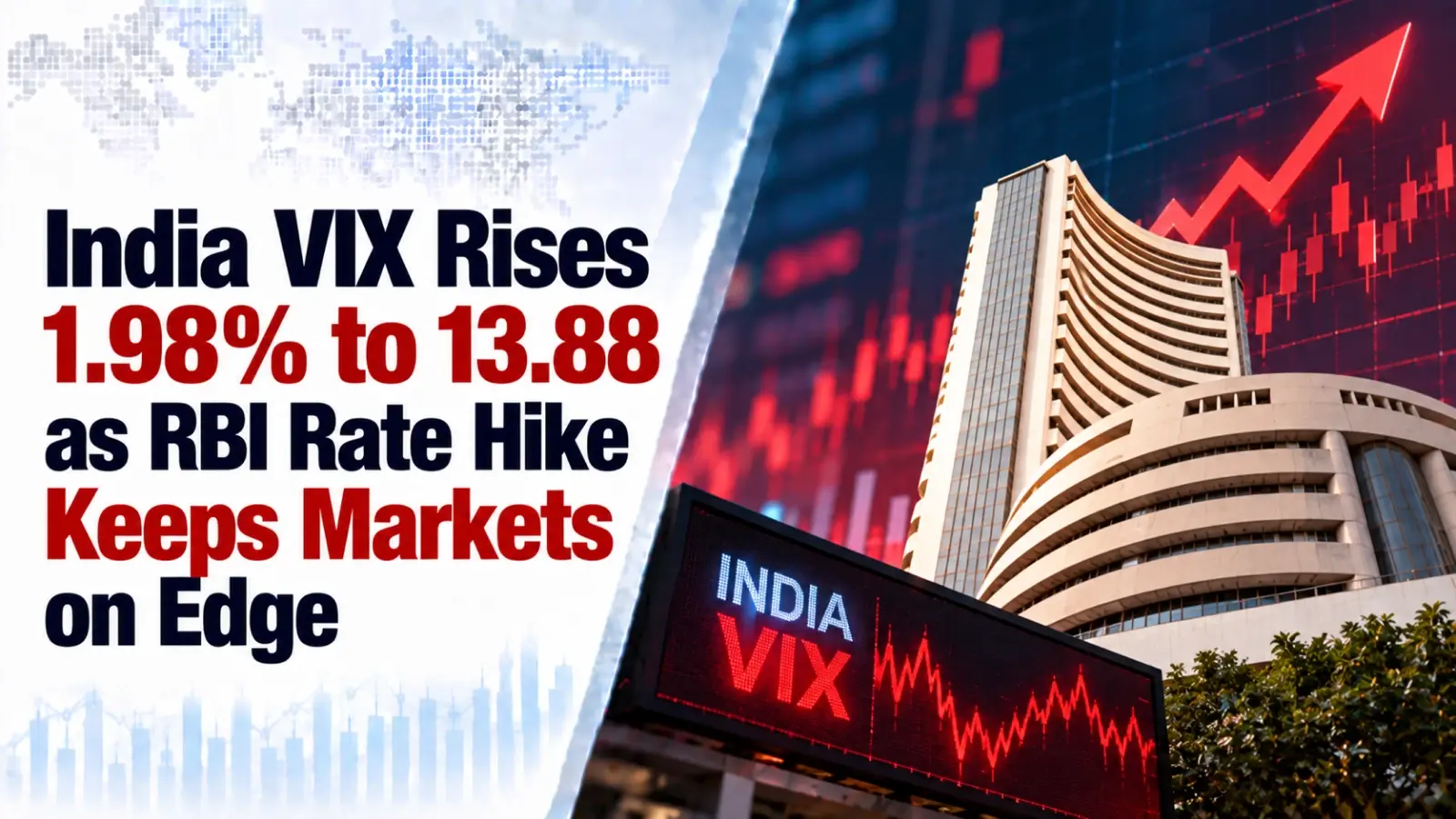
India VIX Rises 1.98% to 13.88 as RBI Rate Hike Keeps Markets on Edge
Authored By HDFC SKY | Last Modified: Oct 7, 2026 04:37 PM IST
Open Free Demat Account
Open Free Demat Account
Mumbai, October 7, 2026: Market volatility picked up on Wednesday as investors reacted to the Reserve Bank of India’s rate hike, a weaker rupee and persistently high crude oil prices. India VIX, the market’s widely watched fear gauge, rose 1.98% to close at 13.88.
The volatility index gained 0.27 points from its previous close of 13.61. It opened at 13.60 and climbed as high as 14.31 during the session before easing in the latter part of the day.
The rise in India VIX came against a backdrop of several developments weighing on investor sentiment. The RBI raised its repo rate by 25 basis points to 5.50% and moved its policy stance from neutral to calibrated tightening. Meanwhile, Brent crude stayed above $100 a barrel and the rupee traded close to its record low against the US dollar.
While the combination of these factors pushed volatility higher during the session, the India VIX did not hold on to its intraday peak, suggesting that some of the initial nervousness had eased by the close.

India VIX Gains Despite Easing from Intraday High
The day’s move in India VIX was relatively modest when measured by the closing change, but the intraday range was more pronounced. The index moved between 13.60 and 14.31, a 0.71-point swing.
India VIX began the session at 13.60, which was also its low for the day, before rising through the trading session. The index eventually settled at 13.88, 1.98% higher than Tuesday’s close.
India VIX tracks the market’s expectations of near-term volatility using Nifty option prices. As a result, it often reacts quickly when investors are faced with uncertainty around monetary policy, inflation, currency movements or global markets.
The index’s 52-week range currently stands between 8.72 and 28.90. It has gained 46.41% so far this year.
RBI Rate Hike Adds to Market Uncertainty
The RBI’s decision to raise the repo rate by 25 basis points to 5.50% was one of the key triggers for market activity on Wednesday.
The rate increase was the first in nearly four years and was backed unanimously by the Monetary Policy Committee. However, the change in the central bank’s policy stance was arguably just as important for markets.
The RBI shifted its stance from neutral to calibrated tightening, signalling a greater willingness to respond to inflationary pressures as price risks build.
The move comes at a time when crude oil prices have remained elevated, creating an additional challenge for the domestic economy. Higher energy prices can put pressure on inflation as well as India’s import bill and currency.
Inflation and Growth in Focus
Inflation has also emerged as a key consideration for the RBI. Consumer price inflation rose to 4.82% in August, remaining above the central bank’s 4% medium-term target for a third consecutive month.
At the same time, economic growth has remained relatively strong. India’s GDP expanded 7.8% in the April-June quarter, giving policymakers room to focus more closely on inflation without facing the backdrop of a sharply slowing economy.
The RBI has also raised its inflation forecast, with inflation expected to average around 5.8% over the next three quarters.
For equity investors, the combination of firmer monetary policy, elevated oil prices and pressure on the rupee has created a more uncertain near-term environment. That was reflected in Wednesday’s movement in India VIX, which rose during the session even as it finished well below its day’s high.
No CRR Hike Limits Additional Liquidity Pressure
The RBI did not increase the cash reserve ratio (CRR) alongside the repo rate hike, avoiding an additional liquidity-tightening measure during the policy announcement.
Instead, the central bank indicated that liquidity would be managed through measures including bond sales and foreign exchange swaps. The absence of an additional CRR increase was relevant to the market’s response because the policy decision combined a higher policy rate with no further increase in the reserve requirement.
Financial stocks subsequently recovered from their initial weakness, while broader market losses also moderated during the session. This helped India VIX move away from its 14.31 intraday high and finish at 13.88.
Brent Above $100 Adds Inflation and Currency Pressure
Crude oil remained another significant factor during the 7 October session, with Brent trading around $101–$102 a barrel. Brent was reported at approximately $101.51, up around 0.92%, while West Texas Intermediate (WTI) crude was around $90.25 in the morning market.
Higher crude prices were particularly relevant alongside the RBI’s inflation concerns. Oil prices affect India’s import bill, inflation and external balances, while movements in crude can also influence the domestic currency.
The rise in oil prices was linked to continuing geopolitical developments in the Middle East, including concerns surrounding supply disruptions and attacks involving Iran-backed Houthis. The developments kept energy markets under pressure during the Indian trading session.
Rupee Nears ₹97 as Foreign Exchange Reserves Decline
The Indian rupee weakened by nearly 0.5% to ₹96.8450 against the US dollar, moving closer to its reported record low of around ₹96.96.
The currency movement came despite RBI intervention. India’s foreign exchange reserves had declined to approximately $734.6 billion, around $50 billion below their September peak, with intervention through spot dollar sales and foreign exchange swaps contributing to the decline.
The rupee’s weakness added another layer to the day’s domestic market conditions, particularly as crude remained above $100 a barrel and inflation concerns were already influencing the RBI’s policy decision.
Asian Markets Fall as Oil and Global Rates Stay in Focus
Global market conditions also contributed to the day’s volatility. Asian equities weakened during the session despite Wall Street having closed at record levels previously.
Japan’s Nikkei was down around 0.9%, while the MSCI Asia-Pacific ex-Japan index declined by approximately 0.5% during the morning market. The mixed global backdrop reflected renewed attention on oil prices, Middle East developments and monetary policy.
US Federal Reserve communications and minutes were also in focus, with market expectations surrounding future US interest-rate decisions remaining relevant to global currency and bond markets. These developments formed part of the broader international backdrop during India’s trading session.
Rate-Sensitive Stocks Weaken After 25-Basis-Point Hike
The RBI decision affected several rate-sensitive areas of the domestic market during the session. By around 2 pm, the Nifty was approximately 0.7% lower, while several stocks recorded new 52-week lows.
Pressure was reported across real estate, automobiles and non-banking financial companies (NBFCs). Individual stocks including Tata Power, M&M, Muthoot Finance, IREDA and IRFC were among those highlighted as touching 52-week lows following the policy decision.
The broader weakness contributed to the early increase in India VIX as market conditions remained unsettled around the monetary policy announcement. However, the subsequent recovery in financial stocks helped contain the increase in volatility towards the closing session.
Titan Falls After Jewellery Business Update
Titan was another notable stock-level development during the session, with the company’s shares falling approximately 3.4% in early trade after weaker-than-expected jewellery business updates.
The decline added to the weakness among individual large-cap stocks during the opening phase. However, the movement was separate from the broader monetary-policy and crude-oil developments that shaped the overall volatility environment.
The combination of individual stock declines and weakness across rate-sensitive sectors contributed to the broader market pressure observed during the session.
India VIX Remains Neutral Despite 46.41% YTD Gain
Despite its 1.98% rise on 7 October, India VIX’s daily technical rating remained neutral. The index’s year-to-date return stood at 46.41%, while its 52-week high and low were 28.90 and 8.72, respectively.
The day’s pivot calculations placed the classic pivot point at 13.97, with resistance levels at 14.41, 15.22 and 15.66, while support levels stood at 13.16, 12.72 and 11.91. The Fibonacci pivot levels placed resistance at 14.44, 14.74 and 15.22, with support at 13.49, 13.19 and 12.72.
Seasonality data showed that India VIX has recorded positive October returns in 9 of 18 years. October’s maximum positive change was 26.73% in 2020, while its maximum negative change was -30.99% in 2013. The average October change was -1.34%.
India VIX closed at 13.88, up 1.98%, after reaching 14.31 during the session. The day’s volatility was shaped by the RBI’s 5.50% repo rate, its shift to calibrated tightening, Brent crude above $100, rupee weakness near ₹97, weaker Asian markets and pressure across rate-sensitive sectors.
Disclaimer
At HDFC SKY*, we take utmost care and due diligence in curating and presenting news and market-related content. However, inadvertent errors or omissions may occasionally occur.
If you have any concerns, questions, or wish to point out any discrepancies in our content, please feel free to write to us at content@hdfcsec.com.
Please Note: The information shared is intended solely for informational purposes and does not make any investment recommendations.
HDFC SKY from HDFC Securities, one of most trusted trading platforms in India, has been recognized with the *Next-Gen Digi Content Awards 2025-26.
 Join Us
 Add as preferred source on Google


More Markets News



1 min read







Open Free Demat Account
Open Free Demat Account











Invest Anytime, Anywhere


By signing up I certify terms, conditions & privacy policy