Nifty 50
- Dr. Reddy's Labs₹1,229.4032.40 (2.71%)
- Apollo Hospitals₹7,775-252.50 (-3.15%)
- Bajaj Auto₹10,034256.00 (2.62%)
- ITC₹257.90-8.10 (-3.05%)
- Tata Motors PV₹284.454.55 (1.63%)
- Tech Mahindra₹1,471-43.10 (-2.85%)
- Bharat Electronics₹373.905.75 (1.56%)
- L&T₹3,627.50-75.80 (-2.05%)
- BSE₹3,330.2043.00 (1.31%)
- Max Healthcare₹865.95-17.85 (-2.02%)
- Cipla₹1,317.4016.40 (1.26%)
- Hindalco Industries₹882.50-17.85 (-1.98%)
- Eicher Motors₹7,11969.00 (0.98%)
- Hindustan Unilever₹1,820.70-36.00 (-1.94%)
- Mahindra & Mahindra₹2,81316.80 (0.60%)
- SBI₹941-18.10 (-1.89%)
- Kotak Mahindra Bank₹443.402.40 (0.54%)
- Coal India₹404.80-6.75 (-1.64%)
- HCL Technologies₹1,2236.30 (0.52%)
- Bharti Airtel₹1,778.70-26.40 (-1.46%)

- Offerings
- Tools & Platforms
Tools & Calculators
- Open API
- Calculators
- SIP Calculator
- CAGR Calculator
- Compound Interest Calculator
- FD Calculator
- RD Calculator
- EPF Calculator
- Retirement Calculator
- HDFC SIP Calculator
- Mutual Fund Return Calculator
- Lumpsum Calculator
- Step Up SIP Calculator
- ETF SIP Calculator
- Brokerage Calculator
- Equity Margin Calculator
- SWP Calculator
- EMI Calculator
- MTF Calculator
- Margin Pledge Calculator
- Algo Strategy
- Markets
Stocks
F&O
Mutual Funds
- More
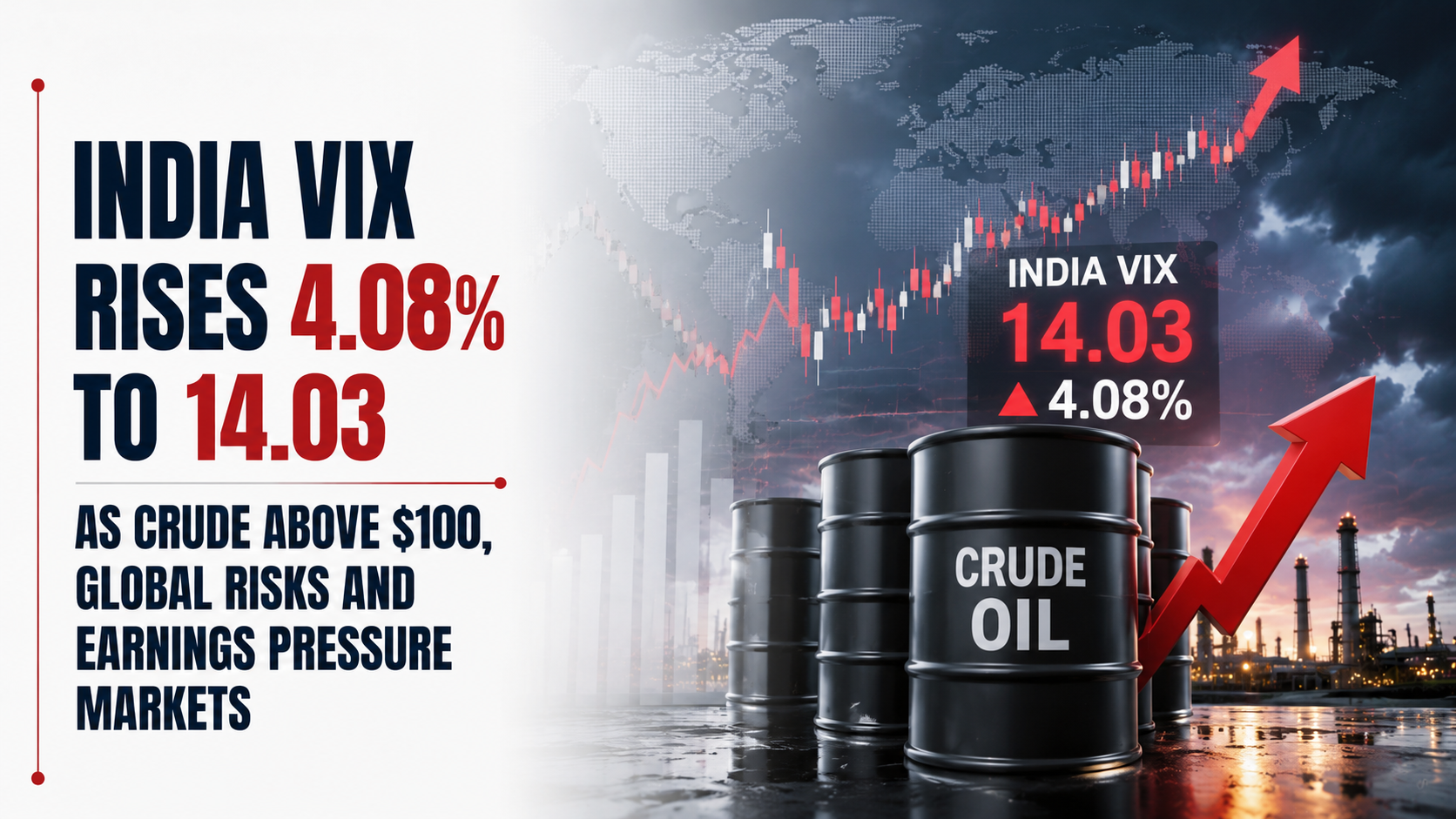
India VIX Rises 4.08% to 14.03 as Crude Above $100, Global Risks and Earnings Pressure Markets
Authored By HDFC SKY | Last Modified: Jul 24, 2026 04:59 PM IST
Open Free Demat Account
Open Free Demat Account
Mumbai, July 24: India VIX, the National Stock Exchange’s volatility index, closed higher on Friday, reflecting elevated expectations of near-term market fluctuations amid rising geopolitical tensions, crude oil prices above $100 per barrel, sustained foreign institutional selling, weak global cues and uncertainty surrounding the ongoing Q1 FY27 corporate earnings season.
The index settled at 14.03, up 0.55 points or 4.08%, after touching an intraday high of 14.76 and a low of 13.18. The closing level remained below the 52-week high of 28.90 but significantly above the 52-week low of 8.72, while its year-to-date return stood at 48.00%.

India VIX Hits 14.76 as Volatility Expectations Climb
India VIX opened at 13.47, marginally below the previous close of 13.48, before gaining momentum through the session and reaching an intraday high of 14.76. During the trading day, the index traded within a range of 13.18–14.76, indicating higher pricing of options as market participants factored in the possibility of wider price movements over the coming weeks.
Although the index had traded between 14.15 and 14.77 during various stages of the session, it finally closed at 14.03, marking its strongest closing level in several sessions. Despite the day’s rise, the index remained well below the peak levels recorded during major periods of market stress earlier in the year.
Markets Record Worst Weekly Performance in Four Months
The rise in India VIX coincided with another weak session for Indian equities, extending the benchmark indices’ losing streak to a fifth consecutive day. The Nifty 50 slipped below 23,700 during the session after briefly testing the 23,600 zone before recovering some losses towards the close.
The Sensex declined by more than 900 points intraday, touching a low of 75,474, before trimming part of the decline. On a weekly basis, the Nifty 50 fell around 2.8%, while the Sensex declined approximately 3.2%, making it the weakest weekly performance in nearly four months. Broader markets also remained under pressure, with mid-cap and small-cap indices extending losses for a third straight session, while the sell-off erased more than ₹3 lakh crore from the market capitalisation of companies listed on the BSE.
Middle East Conflict and $100 Crude Lift Risk Levels
Escalating geopolitical developments in West Asia remained the principal catalyst behind Friday’s increase in market volatility. Reports indicated that Iran-aligned Houthi rebels attacked two Saudi oil tankers in the Red Sea and announced a naval blockade on Saudi Arabia, while the United States continued military operations against Iran for a thirteenth consecutive night.
US President Donald Trump also warned of further military action, whereas Iran reportedly rejected a ceasefire proposal conveyed through Iraqi mediation. Concerns surrounding shipping disruptions in both the Red Sea and the Strait of Hormuz heightened global uncertainty and pushed Brent crude above $100 per barrel, with prices touching nearly $102 during the week. The sharp increase in oil prices raised concerns over India’s import costs, inflationary pressures and corporate input expenses, contributing to the rise in implied market volatility.
Weak Earnings and FII Selling Add to Pressure
The ongoing Q1 FY27 earnings season also contributed to elevated market volatility as several companies reported mixed or weaker-than-expected financial results. Infosys reported a quarter-on-quarter decline of 8.61% in consolidated net profit to ₹7,769 crore and reduced the upper end of its FY27 constant currency revenue growth guidance to 3% from 3.5%, leading to a decline of nearly 3% in its share price.
Meesho reported a consolidated net loss of ₹1,328.35 crore, while InterGlobe Aviation (IndiGo) also witnessed weakness following its quarterly results. At the same time, Foreign Portfolio Investors (FPIs) remained net sellers, offloading equities worth ₹2,999.23 crore on 23 July, while Domestic Institutional Investors (DIIs) largely offset the outflows through net purchases of ₹2,947.14 crore.
Analysts noted that the combination of earnings uncertainty and continued institutional selling contributed to higher option premiums during the session.
Global Weakness and Softer Domestic Data Deepen Caution
Global markets remained under pressure after overnight declines in the United States, where the Nasdaq fell 2.2%, the S&P 500 declined 1.2%, and the Dow Jones Industrial Average lost around 1%, following renewed concerns over rising artificial intelligence spending and higher bond yields.
Asian markets also traded lower, with Japan’s Nikkei declining around 2.8% and Hong Kong’s Hang Seng falling approximately 1.5%. Domestically, the HSBC Flash India Composite Purchasing Managers’ Index (PMI) Output Index declined to 54.3 in July from 57.1 in June, marking the slowest expansion in private sector activity since March 2022.
The services PMI also eased to 53.1 from 57.4, its lowest reading since February 2022, adding to concerns surrounding the pace of business activity during the quarter.
Technical Levels Show Neutral Trend After Closing
India VIX continued to carry a Neutral technical rating at the close of trading. The day’s Classic Pivot Point stood at 12.81, with resistance levels placed at 13.90, 14.51 and 15.60, while support levels were identified at 12.20, 11.11 and 10.50. The index closed above its first resistance level after touching an intraday high of 14.76, while remaining below the higher resistance range. Seasonality data showed that 14 out of the past 18 years have delivered negative returns for India VIX during July, with the month recording an average decline of 7.94%, although historical performance does not necessarily reflect current market conditions.
India VIX closed at 14.03, reflecting higher expected market volatility amid geopolitical developments, elevated crude oil prices, mixed corporate earnings, foreign institutional outflows, weaker global markets and softer domestic economic data. While the index moved above 14 during the session, it remained below its 52-week high of 28.90, with the technical trend continuing to be classified as Neutral.
Source
- https://www.nseindia.com/reports-indices-historical-vix
Disclaimer
If you have any concerns, questions, or wish to point out any discrepancies in our content, please feel free to write to us at content@hdfcsec.com.
Please Note: The information shared is intended solely for informational purposes and does not make any investment recommendations
Disclaimer
At HDFC SKY*, we take utmost care and due diligence in curating and presenting news and market-related content. However, inadvertent errors or omissions may occasionally occur.
If you have any concerns, questions, or wish to point out any discrepancies in our content, please feel free to write to us at content@hdfcsec.com.
Please Note: The information shared is intended solely for informational purposes and does not make any investment recommendations.
HDFC SKY from HDFC Securities, one of most trusted trading platforms in India, has been recognized with the *Next-Gen Digi Content Awards 2025-26.
 Join Us
 Add as preferred source on Google


More Business News









Open Free Demat Account
Open Free Demat Account











Invest Anytime, Anywhere


By signing up I certify terms, conditions & privacy policy