Nifty 50
- Bajaj Finance₹1,035.1026.30 (2.61%)
- Coal India₹423.10-4.90 (-1.14%)
- Bajaj Finserv₹1,85531.60 (1.73%)
- TCS₹2,093.30-11.70 (-0.56%)
- Hindalco Industries₹989.1016.10 (1.65%)
- Wipro₹165.16-0.84 (-0.51%)
- Tata Steel₹187.592.62 (1.42%)
- ONGC₹235-1.13 (-0.48%)
- Nestle₹1,382.5018.60 (1.36%)
- Infosys₹1,024.50-4.90 (-0.48%)
- JSW Steel₹1,283.9016.90 (1.33%)
- Cipla₹1,379.10-5.00 (-0.36%)
- ITC₹268.903.10 (1.17%)
- Titan Company₹4,913.50-15.00 (-0.30%)
- UltraTech Cement₹11,128128.00 (1.16%)
- NTPC₹327.05-0.75 (-0.23%)
- Apollo Hospitals₹8,919.5084.00 (0.95%)
- ICICI Bank₹1,336.80-2.80 (-0.21%)
- L&T₹3,90336.60 (0.95%)
- Tech Mahindra₹1,549.70-1.90 (-0.12%)

- Offerings
- Tools & Platforms
Tools & Calculators
- Open API
- Calculators
- SIP Calculator
- CAGR Calculator
- Compound Interest Calculator
- FD Calculator
- RD Calculator
- EPF Calculator
- Retirement Calculator
- HDFC SIP Calculator
- Mutual Fund Return Calculator
- Lumpsum Calculator
- Step Up SIP Calculator
- ETF SIP Calculator
- Brokerage Calculator
- Equity Margin Calculator
- SWP Calculator
- EMI Calculator
- MTF Calculator
- Margin Pledge Calculator
- Algo Strategy
- Markets
Stocks
F&O
Mutual Funds
- More
India VIX Slips 3.12% as RBI Policy Wait Keeps Volatility Contained
Authored By HDFC SKY | Last Modified: Aug 5, 2026 12:21 PM IST
Open Free Demat Account
Open Free Demat Account
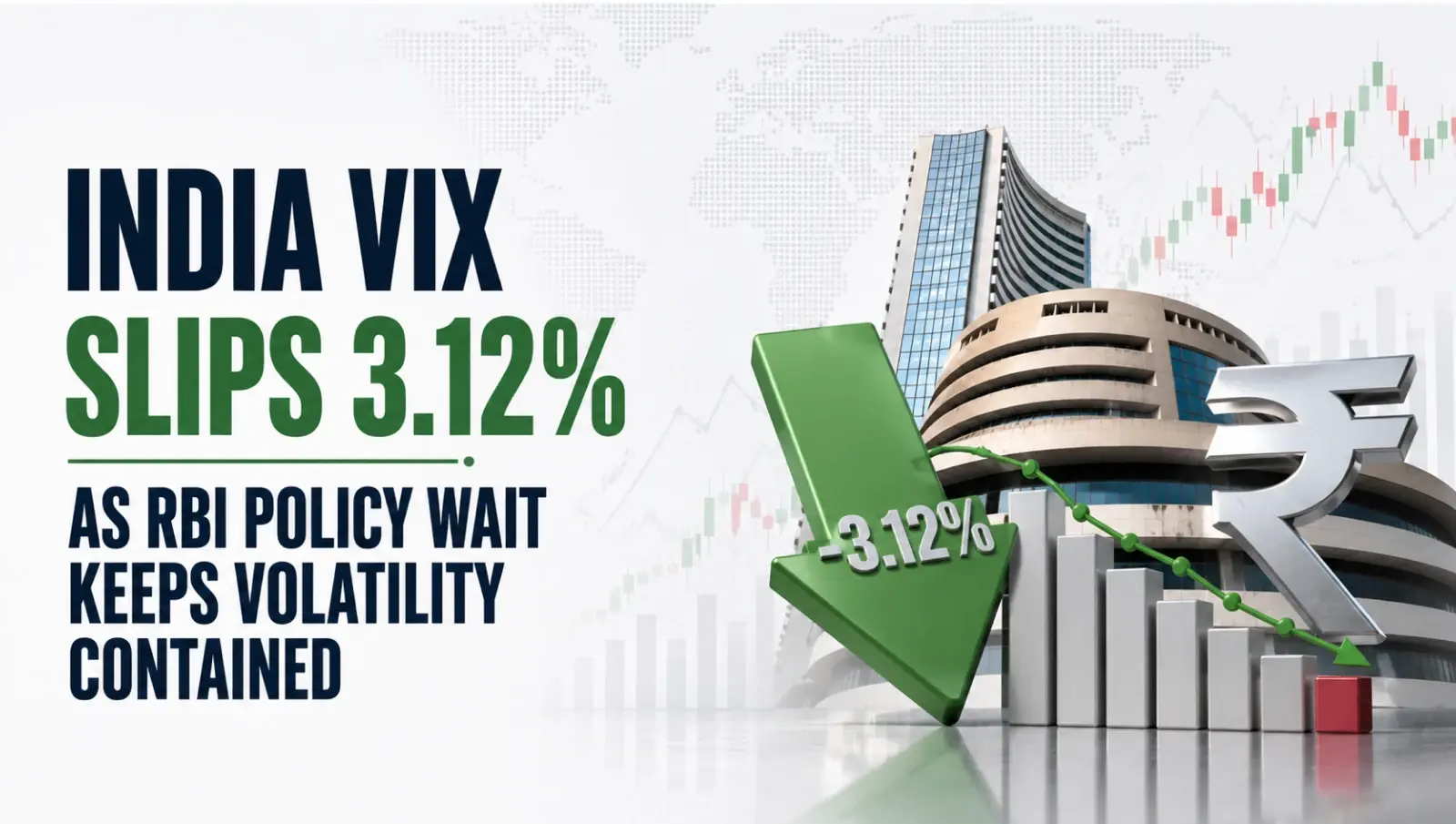
Mumbai, Aug 5: India VIX, the domestic market’s volatility gauge, ended the session on 5 August 2026 at 12.01, down 0.38 points (3.12%) from the previous close of 12.19, reflecting relatively subdued volatility expectations despite multiple domestic and global developments influencing trading activity. The index opened at 12.19, touched an intraday high of 12.19, slipped to a day’s low of 10.80, and remained close to the lower end of its 52-week range of 8.72-28.90. The movement comes as market participants tracked the Reserve Bank of India’s (RBI) monetary policy decision, softer crude oil prices, global market strength, corporate earnings and the implementation of the National Stock Exchange (NSE)’s new closing auction mechanism.

India VIX Falls to 12.01 as RBI Policy Wait Restrains Volatility
India VIX remained below the 12.20 mark throughout the trading session, highlighting a relatively stable volatility environment compared with the sharp swings witnessed earlier in July. With the benchmark opening at 12.19, matching the previous close, and falling to an intraday low of 10.80, the index reflected measured expectations ahead of the RBI’s monetary policy announcement. Analysts noted that market participants largely refrained from taking aggressive positions while awaiting clarity on the central bank’s stance regarding inflation, liquidity conditions and economic growth. As a result, hedging activity remained moderate, keeping options premiums comparatively contained during the session.
RBI Policy Focus and Global Cues Keep Market Expectations Balanced
The RBI’s monetary policy meeting remained the primary domestic event influencing volatility during the day. Expectations broadly centred on the policy repo rate remaining unchanged alongside commentary on inflation, growth and liquidity management. At the same time, improving global market conditions also contributed to a calmer trading environment. International equity markets continued to draw support from encouraging corporate earnings, while Asian markets traded broadly higher in response to positive global cues. Analysts stated that the combination of policy caution and steady overseas markets prevented any significant rise in volatility expectations during the session.
Softer Crude Oil Prices Reduce Near-Term Volatility Pressure
Crude oil prices also emerged as an important factor influencing market volatility on 5 August. Brent crude eased amid optimism surrounding diplomatic developments involving the United States and Iran, reducing immediate concerns over higher imported inflation and pressure on corporate costs. Lower energy prices also eased concerns surrounding fiscal pressures, contributing to relatively stable market conditions. The moderation in crude oil prices coincided with India VIX remaining close to 12, indicating that lower external cost pressures supported expectations of comparatively stable market conditions during the trading session.
Q1 FY27 Earnings Stability Keeps India VIX Near 12
Corporate earnings continued to influence trading activity as the first-quarter earnings season progressed without major surprises. Unlike the heightened uncertainty witnessed during July, the ongoing Q1 FY27 results broadly aligned with market expectations, limiting the need for extensive short-term hedging. The absence of significant earnings shocks helped keep India VIX close to 12, with analysts observing that the earnings season has so far contributed to maintaining relatively measured volatility levels across the broader market.
NSE Closing Auction Changes Continue Supporting Intraday Swings
Apart from macroeconomic developments, structural changes in market operations also remained under focus. The National Stock Exchange’s new closing auction mechanism for futures and options (F&O) stocks continued to influence end-of-day trading patterns during the week. According to market participants, the revised framework has led to comparatively larger closing price adjustments and increased caution among option writers near the end of the trading session. Although broader volatility eased during the day, the implementation of the new mechanism remained one of the reasons India VIX continued to trade around 12 instead of declining closer to its annual lows.
Previous Session’s 12.19 Close Set The Stage For Today’s Decline
The latest decline followed a relatively firmer session on 4 August, when India VIX rose by around 1.8% before easing during Wednesday’s trade. The previous session reflected temporary uncertainty linked to the RBI policy announcement, the revised NSE closing auction mechanism and increased demand for short-term downside protection. India VIX subsequently closed at 12.19, establishing the base from which it declined by 3.12% on 5 August as volatility expectations moderated.
India VIX Stays Above 8.72 But Far Below 28.90 Peak
Despite the day’s decline, India VIX continued to trade comfortably above its 52-week low of 8.72 while remaining significantly below its 52-week high of 28.90. The current level of 12.01 places the index closer to the lower end of its annual trading range, indicating that volatility has eased substantially from the elevated levels recorded during periods of heightened uncertainty earlier this year. The index has also delivered 26.69% year-to-date returns, underscoring the sharp fluctuations experienced across different phases of 2026 despite the current moderation.
August History Shows 13 Of 18 Years Delivered Gains
Seasonality data continues to highlight August as a historically positive month for India VIX. Over the past 18 years, the volatility index has recorded positive returns in 13 August trading periods. Historical data shows the month has delivered a maximum positive change of 68.84% in 2015, an average positive gain of 16.77%, a maximum decline of 11.26% in 2016, an average negative movement of 6.01%, and an overall average monthly change of 10.44%. While historical patterns provide context, the current session continued to be shaped primarily by prevailing macroeconomic and market developments.
Technical Levels Show Neutral Trend Around 12.05 Pivot
Technical indicators continued to classify India VIX under a Neutral trend during the session. The classic pivot point stood at 12.05, with resistance levels placed at 12.68, 13.17 and 13.80, while support levels were identified at 11.56, 10.93 and 10.44. Fibonacci pivot levels were calculated at 12.48, 12.74 and 13.17 on the upside, with supports at 11.62, 11.36 and 10.93. Camarilla levels indicated resistance at 12.29, 12.40 and 12.50, while support levels stood at 12.09, 11.98 and 11.88, reflecting the day’s technical positioning around the 12 mark.
India VIX ended the 5 August 2026 session at 12.01, down 3.12%, as softer crude oil prices, steady global markets, the ongoing Q1 FY27 earnings season and the RBI’s monetary policy meeting collectively shaped trading conditions. The index remained within a 10.80-12.19 intraday range while continuing to trade near the lower end of its annual range.
Source
- https://www.nseindia.com/reports-indices-historical-vix
Disclaimer
If you have any concerns, questions, or wish to point out any discrepancies in our content, please feel free to write to us at content@hdfcsec.com.
Please Note: The information shared is intended solely for informational purposes and does not make any investment recommendations
Disclaimer
At HDFC SKY*, we take utmost care and due diligence in curating and presenting news and market-related content. However, inadvertent errors or omissions may occasionally occur.
If you have any concerns, questions, or wish to point out any discrepancies in our content, please feel free to write to us at content@hdfcsec.com.
Please Note: The information shared is intended solely for informational purposes and does not make any investment recommendations.
HDFC SKY from HDFC Securities, one of most trusted trading platforms in India, has been recognized with the *Next-Gen Digi Content Awards 2025-26.
 Join Us
 Add as preferred source on Google


More Business News





Open Free Demat Account
Open Free Demat Account












Invest Anytime, Anywhere


By signing up I certify terms, conditions & privacy policy