Nifty 50
- HDFC Life Insurance ₹556.8526.65 (5.03%)
- ONGC₹232.94-3.86 (-1.63%)
- Dr. Reddy's Labs₹1,187.4047.40 (4.16%)
- Titan Company₹4,870-38.50 (-0.78%)
- SBI Life Insurance ₹1,74446.10 (2.72%)
- HDFC Bank₹717.80-3.70 (-0.51%)
- Eternal₹325.058.05 (2.54%)
- Coal India₹420.10-2.15 (-0.51%)
- InterGlobe Aviation₹4,844110.50 (2.33%)
- Bajaj Auto₹11,543-50.00 (-0.43%)
- Bharat Electronics₹394.608.85 (2.29%)
- HCL Technologies₹1,247.60-5.40 (-0.43%)
- Jio Financial ₹229.624.78 (2.13%)
- Infosys₹1,057.30-2.70 (-0.25%)
- Shriram Finance₹99819.00 (1.94%)
- ICICI Bank₹1,356-2.80 (-0.21%)
- Maruti Suzuki₹12,399233.00 (1.92%)
- Nestle₹1,382-2.50 (-0.18%)
- Tata Motors PV₹306.705.70 (1.89%)
- SBI₹990.80-0.60 (-0.06%)

- Offerings
- Tools & Platforms
Tools & Calculators
- Open API
- Calculators
- SIP Calculator
- CAGR Calculator
- Compound Interest Calculator
- FD Calculator
- RD Calculator
- EPF Calculator
- Retirement Calculator
- HDFC SIP Calculator
- Mutual Fund Return Calculator
- Lumpsum Calculator
- Step Up SIP Calculator
- ETF SIP Calculator
- Brokerage Calculator
- Equity Margin Calculator
- SWP Calculator
- EMI Calculator
- MTF Calculator
- Margin Pledge Calculator
- Algo Strategy
- Markets
Stocks
F&O
Mutual Funds
- More
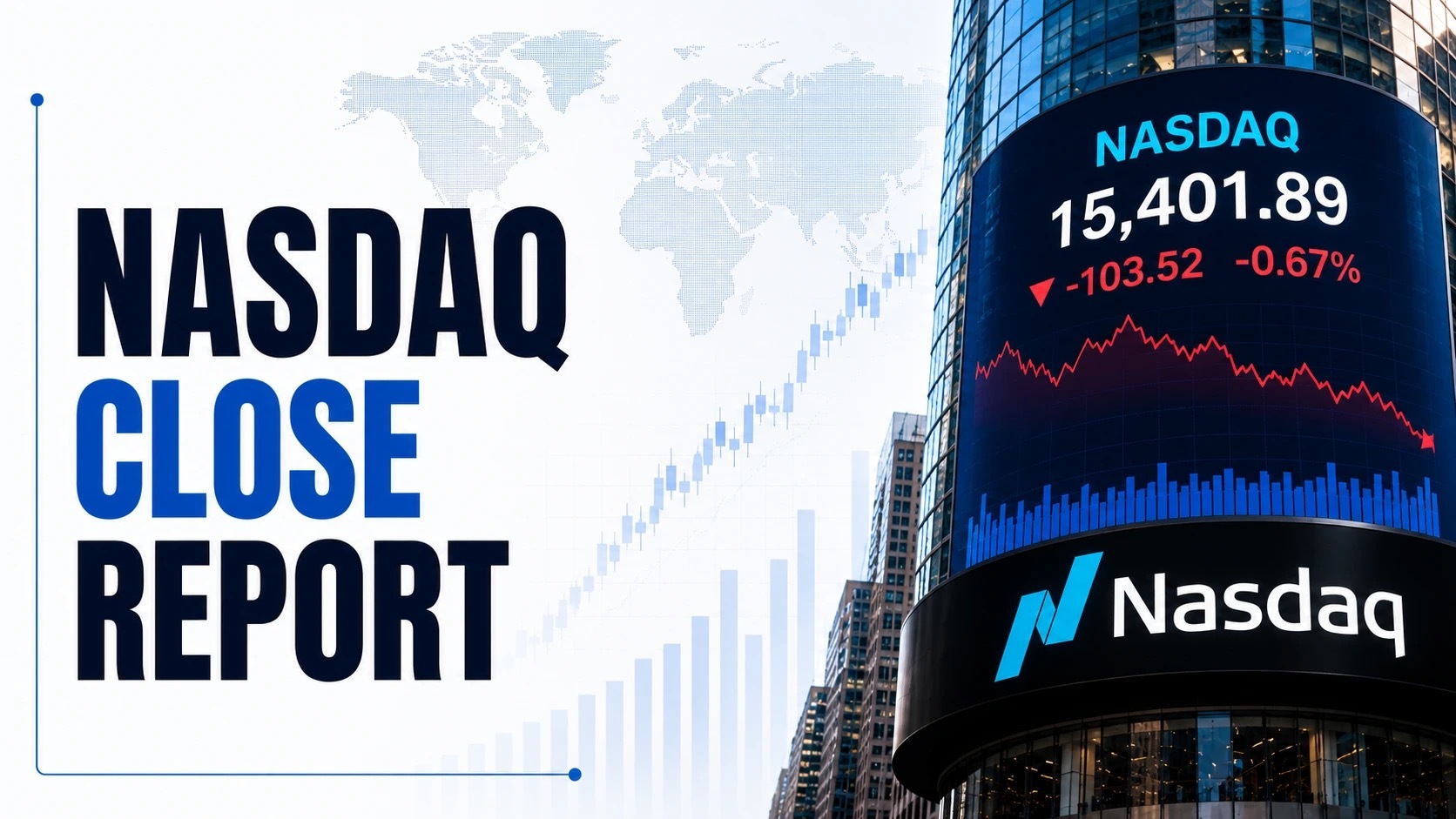
Nasdaq Closes Near Flat at 25,978.42 as Fed Rate Hike Jolts Dow Down 631 Points; Russell 2000 Slides 0.71%
Authored By HDFC SKY | Last Modified: Sep 17, 2026 11:11 AM IST
Open Free Demat Account
Open Free Demat Account
Mumbai, Sept 17: The US equity market ended Wednesday’s volatile session with a sharply divided close as the Federal Reserve delivered its first interest rate hike in more than three years. The technology-heavy Nasdaq Composite absorbed the policy shock to finish nearly unchanged, while the blue-chip Dow Jones Industrial Average bore the brunt of the selling pressure, tumbling over 630 points as investors digested the central bank’s hawkish guidance and the prospect of further tightening before the year ends. The S&P 500 also ended in negative territory, while the small-cap Russell 2000 extended its recent underperformance.

Dow Sinks 631 Points (-1.21%) as Rate-Sensitive Financials Lead Broad Selloff
The Dow Jones Industrial Average closed at 51,462.55, down 630.56 points or 1.21%, marking one of its sharpest single-day declines in recent months. The index opened at 52,115.40 and touched an intraday high of 52,173.70 before the selling intensified during Fed Chair Kevin Warsh’s press conference, ultimately sliding to a session low of 51,186.67. The previous close stood at 52,093.11. Trading volume was recorded at 381.9 million shares, and the average volume stands at approximately 494.7 million.
Financial heavyweights were the primary drag on the 30-stock index. Goldman Sachs tumbled 3.96%, American Express declined 3.63%, JPMorgan Chase dropped 0.99%, and Visa fell 1.22%. Industrial bellwethers also contributed to the weakness, with Boeing sliding 3.71% and IBM plunging 4.40%. On the upside, Honeywell Technologies advanced 2.12%, Merck added 0.78%, and Apple edged up 0.36%, providing only marginal support. The Dow’s 52-week range spans from a low of 45,057.28 to a high of 54,744.33.
S&P 500 Drops 33.49 Points (-0.44%) to 7,552.24; Energy and Materials Buck the Trend
The benchmark S&P 500 settled at 7,552.24, registering a decline of 33.49 points or 0.44%. The index had opened at 7,601.25 and reached an intraday high of 7,626.79 before pulling back sharply to a low of 7,507.77. The prior session’s close was 7,585.73. Volume on the index stood at approximately 2.78 billion shares, below the average of about 5.18 billion. The 52-week range for the S&P 500 extends from 6,316.91 to 7,816.70.
Sectoral performance within the S&P 500 was notably divergent. Energy and materials emerged as the only gainers on Tuesday’s session, with the energy sector advancing 2.26% and materials adding 0.37%, driven primarily by the surge in crude oil prices. However, on Wednesday, the energy sector gave back some of those gains as crude oil prices retreated from recent highs. Consumer discretionary and utilities led the laggards, dropping 1.76% and 1.2% respectively. Information technology was among the few sectors that managed to stay in positive territory during the session, supported by semiconductor names.
Among individual components, Intel surged 4.15%, Advanced Micro Devices climbed 1.69%, and Oracle gained 2.06%. Conversely, IBM plummeted 4.40%, Salesforce declined 1.98%, and General Motors dropped 2.12%. The mixed performance reflected the market’s selective appetite for technology and semiconductor exposure while shunning rate-sensitive and economically sensitive sectors.
Nasdaq Composite Ends at 25,978.42 (-0.01%) as Intel Jumps 4.15% and AMD Gains 1.69%
The Nasdaq Composite closed at 25,978.42, virtually flat with a marginal decline of 3.15 points or 0.01%. The technology-heavy index opened at 26,108.46 and reached an intraday high of 26,225.09, but relinquished most of its gains as the Fed’s policy announcement and subsequent commentary weighed on sentiment. The session low was 25,802.96, and the previous close stood at 25,981.57. Trading volume was substantial at approximately 7.97 billion shares, slightly below the average of about 8.69 billion. The 52-week range for the Nasdaq spans from 20,690.25 to 27,190.21.
Semiconductor stocks provided crucial support to the Nasdaq. Intel emerged as a standout performer, surging 4.15%, while Advanced Micro Devices gained 1.69% and Nvidia added 0.80%. Marvell Technology jumped 3.53%, and ASML Holding advanced 0.66%. Among other notable movers, Palantir Technologies rose 1.04%, and Meta Platforms gained 0.46%. On the losing side, Microsoft declined 1.37%, Netflix fell 1.95%, and T-Mobile US dropped 2.43%. The relative resilience of the Nasdaq compared to the Dow underscored the market’s continued preference for growth-oriented technology exposure even amid a tightening monetary policy environment.
Also Read: What Is the New York Stock Exchange (NYSE)?
Russell 2000 Slips 20.33 Points (-0.71%) to 2,849.96 as Small Caps Extend Losses
The Russell 2000 Index, which tracks the performance of small-capitalisation US companies, closed at 2,849.96, down 20.33 points or 0.71%. The index opened at 2,873.75 and reached an intraday high of 2,887.82 before declining to a low of 2,832.37. The previous close was 2,870.29. The 52-week range for the Russell 2000 extends from 2,303.46 to 3,069.71.
Small-cap stocks have historically been more sensitive to changes in interest rates due to their greater reliance on debt financing and more domestically focused revenue streams. The underperformance of the Russell 2000 relative to the Nasdaq on Wednesday reflected this dynamic, with investors favouring large-cap technology names over smaller, rate-sensitive companies. Notable decliners within the index included several energy-related names such as Magnolia Oil & Gas, which fell 8.63%, and Matador Resources, which declined 8.53%.
S&P 100 Declines 19.02 Points (-0.50%) to 3,751.82 as Mega-Cap Weakness Weighs
The S&P 100 Index, which comprises the largest and most established companies in the S&P 500, closed at 3,751.82, down 19.02 points or 0.50%. The index opened at 3,780.53 and reached an intraday high of 3,791.35, with a session low of 3,734.44. The previous close was 3,770.84, and the 52-week range spans from 3,074.00 to 3,853.17.
The decline in the S&P 100 was driven primarily by weakness in mega-cap financial and industrial names, partially offset by gains in select technology and healthcare constituents. The index’s performance broadly mirrored the S&P 500, reflecting the outsized influence of the largest US corporations on overall market direction.
Dow Jones Composite Falls 240.98 Points (-1.47%) as Transportation and Utility Averages Weaken
The Dow Jones Composite Average, which encompasses 65 stocks across the industrial, transportation, and utility sectors, closed at 16,136.98, down 240.98 points or 1.47%. The index opened at 16,343.55 and reached an intraday high of 16,358.49, with a low of 16,057.67. The previous close was 16,377.96, and the 52-week range spans from 14,090.12 to 17,246.95.
The Dow Jones Transportation Average was a significant drag, closing at 20,075.60, down 574.20 points or 2.78%. The index opened at 20,416.64 and reached an intraday high of the same level, with a low of 19,965.84. The previous close was 20,649.80. The transportation index’s sharp decline reflected growing concerns about the impact of higher fuel costs and elevated interest rates on logistics and shipping companies. The Dow Jones Utility Average ended at 1,047.84, down 0.59 points or 0.06%, with an intraday range of 1,045.45 to 1,056.49. The utility sector’s marginal decline masked broader weakness in rate-sensitive bond proxies, as rising Treasury yields continued to erode the appeal of dividend-paying utility stocks.
Philadelphia Semiconductor Index Rises 70.56 Points (+0.63%) to 11,246.11 on Chip Stock Rebound
The Philadelphia Semiconductor Sector Index (SOX) closed at 11,246.11, gaining 70.56 points or 0.63%. The index opened at 11,347.68 and reached an intraday high of 11,413.46, with a session low of 11,132.26. The previous close was 11,175.55. The 52-week range for the SOX index extends from 5,980.24 to 14,655.29.
The semiconductor sector’s resilience stood in stark contrast to the broader market weakness, with Intel leading the gains following reports that South Korean memory chip giant SK Hynix was exploring a partnership to manufacture memory chips in the United States. Nvidia also contributed to the sector’s advance, rising 0.80% as the artificial intelligence infrastructure trade remained firmly supported. The semiconductor index’s performance underscored the market’s continued willingness to allocate capital to AI-related and chip-making exposure despite the broader macro headwinds.
Also Read: How to invest in US stocks
NYSE Composite Declines 220.84 Points (-0.92%) to 23,907.61 as Breadth Weakens
The NYSE Composite Index closed at 23,907.61, down 220.84 points or 0.92%. The index opened at 24,128.46 and reached an intraday high of 24,188.13, with a low of 23,791.61. The previous close was 24,128.46, and the 52-week range spans from 20,906.44 to 24,866.75. The decline in the NYSE Composite, which encompasses a broad cross-section of US-listed companies across all market capitalisations, reflected the widespread nature of Wednesday’s selling pressure. Declining issues significantly outnumbered advancing ones across the exchange, indicating weak market breadth beneath the surface of the major indices.
S&P MidCap 400 Falls 27.21 Points (-0.74%) and S&P SmallCap 600 Drops 6.99 Points (-0.41%)
The S&P MidCap 400 Index closed at 3,635.29, down 27.21 points or 0.74%. The index opened at 3,662.50 and reached an intraday high of 3,686.40, with a low of 3,608.90. The previous close was 3,662.50, and the 52-week range spans from 3,107.41 to 3,928.98.
The S&P SmallCap 600 Index ended at 1,697.90, down 6.99 points or 0.41%. The index opened at 1,706.63 and reached an intraday high of 1,717.17, with a low of 1,683.79. The previous close was 1,704.89, and the 52-week range extends from 1,364.16 to 1,832.20. The divergence in performance between mid-cap and small-cap indices reflected varying degrees of sensitivity to domestic economic conditions and interest rate changes, with mid-cap companies appearing more vulnerable to the shifting rate environment.
Fed Rate Hike to 3.75%-4.00% Triggers Sharp Reversal; 10-Year Yield Tops 5%
The Federal Reserve’s decision to raise the target federal funds rate by 25 basis points to a range of 3.75% to 4.00% marked its first rate hike since July 2023 and triggered a sharp reversal in equity markets during Chair Kevin Warsh’s press conference. The FOMC vote was unanimous at 12-0, and the central bank’s Summary of Economic Projections signalled at least one additional rate hike before the end of 2026.
Market expectations had largely priced in the rate hike, with Fed fund futures indicating a 91%-93% probability of a 25-basis-point increase ahead of the announcement. However, Warsh’s hawkish commentary — emphasising that “inflation is too high and has been for too long” — caught investors off guard and prompted a reassessment of the trajectory for monetary policy. The 10-year Treasury yield, which had retreated to approximately 4.95% immediately following the Fed decision, climbed back above the psychologically significant 5.00% level as Warsh spoke, reaching approximately 5.01%.
Long-dated bond yields rose across the curve, with the 30-year Treasury yield trading at approximately 5.33% and the 2-year yield at approximately 4.70%. The yield curve movements reflected the market’s recalibration of expectations for the pace of future rate increases and the persistence of elevated inflation.
Energy Sector Retreats as Brent Crude Pulls Back from $109; Gold Gains 1.19%
Crude oil prices remained above $100 per barrel but retreated from their recent highs during Wednesday’s session. Brent crude futures, the international benchmark, declined 1.48% to $107.14, while West Texas Intermediate (WTI) crude fell 2.12% to $103.58. The pullback followed a sharp rally earlier in the week, when Brent briefly approached $109 per barrel amid escalating geopolitical tensions in the Middle East and concerns over supply disruptions.
Gold futures advanced 1.19% to $4,343.37, reflecting continued demand for defensive assets amid elevated inflation and geopolitical uncertainty. The US Dollar Index (DXY) edged up 0.07% to 99.69, maintaining its recent strength as the Fed’s hawkish stance reinforced the dollar’s yield advantage. The euro was little changed at 1.154, while the Japanese yen remained under pressure at 155.237 against the dollar.
Retail Sales Jump 1.2% in August; Consumer Spending Defies Inflation Pressures
The US Census Bureau reported that retail sales rose 1.2% in August, rebounding from a revised decline of 0.5% in July and exceeding the consensus estimate of a 0.9% increase. Retail sales excluding autos, auto parts, and gas also rose 1.2% month over month, with nearly all categories recording gains. The stronger-than-expected consumer spending data highlighted the resilience of US households despite persistent inflation pressures and elevated energy costs.
The data was released ahead of the Fed’s policy decision and added to the case for continued monetary tightening. The August retail sales figures suggested that consumer demand remained robust enough to support economic growth, potentially complicating the Fed’s efforts to bring inflation back towards its 2% target.
Also Read: US Stock Market Timings
Energy and Materials Struggle as Information Technology Holds Ground
Sector performance within the S&P 500 reflected the market’s selective positioning ahead of and following the Fed decision. Information technology was among the few sectors to maintain positive momentum, supported by semiconductor strength. Financials were the weakest performers, with the sector declining approximately 0.48% as higher rates raised concerns about lending growth and credit quality. Energy, which had been the standout performer earlier in the week, gave back some gains as crude prices retreated. Utilities and consumer discretionary also underperformed, weighed down by rising Treasury yields and concerns about the sustainability of consumer spending.
Communication services and healthcare were mixed, with select names in both sectors finding support while broader sector performance remained subdued. Real estate and materials traded in negative territory, reflecting the broader risk-off sentiment that pervaded the session.
Notable Gainers and Losers as Market Breadth Weakens
Among the top gainers on the day, Arcutis Biotherapeutics surged 11.19%, AXT jumped 11.44%, and Cipher Digital climbed 10.80%. Amneal Pharmaceuticals advanced 8.59%, Coherent Corp gained 6.81%, and Credo Technology Group rose 7.38%.
On the losing side, J.B. Hunt Transport Services plunged 13.30% after the company warned of a sequential decline in third-quarter earnings. Webull Corporation declined 11.20%, Pulse Biosciences fell 10.13%, and Bullish dropped 9.55%. ON Semiconductor tumbled 9.02%, and Magnolia Oil & Gas declined 8.63%.
The divergence between gainers and losers underscored the market’s highly selective approach, with investors favouring companies with idiosyncratic catalysts while shunning those facing company-specific headwinds.
Semiconductor Stocks Show Resilience While Financials and Energy Face Pressure
Semiconductor stocks demonstrated notable resilience amid the broader market turbulence, with Intel, AMD, Nvidia, and Marvell Technology all posting gains. The sector benefited from continued investor interest in artificial intelligence infrastructure and reports of potential US-based manufacturing partnerships. Financial stocks faced the brunt of the selling pressure as rising Treasury yields raised concerns about net interest margins, loan demand, and credit quality. Big banks, including Goldman Sachs, American Express, Bank of America, and Wells Fargo, all declined significantly. Energy stocks, which had been the beneficiaries of the oil price rally earlier in the week, retreated as crude prices pulled back from recent highs. The technology sector’s relative strength contrasted sharply with the weakness in financials and energy, highlighting the market’s preference for growth-oriented exposure in the current environment.
Also Read: What Are Fractional Shares?
Fed Rate Decision, Oil Prices, and Treasury Yields Drive Market Sentiment
The Federal Reserve’s rate hike, surging oil prices, and elevated Treasury yields collectively shaped Wednesday’s market action. The Fed’s decision to raise rates for the first time in more than three years, coupled with Chair Warsh’s hawkish commentary, prompted a sharp reassessment of the trajectory for monetary policy and its implications for economic growth.
The 10-year Treasury yield’s move back above 5%, a level not seen since 2007, reinforced concerns about the cost of borrowing for businesses and consumers. Elevated crude oil prices, while retreating from their session highs, remained a key source of inflation risk. Global equity markets were mostly positive, with the FTSE gaining 0.40%, the DAX rising 0.38%, and the Nikkei 225 advancing 0.69%, suggesting that investors were willing to add risk despite the uncertainty surrounding US monetary policy.
The Federal Reserve’s first rate hike in over three years, combined with Chair Warsh’s hawkish inflation assessment, reshaped market expectations for the remainder of 2026. Investors should monitor the trajectory of the 10-year Treasury yield, which has reclaimed the 5% threshold, alongside the Fed’s updated dot plot for signals on the pace of future tightening. Elevated crude oil prices above $100 per barrel and persistent inflation readings will remain critical variables influencing both monetary policy and sector-level performance across US equity markets.
Source
- https://www.nasdaq.com/
- spglobal.com/spdji/en/indices/equity/sp-500/
- https://www.dowjones.com/
- https://www.spglobal.com/spdji/en/indices/equity/dow-jones-industrial-average/
- https://www.spglobal.com/spdji/en/indices/equity/sp-500/
- https://www.nasdaq.com/market-activity/index/comp
- https://www.nasdaq.com/market-activity/quotes/nasdaq-ndx-index
- https://www.spglobal.com/spdji/en/indices/equity/sp-100/
- https://www.lseg.com/en/ftse-russell/indices/russell-us
- https://www.nyse.com/index
- https://www.nyse.com/index
- https://www.spglobal.com/spdji/en/indices/equity/dow-jones-transportation-average/
- https://www.spglobal.com/spdji/en/indices/equity/dow-jones-utility-average/
- https://www.spglobal.com/spdji/en/indices/equity/dow-jones-composite-average/
- https://www.nasdaq.com/market-activity/index/sox
- https://www.cboe.com/tradable_products/vix/
Disclaimer
At HDFC SKY*, we take utmost care and due diligence in curating and presenting news and market-related content. However, inadvertent errors or omissions may occasionally occur.
If you have any concerns, questions, or wish to point out any discrepancies in our content, please feel free to write to us at content@hdfcsec.com.
Please Note: The information shared is intended solely for informational purposes and does not make any investment recommendations.
HDFC SKY from HDFC Securities, one of most trusted trading platforms in India, has been recognized with the *Next-Gen Digi Content Awards 2025-26.
 Join Us
 Add as preferred source on Google


More International News



Open Free Demat Account
Open Free Demat Account











Invest Anytime, Anywhere


By signing up I certify terms, conditions & privacy policy