Nifty 50
- HDFC Life Insurance ₹558.6028.40 (5.36%)
- ONGC₹232.96-3.84 (-1.62%)
- SBI Life Insurance ₹1,763.4065.50 (3.86%)
- Bajaj Auto₹11,476-117.00 (-1.01%)
- Dr. Reddy's Labs₹1,173.2033.20 (2.91%)
- Titan Company₹4,864-44.50 (-0.91%)
- Bharat Electronics₹395.509.75 (2.53%)
- HDFC Bank₹716.35-5.15 (-0.71%)
- InterGlobe Aviation₹4,845.50112.00 (2.37%)
- HCL Technologies₹1,245-8.00 (-0.64%)
- Eternal₹324.457.45 (2.35%)
- Infosys₹1,053.40-6.60 (-0.62%)
- Jio Financial ₹229.945.10 (2.27%)
- Nestle₹1,376.20-8.30 (-0.60%)
- Shriram Finance₹998.9019.90 (2.03%)
- Coal India₹420.10-2.15 (-0.51%)
- Tata Motors PV₹306.155.15 (1.71%)
- ICICI Bank₹1,355-3.80 (-0.28%)
- Tata Consumer ₹1,016.9016.80 (1.68%)
- Grasim Industries₹3,179.10-7.90 (-0.25%)

- Offerings
- Tools & Platforms
Tools & Calculators
- Open API
- Calculators
- SIP Calculator
- CAGR Calculator
- Compound Interest Calculator
- FD Calculator
- RD Calculator
- EPF Calculator
- Retirement Calculator
- HDFC SIP Calculator
- Mutual Fund Return Calculator
- Lumpsum Calculator
- Step Up SIP Calculator
- ETF SIP Calculator
- Brokerage Calculator
- Equity Margin Calculator
- SWP Calculator
- EMI Calculator
- MTF Calculator
- Margin Pledge Calculator
- Algo Strategy
- Markets
Stocks
F&O
Mutual Funds
- More
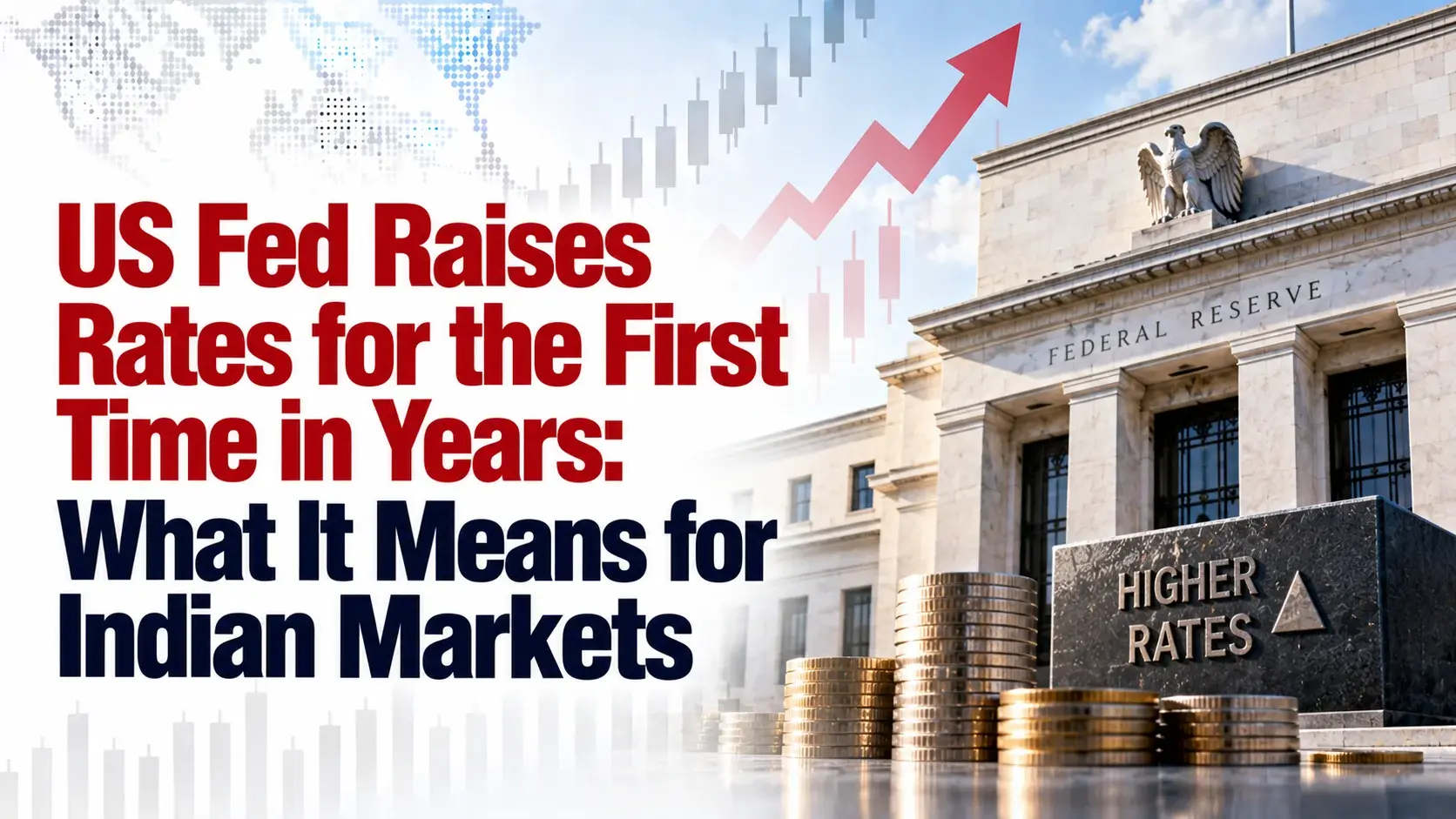
US Fed Raises Rates for the First Time in Years: What It Means for Indian Markets
Authored By HDFC SKY | Last Modified: Sep 17, 2026 12:38 PM IST
Open Free Demat Account
Open Free Demat Account
Mumbai, Sept 17: The US Federal Reserve raised interest rates on Wednesday, lifting its benchmark overnight rate by a quarter of a percentage point to the 3.75-4.00 per cent range, with new central bank chief Kevin Warsh joining a unanimous decision. The move effectively acknowledges the Trump administration’s struggle to control inflation, which policymakers worry could worsen further. The Fed cited a combination of Trump’s global import tariffs, an energy shock following the start of the US-Israeli war with Iran, and heavy capital spending tied to the artificial intelligence boom as the reasons price pressures remained too intense to hold rates steady.
Updated quarterly projections showed 16 of 18 policymakers now expect at least one more quarter-point hike by the end of this year, with only two seeing rates staying stable from here. All but one policymaker flagged upside risks to inflation that they no longer attribute mainly to one-off supply shocks. Warsh, who has not submitted his own rate or economic projections, said the tightening also reflects an economy he sees picking up speed, with strong growth and job data adding to price pressures that are no longer rooted solely in oil costs or tariffs.
For Indian markets, a genuine US rate hike, rather than the rate cuts many investors had been positioning for earlier this year, marks a meaningful shift in the global monetary backdrop. Here’s how it could play out for Indian stocks and investors:
- Foreign portfolio flows could turn more cautious. Higher US rates make American treasuries and dollar-denominated assets more attractive relative to emerging markets like India, which could slow or reverse foreign institutional investor (FII) inflows into Indian equities. A sustained FII pullback would weigh most heavily on large-cap, FII-heavy stocks and sectors such as banking and IT.
- The rupee faces fresh depreciation pressure. A widening interest rate differential between the US and India typically strengthens the dollar against emerging-market currencies. A weaker rupee would raise import costs, particularly with crude oil already elevated because of the Gulf conflict, adding to India’s current account and inflation concerns.
- IT and export-oriented stocks face a mixed setup. A stronger dollar is a near-term tailwind for IT exporters like TCS, Infosys, Wipro and HCL Technologies, since their revenues are dollar-denominated and translate into more rupees. However, the same rate hike signals a more hawkish US economic environment, which could dampen US corporate technology spending, a headwind for the sector’s growth outlook.
- Rate-sensitive domestic sectors could see pressure. Sectors such as real estate, auto and non-banking financial companies (NBFCs), which are sensitive to borrowing costs and global liquidity conditions, could see selling pressure if the Fed’s hawkish signal pushes global bond yields higher and raises borrowing costs for Indian companies with dollar-denominated debt.
- The Reserve Bank of India’s own rate path narrows. With the Fed now hiking rather than cutting, the RBI has less room to ease domestic rates without risking further rupee weakness, since a large rate gap between the two central banks could accelerate capital outflows. This could push the RBI toward a more cautious, wait-and-watch stance on its own policy in the coming months.
- Gold and defensive sectors may see continued interest. Rate hikes paired with persistent inflation and geopolitical risk have historically supported gold as a hedge, a trend already visible in India’s gold ETF rally this week. FMCG and other defensive, domestically focused sectors could also see relative outperformance if investors rotate away from rate-sensitive and export-dependent stocks.
Taken together, the Fed’s shift from an expected rate-cutting cycle to a renewed hiking cycle changes the calculus for Indian markets on multiple fronts at once: flows, the currency, borrowing costs and sector rotation. The scale of the actual impact will depend heavily on how aggressively the Fed follows through on further hikes signalled for later this year, and on whether the Iran-Saudi conflict and its effect on oil prices ease or continue to escalate in parallel.
Source
- https://www.federalreserve.gov/newsevents/pressreleases/monetary20260916a.htm
Disclaimer
At HDFC SKY*, we take utmost care and due diligence in curating and presenting news and market-related content. However, inadvertent errors or omissions may occasionally occur.
If you have any concerns, questions, or wish to point out any discrepancies in our content, please feel free to write to us at content@hdfcsec.com.
Please Note: The information shared is intended solely for informational purposes and does not make any investment recommendations.
HDFC SKY from HDFC Securities, one of most trusted trading platforms in India, has been recognized with the *Next-Gen Digi Content Awards 2025-26.
 Join Us
 Add as preferred source on Google


More Business News




Open Free Demat Account
Open Free Demat Account









Invest Anytime, Anywhere


By signing up I certify terms, conditions & privacy policy