Nifty 50
- Bharti Airtel₹1,862.7068.10 (3.79%)
- Trent₹2,921.20-49.80 (-1.68%)
- Tech Mahindra₹1,629.2054.00 (3.43%)
- Nestle₹1,369.20-14.00 (-1.01%)
- HCL Technologies₹1,367.2040.20 (3.03%)
- Bharat Electronics₹380.40-1.95 (-0.51%)
- Maruti Suzuki₹11,501323.00 (2.89%)
- Adani Enterprises₹2,709-13.60 (-0.50%)
- Reliance Industries₹1,207.7033.10 (2.82%)
- ONGC₹224.60-0.90 (-0.40%)
- ICICI Bank₹1,374.8036.20 (2.70%)
- Titan Company₹4,437.30-6.70 (-0.15%)
- TCS₹2,362.9058.00 (2.52%)
- JSW Steel₹1,202.3026.10 (2.22%)
- Infosys₹1,111.9523.95 (2.20%)
- Mahindra & Mahindra₹2,84955.30 (1.98%)

- Offerings
- Tools & Platforms
Tools & Calculators
- Open API
- Calculators
- SIP Calculator
- CAGR Calculator
- Compound Interest Calculator
- FD Calculator
- RD Calculator
- EPF Calculator
- Retirement Calculator
- HDFC SIP Calculator
- Mutual Fund Return Calculator
- Lumpsum Calculator
- Step Up SIP Calculator
- ETF SIP Calculator
- Brokerage Calculator
- Equity Margin Calculator
- SWP Calculator
- EMI Calculator
- MTF Calculator
- Margin Pledge Calculator
- Algo Strategy
- Markets
Stocks
F&O
Mutual Funds
- More
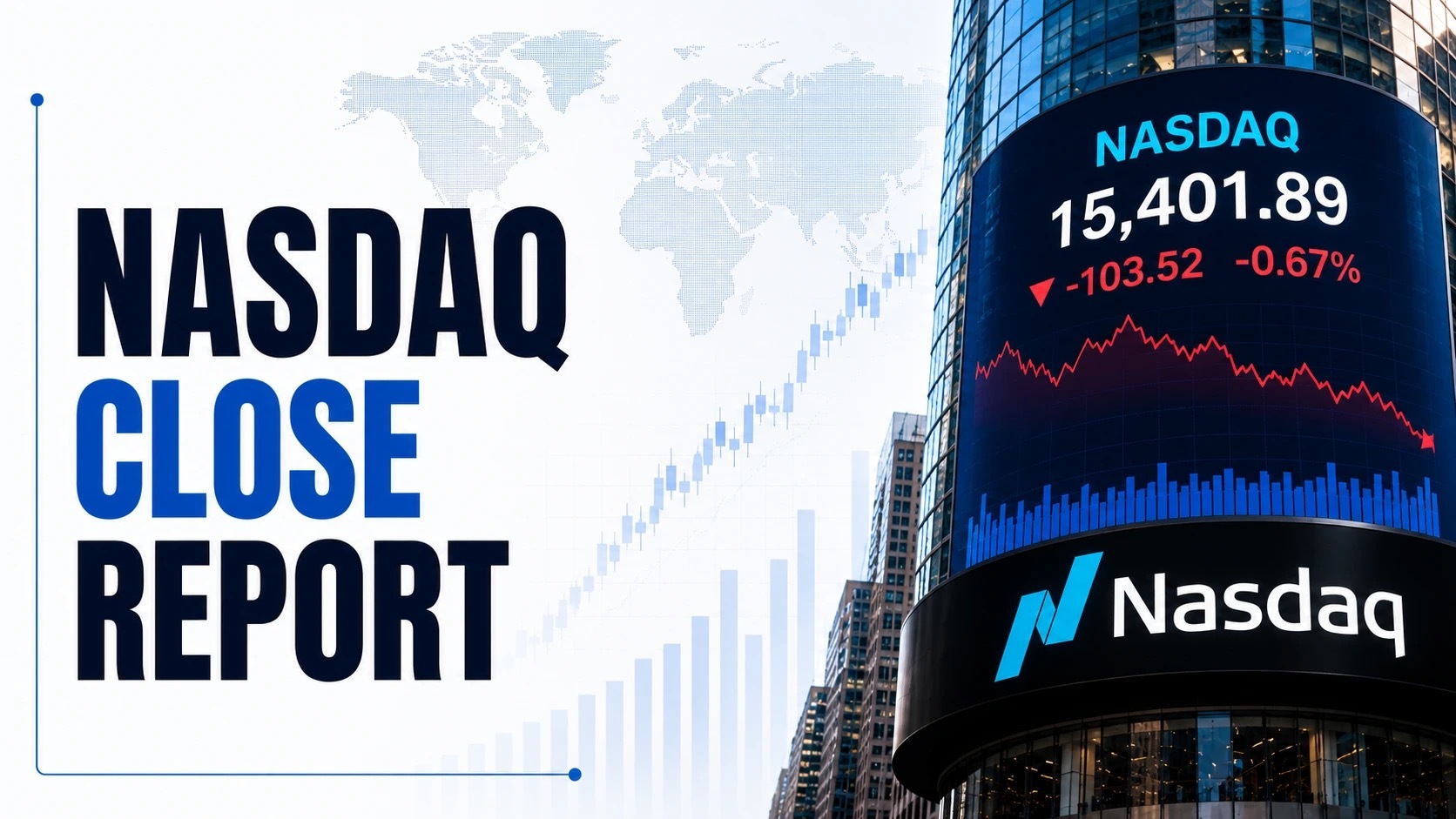
Nasdaq Falls 1.88%, S&P 500 Drops 1.11% and Dow Jones Slips 0.09% as Hot Inflation Fuels Fed Rate Hike Fears and Tech Sell-Off
Authored By HDFC SKY | Last Modified: Oct 15, 2026 09:16 AM IST
Open Free Demat Account
Open Free Demat Account
Mumbai, 14 October 2026: US equities closed sharply lower on Wednesday as hotter-than-expected September inflation data revived expectations of a Federal Reserve rate hike, while a deepening sell-off in semiconductor and artificial intelligence-related shares weighed heavily on technology benchmarks.
The S&P 500 fell 1.11% to 7,718.94, the Nasdaq Composite dropped 1.88% to 26,692.87, and the Dow Jones Industrial Average lost 48.62 points, or 0.09%, to close at 51,621.48. The session was defined by a sharp divergence beneath headline indices, with energy and defensive sectors providing partial support while rate-sensitive technology and financial shares bore the brunt of selling pressure.

Dow Jones Falls 49 Points as Inflation Fears Offset Healthcare Gains
The Dow Jones Industrial Average opened at 51,684.75 and closed at 51,621.48, registering a loss of 48.62 points, or 0.09%. The index touched an intraday high of 51,869.75 and a low of 51,365.42 during the session. Movements in key constituents shaped the index’s performance, with NVIDIA falling 2.94%, Amazon declining 2.25%, and Microsoft shedding 1.35%.
On the upside, Home Depot advanced 3.39%, Chevron gained 3.12%, and IBM rose 2.77%. The session followed the release of September consumer price data that exceeded economists’ expectations, which affected trading across major US equities.
Among the top gainers within the Dow, Home Depot led with a 3.39% advance, followed by Chevron at 3.12% and IBM at 2.77%. Merck added 2.68%, and McDonald’s rose 2.61%. On the losing side, NVIDIA was the biggest drag with a 2.94% decline, while Amazon fell 2.25% and Caterpillar dropped 2.17%. Microsoft lost 1.35%, and UnitedHealth declined 1.34%.
S&P 500 Drops 1.11% as Energy Rally Fails to Offset Technology Declines
The S&P 500 opened at 7,774.18 and ended at 7,718.94, recording a loss of 86.51 points, or 1.11%. During the session, the index reached a high of 7,789.15 and a low of 7,693.31. Movements across sectors were sharply divided, with energy shares posting the strongest gains while technology and semiconductor-related constituents lagged significantly.
Notable movers included Accenture, which surged 5.96%, Marathon Petroleum at 4.77%, and Valero Energy at 4.65%. On the downside, Oracle fell 5.48%, Corning declined 6.38%, and Applied Materials dropped 2.13%. The index’s closing performance came as investors assessed the hotter-than-expected CPI report alongside persistent weakness in memory chip stocks. The top gainers within the S&P 500 included Accenture at 5.96%, Marathon Petroleum at 4.77%, Valero Energy at 4.65%, and Phillips 66 at 4.05%. PepsiCo rose 3.73%, and Home Depot gained 3.39%. The top losers included Dell Technologies at -11.76%, Corning at -6.38%, Oracle at -5.48%, and Applied Materials at -2.13%.
Nasdaq Falls 1.88% as Technology Shares Retreat on Rate Concerns
The Nasdaq Composite opened at 27,031.64 and closed at 26,692.87, marking a loss of 511.51 points, or 1.88%. Its intraday high stood at 27,134.29, while the low was 26,602.12. Technology and growth-oriented shares, including NVIDIA (-2.94%), Broadcom (-4.35%), Micron Technology (-4.79%), Intel (-5.34%), and AMD (-3.90%), recorded notable declines, contributing to the index’s daily performance. The technology-heavy benchmark responded to the inflation data and elevated Treasury yields during the session.
The Nasdaq 100 heatmap reflected widespread weakness, with Arm Holdings falling 6.48%, Applied Materials down 2.13%, and Lam Research losing 2.71%. Among the few gainers, Apple rose 1.11%, Netflix gained 2.68%, and Adobe advanced 3.56%. CoreWeave sank nearly 17% to lead Nasdaq 100 decliners, while Nebius Group fell 10%.
The top gainers within the Nasdaq Composite included JBDI Holdings at 251.79%, Alaunos Therapeutics at 187.14%, and Pinnacle Food Group, while the top losers included Applied Optoelectronics at -11.82%, MaxLinear at -11.08%, and Hut 8 Corp at -10.45%.
Also Read: How to invest in US stocks
Russell 2000 Falls 1.93% as Smaller Stocks Hit Four-Month Low
The Russell 2000 opened at 2,767.05 and closed at 2,729.53, losing 53.84 points, or 1.93%. It recorded an intraday high of 2,767.05 and a low of 2,720.04. The index fell to a four-month low during the session, with the RSI reading signalling deeply oversold conditions for small-cap shares.
Movements among smaller-cap companies, including Hut 8 Corp (-10.87%), Riot Platforms (-9.17%), and Cypher Digital (-12.35%), contributed to the benchmark’s performance. Among the gainers, Haemonetics Corporation surged 17.46%, Veradermics gained 14.13%, and Erasca rose 9.49%. On the losing side, Applied Optoelectronics fell 11.82%, and MaxLinear dropped 11.08%.
S&P 100 Declines 1.10% as Large-Cap Shares Track Inflation Data
The S&P 100 opened at 3,878.84 and finished at 3,849.76, recording a loss of 42.72 points, or 1.10%. The index traded between 3,891.00 and 3,838.08 during the session. Movements in major large-cap constituents reflected the broader market’s response to the inflation report, with technology names under pressure while energy and defensive shares provided some stability. The index’s 52-week high stands at 3,914.19 and the low at 3,074.00.
Dow Composite Falls 0.05% as Transport and Utility Indices Diverge
The Dow Jones Composite Average opened at 16,150.98 and closed at 16,150.86, losing 8.66 points, or 0.05%, after moving between 16,192.47 and 16,055.75. The Dow Jones Transportation Average ended at 19,829.96, compared with an opening level of 19,784.90, representing a gain of 0.10%. The Dow Jones Utility Average closed at 1,065.43, changing -0.14% from its opening level of 1,065.05. Movements in relevant constituents reflected the mixed performance across industrial, transportation, and utility shares during the session.
Philadelphia Semiconductor Index Falls 4.30% as Chip Stocks Extend Rout
The Philadelphia Semiconductor Index (SOX) opened at 11,960.04 and closed at 11,684.38, losing 524.41 points, or 4.30%. Its intraday high was 12,022.21, while the low was 11,638.92. Semiconductor-related constituents such as NVIDIA (-2.94%), Broadcom (-4.35%), Micron (-4.79%), and Intel (-5.34%) contributed to the sector benchmark’s daily performance amid escalating concerns over AI infrastructure spending and rising borrowing costs.
The index has now fallen for six consecutive sessions, a streak in which it has declined more than 10%, marking its longest losing streak since May 2025. Applied Optoelectronics fell 11.82%, and MaxLinear dropped 11.08% within the semiconductor space. Arm Holdings declined 6.48%, and Coherent Corp lost 9.19%, reflecting the breadth of the sell-off across chip-related shares.
NYSE Composite Falls 0.50% as Broader Shares Track Inflation Data
The NYSE Composite Index opened at 23,867.04 and closed at 23,865.42, recording a loss of 119.58 points, or 0.50%. The index traded between 23,919.08 and 23,763.26 during the session. Movements across energy, healthcare, and financial segments contributed to its performance as the inflation report shaped broader US equity trading. The index’s 52-week high stands at 24,866.75 and the low at 20,906.44.
Also Read: US Stock Market Timings
S&P MidCap 400 Falls 1.30% and SmallCap 600 Drops 1.56%
The S&P MidCap 400 opened at 3,642.08 and closed at 3,611.25, moving -47.46 points, or -1.30%, with an intraday range of 3,592.17–3,642.08. The S&P SmallCap 600 opened at 1,664.99 and ended at 1,647.00, losing 26.09 points, or 1.56%, after trading between 1,638.21 and 1,664.99. The two benchmarks reflected movements among mid- and small-cap shares as the inflation data and elevated Treasury yields affected the wider market.
CPI at 3.7% Drives Session as Rate Hike Odds Rise Sharply
The principal market catalyst was the September Consumer Price Index (CPI) report released by the Bureau of Labour Statistics. The CPI rose 0.6% month-over-month, in line with expectations, while the year-over-year reading came in at 3.7%, exceeding the 3.6% consensus estimate and accelerating from 3.4% in August. Core CPI, which excludes volatile food and energy prices, rose 0.3% monthly and 2.6% annually, both slightly above expectations of 0.2% and 2.5% respectively.
The report showed that gasoline prices surged 34.2% over the last 12 months, contributing significantly to the headline figure. Following the release, traders priced in a 37% likelihood of a Federal Reserve rate hike at its October 27-28 meeting, up from 22% before the data, and a 91% probability of at least a quarter-point increase by December, according to CME FedWatch.
The inflation report coincided with commentary from Federal Reserve officials. New York Fed President John Williams indicated the central bank may need to raise rates once more this year but saw no need for further hikes in 2027. Fed Vice Chair for Supervision Michelle Bowman stated there was no urgency for further action, saying, “I don’t feel any urgency for taking further action at this point; we really need to take some time and understand how things will evolve”.
The Fed’s Beige Book report, released Wednesday afternoon, showed that higher oil prices permeated all District reports, with firms reporting elevated diesel prices and noting that fuel surcharges were passing on increased costs throughout the supply chain.
VIX Rises 10.22% to 16.83 as Volatility Expectations Increase
The CBOE Volatility Index (VIX) rose 10.22% to 16.83, compared with its previous close of 15.27. The index, which measures expected volatility in the S&P 500 over the coming 30 days, traded between 14.98 and 17.45 during the session. Its movement during the session coincided with the hotter-than-expected inflation report and the sell-off in technology and semiconductor shares.
Eight of Eleven S&P 500 Sectors Decline as Energy Leads Gains
Performance across the 11 S&P 500 sectors was broadly lower, with eight sectors ending in the red. Energy recorded the strongest move at +1.80%, supported by rising crude oil prices and renewed attacks on Saudi energy infrastructure. Health Care was the worst-performing sector, declining 1.35%, weighed down by Johnson & Johnson’s 5.73% tumble.
The remaining sectors recorded the following moves: Information Technology -1.2%, Communication Services +0.74%, Consumer Discretionary -0.3%, Consumer Staples -0.3%, Financials -0.42%, Industrials -0.5%, Utilities -0.2%, Real Estate -0.3%, and Materials -0.4%.
The sector movements followed the inflation data release, which particularly pressured rate-sensitive technology and financial shares while supporting energy and defensive names.
Apple Gains 1.11% as Magnificent Seven Stocks Show Mixed Performance
Among the Magnificent Seven, Apple moved +1.11%, NVIDIA changed -2.94%, and Microsoft recorded -1.35%. Amazon declined 2.25%, Alphabet fell 0.63%, Meta Platforms slipped 0.06%, and Tesla lost 0.74%. Their daily movements contributed to the performance of major US equity benchmarks, with the Roundhill Magnificent Seven ETF (MAGS) declining 2%. Apple’s market capitalisation once again crossed the $5 trillion mark in intraday trading, just months after it first touched the threshold in late July.
Semiconductor Stocks Fall 4.30% as AI Infrastructure Shares Slump
Semiconductor stocks were sharply lower, with the Philadelphia Semiconductor Index moving -4.30%. Memory stocks headed lower for a third consecutive day, with SK Hynix, Micron Technology (-4.79%), SanDisk (-4.90%), Seagate Technology (-4.05%), and Western Digital (-2.99%) all in the red. The broader iShares Semiconductor ETF (SOXX) fell 4.5%. Financial stocks recorded a decline, with the S&P 500 Banks Index hitting a more than four-month low, down 1.3%.
Bank of America shares sank nearly 5% after the banking giant’s third-quarter revenue missed expectations and it was hit with more than $1.2 billion in federal penalties. Energy stocks moved higher alongside changes in crude oil prices, with ExxonMobil, Chevron, and ConocoPhillips hitting all-time intraday highs as crude prices climbed above $95 per barrel. AI and growth stocks were lower, with CoreWeave plummeting more than 15% and Oracle declining almost 9%, as investors’ concerns about technology companies using too much debt to fuel the AI boom came to the fore.
Also Read: What Is the New York Stock Exchange (NYSE)?
September CPI at 3.7% Exceeds Expectations as Gasoline Prices Surge
The latest economic data showed the September Consumer Price Index at 3.7% year-over-year, compared with 3.4% in August and above the 3.6% expectation. Month-over-month, CPI rose 0.6%, in line with expectations. Core CPI stood at 2.6% annually, while the monthly core reading recorded 0.3%.
The releases provided the latest information on inflation during the session, with gasoline prices rising 34.2% over the last 12 months and the national average for a gallon of gas at $4.33, compared to about $3.08 a year earlier.
Fed Rate Hike Odds Rise to 37% as Treasury Yields Retreat Late
The Federal Reserve remained a key focus as markets assessed the inflation data and its implications for monetary policy. Following the report, the implied probability of a rate hike at the Fed’s October 27-28 meeting rose to approximately 37% from 22% before the data, while the likelihood of at least a quarter-point increase by December stood at 91%, up from 88%.
The 2-year US Treasury yield stood at 4.823%, while the 5-year yield was 4.899%. The 10-year Treasury yield stood at 5.19%, and the 30-year yield was 5.58%. The yield curve changed as Treasury trading reflected shifting rate expectations, with yields initially jumping after the CPI release before pulling back in late-afternoon trading. Brent Crude Above $106 as Gold Falls 1.3% on Dollar Strength; Dollar Index Rises 0.68% to 102.86 as Rate Expectations Shift
Brent Crude Holds Above $106 as IEA Warns Diesel Tightness Extends Into 2027
Brent crude traded at $106.10, changing +0.4%, while WTI crude stood at $95.15, moving +1.1%. Oil prices edged higher after two vessels were struck in the Strait of Hormuz, and Iranian officials said they were deploying new tactics to target ships. The session also followed reports that an administrative building of Saudi Arabian state oil giant Saudi Aramco was struck by neighbouring Yemen’s Houthi rebels. US crude oil prices were up 4% for the week and trading above $95 per barrel as fighting escalated in the Middle East.
The move in crude coincided with record intraday highs for major US oil producers. ExxonMobil hit $177.36, Chevron touched $222.20, and ConocoPhillips reached $142.50, before shares pulled back slightly from those levels. The International Energy Agency (IEA) warned in its October Oil Market Report that constraints on the diesel market would extend well into 2027, with supply remaining tight into the latter half of next year. The IEA said a counter-seasonal tightening in gasoil markets in the third quarter, combined with much heavier-than-normal inventory declines in the preceding three months, had deprived global gasoil markets of crucial stock cover ahead of the peak winter demand season. Global diesel exports dropped by 700,000 barrels per day year-on-year last month, while a 1.3 million barrels per day loss from Russia and the Middle East was only partly offset by higher supply from other sources.
The fuel backdrop also remained elevated for consumers. Gasoline prices topped $4 a gallon for a record 158 days, breaking the 2022 record of 157 days, according to GasBuddy analysis. The national average stood at $4.33 a gallon, compared with about $3.08 a gallon a year earlier. The IEA warning and the Strait of Hormuz attacks formed the main supply-side developments shaping crude trading during the session.
Gold Falls 1.3% as Dollar Index Hits 102.86 on Rate Hike Expectations
Gold extended losses for a third straight session as stronger-than-expected US inflation data increased Federal Reserve rate hike bets for this month. Spot gold dropped 1.7% to $4,086.06 per ounce by 9:03 a.m. EDT, its lowest since 7 October. US gold futures for December delivery fell 1.6% to $4,108.60 per ounce. Later in the session, gold futures pulled back 1.3% to $4,120 an ounce. The move followed the September Consumer Price Index (CPI) report, which showed headline inflation at 3.7% year-on-year, above the 3.6% expected by economists, while core CPI rose 2.6%, above the 2.5% consensus estimate.
The US Dollar Index (DXY), which measures the greenback against a basket of six currencies, rose 0.68% to 102.86, its highest since April 2025, shaking off the previous day’s losses. The dollar had earlier risen 0.3% against a basket of currencies as US Treasury yields shot higher and stock futures fell following the inflation release.
The report firmed up expectations for another rate rise as early as this month. Traders had priced interest-rate futures for about a 22% chance of an October rate hike before the data. After the report, the implied probability of a rate hike at the Fed’s 27-28 October meeting rose to around 40%.
The currency and rate backdrop moved together with Treasury yields. The 2-year US Treasury yield, which is most sensitive to shifts in expectations for inflation and monetary policy, leapt 7 basis points to 4.872%, from around 4.77% earlier. The 10-year Treasury yield rose 6.6 basis points to 5.283%, while the 30-year bond yield rose 2.9 basis points to 5.592%.
Later in the afternoon, the 10-year yield was at 5.19%, down two basis points from Tuesday’s close and from a post-CPI jump to 5.33%. The 2-year yield was last up 2.98 basis points at 4.823%. Federal Reserve officials offered differing views during the session. Vice Chair for Supervision Michelle Bowman said there was no urgency for further action, while New York Fed President John Williams signalled one more rate hike this year and none in 2027. The Fed’s Beige Book report also showed that higher oil prices permeated all District reports, with firms reporting elevated diesel prices and passing on increased costs through the supply chain.
The closing session was shaped by September CPI at 3.7%, which exceeded expectations, alongside a deepening sell-off in semiconductor and AI infrastructure shares. The major US indices finished lower, with the Nasdaq falling 1.88% and the S&P 500 declining 1.11%. Energy and defensive sectors provided partial support, while technology and financial shares faced pressure. These figures provide a factual summary of the session and its key market developments.
Disclaimer
The information shared here is intended solely for informational and educational purposes and does not constitute investment recommendations. While we practice strict due diligence in curating daily market data, readers must perform independent research before trading. To flag any real-time data discrepancies or content concerns, please write to us at content@hdfcsec.com.
 Join Us
 Add as preferred source on Google


More International News






Open Free Demat Account
Open Free Demat Account












Invest Anytime, Anywhere


By signing up I certify terms, conditions & privacy policy