Nifty 50
- Apollo Hospitals₹8,027.50361.50 (4.72%)
- BSE₹3,287.20-47.60 (-1.43%)
- ITC₹26611.00 (4.31%)
- Reliance Industries₹1,170.30-7.70 (-0.65%)
- Eicher Motors₹7,050282.50 (4.17%)
- JSW Steel₹1,168-7.20 (-0.61%)
- TCS₹2,15680.00 (3.85%)
- Cipla₹1,301-5.80 (-0.44%)
- HCL Technologies₹1,216.7039.80 (3.38%)
- Adani Ports₹1,76153.00 (3.10%)
- Infosys₹1,023.4026.40 (2.65%)
- Shriram Finance₹940.4523.20 (2.53%)
- Tata Motors PV₹279.906.90 (2.53%)
- UltraTech Cement₹10,675249.00 (2.39%)

- Offerings
- Tools & Platforms
Tools & Calculators
- Open API
- Calculators
- SIP Calculator
- CAGR Calculator
- Compound Interest Calculator
- FD Calculator
- RD Calculator
- EPF Calculator
- Retirement Calculator
- HDFC SIP Calculator
- Mutual Fund Return Calculator
- Lumpsum Calculator
- Step Up SIP Calculator
- ETF SIP Calculator
- Brokerage Calculator
- Equity Margin Calculator
- SWP Calculator
- EMI Calculator
- MTF Calculator
- Margin Pledge Calculator
- Algo Strategy
- Markets
Stocks
F&O
Mutual Funds
- More
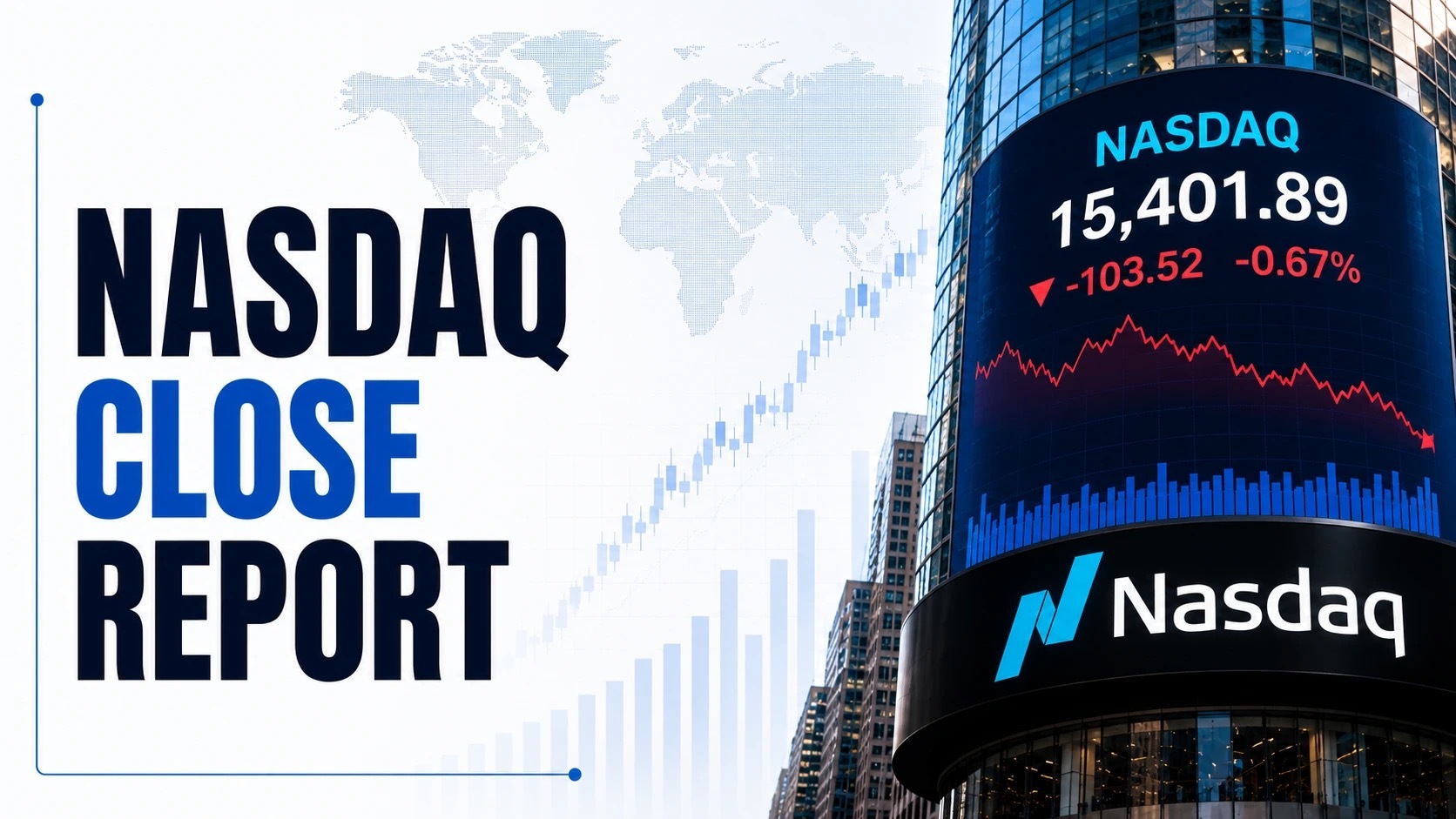
Nasdaq Gains 0.66% as Chip Stocks Rebound, Dow Posts Third Straight Winning Session Amid Falling Treasury Yields and Oil Prices
Authored By HDFC SKY | Published at: Aug 26, 2026 08:40 AM IST
Open Free Demat Account
Open Free Demat Account
Mumbai, Aug 26: U.S. stock markets closed higher on Tuesday, with the tech-heavy Nasdaq Composite leading gains as semiconductor stocks staged a broad recovery from Monday’s sharp sell-off. The Dow Jones Industrial Average extended its winning streak to three sessions, while the S&P 500 also finished in positive territory. The rally was supported by falling Treasury yields and a sharp pullback in crude oil prices, though weaker-than-expected consumer confidence data and escalating U.S.-Canada trade tensions tempered broader market enthusiasm.

Dow Jones Industrial Average Rises 160 Points for Third Straight Gain
The Dow Jones Industrial Average (^DJI) climbed 160.24 points, or 0.30%, to close at 53,577.40. The index opened at 53,594.92 and traded within an intraday range of 53,386.37 to 53,675.32. Trading volume for the session stood at 391,869,398 shares.
The index’s advance was supported by gains in technology and financial stocks. Nvidia (NVDA) rose 2.16%, Goldman Sachs (GS) gained 2.20%, IBM (IBM) added 1.41%, and Cisco Systems (CSCO) advanced 0.80%. JPMorgan Chase (JPM) added 0.08% and Boeing (BA) rose 0.26%.
On the downside, Walmart (WMT) declined 1.05%, Chevron (CVX) fell 1.61%, McDonald’s (MCD) dropped 1.61%, and Procter & Gamble (PG) declined 0.82%. Apple (AAPL) edged lower by 0.14% and Amazon (AMZN) fell 0.39%. The Dow’s muted advance was constrained by weakness in energy and consumer staples, which offset gains in technology and industrials.
S&P 500 Adds 0.32% as Technology and Healthcare Sectors Lead
The S&P 500 (^GSPC) rose 24.42 points, or 0.32%, to close at 7,677.28. The index opened at 7,676.66 and traded between an intraday low of 7,650.92 and a high of 7,686.11. Trading volume for the session reached 2,328,510,000 shares.
The Information Technology sector was the best-performing sector, rebounding from Monday’s decline as semiconductor and AI-related stocks powered higher. Moderna (MRNA) surged 13.89% to $158.18, the session’s largest advance among S&P 500 constituents, following positive Phase 3 trial data for its personalised melanoma vaccine developed with Merck. Merck & Co. (MRK) gained 3.88%, General Electric (GE) rose 2.25%, Advanced Micro Devices (AMD) surged 4.85%, and Micron Technology (MU) advanced 2.48%.
On the losing side, Dick’s Sporting Goods (DKS) plunged 29.13% to $127.10, the session’s worst performer, after reporting second-quarter earnings that missed both profit and revenue estimates and cutting its full-year guidance.
Deere & Co. (DE) fell 2.64%, Exxon Mobil (XOM) dropped 2.09%, PepsiCo (PEP) declined 1.66%, and Chevron (CVX) lost 1.61%. Costco (COST) fell 1.17% and Walmart (WMT) declined 1.05%.
Nasdaq Composite Jumps 0.66% as Semiconductor Stocks Rebound
The Nasdaq Composite (^IXIC) advanced 171.11 points, or 0.66%, to close at 26,151.30. The index opened at 26,148.71 and traded within a range of 26,034.35 to 26,225.83. Trading volume for the session stood at 6,457,196,000 shares.
The recovery in semiconductor stocks was the primary driver of the Nasdaq’s outperformance. Advanced Micro Devices (AMD) surged 4.85%, Micron Technology (MU) gained 2.48%, and Nvidia (NVDA) rose 2.16%, snapping a seven-day losing streak. Marvell Technology (MRVL) added 4.91% and Western Digital (WDC) climbed 3.53%.
Netflix (NFLX) jumped 2.82%, Meta Platforms (META) rose 1.96%, and Tesla (TSLA) advanced 0.37%. However, some technology names faced pressure: Palo Alto Networks (PANW) declined 3.10%, Intuit (INTU) fell 3.43%, CrowdStrike (CRWD) dropped 2.78%, and Apple (AAPL) edged lower by 0.14%.
Russell 2000 Rises 0.48% as Small-Caps Outperform
The Russell 2000 Index (^RUT), tracking small-cap stocks, gained 14.52 points, or 0.48%, to close at 3,009.60. The index opened at 3,004.81 and traded within a daily range of 3,000.47 to 3,011.97. Trading volume was reported at 5,426,291,269 shares.
Small-cap stocks outperformed their large-cap counterparts, suggesting improved risk appetite among investors. The Russell 2000’s advance was supported by broad-based gains across multiple sectors. BE (BE) surged 6.50%, CRSP (CRSP) jumped 6.70%, and TWST (TWST) gained 7.54%. On the healthcare front, KRYS (KRYS) rose 4.23% and KYMR (KYMR) added 4.68%. HIMS (HIMS) gained 2.14% and CRDO (CRDO) rose 1.75%. The index’s positive performance reflected resilient domestic economic activity, though ongoing trade uncertainty kept gains contained.
Also Read: How to Invest in the US Stocks From India
S&P 100 Gains 0.38% as Mega-Cap Tech Stocks Recover
The S&P 100 Index (OEX) rose 14.24 points, or 0.38%, to close at 3,783.81. The index opened at 3,783.11 and traded between a low of 3,770.07 and a high of 3,789.90.
The index’s advance was supported by gains in mega-cap technology stocks. Nvidia (NVDA) rose 2.16%, Meta Platforms (META) added 1.96%, Netflix (NFLX) gained 2.82%, and Alphabet (GOOGL) rose 0.10%. Tesla (TSLA) advanced 0.37%, contributing to the index’s positive performance. On the losing side, Apple (AAPL) declined 0.14%, Amazon (AMZN) fell 0.39%, and Costco (COST) dropped 1.17%.
Dow Jones Composite, Transportation and Utility Averages Show Modest Gains
The Dow Jones Composite Average (DJC) added 38.65 points, or 0.23%, to close at 16,905.08. The index opened at 16,912.44 and traded between 16,859.42 and 16,942.52.
The Dow Jones Transportation Average (DJT) rose 24.46 points, or 0.11%, finishing at 21,455.62. The index opened at 21,484.66 and traded within a range of 21,362.89 to 21,557.11. Transportation stocks showed resilience despite economic uncertainties, supported by stable fuel prices and steady demand for goods movement.
The Dow Jones Utility Average (DJU) gained 0.61 points, or 0.056%, to close at 1,089.90. The index opened at 1,088.77 and traded between 1,086.77 and 1,094.30. Utilities, typically considered defensive, underperformed the broader market as investors rotated toward growth sectors.
PHLX Semiconductor Sector Surges 1.44% as Chip Stocks Lead Market Recovery
The PHLX Semiconductor Sector Index (SOX) jumped 164.87 points, or 1.44%, to close at 11,588.04. The index opened at 11,583.05 and traded within a range of 11,494.78 to 11,708.13.
The semiconductor sector’s rebound was the most significant driver of Tuesday’s market rally. Advanced Micro Devices (AMD) surged 4.85%, Marvell Technology (MRVL) added 4.91%, and Micron Technology (MU) gained 2.48%. Nvidia (NVDA) rose 2.16%, snapping its longest losing streak since 2022.
Western Digital (WDC) climbed 3.53%, while Seagate Technology (STX) gained 3.40%. The rally in semiconductor stocks came ahead of Nvidia’s highly anticipated quarterly results, scheduled for release after Wednesday’s closing bell.
Also Read: How to Invest in S&P 500 Stocks Through Index Funds
NYSE Composite Adds 0.17% as Breadth Improves
The NYSE Composite Index (NYA) rose 41.49 points, or 0.17%, to close at 24,768.13. The index opened at 24,726.64 and traded within a range of 24,668.80 to 24,777.55.
The NYSE Composite’s advance was supported by gains in healthcare, financial, and industrial stocks, which offset declines in energy and consumer discretionary names. The index’s relatively modest gain reflected cautious sentiment amid escalating trade tensions and weaker economic data.
S&P MidCap 400 and SmallCap 600 Show Mixed Performance
The S&P 400 MidCap Index (SP400) declined 1.55 points, or 0.041%, to close at 3,799.75. The index opened at 3,801.30 and traded between 3,788.22 and 3,815.53.
The S&P SmallCap 600 Index, which tracks smaller companies, showed a mixed performance. Mid-cap stocks underperformed relative to large-caps, reflecting cautious investor sentiment toward mid-sized companies amid trade uncertainties and consumer confidence concerns. Small-caps, however, showed resilience, supported by domestic economic activity and a weaker dollar.
Falling Yields and Oil Prices Provide Support
The primary drivers of Tuesday’s market rally were falling Treasury yields and declining oil prices. The 10-year Treasury yield dropped more than 7 basis points to 4.625%, reducing borrowing costs and boosting the attractiveness of growth and technology stocks. Crude oil prices fell over 3% as the U.S. shifted to economic pressure on Iran, easing geopolitical risks and inflationary concerns.
However, these positives were partially offset by weaker-than-expected consumer confidence data, which fell to its lowest level since January, and escalating U.S.-Canada trade tensions. Investors also remained cautious ahead of Nvidia’s earnings release on Wednesday and Federal Reserve Chairman Kevin Warsh’s Jackson Hole speech on Friday.
Volatility Indices Show Elevated Caution
The CBOE Volatility Index (VIX) was down 0.19% at 15.82, indicating that while market anxiety had eased slightly, investors remained cautious. The VIX’s decline from recent elevated levels reflected reduced near-term uncertainty.
The CBOE Nasdaq Volatility Index (VXN) also declined, suggesting that technology-sector volatility had moderated. The CBOE S&P 500 3-Month Volatility Index (VIX3M) remained elevated, indicating that investors were pricing in heightened uncertainty over the medium term.
Also Read : US Stock Market Timings
Information Technology Leads as Energy and Consumer Staples Lag
The Information Technology sector emerged as the best performer, rising 0.7%, driven by the semiconductor rebound. Supermicro (SMCI) gained nearly 9%, leading the sector, while Advanced Micro Devices (AMD) surged 4.85% and Nvidia (NVDA) rose 2.16%.
The Energy sector was the worst performer, falling sharply as crude oil prices plunged more than 3%. Exxon Mobil (XOM) dropped 2.09%, Chevron (CVX) lost 1.61%, and ConocoPhillips (COP) declined 0.5%.
Consumer Staples also underperformed, with Walmart (WMT) declining 1.05%, Costco (COST) falling 1.17%, and PepsiCo (PEP) dropping 1.66%.
The Healthcare sector performed well, supported by Moderna (MRNA) surging 13.89% and Merck (MRK) gaining 3.88%. Financials showed mixed performance, with Goldman Sachs (GS) gaining 2.20% while JPMorgan (JPM) added just 0.08%.
Industrials were supported by General Electric (GE) rising 2.25%, while Consumer Discretionary faced pressure from Dick’s Sporting Goods (DKS) plunging 29.13%.
Biggest Gainers, Losers and Magnificent Seven Performance
Among the session’s top gainers in the S&P 500, Moderna (MRNA) surged 13.89% following positive Phase 3 trial data for its personalised melanoma vaccine developed with Merck. Supermicro (SMCI) gained nearly 9% on AI server demand optimism ahead of Nvidia earnings. Advanced Micro Devices (AMD) rose 4.85%, Marvell Technology (MRVL) added 4.91%, and Micron Technology (MU) advanced 2.48%, all benefiting from the semiconductor sector rebound. Western Digital (WDC) climbed 3.53% and Seagate Technology (STX) gained 3.40% as memory and storage stocks recovered.
The session’s worst performers included Dick’s Sporting Goods (DKS), which plunged 29.13% after missing second-quarter earnings and revenue estimates and cutting its full-year guidance. Deere & Co. (DE) fell 2.64% on sector weakness, while energy stocks faced pressure from falling crude oil prices. Exxon Mobil (XOM) dropped 2.09%, Chevron (CVX) lost 1.61%, and PepsiCo (PEP) declined 1.66% amid consumer staples weakness.
Among the Magnificent Seven, Nvidia (NVDA) rose 2.16%, snapping a seven-day losing streak. Meta Platforms (META) added 1.96% and Netflix (NFLX) jumped 2.82%, while Tesla (TSLA) advanced 0.37%. Alphabet (GOOGL) declined 0.32%, Amazon (AMZN) fell 0.39%, and Apple (AAPL) edged lower by 0.14%, reflecting mixed performance among mega-cap technology stocks.
US Consumer Confidence, Home Sales and Treasury Yields Weaken as Canada Escalates Tariffs
US consumer confidence fell 0.8 points to 89.4 in August, its lowest since January and below the 90.2 consensus, as expectations weakened despite a 6.8-point rise in the present situation index to 121.2. The expectations index fell 5.8 points to 68.2, reflecting increased pessimism about the labour market and business conditions. Meanwhile, July new home sales dropped to 607,000, below the 620,000 estimate and revised June figure of 678,000, marking the lowest level since January amid elevated mortgage rates and housing prices.
Canada announced retaliatory tariffs of 15%-50% on more than 700 US goods, covering approximately $20 billion, effective September 8, after Washington imposed additional 50% tariffs. Ottawa also announced $7.5 billion in support. In bonds, the 10-year Treasury yield fell over 7 basis points to 4.625%, while the 30-year yield dropped to 5.17%, the 2-year to 4.208% and 5-year to 4.208%, amid potential Treasury buybacks funded through its nearly $1 trillion General Account.
Oil Falls 3.9%, Gold Tops $4,700 and Bitcoin Tests $81,200 as Markets Track Iran, Dollar and Fed
Brent crude fell 3.9% to $88.58 a barrel and WTI dropped 3.1% to $82.36, with oil down more than 5% this week as US economic pressure on Iran eased fears of a wider Gulf conflict. Spot gold gained 0.4% to $4,715 an ounce, extending its August advance to 15%, while silver rose 0.8% to $56.20 and copper slipped 0.5% to $4.85 per pound.
Bitcoin briefly topped $81,200 before retreating to around $78,700, up about 30% over 10 days, as crypto sentiment reached “extreme greed.” The dollar index fell 0.1% to 98.93, with the euro at $1.167, yen at 159.24 and pound at $1.302. Markets now await July PCE inflation data and Federal Reserve Chair Kevin Warsh’s Jackson Hole speech, while the IMF urged governments to address rising debt and deficits.
Tuesday’s rally reflected falling Treasury yields, recovering semiconductor stocks and lower oil prices. However, weaker consumer confidence, rising US-Canada trade tensions and upcoming Nvidia earnings and Jackson Hole commentary could create headwinds, keeping markets focused on inflation, Fed policy and trade developments.
Source
- https://www.nasdaq.com/
- spglobal.com/spdji/en/indices/equity/sp-500/
- https://www.dowjones.com/
- https://www.spglobal.com/spdji/en/indices/equity/dow-jones-industrial-average/
- https://www.spglobal.com/spdji/en/indices/equity/sp-500/
- https://www.nasdaq.com/market-activity/index/comp
- https://www.nasdaq.com/market-activity/quotes/nasdaq-ndx-index
- https://www.spglobal.com/spdji/en/indices/equity/sp-100/
- https://www.lseg.com/en/ftse-russell/indices/russell-us
- https://www.nyse.com/index
- https://www.nyse.com/index
- https://www.spglobal.com/spdji/en/indices/equity/dow-jones-transportation-average/
- https://www.spglobal.com/spdji/en/indices/equity/dow-jones-utility-average/
- https://www.spglobal.com/spdji/en/indices/equity/dow-jones-composite-average/
- https://www.nasdaq.com/market-activity/index/sox
- https://www.cboe.com/tradable_products/vix/
Disclaimer
If you have any concerns, questions, or wish to point out any discrepancies in our content, please feel free to write to us at content@hdfcsec.com.
Please Note: The information shared is intended solely for informational purposes and does not make any investment recommendations
HDFC SKY, one of India’s most trusted trading platforms, has been recognized with the Next-Gen Digi Content Awards 2025–26.
Disclaimer
At HDFC SKY*, we take utmost care and due diligence in curating and presenting news and market-related content. However, inadvertent errors or omissions may occasionally occur.
If you have any concerns, questions, or wish to point out any discrepancies in our content, please feel free to write to us at content@hdfcsec.com.
Please Note: The information shared is intended solely for informational purposes and does not make any investment recommendations.
HDFC SKY from HDFC Securities, one of most trusted trading platforms in India, has been recognized with the *Next-Gen Digi Content Awards 2025-26.
 Join Us
 Add as preferred source on Google


More International News






Open Free Demat Account
Open Free Demat Account












Invest Anytime, Anywhere


By signing up I certify terms, conditions & privacy policy