Nifty 50
- Trent₹2,878.40298.40 (11.57%)
- Tech Mahindra₹1,508.60-27.30 (-1.78%)
- Kotak Mahindra Bank₹430.9514.95 (3.59%)
- Max Healthcare₹905-12.00 (-1.31%)
- HDFC Life Insurance ₹54615.00 (2.82%)
- Apollo Hospitals₹7,890-95.00 (-1.19%)
- Jio Financial ₹217.905.90 (2.78%)
- ITC₹265.80-3.10 (-1.15%)
- BSE₹3,250.6071.00 (2.23%)
- Infosys₹1,008.80-11.70 (-1.15%)
- Reliance Industries₹1,207.2020.80 (1.75%)
- TCS₹2,093.20-21.20 (-1.00%)
- JSW Steel₹1,255.6020.30 (1.64%)
- HCL Technologies₹1,190-11.90 (-0.99%)
- Hindustan Unilever₹1,863.2024.80 (1.35%)
- ONGC₹222.97-1.93 (-0.86%)
- Axis Bank₹1,238.5016.30 (1.33%)
- Coal India₹421.55-3.55 (-0.84%)
- Eternal₹325.054.25 (1.32%)
- Tata Consumer ₹950.10-3.65 (-0.38%)

- Offerings
- Tools & Platforms
Tools & Calculators
- Open API
- Calculators
- SIP Calculator
- CAGR Calculator
- Compound Interest Calculator
- FD Calculator
- RD Calculator
- EPF Calculator
- Retirement Calculator
- HDFC SIP Calculator
- Mutual Fund Return Calculator
- Lumpsum Calculator
- Step Up SIP Calculator
- ETF SIP Calculator
- Brokerage Calculator
- Equity Margin Calculator
- SWP Calculator
- EMI Calculator
- MTF Calculator
- Margin Pledge Calculator
- Algo Strategy
- Markets
Stocks
F&O
Mutual Funds
- More
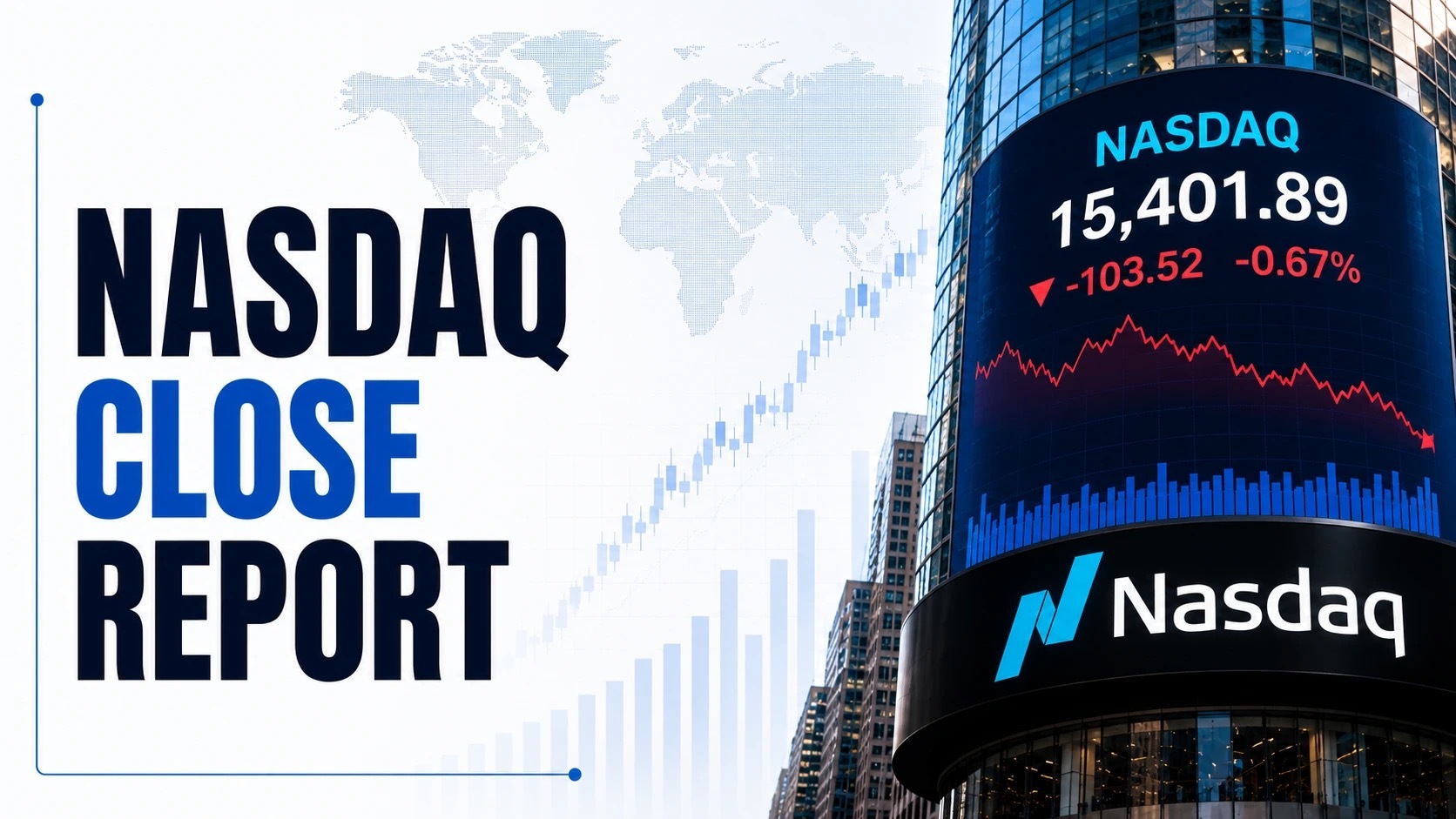
Nasdaq Hits Record 27,477 as Nvidia Surges 2% and Treasury Yields Climb to 5.33%
Authored By HDFC SKY | Published at: Oct 6, 2026 08:50 AM IST
Open Free Demat Account
Open Free Demat Account
Mumbai, 6 October 2026: US equities closed higher on Monday, 5 October 2026, as the technology-heavy Nasdaq Composite notched a fresh all-time high, even as Treasury yields surged to their highest levels in more than two decades and crude oil prices remained elevated above $100 per barrel.
The Dow Jones Industrial Average added 90.94 points to close at 51,267.90, the S&P 500 advanced approximately 0.7%, and the Nasdaq Composite gained 286.45 points, or 1.05%, to finish at 27,477.31, marking its second consecutive session of sharp gains.
The session’s trading was shaped by a combination of weakening Federal Reserve rate-hike expectations following last week’s soft jobs data, persistent strength in artificial intelligence-linked technology shares, and a global bond sell-off that kept long-dated Treasury yields near multi-year highs.

Dow Jones Gains 91 Points as Tech Strength Offsets Yield Pressure
The Dow Jones Industrial Average opened at 51,199.25 and closed at 51,267.90, registering a gain of 90.94 points, or 0.18%. The index touched an intraday high of 51,404.86 and a low of 50,862.85 during the session. Movements among the index’s constituent companies were mixed, with technology and consumer-oriented names providing support.
Microsoft shares advanced 1.45%, while Nvidia gained 2.06% and Visa rose 2.50%. Merck recorded the steepest decline within the index, falling 3.32%, followed by CRM, which shed 2.11%, and JNJ, which declined 1.29%. The session followed a rally in technology shares and a decline in oil prices that eased some inflation concerns, even as the benchmark 10-year Treasury yield held above 5.3%.
The index’s modest gain reflected the broader market’s bifurcated performance, where technology and growth-oriented sectors advanced while more traditional value-oriented components lagged.
S&P 500 Gains 0.7% as Materials and Tech Sectors Drive Advances
The S&P 500 opened at 7,724.71 and ended the session at 7,774.22, gaining 51.50 points, or approximately 0.67%. The index reached a high of 7,789.98 during the session and touched a low of 7,724.71. Ten of the eleven S&P 500 sectors ended in positive territory, with Materials leading the gains at approximately 1.22%, followed by Information Technology and Consumer Discretionary.
The Real Estate sector was the sole laggard, declining approximately 0.42%. Among individual constituents, PTC surged 33.57% following the announcement of its acquisition by Schneider Electric, making it the index’s top gainer. Steel Dynamics advanced 2.42%, while Coinbase Global rose 2.84%. On the losing side, C.H. Robinson Worldwide plummeted 10.85% after announcing its $5.8 billion acquisition of RXO, and Bristol-Myers Squibb declined 3.92%.
The index’s closing performance came as investors assessed the implications of the Institute for Supply Management’s services sector report and weighed the trajectory of Federal Reserve monetary policy.
Nasdaq Composite Gains 1.05% as AI-Linked Shares Reach Record Highs
The Nasdaq Composite opened at 27,225.93 and closed at 27,477.31, marking a gain of 286.45 points, or 1.05%. The index established a new intraday all-time high of 27,544.06 and a low of 27,223.49 during the session. Technology and growth-oriented shares led the advance, with Nvidia climbing 2.06% to a record closing high, Microsoft gaining 1.45%, and Meta Platforms adding 1.88%.
Tesla rose 2.17%, while SpaceX surged 7.63%. Within the Nasdaq 100, Western Digital was the standout performer with a gain of 6.28%, followed by Seagate Technology at 4.47% and Shopify at 5.75%. On the downside, Intel declined 2.60%, QCOM fell 2.31%, and Micron Technology shed 1.09%.
The technology-heavy benchmark’s record close came as traders looked past elevated Treasury yields and focused on the earnings potential of artificial intelligence-related companies. The index has now closed at record highs for two consecutive sessions, with Nvidia alone contributing a significant portion of the gain.
Also Read: What Is the New York Stock Exchange (NYSE)?
Russell 2000 Gains 0.60% as Smaller Stocks Track Broader Market Strength
The Russell 2000 opened at 2,834.23 and closed at 2,849.87, gaining 16.97 points, or 0.60%. The small-cap index recorded an intraday high of 2,859.13 and a low of 2,821.63. Movements among smaller-cap companies were mixed, with RXO surging 22.41% on news of its acquisition by C.H. Robinson Worldwide and PCVX advancing 30.83%.
Twist Bioscience rose 8.55%, while ACM Research declined 8.65% and Beta Technologies fell 6.68%. The benchmark’s advance reflected a broadening of market participation, though small-cap stocks continued to face headwinds from elevated borrowing costs and a strong US dollar.
The Russell 2000’s gain was notably more modest than the Nasdaq’s, reflecting the greater sensitivity of smaller companies to interest rate movements and domestic economic conditions.
S&P 100 Advances 0.66% as Large-Cap Shares Track Technology Momentum
The S&P 100 opened at 3,854.68 and finished at 3,879.97, recording a gain of 25.29 points, or 0.66%. The large-cap index traded between a low of 3,855.63 and a high of 3,890.18 during the session. Movements in major large-cap constituents were led by Microsoft at 1.45%, Nvidia at 2.06%, and Meta Platforms at 1.88%. Visa advanced 2.50%, while Merck declined 3.32% and Bristol-Myers Squibb fell 3.92%.
The index’s performance reflected the continued concentration of market gains in a relatively narrow group of mega-cap technology and communications companies. The S&P 100’s advance was supported by the same technology-driven momentum that lifted the Nasdaq Composite to a record close, though the broader index’s gains were tempered by weakness in healthcare and industrial components.
Dow Composite Gains 0.12% as Transport and Utility Indices Diverge
The Dow Jones Composite Average opened at 16,005.17 and closed at 15,998.71, recording a gain of 18.72 points, or 0.12%, after moving between a high of 16,053.01 and a low of 15,882.29. The Dow Jones Transportation Average ended at 19,791.56, compared with an opening level of 19,896.76, representing a decline of 1.09% or 218.19 points. The Dow Jones Utility Average closed at 1,020.78, advancing 0.27% or 2.76 points from its opening level of 1,021.37.
Within the transportation index, the decline was led by C.H. Robinson Worldwide’s 10.85% drop, while the utility index’s gain reflected broad-based strength across its components. The divergence between the transportation and utility averages reflected differing sector dynamics, with transport stocks weighed down by freight-related weakness and utilities benefiting from their defensive characteristics.
Philadelphia Semiconductor Index Gains 0.27% as Chip Stocks Show Mixed Performance
The Philadelphia Semiconductor Index (SOX) opened at 13,148.84 and closed at 13,172.74, gaining 36.06 points, or 0.27%. The semiconductor benchmark recorded an intraday high of 13,179.71 and a low of 13,004.67. Among semiconductor-related constituents, Nvidia advanced 2.06% and Broadcom added 2.09%, while Intel declined 2.60% and QCOM fell 2.31%. Micron Technology shed 1.09%, and Applied Materials gained 0.42%.
The index’s modest gain masked significant dispersion among individual chipmakers, with AI-focused companies outperforming those tied to traditional computing markets. The SOX’s advance came as investors continued to favour semiconductor companies with exposure to artificial intelligence and data centre infrastructure.
Also Read: How to invest in US stocks
NYSE Composite Changes 0.56% as Broader Shares Track Positive Market Tone
The NYSE Composite Index opened at 23,654.31 and closed at 23,787.51, recording a gain of 133.20 points, or 0.56%. The index traded between a low of 23,581.09 and a high of 23,857.16 during the session. Movements across a broad range of market segments contributed to the index’s performance, with materials, energy, and communication services sectors providing support.
The NYSE Composite’s advance reflected the generally positive tone across US equity markets, though the index’s gain lagged that of the technology-heavy Nasdaq. The breadth of the NYSE Composite’s advance, with a majority of its components participating in the rally, suggested a relatively healthy market environment despite elevated Treasury yields.
S&P MidCap 400 and SmallCap 600 Advance as Smaller Shares Track Market Gains
The S&P MidCap 400 opened at 3,668.01 and closed at 3,678.25, moving 10.24 points, or 0.28%, with an intraday range of 3,643.37 to 3,703.60. The S&P SmallCap 600 opened at 1,686.79 and ended at 1,689.69, gaining 3.94 points, or 0.23%, after trading between 1,671.80 and 1,700.38.
The two benchmarks reflected movements among mid- and small-cap shares, which continued to lag their larger-cap counterparts. The modest gains in these indices compared with the Nasdaq’s 1.05% advance highlighted the continued preference among market participants for large-cap technology and growth-oriented companies over smaller, more domestically-focused enterprises.
Oil, Yields and Fed Expectations Drive the Session’s Market Direction
The principal market catalyst was the combination of weakening Federal Reserve rate-hike expectations following Friday’s weak September jobs report, persistent strength in artificial intelligence-linked technology shares, and elevated Treasury yields.
The Labor Department’s report showed the US economy added just 29,000 jobs in September, significantly below expectations, which prompted traders to scale back bets on an October rate hike. The 10-year Treasury yield rose approximately 3 basis points to 5.33%, while the 30-year yield climbed to approximately 5.69%, its highest level since 2002. The dollar index held firm around 102, benefiting from weakness in the euro amid political gridlock in France and Spain.
A secondary catalyst was the decline in oil prices, with Brent crude falling below $101 per barrel as traders digested the latest Middle East developments, including the Group of Seven nations’ agreement to release 100 million barrels of crude and diesel stockpiles.
The combination of lower oil prices and reduced Fed rate-hike expectations provided a supportive backdrop for equities, particularly for technology companies whose valuations are more sensitive to interest rate movements. Trading remained focused on the trajectory of monetary policy and the sustainability of corporate earnings growth, with the third-quarter earnings season set to begin in earnest the following week.
VIX Rises 5.55% as Market Volatility Indicator Moves Higher
The CBOE Volatility Index (VIX) changed 5.55% to 16.16, compared with its previous close of approximately 15.31. The index, which measures expected volatility in the S&P 500 over the coming 30 days, rose even as equities advanced, an unusual occurrence that market observers attributed to increased demand for call options as investors positioned for potential further gains.
The CBOE Nasdaq Volatility Index (VXN) moved lower, declining approximately 5.8%, reflecting the more pronounced rally in technology shares relative to the broader market. The divergence between the VIX and VXN suggested that while investors sought protection against broad market volatility, they remained relatively more confident in the trajectory of technology stocks.
S&P 500 Sectors Show Broad Strength Across Ten of Eleven Groups
Performance across the 11 S&P 500 sectors was broadly higher, with ten groups ending in positive territory. Materials recorded the strongest move at approximately 1.22%, while Real Estate declined approximately 0.42% as the sole negative sector.
The remaining sectors recorded the following approximate moves: Information Technology advanced approximately 1.1%, Communication Services rose approximately 0.9%, Consumer Discretionary gained approximately 1.4%, Consumer Staples advanced modestly, Financials recorded a slight gain, Health Care declined approximately 0.04%, Industrials moved marginally higher, Energy advanced approximately 0.8%, and Utilities added approximately 0.6%.
The sector movements followed the technology-led rally and the decline in oil prices, which provided support to energy stocks even as crude benchmarks settled lower.
Also Read: US Stock Market Timings
Magnificent Seven Surge as Nvidia Jumps 2.06%, Fueling Nasdaq’s Record Close
Among the Magnificent Seven, Nvidia moved 2.06% higher, Microsoft changed 1.45%, Meta Platforms recorded a gain of 1.88%, Apple declined 0.24%, Amazon slipped 0.11%, Tesla advanced 2.17%, and Alphabet gained approximately 0.86% through its GOOGL and GOOG share classes.
The collective strength of these mega-cap technology companies contributed significantly to the Nasdaq Composite’s record close and provided support to the S&P 500. Nvidia’s advance was particularly notable, as the company closed at a new all-time high for the second consecutive session.
AI Stocks Surge 9.08% as Energy Gains 3.26%, Driving Selective Market Strength
Semiconductor stocks were mixed, with the Philadelphia Semiconductor Index moving 0.27% higher. Financial stocks recorded modest gains, with Visa advancing 2.50%, Mastercard adding 2.24%, and Wells Fargo rising 1.18%, while Goldman Sachs declined 1.02%. Energy stocks moved higher alongside broad market strength despite crude oil prices settling lower, with Marathon Petroleum gaining 2.59% and Valero Energy advancing 3.26%.
AI and growth stocks were generally higher, with Cerebras Systems surging 9.08% and Tempus AI gaining 9.03%, contributing to the technology-heavy indices’ performance. The mixed performance across sectors reflected the market’s selective focus on companies with strong growth prospects and exposure to artificial intelligence trends.
Economic Data Shows ISM Services PMI at 54.9 as Markets Assess Growth Trajectory
The latest economic data showed the Institute for Supply Management’s services Purchasing Managers’ Index (PMI) at 54.9 in September, compared with 55.4 in August. The reading, which was slightly below the consensus estimate of approximately 55, still indicated expansion in the services sector for the 27th consecutive month.
The employment index within the survey rose to 50.1 from 47.8, moving into expansion territory for the first time in three months, while the prices index climbed to 74.0 from 72.6, reaching its highest level since July 2022. The new export orders index plunged 9.4 points to 46.9, signalling contraction for the first time in eight months.
The releases provided the latest information on services sector activity, employment conditions, and inflationary pressures during the session.
10-Year Treasury Yield Hits 5.33% as Fed Rate Bets Shift on Weak Jobs Data
The Federal Reserve remained a key focus as markets assessed the implications of Friday’s weak employment report and the central bank’s September meeting minutes, which were scheduled for release later in the week.
The latest data showed traders pricing in nearly an 80% chance that the Fed would keep interest rates unchanged at its October meeting, though expectations for a December rate hike remained around 69%. The 2-year US Treasury yield stood at approximately 4.85%, while the 5-year yield was approximately 5.09%.
The 10-year Treasury yield stood at 5.33%, and the 30-year yield was approximately 5.69%. The yield curve steepened as long-dated yields rose more than shorter-dated maturities, reflecting concerns about government finances, heavy debt issuance, and elevated energy costs.
Brent Falls 1.89% to $100.32 as G7 Reserve Release Eases Oil Supply Fears
Brent crude traded at $100.32, declining 1.89% or $1.93, while West Texas Intermediate crude stood at $89.43, moving 1.84% lower or $1.68. Gold traded at approximately $4,160 per ounce, changing marginally, while silver moved 2.02% higher in domestic Indian markets. Copper and natural gas prices also recorded movements during the session.
The commodity moves followed the Group of Seven nations’ agreement to release 100 million barrels of crude and diesel from strategic reserves, which eased supply concerns, and the decline in oil prices provided relief to equities by reducing inflationary pressures. Natural gas futures settled at $3.066 per million British thermal units, their highest close since September 25.
Dollar Index Climbs 0.23% to 102.164 as Euro Hits 17-Month Low
The US Dollar Index (DXY) moved 0.23% higher to 102.164. EUR/USD stood at approximately 1.119, with the euro hitting a 17-month low against the dollar amid political uncertainty in France and Spain. USD/JPY traded at approximately 158.219, and GBP/USD was at approximately 1.33.
The dollar’s strength followed the scaling back of Fed rate-hike expectations, which was offset by weakness in the euro driven by fiscal concerns in France and the announcement of snap elections in Spain. Currency movements followed the divergence in monetary policy expectations and political developments across major economies.
The closing session was shaped by weakening Federal Reserve rate-hike expectations following soft jobs data, alongside continued strength in technology and AI-linked shares and a decline in oil prices. The major US indices finished higher, while sector, bond, commodity and currency markets recorded the changes outlined above. These figures provide a factual summary of the session and its key market developments.
Source
- https://www.nasdaq.com/
- spglobal.com/spdji/en/indices/equity/sp-500/
- https://www.dowjones.com/
- https://www.spglobal.com/spdji/en/indices/equity/dow-jones-industrial-average/
- https://www.spglobal.com/spdji/en/indices/equity/sp-500/
- https://www.nasdaq.com/market-activity/index/comp
- https://www.nasdaq.com/market-activity/quotes/nasdaq-ndx-index
- https://www.spglobal.com/spdji/en/indices/equity/sp-100/
- https://www.lseg.com/en/ftse-russell/indices/russell-us
- https://www.nyse.com/index
- https://www.nyse.com/index
- https://www.spglobal.com/spdji/en/indices/equity/dow-jones-transportation-average/
- https://www.spglobal.com/spdji/en/indices/equity/dow-jones-utility-average/
- https://www.spglobal.com/spdji/en/indices/equity/dow-jones-composite-average/
- https://www.nasdaq.com/market-activity/index/sox
- https://www.cboe.com/tradable_products/vix/
Disclaimer
At HDFC SKY*, we take utmost care and due diligence in curating and presenting news and market-related content. However, inadvertent errors or omissions may occasionally occur.
If you have any concerns, questions, or wish to point out any discrepancies in our content, please feel free to write to us at content@hdfcsec.com.
Please Note: The information shared is intended solely for informational purposes and does not make any investment recommendations.
HDFC SKY from HDFC Securities, one of most trusted trading platforms in India, has been recognized with the *Next-Gen Digi Content Awards 2025-26.
 Join Us
 Add as preferred source on Google


More International News





Open Free Demat Account
Open Free Demat Account












Invest Anytime, Anywhere


By signing up I certify terms, conditions & privacy policy