Nifty 50
- Bajaj Auto₹9,994216.00 (2.21%)
- Tech Mahindra₹1,482.20-31.90 (-2.11%)
- Bharat Electronics₹374.606.45 (1.75%)
- Hindalco Industries₹896.70-3.65 (-0.41%)
- Asian Paints₹2,370.9031.80 (1.36%)
- ITC₹265.05-0.95 (-0.36%)
- Jio Financial ₹217.502.88 (1.34%)
- Axis Bank₹1,254.70-4.40 (-0.35%)
- TCS₹2,18327.00 (1.25%)
- Bharti Airtel₹1,801.90-3.20 (-0.18%)
- Trent₹2,95435.80 (1.23%)
- SBI₹958.20-0.90 (-0.09%)
- Reliance Industries₹1,183.3013.00 (1.11%)
- Mahindra & Mahindra₹2,826.9030.70 (1.10%)
- Adani Enterprises₹2,661.9027.50 (1.04%)
- HCL Technologies₹1,229.3012.60 (1.04%)

- Offerings
- Tools & Platforms
Tools & Calculators
- Open API
- Calculators
- SIP Calculator
- CAGR Calculator
- Compound Interest Calculator
- FD Calculator
- RD Calculator
- EPF Calculator
- Retirement Calculator
- HDFC SIP Calculator
- Mutual Fund Return Calculator
- Lumpsum Calculator
- Step Up SIP Calculator
- ETF SIP Calculator
- Brokerage Calculator
- Equity Margin Calculator
- SWP Calculator
- EMI Calculator
- MTF Calculator
- Margin Pledge Calculator
- Algo Strategy
- Markets
Stocks
F&O
Mutual Funds
- More
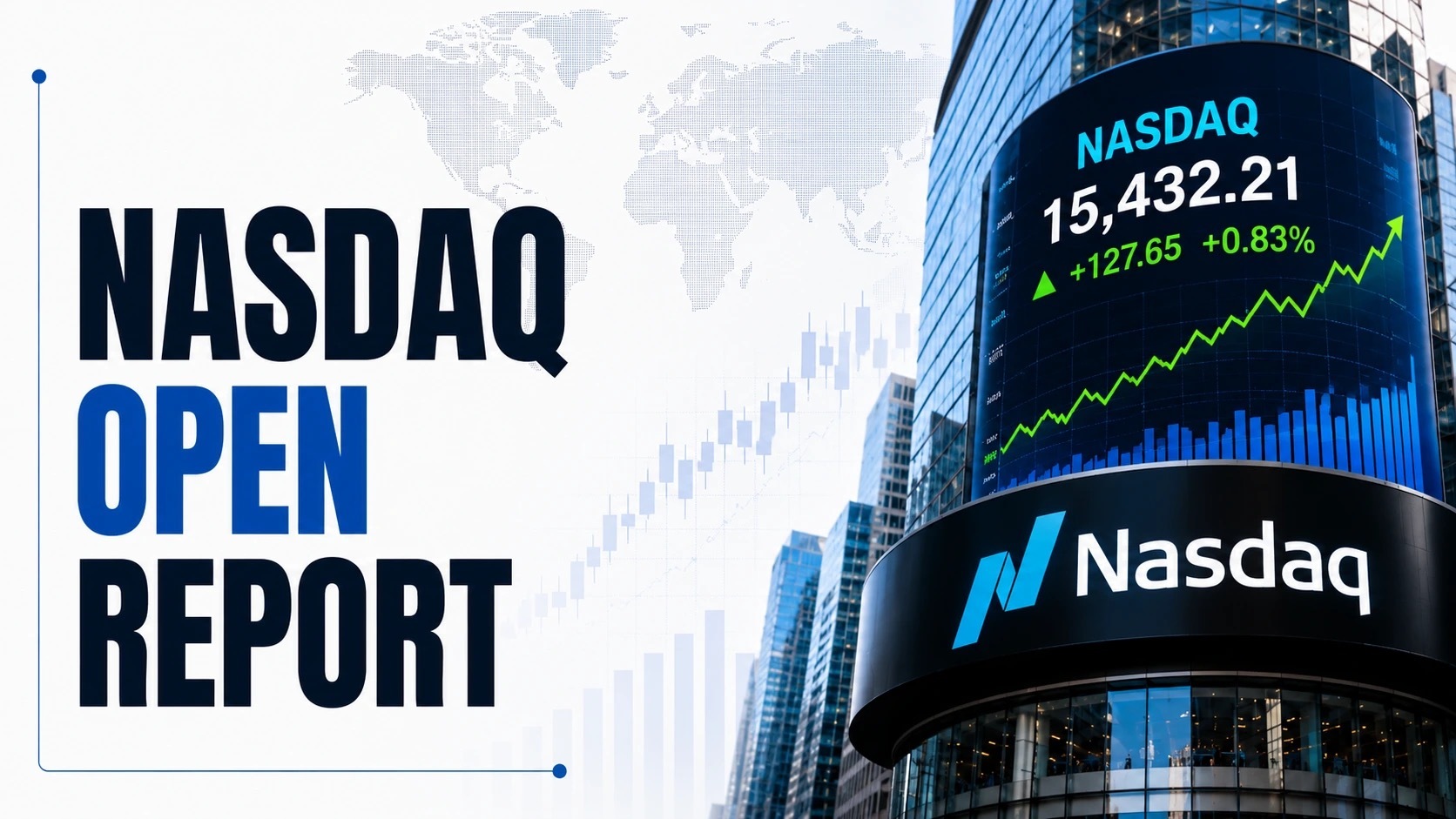
Nasdaq Holds Gains, Dow and S&P 500 Slip as AI Rally Offsets Middle East Oil Jitters
Authored By HDFC SKY | Last Modified: Aug 17, 2026 08:34 PM IST
Open Free Demat Account
Open Free Demat Account
Mumbai, Aug 17: US stock markets opened mixed on Monday as renewed artificial intelligence optimism lifted semiconductor stocks, helping the tech-heavy Nasdaq Composite hold its ground against broader market pressures from escalating Middle East tensions and rising crude oil prices.
The Nasdaq Composite (^IXIC) traded at 26,735.98, up 6.81 points or 0.03% in early trading, while the Dow Jones Industrial Average (^DJI) declined 153.31 points or 0.29% to 53,579.10. The S&P 500 (^GSPC) fell 12.81 points or 0.16% to 7,772.95, as investors weighed fresh geopolitical risks against expectations of fewer Federal Reserve rate hikes.
Chip Stocks Surge as Anthropic’s USD 11.5 Billion Revenue Sparks AI Hardware Rally
Memory and semiconductor stocks led Monday’s gains after Bloomberg News reported that artificial intelligence company Anthropic’s second-quarter revenue exceeded USD 11.5 billion, a staggering increase from USD 787 million in the year-ago period and USD 4.73 billion in the first quarter of 2026.
Micron Technology (MU) shares surged 4.84 % in early trading, crossing the psychologically significant USD 1,000 level to trade at USD 1,016.81. The stock has rallied 36% from its July lows and remains up 240% year-to-date. SanDisk (SNDK) jumped 8.44%, while Western Digital (WDC) gained 7.52% and Marvell Technology (MRVL) advanced 6.13%.
Also Read: What Is the New York Stock Exchange (NYSE)?
Applied Materials (AMAT) rose 4.98%, and Lam Research (LRCX) climbed 1.67 %, as the broader iShares Semiconductor ETF (SOXX) advanced approximately 2%. The AI-driven demand for memory chips and semiconductor equipment continues to fuel sector-wide momentum, with Anthropic’s growth projections suggesting sustained infrastructure spending.
The Roundhill Memory ETF (DRAM) advanced 5% in early trading, with components including Sandisk, Western Digital, SK Hynix, Micron Technology, and Seagate Technology posting robust gains ranging from 1.5% to 5.5%.
Oil Prices Climb as Iran Signals Offensive Shift, Hormuz Blockade Intensifies
Geopolitical tensions in the Middle East pushed crude oil prices higher on Monday, counterbalancing the positive sentiment from AI-driven tech gains. Brent crude futures (BZ=F) traded at approximately USD 89 per barrel, while West Texas Intermediate futures (CL=F) hovered near USD 83 per barrel.
A senior Iranian official told Reuters that the country may shift from a defensive to an offensive policy if diplomatic efforts with the United States fail. The official added that Iran would escalate tensions in the Strait of Hormuz, the critical passageway through which roughly one-fifth of the world’s traded oil supplies passed before the conflict.
Also Read: How to invest in US stocks
The 60-day ceasefire between the US and Iran is set to expire Monday with no breakthrough or deal in sight. US President Donald Trump threatened to bomb Oman if the country obstructs the US blockade of Iranian ships in the Strait of Hormuz, telling Fox News, “If Oman gets in the way, we’ll bomb them.”
Lebanon saw its deadliest day of fighting in months on Sunday as Israel struck Tehran-backed Hezbollah, according to Bloomberg. Brent crude has rallied more than 45% this year, with the US-Iran war now in its sixth month, including a full naval blockade of Iran’s ports.
Fed Rate Hike Odds Drop to 31% as Soft Data Eases Policy Concerns
Markets have significantly reduced expectations of a Federal Reserve rate hike in September following a string of mild inflation reports and weaker-than-expected retail sales data. The CME Group’s FedWatch tool now shows a 30.6% probability of a 25-basis-point rate increase at the Fed’s September meeting, down from approximately even odds a week earlier.
The S&P 500 notched a fresh all-time high last week, extending its winning streak to three weeks, as blockbuster earnings season buoyed investor sentiment. Robust earnings from several megacap companies eased valuation concerns, drawing investors back towards AI-related stocks.
Also Read: What is NASDAQ Composite
The Federal Open Market Committee meeting minutes, scheduled for release on Wednesday, could offer further clues into Fed officials’ thinking regarding monetary policy. Investors also await Federal Reserve Chairman Kevin Warsh’s speech at the Jackson Hole symposium for additional guidance on the central bank’s policy trajectory.
Treasury Yields Extend Gains as National Debt Concerns Deepen
Long-term Treasury yields continued their upward trajectory on Monday amid growing concerns about the US national debt. The 10-year Treasury yield (^TNX) rose 1 basis point to 4.71%, while the 30-year yield (^TYX) added 2 basis points to 5.28%.
The Treasury Department is slated to sell USD 16 billion of 20-year debt on Wednesday. In the when-issued market, the new bonds were indicated at a yield of around 5.27%, which would mark the highest yield for the tenor since it was reintroduced in 2020.
Last week’s consumer and producer price reports fell within market expectations, prompting traders to pare wagers on the Federal Reserve raising interest rates in September. Short-term debt yields declined as long-term bond yields rose, mirroring investors’ increased compensation demands to finance the nation’s growing deficit.
Goldman Sachs Warns Consumer Spending Slowdown Looms as Tax Refund Boost Fades
Goldman Sachs economists warned that the recent US consumer spending resilience may be tested in the coming months as the boost from higher-than-planned tax refunds fades.
Sales among consumer-facing companies rose at a healthy pace in the second quarter, powered by higher-than-planned tax refunds. Second-quarter sales at consumer companies rose 5.9% year-over-year among the median S&P 500 consumer discretionary company and 3.9% for the median consumer staples company, according to Goldman Sachs economist Jan Hatzius.
Also Read: Understanding Dow Jones Industrial Average (DJIA) – A Complete Guide
The strength in consumer spending was broad-based, with same-store sales accelerating for companies serving both lower- and higher-income consumers. However, clouds are on the horizon.
“We expect sluggish consumer spending growth ahead,” Hatzius wrote. Although Friday’s drop in July retail sales partly reflected the negative impact of an earlier-than-usual Amazon Prime Day, the revised sequential path now looks much more consistent with our view that the strength of real consumer spending in the spring was the temporary byproduct of the tax refund surge. The firm expects real consumer spending growth to slow to 1 to 1.5% in the second half as real cash flow stagnates.
L3Harris Replaces CEO Over Code of Conduct Violation, Shares Slip
L3Harris Technologies (LHX) announced that CEO Christopher Kubasik had stepped down and was being replaced by company executive Sam Mehta, effective immediately, after the company “became aware of certain conduct” that was “not consistent with the values of the Company as outlined in its Code of Conduct.”
Shares of L3Harris declined 2.5% in premarket trading following the announcement. The defense contractor stated that Kubasik’s “conduct was unrelated to the Company’s financial reporting, controls, customer relationships or operational performance.”
The Melbourne, Florida-based firm added that after an investigation, its board decided to enter into a separation agreement with its chief executive. “Chris has overseen significant transformation during his tenure at L3Harris, and he has built a strong team to carry the business forward,” the firm said. L3Harris stock entered Monday down less than 1% this year.
Bank of America Identifies 16 AI Bargains After Sector Pullback
Bank of America analysts identified 16 companies that have recently suffered more than 20% drawdowns from their 52-week highs despite upward earnings revisions, offering what they called “attractive medium-term upside.”
Though AI spending by America’s biggest tech giants is seen peaking this year, growth rates for the companies in the list “are expected to remain strong” into 2027, according to the analysts. Memory chip leader Micron Technology, chip equipment maker Lam Research, and hard drive maker Seagate were among the picks, all remaining among the S&P 500’s top performers this year despite recent pullbacks.
Also Read: What Is the S&P 500? A Simple Guide for Everyday Investors
Meta (META) also made the list, with Bank of America stating it believes the Street underappreciates the company’s ability to monetise its growing capacity assets and its growing ad revenues. The social media giant is reportedly in talks to lease extra compute to Anthropic. Meta shares are down roughly 10% year-to-date and have lost about a quarter of their value from their highs last August.
Gold Extends Gains as Bank of America Calls It ‘Best Hedge Against Dollar Debasement’
Gold futures (GC=F) continued to advance on Monday, trading at USD 4,442 per troy ounce, up nearly 11% over the past month. The precious metal has benefited from concerns over the growing national debt and pared-back expectations of a Fed rate hike.
Bank of America strategist Michael Hartnett said gold remains the “best hedge against dollar debasement, bond collapse, asset inflation, capitalist populism vs socialist populism politics of 2020s,”. Hartnett stated that the trade is “long gold” after BofA’s weekly flows data showed that gold funds attracted USD 6.3 billion last week, the largest weekly inflow since January.
Retail Earnings Take Centre Stage as Markets Assess Consumer Health
Investor attention turns toward retail earnings this week, with limited market-moving economic data on the calendar. Major retailers including Walmart (WMT), Target (TGT), Lowe’s (LOW), and Home Depot (HD) report quarterly results, providing insights into consumer health during the important back-to-school shopping season.
Home Depot and Lowe’s report on Tuesday and Wednesday respectively, while Walmart’s results are due Thursday. The retail earnings will offer clues on whether last week’s soft consumer data represents a temporary blip or a more significant trend.
Barring any surprises, traders may focus on this week’s retail earnings, which may offer some insight into whether last week’s soft consumer data was a one-off or possibly something more significant, according to Chris Larkin, E*TRADE from Morgan Stanley’s Managing Director of Trading and Investing.
New York Manufacturing Hits Four-Year High as Empire State Survey Surges
Factory activity in the New York region hit a multi-year high during August, spurred by a jump in unfilled orders, according to the regional Federal Reserve’s survey.
The New York Fed’s Empire State Manufacturing Survey posted a reading of 20.6, its best level in more than four years, up 5 points from July and well ahead of the Dow Jones consensus for 12. Though readings on new orders and shipments were softer than July, they both still showed expansion.
Also Read: US Stock Market Timings
Unfilled orders jumped to 15.5, up 10 points from a month ago, while the employment measure edged lower to 9.3. The prices paid index rose but the prices received measure decreased. The index surveys the percentage difference between managers reporting growth against contraction.
Dollar Index Hits Three-Month Low as Rate Hike Odds Slide
The US dollar index, which tracks the value of the greenback against a basket of foreign currencies, declined 0.2% to a nearly three-month low of 99.42. The dollar’s weakness reflects investor expectations that the Federal Reserve will hold rates steady in September.
The decline in the dollar has provided support for gold and other commodities priced in the US currency. Copper prices hit their highest in more than six months on Monday due to worries about availability on the London Metal Exchange, where inventories are at their lowest since February.
Benchmark copper traded up 1.1% at USD 14,310 a metric ton from an earlier high at USD 13,396. Prices of the metal used in the power and construction industries hit an all-time high at USD 14,527.5 in January.
Harvard Management Reports USD 2.2 Billion SpaceX Stake
Harvard Management Company, the firm that manages the university’s massive endowment, reported a new largest stock holding in its latest quarterly filing released after markets closed Friday.
The university holds a stake of just under 13 million shares of SpaceX (SPCX), valued at over USD 2.2 billion at the time of the filing. The rocket, AI, and connectivity company went public in June and received investments from numerous universities during its years as a private company.
SpaceX shares, which have gained 33% from the record low hit two weeks ago, were little changed at USD 140 ahead of the opening bell. The stock remains below the USD 150 opening price logged on IPO day two months ago but has shown signs of recovery in recent sessions.
Markets enter a pivotal week with retail earnings providing crucial consumer health signals amid rising geopolitical tensions and elevated oil prices. The Federal Reserve’s meeting minutes and Jackson Hole symposium will offer monetary policy direction, while AI sector momentum faces valuation concerns amid concentrated gains in semiconductor stocks.
Source
- spglobal.com/spdji/en/indices/equity/sp-500/
Disclaimer
If you have any concerns, questions, or wish to point out any discrepancies in our content, please feel free to write to us at content@hdfcsec.com.
Please Note: The information shared is intended solely for informational purposes and does not make any investment recommendations
Disclaimer
At HDFC SKY*, we take utmost care and due diligence in curating and presenting news and market-related content. However, inadvertent errors or omissions may occasionally occur.
If you have any concerns, questions, or wish to point out any discrepancies in our content, please feel free to write to us at content@hdfcsec.com.
Please Note: The information shared is intended solely for informational purposes and does not make any investment recommendations.
HDFC SKY from HDFC Securities, one of most trusted trading platforms in India, has been recognized with the *Next-Gen Digi Content Awards 2025-26.
 Join Us
 Add as preferred source on Google


More Business News





Open Free Demat Account
Open Free Demat Account











Invest Anytime, Anywhere


By signing up I certify terms, conditions & privacy policy