Nifty 50
- Dr. Reddy's Labs₹1,229.4032.40 (2.71%)
- Apollo Hospitals₹7,775-252.50 (-3.15%)
- Bajaj Auto₹10,034256.00 (2.62%)
- ITC₹257.90-8.10 (-3.05%)
- Tata Motors PV₹284.454.55 (1.63%)
- Tech Mahindra₹1,471-43.10 (-2.85%)
- Bharat Electronics₹373.905.75 (1.56%)
- L&T₹3,627.50-75.80 (-2.05%)
- BSE₹3,330.2043.00 (1.31%)
- Max Healthcare₹865.95-17.85 (-2.02%)
- Cipla₹1,317.4016.40 (1.26%)
- Hindalco Industries₹882.50-17.85 (-1.98%)
- Eicher Motors₹7,11969.00 (0.98%)
- Hindustan Unilever₹1,820.70-36.00 (-1.94%)
- Mahindra & Mahindra₹2,81316.80 (0.60%)
- SBI₹941-18.10 (-1.89%)
- Kotak Mahindra Bank₹443.402.40 (0.54%)
- Coal India₹404.80-6.75 (-1.64%)
- HCL Technologies₹1,2236.30 (0.52%)
- Bharti Airtel₹1,778.70-26.40 (-1.46%)

- Offerings
- Tools & Platforms
Tools & Calculators
- Open API
- Calculators
- SIP Calculator
- CAGR Calculator
- Compound Interest Calculator
- FD Calculator
- RD Calculator
- EPF Calculator
- Retirement Calculator
- HDFC SIP Calculator
- Mutual Fund Return Calculator
- Lumpsum Calculator
- Step Up SIP Calculator
- ETF SIP Calculator
- Brokerage Calculator
- Equity Margin Calculator
- SWP Calculator
- EMI Calculator
- MTF Calculator
- Margin Pledge Calculator
- Algo Strategy
- Markets
Stocks
F&O
Mutual Funds
- More
Reliance's AI Ambition in Focus Ahead of AGM Tomorrow; Mukesh Ambani's ₹10 Lakh Crore Bet to Reinvent India's Largest Conglomerate
Authored By HDFC SKY | Published at: Jun 18, 2026 01:52 PM IST

Open Free Demat Account
Open Free Demat Account
Mumbai, June 18: Reliance Industries is no longer talking about artificial intelligence as a technology upgrade. It is positioning AI as the operating system for the entire conglomerate.
Ahead of its annual general meeting on Friday, the company has reportedly circulated what executives are calling an internal “manifesto” aimed at transforming Reliance into an “AI-native” enterprise, embedding artificial intelligence across businesses ranging from telecom and retail to energy, manufacturing and financial services. The initiative marks the clearest articulation yet of Chairman Mukesh Ambani’s ambition to make Reliance the central force in India’s AI economy.
The scale of that ambition is staggering. Earlier this year, Reliance committed roughly $110 billion (about ₹10 lakh crore) to build AI infrastructure, data centres, edge computing networks and AI services, making it one of the largest technology investment programmes ever announced by an Indian company.

From Oil-to-Telecom to AI
Reliance has reinvented itself before.
In the 2000s, it evolved from a petrochemicals giant into a consumer-facing conglomerate. In 2016, it disrupted India’s telecom market through Jio, dramatically lowering data prices and bringing millions online.
Now Ambani appears to be pursuing a similar strategy in AI.
At the India AI Impact Summit in February, Ambani said India “cannot afford to rent intelligence” and pledged to make AI as affordable and accessible as mobile data became after Jio’s launch. The objective is not merely to consume AI built elsewhere but to create domestic infrastructure capable of supporting India’s digital economy.
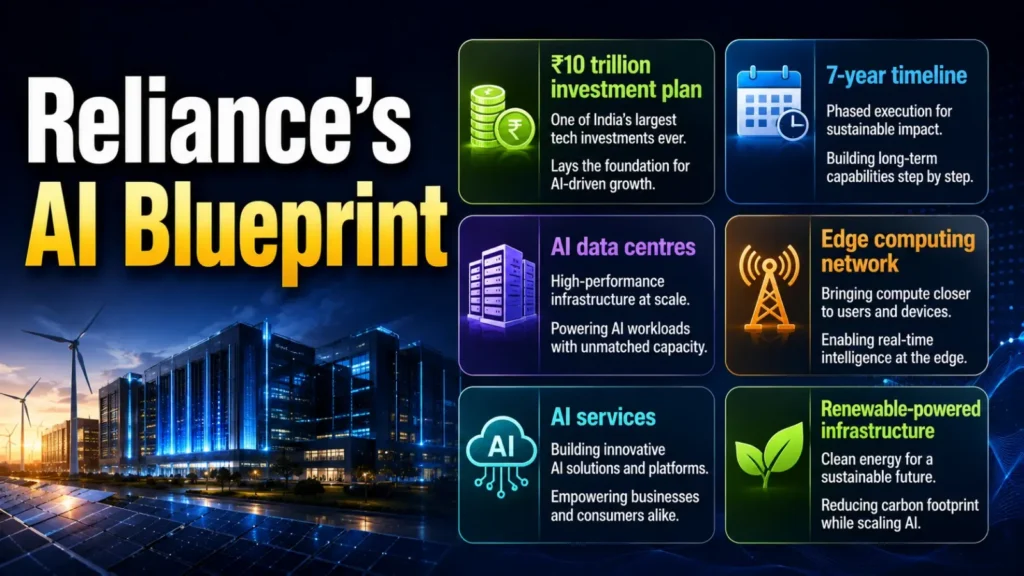
Building the Infrastructure First
Unlike many corporate AI strategies that focus on chatbots and productivity tools, Reliance is concentrating first on the infrastructure layer.
The company is building large AI-ready data centre campuses in Jamnagar, Gujarat, supported by renewable energy assets and connectivity infrastructure. More than 120 megawatts of capacity are expected to come online this year as part of a broader multi-gigawatt vision.
The strategy mirrors Reliance’s telecom playbook: own the underlying infrastructure before monetising services.
Analysts say this approach could give Reliance a significant advantage because AI’s biggest bottleneck globally is not software but computing power, energy availability and data-centre capacity.
The Meta Validation
Perhaps the strongest endorsement of Reliance’s AI ambitions came last week from Meta.
The Facebook and Instagram parent signed a deal to lease capacity at a 168-megawatt AI-enabled data centre being built by Reliance in Jamnagar. The facility will support Meta’s AI infrastructure requirements and marks the company’s first AI-focused data-centre partnership in India.
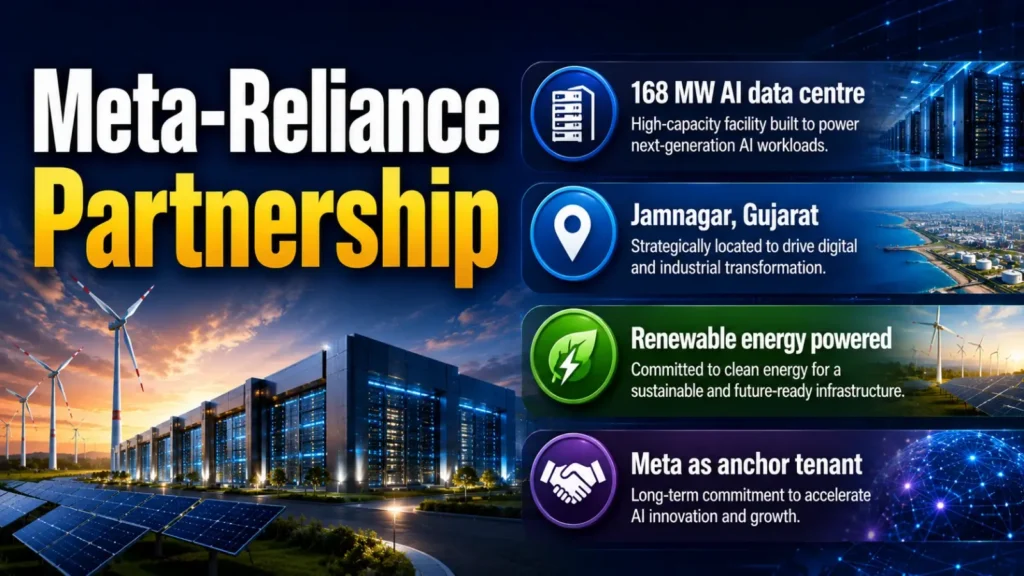
For Reliance, the significance goes beyond the contract itself.
The agreement demonstrates that global technology giants are willing to treat India not merely as a market for AI products but as a location for AI infrastructure. Industry estimates suggest India’s data-centre market could nearly double by 2034 as demand for AI computing surges.
The partnership also deepens a relationship that began with Meta’s multibillion-dollar investment in Jio Platforms and has expanded into enterprise AI solutions and now computing infrastructure.
Where AI Could Transform Reliance
The most immediate opportunities lie inside Reliance’s existing businesses.
For Jio, AI could improve network management, customer service and enterprise offerings. In retail, AI can optimise inventory, logistics, pricing and personalised commerce. Manufacturing operations can use AI to improve efficiency and predictive maintenance, while energy businesses can deploy AI for optimisation and automation.
The group’s enormous consumer footprint provides another advantage. Between Jio, retail and digital services, Reliance interacts with hundreds of millions of Indians, generating vast amounts of data that could be used to train and refine AI applications within regulatory boundaries.
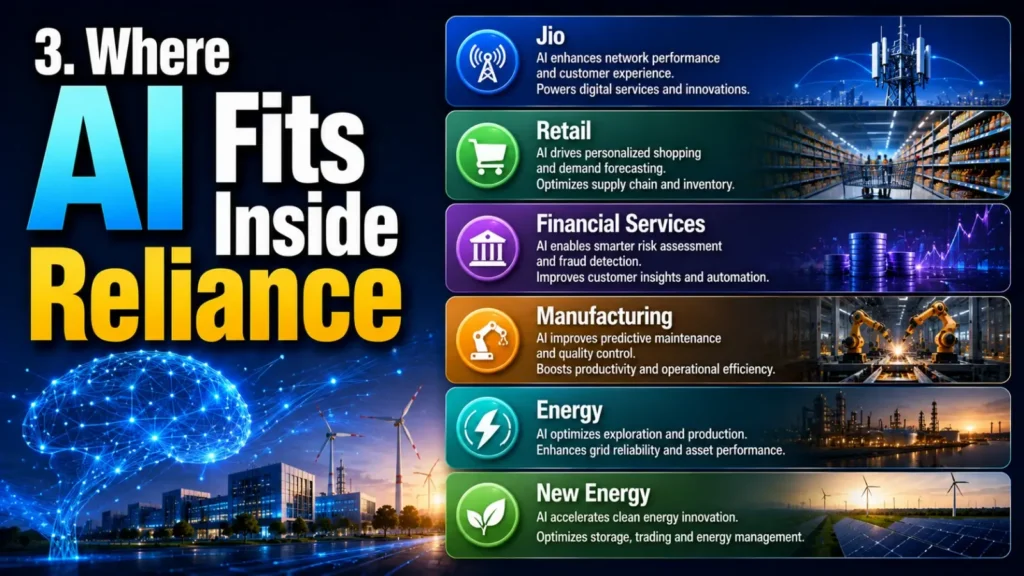
The Risks Are Equally Large
The vision is compelling, but execution will determine whether Reliance’s AI bet succeeds.
The company is investing on a scale unprecedented in India, yet monetisation pathways remain uncertain. Globally, technology companies are spending hundreds of billions of dollars on AI infrastructure even as investors question when returns will materialise.
There are also operational challenges. Building large data centres requires enormous power resources, sophisticated cooling systems and reliable demand from enterprise customers. Competition is intensifying as global cloud providers and Indian conglomerates race to establish AI infrastructure footprints.
India’s AI Champion?
The broader significance of Reliance’s manifesto extends beyond the company itself.
India has traditionally been a consumer of global technology platforms. Reliance’s strategy seeks to position the country as a producer of AI infrastructure and eventually AI services.
If Jio’s telecom disruption was about making data affordable, Reliance’s next act appears aimed at making computing power affordable.
Whether that ambition succeeds will depend on execution, regulation and adoption. But with a ₹10 lakh crore investment plan, partnerships with global technology leaders and a company-wide push to become AI-native, Reliance has made one thing clear: it intends to be at the centre of India’s AI future.
Source
- Public data, https://www.livemint.com/companies/news/ril-manifesto-mukesh-ambani-top-executives-reliance-ai-native-conglomerate-ril-agm-11781681979474.html
Disclaimer
If you have any concerns, questions, or wish to point out any discrepancies in our content, please feel free to write to us at content@hdfcsec.com.
Please Note: The information shared is intended solely for informational purposes and does not make any investment recommendations
Disclaimer
At HDFC SKY*, we take utmost care and due diligence in curating and presenting news and market-related content. However, inadvertent errors or omissions may occasionally occur.
If you have any concerns, questions, or wish to point out any discrepancies in our content, please feel free to write to us at content@hdfcsec.com.
Please Note: The information shared is intended solely for informational purposes and does not make any investment recommendations.
HDFC SKY from HDFC Securities, one of most trusted trading platforms in India, has been recognized with the *Next-Gen Digi Content Awards 2025-26.
 Join Us
 Add as preferred source on Google


More Business News






Open Free Demat Account
Open Free Demat Account










Invest Anytime, Anywhere


By signing up I certify terms, conditions & privacy policy