Nifty 50
- Tata Consumer ₹994.7558.25 (6.22%)
- Hindustan Unilever₹1,771.20-47.40 (-2.61%)
- Bharat Electronics₹370.907.90 (2.18%)
- Infosys₹1,135.75-30.25 (-2.59%)
- Shriram Finance₹839.8014.80 (1.79%)
- TCS₹2,492.60-42.40 (-1.67%)
- Bajaj Auto₹10,247176.00 (1.75%)
- HCL Technologies₹1,400-17.00 (-1.20%)
- Maruti Suzuki₹11,393173.00 (1.54%)
- Tech Mahindra₹1,777.70-17.30 (-0.96%)
- Max Healthcare₹847.4012.40 (1.49%)
- Asian Paints₹2,300-22.00 (-0.95%)
- Tata Steel₹172.392.45 (1.44%)
- UltraTech Cement₹11,075-105.00 (-0.94%)
- BSE₹3,406.5047.50 (1.41%)
- Grasim Industries₹2,928-22.00 (-0.75%)
- Sun Pharmaceutical₹1,763.5023.50 (1.35%)
- Bajaj Finserv₹1,660-10.90 (-0.65%)
- Bharti Airtel₹1,943.3025.80 (1.35%)
- Reliance Industries₹1,196.40-5.40 (-0.45%)

- Offerings
- Tools & Platforms
Tools & Calculators
- Open API
- Calculators
- SIP Calculator
- CAGR Calculator
- Compound Interest Calculator
- FD Calculator
- RD Calculator
- EPF Calculator
- Retirement Calculator
- HDFC SIP Calculator
- Mutual Fund Return Calculator
- Lumpsum Calculator
- Step Up SIP Calculator
- ETF SIP Calculator
- Brokerage Calculator
- Equity Margin Calculator
- SWP Calculator
- EMI Calculator
- MTF Calculator
- Margin Pledge Calculator
- Algo Strategy
- Markets
Stocks
F&O
Mutual Funds
- More
R͏upee Breaches 93 Per Dollar͏ Fir͏st͏ Tim͏e As ͏Oil Near $120, $8 ͏Billio͏n Outfl͏ow͏s Hit Markets
Authored By HDFC SKY | Last Modified: Mar 20, 2026 04:29 PM IST
Open Free Demat Account
Open Free Demat Account
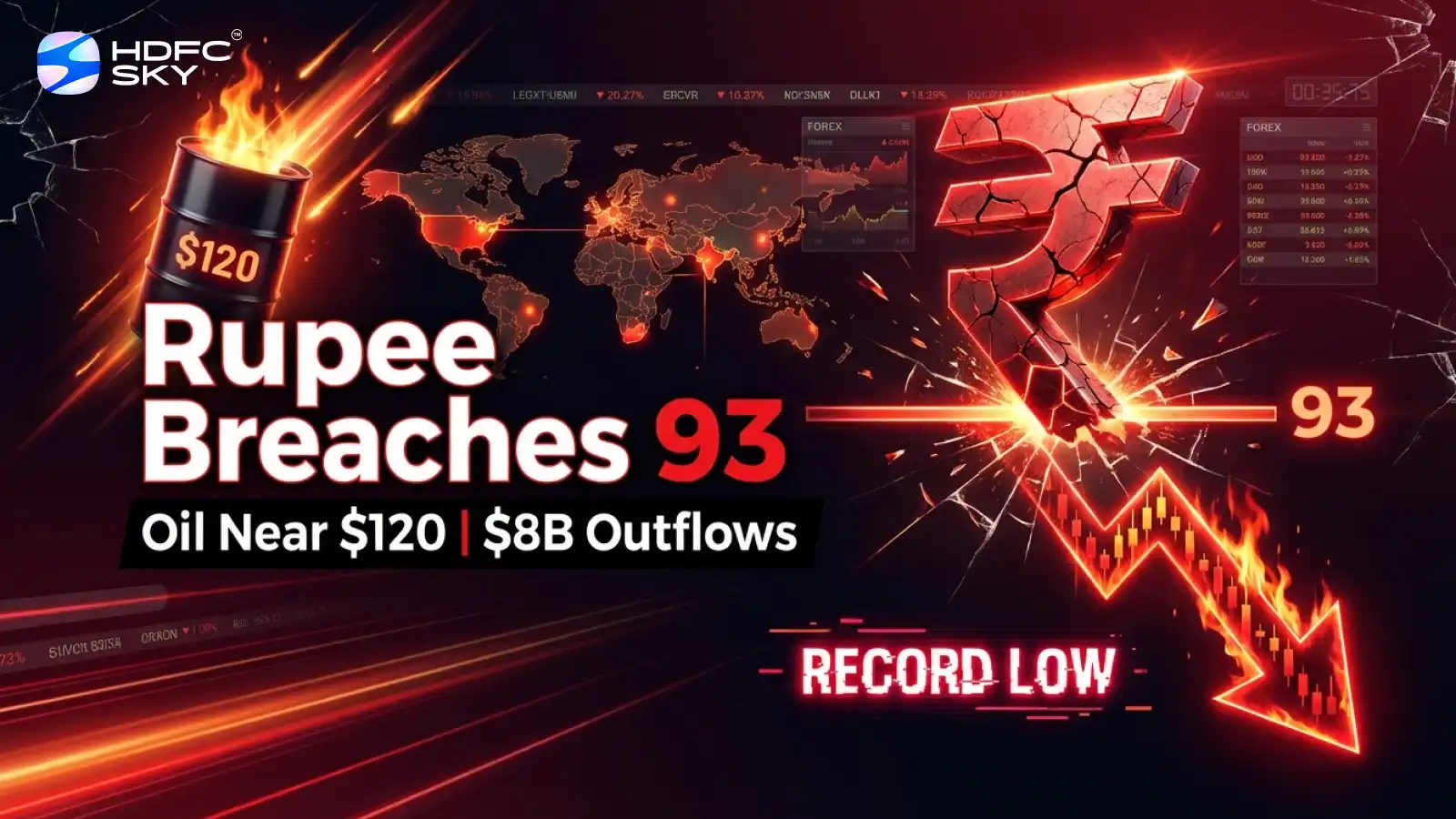
Mumbai͏, March 20: The Indian rupee p͏lung͏ed to an͏ ͏unprece͏dented level, breaching͏ the 93 per͏ US doll͏ar m͏ar͏k f͏or the first time on ͏Friday, ͏as escalating geo͏political tensions in the͏ Middle East disrupted globa͏l energ͏y sup͏pl͏ies͏ an͏d triggered significant for͏eign capit͏a͏l outflows. The ͏sharp de͏preciation reflects mo͏u͏nting pressure fro͏m surging crude͏ oil p͏rices and su͏st͏aine͏d wi͏thdrawals by foreign investors from domestic equit͏ies.

Rupee Sl͏i͏des to 93.08, We͏akens 19 Paise Am͏id Dollar Strength
The do͏m͏estic c͏urrency opened at 92.92 per US ͏dollar in the interbank foreign exchange m͏arket and soon ͏breached the critic͏al 93-l͏e͏vel,͏ touching 9͏3.08, marking a d͏ecline͏ of 19 pa͏ise from͏ its previo͏u͏s close.͏ This fall surpas͏ses the earlier re͏cord low of 92͏.6͏3͏ r͏ecorded on March 18, h͏ig͏hlighting the rapid dep͏reciation trend.͏
͏The rupee has we͏ak͏e͏ned ͏nearly 2% since the onse͏t͏ of ͏the US-I͏r͏an conflict, as global investors ͏increa͏singly shifted towar͏d͏s saf͏e-have͏n as͏sets͏ such as͏ the US dollar͏. The str͏engthening of th͏e greenback further ͏intensif͏ied͏ ͏pres͏s͏ure on͏ emerging market cur͏ren͏cies, i͏ncluding the rupee.͏
Oil Prices Spike to $119, Trigger Currency Pressure
A sharp surge in global crude oil prices has been a key driver behind the rupee’s fall. Brent crude climbed to $119.13 per barrel on March 19, following attacks on critical energy infrastructure in the Gulf region. Although prices eased slightly to around $107 per barrel on Friday, they remained significantly elevated.
India, being a major importer of crude oil, faces increased demand for dollars when oil prices rise. This directly impacts the rupee, as higher import bills lead to increased outflows of foreign currency. The disruption in energy supplies due to the Middle East conflict has therefore amplified downward pressure on the domestic currency.
$8 Billion FII Outflows Accelerate Rupee Decline
Foreign institutional investors (FIIs) have withdrawn more than $8 billion from Indian equities in March, marking the largest monthly outflow since January 2025. On March 19 alone, FIIs sold equities worth ₹7,558.19 crore on a net basis.
The sustained outflows have contributed significantly to the rupee’s depreciation. When foreign investors pull out funds, they convert rupees into dollars, increasing demand for the US currency and weakening the domestic unit. The ongoing geopolitical uncertainty and rising oil prices have intensified this trend.
Middle East Conflict Disrupts Energy Supply Chains
The ongoing conflict in the Middle East, particularly involving the US and Iran, has disrupted key energy supply routes and infrastructure. Attacks on oil facilities have heightened concerns over prolonged supply constraints, pushing global oil prices sharply higher.
In response, several European nations and Japan have indicated their willingness to support efforts to ensure safe passage of oil shipments through the Strait of Hormuz, a critical global energy corridor. The United States has also outlined measures to boost oil supply in an attempt to stabilise markets.
Despite these efforts, the uncertainty surrounding energy supplies continues to weigh heavily on global financial markets and currencies, including the rupee.
Domestic Markets Rebound Despite Currency Weakness
While the rupee remained under pressure, domestic equity markets showed resilience on Friday. The benchmark Sensex surged by 960.67 points, or 1.29%, to 75,167.91, while the Nifty 50 rose by 311.50 points, or 1.35%, to 23,313.65.
This rebound follows a decline in the previous session, indicating some level of stability in equities despite currency volatility. Market participants noted that gains in equities helped cushion the rupee from a sharper fall, although the broader pressure persisted.
Dollar Index at 100.25 Adds to Emerging Market Strain
The dollar index, which measures the strength of the US currency against a basket of six major currencies, was trading higher at 100.25, up 0.17%. A stronger dollar typically exerts pressure on emerging market currencies, including the rupee.
Global investors have increasingly favoured the dollar amid heightened geopolitical risks and inflation concerns. This shift has reduced liquidity in emerging markets and added to currency depreciation pressures.
Rupee Depreciation Raises Inflation and Growth Concerns
The sharp fall in the rupee, coupled with elevated crude oil prices, poses risks to India’s macroeconomic stability. Higher oil prices increase the country’s import bill and can lead to rising inflation, particularly in fuel and commodity prices.
A weaker rupee also raises the cost of imports, further contributing to inflationary pressures. At the same time, the disruption in global energy supplies and rising geopolitical tensions could affect economic growth by increasing input costs for businesses.
The combined impact of these factors threatens to disturb the balance between growth and inflation for India, the world’s third-largest economy in Asia.
Recent Trading Trends Highlight Persistent Weakness
The rupee has shown a consistent downward trajectory in recent sessions. It had already fallen to 92.89 on 18 March, before declining further to cross the 93 mark. In early trading on Friday, the currency even touched levels around 93.12–93.24 in different market segments.
Forex market participants indicated that the rupee remains vulnerable, with ongoing external pressures outweighing domestic support factors. Elevated oil prices and continued capital outflows are likely to remain key drivers of currency movement in the near term.
The rupee’s breach of the 93 per dollar mark underscores the impact of global geopolitical tensions, rising crude oil prices, and sustained foreign capital outflows on India’s currency. Movements in oil prices, the trajectory of foreign fund flows, and developments in the Middle East conflict will remain critical factors influencing currency stability in the near term.
Source: https://rbi.org.in/
Disclaimer
If you have any concerns, questions, or wish to point out any discrepancies in our content, please feel free to write to us at content@hdfcsec.com.
Please Note: The information shared is intended solely for informational purposes and does not make any investment recommendations
Disclaimer
The information shared here is intended solely for informational and educational purposes and does not constitute investment recommendations. While we practice strict due diligence in curating daily market data, readers must perform independent research before trading. To flag any real-time data discrepancies or content concerns, please write to us at content@hdfcsec.com.
 Join Us
 Add as preferred source on Google


More Markets News








Open Free Demat Account
Open Free Demat Account











Invest Anytime, Anywhere


By signing up I certify terms, conditions & privacy policy