Nifty 50
- Dr. Reddy's Labs₹1,229.4032.40 (2.71%)
- Apollo Hospitals₹7,775-252.50 (-3.15%)
- Bajaj Auto₹10,034256.00 (2.62%)
- ITC₹257.90-8.10 (-3.05%)
- Tata Motors PV₹284.454.55 (1.63%)
- Tech Mahindra₹1,471-43.10 (-2.85%)
- Bharat Electronics₹373.905.75 (1.56%)
- L&T₹3,627.50-75.80 (-2.05%)
- BSE₹3,330.2043.00 (1.31%)
- Max Healthcare₹865.95-17.85 (-2.02%)
- Cipla₹1,317.4016.40 (1.26%)
- Hindalco Industries₹882.50-17.85 (-1.98%)
- Eicher Motors₹7,11969.00 (0.98%)
- Hindustan Unilever₹1,820.70-36.00 (-1.94%)
- Mahindra & Mahindra₹2,81316.80 (0.60%)
- SBI₹941-18.10 (-1.89%)
- Kotak Mahindra Bank₹443.402.40 (0.54%)
- Coal India₹404.80-6.75 (-1.64%)
- HCL Technologies₹1,2236.30 (0.52%)
- Bharti Airtel₹1,778.70-26.40 (-1.46%)

- Offerings
- Tools & Platforms
Tools & Calculators
- Open API
- Calculators
- SIP Calculator
- CAGR Calculator
- Compound Interest Calculator
- FD Calculator
- RD Calculator
- EPF Calculator
- Retirement Calculator
- HDFC SIP Calculator
- Mutual Fund Return Calculator
- Lumpsum Calculator
- Step Up SIP Calculator
- ETF SIP Calculator
- Brokerage Calculator
- Equity Margin Calculator
- SWP Calculator
- EMI Calculator
- MTF Calculator
- Margin Pledge Calculator
- Algo Strategy
- Markets
Stocks
F&O
Mutual Funds
- More
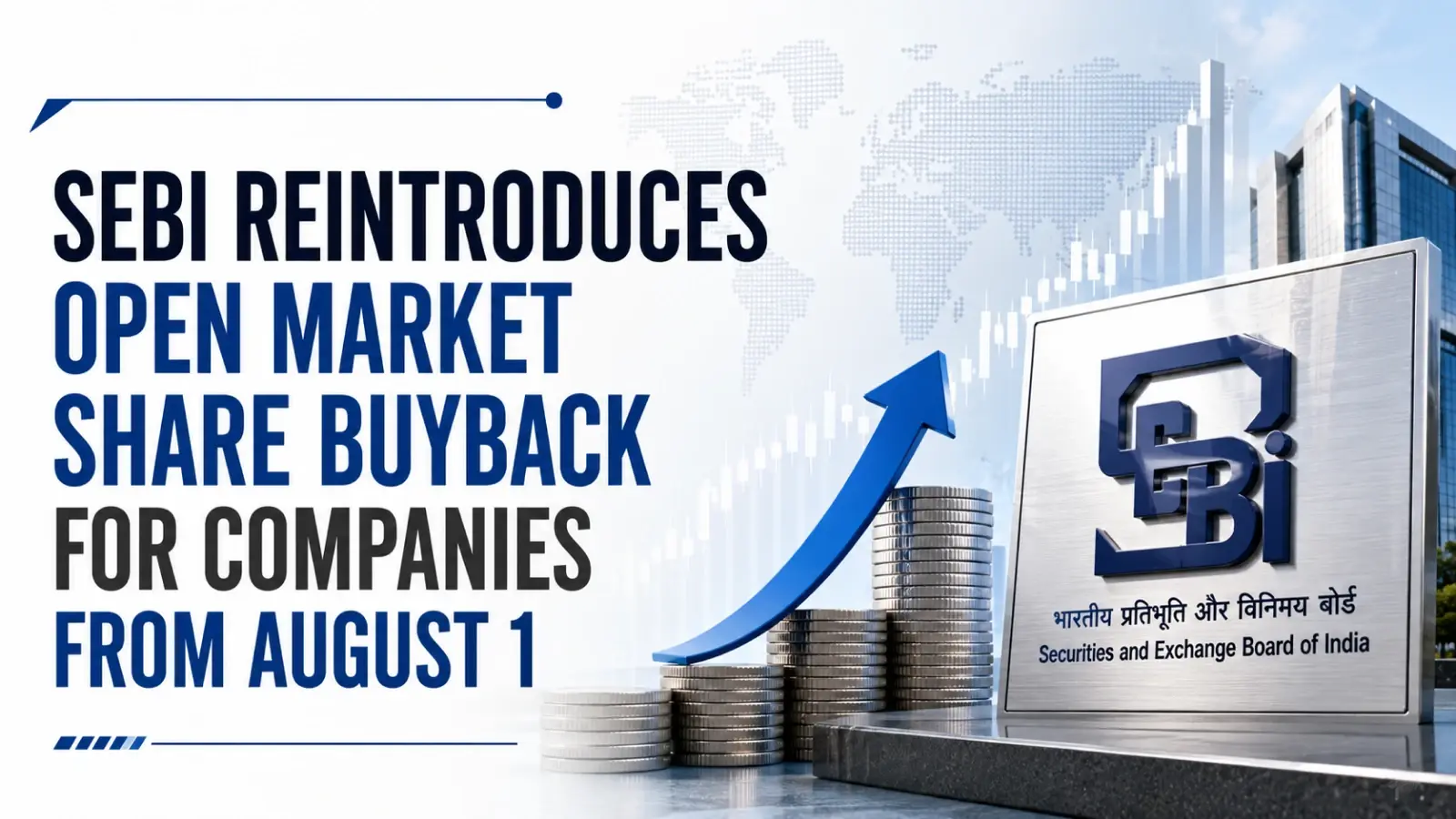
Sebi Reintroduces Open Market Share Buyback for Companies From August 1
Authored By PTI | Last Modified: Jul 7, 2026 12:44 PM IST
Open Free Demat Account
Open Free Demat Account
New Delhi, July 7: Markets regulator Sebi has notified rules to reintroduce share buybacks through stock exchanges, allowing companies to repurchase their own shares in the open market starting August 1, while capping the execution period at 66 working days.
The new rules by the Securities and Exchange Board of India (Sebi) allows firms to carry out buybacks through regular trading mechanisms without a dedicated buyback window.
The move is aimed at improving flexibility and execution efficiency, while potentially enhancing the attractiveness of buybacks as a capital allocation tool for listed companies.
Sebi had phased out open-market buybacks in 2025, citing concerns over uneven treatment of shareholders and tax-related distortions, as the mechanism was seen as favouring select investors.
The reintroduction is expected to revive a capital management route widely used by corporates to return surplus cash to shareholders and support stock prices, particularly in periods of market weakness.
“With effect from August 1, 2026, the buyback from the open market through the stock exchange shall be less than fifteen per cent of the paid up capital and free reserves of the company, based on both standalone and consolidated financial statements of the company,” Sebi said in a notification dated July 1.
This comes after the board of Sebi approved a proposal in this regard in June.
Also, open market buybacks through stock exchanges would be completed within 66 working days from the date of opening of the offer, instead of the earlier framework that allowed a as long as six months duration.
“The buyback offer shall open within four working days from the date of the public announcement and close within 66 working days from the date of opening of the offer,” Sebi said.
To reduce costs and ease doing business, Sebi said that appointing a merchant banker for buybacks is now discretionary for the company. If a company decides not to appoint a merchant banker the activities undertaken by the merchant banker have been assigned to the company, compliance officer, statutory auditor, secretarial auditor and stock exchanges.
To improve shareholder communication, Sebi said there will be dissemination of information about open market buy-backs to shareholders through electronic means in addition to the public announcement being already made through newspaper advertisements.
Under the new buy-back taxation framework (i.e. Capital Gain), public shareholders would be taxed on their actual capital gains when the shares are tendered in buyback, which would be similar to selling the shares in the normal course on the stock exchange.
Consequently, the differential tax advantage that existed earlier between shareholders who were able to participate in the buy-back and those who were not, would not exist any longer.
Further, shifting the tax burden from the company undertaking the buyback to the participating public shareholders has made selling in the normal market equivalent to selling via buyback through the stock exchange.
Further, the open market buyback method through stock exchanges is widely adopted in international jurisdictions.
Also, Sebi said that shares or other specified securities of the company undertaking the buy-back, held by promoter(s) or their associates, shall remain frozen at ISIN level during the buy-back period.
The regulator also inserted an explicit provision to ensure that companies do not announce buybacks that might breach minimum public shareholding (MPS) norms.
Further, Sebi aligned the minimum interval between two buyback offers with the provisions under the Companies Act, 2013, instead of maintaining a separate timeline under buyback regulations.
(Disclaimer: Except for the headline, this article has not been edited by HDFC Sky editorial team and is auto-generated from PTI feed.)
Disclaimer
At HDFC SKY*, we take utmost care and due diligence in curating and presenting news and market-related content. However, inadvertent errors or omissions may occasionally occur.
If you have any concerns, questions, or wish to point out any discrepancies in our content, please feel free to write to us at content@hdfcsec.com.
Please Note: The information shared is intended solely for informational purposes and does not make any investment recommendations.
HDFC SKY from HDFC Securities, one of most trusted trading platforms in India, has been recognized with the *Next-Gen Digi Content Awards 2025-26.
 Join Us
 Add as preferred source on Google


More Business News









Open Free Demat Account
Open Free Demat Account










Invest Anytime, Anywhere


By signing up I certify terms, conditions & privacy policy