Nifty 50
- Eternal₹317.4012.95 (4.25%)
- Shriram Finance₹865-35.90 (-3.98%)
- Apollo Hospitals₹7,730125.50 (1.65%)
- Adani Enterprises₹2,477-73.00 (-2.86%)
- ONGC₹227.502.50 (1.11%)
- JSW Steel₹1,185.50-34.50 (-2.83%)
- Asian Paints₹2,30722.20 (0.97%)
- Jio Financial ₹205.03-5.77 (-2.74%)
- TCS₹2,53023.10 (0.92%)
- Tata Steel₹167.67-4.66 (-2.70%)
- UltraTech Cement₹11,05092.00 (0.84%)
- Adani Ports₹1,702.70-47.30 (-2.70%)
- Maruti Suzuki₹11,23060.00 (0.54%)
- Tech Mahindra₹1,790-39.10 (-2.14%)
- Cipla₹1,3387.10 (0.53%)
- Tata Motors PV₹264.60-5.40 (-2.00%)
- Reliance Industries₹1,1905.50 (0.46%)
- Hindalco Industries₹869.85-15.75 (-1.78%)
- Axis Bank₹1,217.505.50 (0.45%)
- Trent₹2,727.50-48.30 (-1.74%)

- Offerings
- Tools & Platforms
Tools & Calculators
- Open API
- Calculators
- SIP Calculator
- CAGR Calculator
- Compound Interest Calculator
- FD Calculator
- RD Calculator
- EPF Calculator
- Retirement Calculator
- HDFC SIP Calculator
- Mutual Fund Return Calculator
- Lumpsum Calculator
- Step Up SIP Calculator
- ETF SIP Calculator
- Brokerage Calculator
- Equity Margin Calculator
- SWP Calculator
- EMI Calculator
- MTF Calculator
- Margin Pledge Calculator
- Algo Strategy
- Markets
Stocks
F&O
Mutual Funds
- More
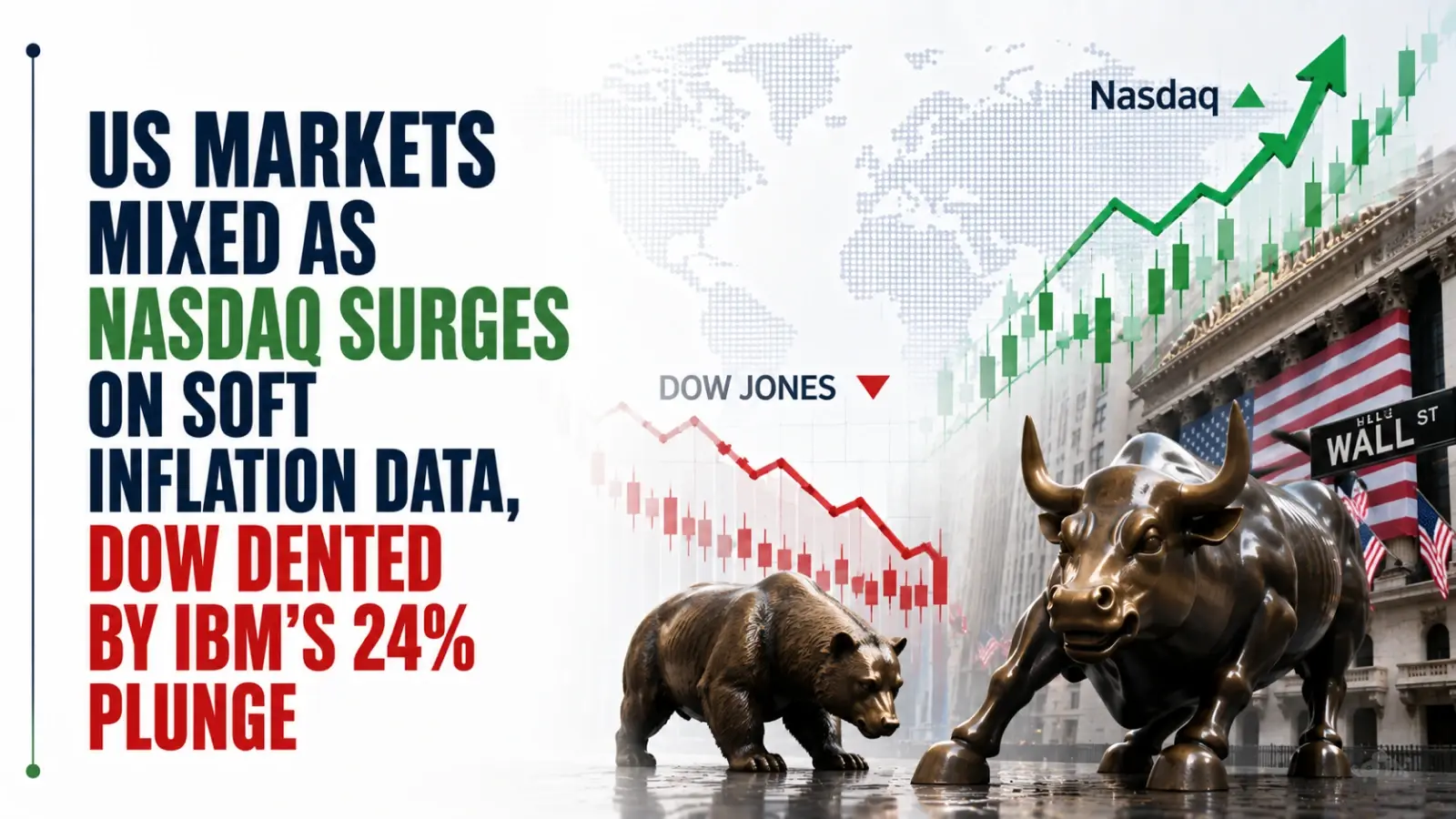
US Markets Mixed as Nasdaq Surges on Soft Inflation Data, Dow Dented by IBM's 24% Plunge
Authored By HDFC SKY | Last Modified: Jul 15, 2026 11:43 AM IST
Open Free Demat Account
Open Free Demat Account
Mumbai, July 14: Wall Street presented a mixed picture during Tuesday’s trading session as softer-than-expected inflation data fuelled a rally in technology and semiconductor stocks, while a precipitous decline in International Business Machines Corp (IBM) and surging oil prices tempered broader market gains. The tech-heavy Nasdaq Composite advanced 0.58% to 26,024.25, while the S&P 500 edged 0.33% higher to 7,540.36. However, the Dow Jones Industrial Average managed only a modest 0.23% gain to 52,621.50, constrained by IBM’s dramatic 24% plunge and weakness in banking stocks.

Nasdaq Gains 0.58% as Semiconductor Stocks Rebound After Monday’s Sell-Off
The Nasdaq Composite’s upward movement was primarily driven by a sharp recovery in semiconductor stocks, which had suffered significant losses in the previous session. The VanEck Semiconductor ETF (SMH) traded more than 2% higher, with several major chipmakers posting substantial gains. Lam Research surged 4.80%, while CrowdStrike Holdings advanced 7.27%, and Marvell Technology gained 3.85%. Micron Technology rose 4.22%, and Advanced Micro Devices climbed 4.30%, reflecting renewed investor appetite for AI-linked technology names.
The rebound in chip stocks came after Monday’s brutal session when the Philadelphia Semiconductor Index plunged 4.8%. South Korean memory chip giant SK Hynix, which had tumbled more than 9% in its second day of trading on US exchanges, surged approximately 11% at the opening bell. The recovery extended to other memory chipmakers, with Sandisk gaining 6.75%, Seagate Technology Holdings rising 3.72%, and Western Digital advancing 4.23%.
June CPI Falls to 3.5% as Cooling Inflation Boosts Rate-Cut Hopes
The primary catalyst behind Tuesday’s market movement was the release of June Consumer Price Index data, which came in significantly below economist expectations. The headline CPI rose 3.5% year-over-year, down from May’s 4.2% reading and below the Dow Jones consensus forecast of 3.8%. On a monthly basis, consumer prices fell 0.4%, marking the largest single-month decline since April 2020, primarily driven by a 9.7% drop in gasoline prices.
Core inflation, which excludes volatile food and energy components, remained flat month-over-month and registered 2.6% annually, below economist expectations of 2.8%. The reading also came in lower than May’s 2.9% annual increase, providing further evidence that inflationary pressures are moderating.
The softer inflation data prompted traders to sharply reduce expectations for near-term Federal Reserve rate hikes. According to the CME’s FedWatch Tool, the probability of a quarter-point rate increase at the Fed’s July meeting dropped to approximately 17% from 42% the previous day. However, traders still anticipate potential tightening at the September meeting, with a 63% probability of the target rate being raised by a quarter or half percentage point.
Also Read: How to invest in US stocks
IBM Plunges 24% After CEO Warns of Disappointing Q2 Results
International Business Machines Corp emerged as the single largest drag on the Dow Jones Industrial Average, with shares plummeting 24.46% to $219.23 in early trading. The decline positioned IBM for its worst single-day performance since October 1987, when the stock fell 23.7%, and potentially its worst day in history based on data going back to 1972.
The dramatic sell-off followed a letter to investors from IBM CEO Arvind Krishna, who warned that second-quarter results would fall short of expectations due to weaker-than-anticipated performance in the company’s software and infrastructure businesses. Krishna disclosed that the company expects second-quarter revenue of $17.2 billion, up just 1%, with software revenue growing 5% and infrastructure revenue declining 7%. Diluted GAAP earnings are projected at $2.27 per share, down 2% year-over-year.
“We expected Infrastructure revenue to decline low-single digits for the year, beginning this quarter. What played out was worse than our expectations, driven by a shortfall in our Z performance and the associated software stack, primarily in Transaction Processing,” Krishna wrote. The CEO attributed the shortfall to clients shifting capital expenditure toward servers, storage, and memory purchases to secure supply-constrained infrastructure ahead of anticipated price increases, alongside distraction from industry-wide cybersecurity concerns.
The negative impact extended beyond IBM, with fellow software stocks experiencing declines. ServiceNow fell 7.6% in pre-market trading, Accenture dropped 7.4%, and Oracle declined 1.1% in sympathy with IBM’s disappointing outlook.
Goldman Sachs Jumps 6.98% as Investment Banking Boom Drives Record Profits
Goldman Sachs delivered a standout performance among banking stocks, surging 6.98% to $1,118.92 after reporting second-quarter results that comfortably exceeded analyst expectations. The investment banking giant posted earnings of $20.98 per share, more than double the $10.91 per share recorded in the same period last year, and significantly above the LSEG consensus estimate of $14.48 per share.
Revenue jumped 39% to $20.34 billion, surpassing the $16.13 billion consensus forecast, driven by exceptional performance in the Global Banking and Markets division. Asset and wealth management revenue surged 20%, while global banking and markets revenue spiked 53%, fuelled by a 55% increase in investment banking fees.
The results reflect a favourable environment for investment banking activity, with elevated market activity and robust dealmaking contributing to the firm’s record performance. Goldman Sachs shares have now advanced approximately 19% year-to-date through Monday’s close, making it one of the top performers in the Dow Jones Industrial Average.
JPMorgan Chase Posts Record $21.2 Billion Quarterly Profit in US Banking History
JPMorgan Chase & Co reported the highest quarterly profit in US banking history, with net income surging 41% to $21.2 billion, or $7.70 per share, far exceeding analyst expectations of $5.64 per share. Total net revenue rose 28% to $57 billion, compared to $45 billion in the year-ago quarter.
CEO Jamie Dimon attributed the blockbuster results to “a particularly favourable environment with an elevated level of market activity, as well as rigorous execution, years of consistent investment and thoughtful capital deployment.” However, shares of JPMorgan declined approximately 2% in early trading despite the record results.
Commercial and investment banking revenue surged 27%, driven by a 35% increase in markets revenue, while asset and wealth management revenue climbed 19%. Consumer and community banking revenue rose 8%, reflecting broad-based strength across the bank’s operations.
Dimon warned of underlying risks despite the robust quarterly performance, noting that “several risks are shifting below the surface like tectonic plates, including geopolitical tensions and wars, sticky inflation, large global fiscal deficits and elevated asset prices.” He cautioned that while these forces may remain manageable, they “could also cause meaningful disruptions when they shift or collide.”
Bank of America and Wells Fargo Beat Estimates as Consumer Resilience Persists
Bank of America reported second-quarter earnings of $1.21 per share, surpassing the LSEG consensus forecast of $1.13 per share, with revenue of $31.7 billion exceeding estimates of $30.72 billion. CEO Brian Moynihan highlighted consumer resilience as a key factor driving the bank’s 27% profit increase, with shares rising 2.25% to $60.84 in early trading.
Wells Fargo also delivered better-than-expected results, posting earnings of $2.00 per share on revenue of $22.62 billion, exceeding analyst expectations of $1.72 per share and $21.84 billion in revenue. Despite the beat, shares traded modestly higher by 0.82% to $88.38, reflecting cautious sentiment amid broader market pressures.
Geopolitical Tensions Send Oil Prices Surging as US Reinstates Hormuz Blockade
Crude oil prices continued their ascent, adding to the geopolitical risk premium following President Donald Trump’s announcement that the US would reinstate a naval blockade on Iranian shipping through the Strait of Hormuz. The blockade, effective Tuesday afternoon, covers Iran’s entire coastline including oil terminals, though neutral vessels transiting to non-Iranian destinations may still pass.
West Texas Intermediate futures gained 3.4% to $80.80 a barrel, while Brent crude futures advanced 4.3% to $86.80 per barrel. The energy price surge followed Monday’s 9% rally, representing the largest two-day increase in oil prices in recent years. The US also proposed implementing a 20% fee on all cargo crossing the waterway, further fuelling concerns about supply chain disruptions and their potential impact on global inflation.
Energy stocks emerged as the top performers in the previous session, with Exxon Mobil rising 4.05% and Chevron gaining 3.29%, and continued to attract investor attention at Tuesday’s open amid sustained geopolitical tensions.
Also Read: US Stock market timings
Fed Chair Warsh to Testify Before Congress as Lawmakers Seek Clarity on Policy
Federal Reserve Chairman Kevin Warsh is scheduled to deliver the central bank’s semi-annual Monetary Policy Report to the US House Financial Services Committee at approximately 10 am ET. In prepared remarks, Warsh is expected to reaffirm the Fed’s commitment to controlling inflation, stating that the central bank and his colleagues “have no tolerance for persistently elevated inflation.”
“If we get policy right—and we will—the inflation surge of the last five years will be a thing of the past,” Warsh is set to tell lawmakers. The comments follow his first Federal Open Market Committee meeting in June, which saw interest rates held steady despite persistent inflationary pressures.
House Financial Services Committee Chairman Rep. French Hill (R-Ark.) indicated that lawmakers are likely to press Warsh on price stability, past policy missteps, and the Fed’s expanded balance sheet. Hill noted that the Fed’s balance sheet has “expanded dramatically” since the financial crisis and remains “a real behemoth in the economy,” raising questions about Warsh’s approach to shrinking the balance sheet.
10-Year Treasury Yield Rises to 4.63% as Markets Assess Fed Policy Path
US Treasury yields edged higher as traders recalibrated expectations for Federal Reserve interest rate policy amid cooling inflation data and ongoing geopolitical tensions. The key 10-year Treasury yield rose more than 1 basis point to 4.63%, while the 2-year Treasury note yield climbed 2 basis points to 4.28%. The 30-year bond yield advanced 1 basis point to reach 5.11%.
The yield movements reflected a complex interplay of factors, including the softer-than-expected inflation data, rising oil prices, and anticipation of Warsh’s congressional testimony. While the June CPI reading reduced near-term rate hike expectations, persistent geopolitical risks and elevated core inflation continued to support higher yields.
Currency and Commodity Markets Respond to Inflation Data and Oil Price Surge
The US dollar index, which tracks the value of the greenback against a basket of foreign currencies, declined 0.5% to 100.69 following the softer inflation data. Bitcoin was trading around $63,700, recovering from overnight lows near $61,800, while gold futures rose 2% to $4,085 per ounce as investors sought safe-haven assets amid geopolitical uncertainty.
The weaker inflation print provided some relief to bond markets, though yields remained elevated due to ongoing supply concerns and geopolitical risks. Investors continued to monitor the escalating US-Iran tensions and their potential implications for global energy supplies and inflation expectations.
About International Business Machines Corp
International Business Machines Corp, headquartered in Armonk, New York, is a multinational technology and consulting company operating across cloud computing, artificial intelligence, quantum computing, and enterprise software solutions. IBM’s shares trade on the New York Stock Exchange under the ticker symbol IBM, with the company serving enterprise clients globally through its hybrid cloud platform and consulting services.
The softer-than-expected June CPI reading provides temporary relief on inflation concerns, though geopolitical risks and oil price volatility remain significant factors. Markets will closely monitor Federal Reserve Chair Warsh’s testimony for policy signals, while the divergence between technology stocks and cyclical sectors highlights ongoing sector rotation dynamics. Bank earnings season continues with further releases expected this week.
Source
- https://www.nasdaq.com/
- spglobal.com/spdji/en/indices/equity/sp-500/
- https://www.dowjones.com/
Disclaimer
If you have any concerns, questions, or wish to point out any discrepancies in our content, please feel free to write to us at content@hdfcsec.com.
Please Note: The information shared is intended solely for informational purposes and does not make any investment recommendations
Disclaimer
At HDFC SKY*, we take utmost care and due diligence in curating and presenting news and market-related content. However, inadvertent errors or omissions may occasionally occur.
If you have any concerns, questions, or wish to point out any discrepancies in our content, please feel free to write to us at content@hdfcsec.com.
Please Note: The information shared is intended solely for informational purposes and does not make any investment recommendations.
HDFC SKY from HDFC Securities, one of most trusted trading platforms in India, has been recognized with the *Next-Gen Digi Content Awards 2025-26.
 Join Us
 Add as preferred source on Google


More Business News








Open Free Demat Account
Open Free Demat Account









Invest Anytime, Anywhere


By signing up I certify terms, conditions & privacy policy