Nifty 50
- Dr. Reddy's Labs₹1,229.4032.40 (2.71%)
- Apollo Hospitals₹7,775-252.50 (-3.15%)
- Bajaj Auto₹10,034256.00 (2.62%)
- ITC₹257.90-8.10 (-3.05%)
- Tata Motors PV₹284.454.55 (1.63%)
- Tech Mahindra₹1,471-43.10 (-2.85%)
- Bharat Electronics₹373.905.75 (1.56%)
- L&T₹3,627.50-75.80 (-2.05%)
- BSE₹3,330.2043.00 (1.31%)
- Max Healthcare₹865.95-17.85 (-2.02%)
- Cipla₹1,317.4016.40 (1.26%)
- Hindalco Industries₹882.50-17.85 (-1.98%)
- Eicher Motors₹7,11969.00 (0.98%)
- Hindustan Unilever₹1,820.70-36.00 (-1.94%)
- Mahindra & Mahindra₹2,81316.80 (0.60%)
- SBI₹941-18.10 (-1.89%)
- Kotak Mahindra Bank₹443.402.40 (0.54%)
- Coal India₹404.80-6.75 (-1.64%)
- HCL Technologies₹1,2236.30 (0.52%)
- Bharti Airtel₹1,778.70-26.40 (-1.46%)

- Offerings
- Tools & Platforms
Tools & Calculators
- Open API
- Calculators
- SIP Calculator
- CAGR Calculator
- Compound Interest Calculator
- FD Calculator
- RD Calculator
- EPF Calculator
- Retirement Calculator
- HDFC SIP Calculator
- Mutual Fund Return Calculator
- Lumpsum Calculator
- Step Up SIP Calculator
- ETF SIP Calculator
- Brokerage Calculator
- Equity Margin Calculator
- SWP Calculator
- EMI Calculator
- MTF Calculator
- Margin Pledge Calculator
- Algo Strategy
- Markets
Stocks
F&O
Mutual Funds
- More
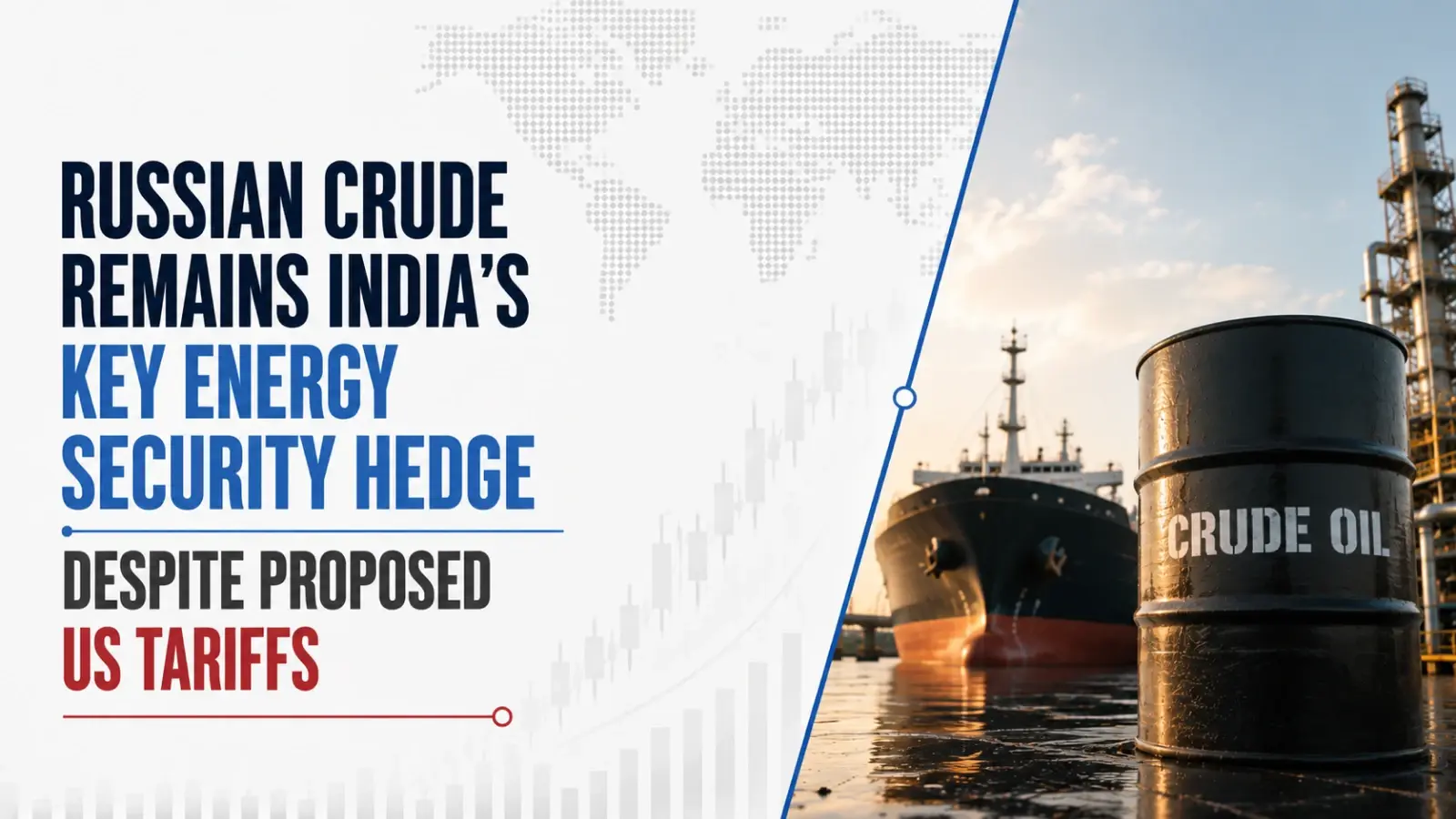
Russian Crude Remains India’s Key Energy Security Hedge Despite Proposed US Tariffs
Authored By PTI | Last Modified: Jul 15, 2026 04:08 PM IST
Open Free Demat Account
Open Free Demat Account
New Delhi: Proposed US tariffs targeting countries that buy Russian crude could inject fresh volatility into global oil markets, but replacing Russian supply would be difficult given limited spare production capacity and ongoing geopolitical risks, according to a Kpler analyst.
“Russian crude has become the country’s strongest energy security hedge, particularly since the Strait of Hormuz disruptions,” according to Sumit Ritolia, an analyst at Kpler.
US senators on Tuesday unveiled a revised bipartisan Russia sanctions bill that would impose sanctions on Russian officials while softening proposed tariffs on countries importing Russian oil and gas. The measure lowers the maximum tariff on the five largest buyers of Russian energy, including China and India, to 100 per cent from the 500 per cent proposed in the original bill introduced in April 2025. It also exempts countries importing less than 15 per cent of Russia’s natural gas exports if they are taking significant steps to reduce those purchases.
Russia supplied around 2.6 million barrels per day (mbd) of crude to India in June, accounting for more than half of the country’s total crude imports, Ritolia said. Imports have risen steadily since March, while July arrivals are on track to match or exceed June’s volumes.
Russian crude has also acted as a stabilizing force in global oil markets, he said, noting that earlier sanctions were designed to keep Russian oil flowing to avoid removing millions of barrels a day from the market and driving prices sharply higher.
“If secondary tariffs of 100 per cent… were implemented in a way that materially reduced purchases of Russian crude, the market would first need to answer a simple question: where would the replacement barrels come from?” Ritolia said.
With limited spare production capacity, persistent risks around the Strait of Hormuz and constrained alternative supplies, replacing Russian exports at scale would be difficult without triggering a significant rise in oil prices, he said.
For India, alternatives capable of replacing Russian crude at comparable volumes, reliability and cost remain limited, making Russian barrels the most practical source of supply under current market conditions, Ritolia added.
While the proposed tariffs increase geopolitical uncertainty, their implementation and impact on global crude flows remain far from certain, he said, warning that any policy that materially disrupts Russian exports could tighten an already constrained oil market with repercussions extending beyond India.
(Disclaimer: Except for the headline, this article has not been edited by HDFC Sky editorial team and is auto-generated from PTI feed.)
Disclaimer
If you have any concerns, questions, or wish to point out any discrepancies in our content, please feel free to write to us at content@hdfcsec.com.
Please Note: The information shared is intended solely for informational purposes and does not make any investment recommendations
Disclaimer
At HDFC SKY*, we take utmost care and due diligence in curating and presenting news and market-related content. However, inadvertent errors or omissions may occasionally occur.
If you have any concerns, questions, or wish to point out any discrepancies in our content, please feel free to write to us at content@hdfcsec.com.
Please Note: The information shared is intended solely for informational purposes and does not make any investment recommendations.
HDFC SKY from HDFC Securities, one of most trusted trading platforms in India, has been recognized with the *Next-Gen Digi Content Awards 2025-26.
 Join Us
 Add as preferred source on Google


More Business News





Open Free Demat Account
Open Free Demat Account










Invest Anytime, Anywhere


By signing up I certify terms, conditions & privacy policy