Nifty 50
- Dr. Reddy's Labs₹1,22120.00 (1.67%)
- Tata Motors PV₹281.75-8.70 (-3.00%)
- Infosys₹1,003.203.00 (0.30%)
- Adani Enterprises₹2,831.10-85.40 (-2.93%)
- HDFC Life Insurance ₹531.600.60 (0.11%)
- Jio Financial ₹220.50-6.50 (-2.86%)
- Power Grid Corp₹261.85-7.65 (-2.84%)
- L&T₹3,766.40-109.80 (-2.83%)
- ONGC₹230-5.86 (-2.48%)
- Adani Ports₹1,743.70-44.30 (-2.48%)
- Hindustan Unilever₹1,896-46.90 (-2.41%)
- Tata Consumer ₹960-23.20 (-2.36%)
- Reliance Industries₹1,197.60-28.40 (-2.32%)

- Offerings
- Tools & Platforms
Tools & Calculators
- Open API
- Calculators
- SIP Calculator
- CAGR Calculator
- Compound Interest Calculator
- FD Calculator
- RD Calculator
- EPF Calculator
- Retirement Calculator
- HDFC SIP Calculator
- Mutual Fund Return Calculator
- Lumpsum Calculator
- Step Up SIP Calculator
- ETF SIP Calculator
- Brokerage Calculator
- Equity Margin Calculator
- SWP Calculator
- EMI Calculator
- MTF Calculator
- Margin Pledge Calculator
- Algo Strategy
- Markets
Stocks
F&O
Mutual Funds
- More
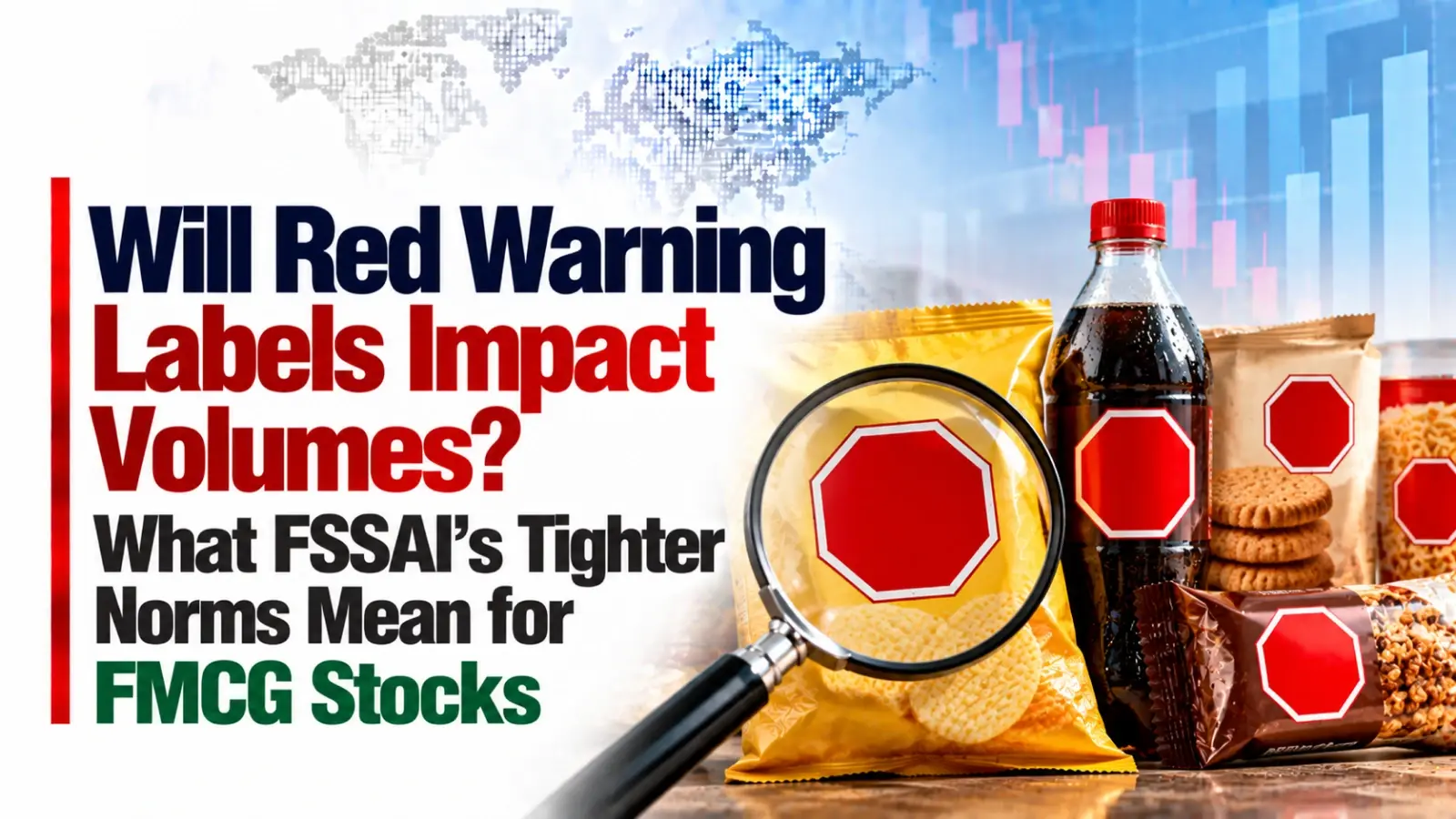
Will Red Warning Labels Impact Volumes? What FSSAI’s Tighter Norms Mean for FMCG Stocks
Authored By HDFC SKY | Last Modified: Sep 28, 2026 04:29 PM IST
Open Free Demat Account
Open Free Demat Account
New Delhi, Sept 28: The government has taken a tougher stance on warning labels for packaged foods containing high quantities of salt, sugar or fat. The Food Safety and Standards Authority of India (FSSAI) said it would require a red label on products that exceed the prescribed limits for any one of these three nutrients. This is a blow to the food industry, which is estimated to be worth more than $100 billion and has opposed such labels for years. The move comes as the government has stepped up its food-safety crackdown by raiding restaurants across the country and seeking to restrict the sale of junk food near schools.
The original directive proposed including a warning only if a product contained high quantities of two of these ingredients. Many activists felt this would not be enough, and the Supreme Court of India also raised questions about the proposal. According to a filing made on September 23, which was not made public but was reviewed by Reuters, the regulator would use a single warning phase and display the name of the nutrient in question inside a red hexagon if only one nutrient exceeds the prescribed limit. Products containing sweeteners will also need to display a warning label on the front of their packaging. Companies will have one year to comply with the guidelines after they are finalised, a process that is expected to take approximately four months.
The industry has objected to these measures and filed a response with the Supreme Court on September 24. The All India Food Processors Association said the colour and icon used for these warning labels should be considered carefully. Since many Indians associate the colour red with the non-vegetarian symbol, the industry believes that another bright red icon could be misleading. It said it is not against front-of-pack warnings, but the thresholds must be decided scientifically. India has become a major market for multinational corporations such as PepsiCo, Coca-Cola, Mondelez and Nestlé, as well as many domestic brands.
How these regulations could affect stock prices:
- Higher costs: Companies will have to spend money reformulating products and changing packaging. If just one ingredient exceeds the prescribed limit, companies will have to place these red symbols on a larger number of products. From chips and cookies to noodles and candy bars, a wide range of products could carry the warning. Changes to recipes and packaging would increase costs and could put pressure on profit margins.
- Potential impact on demand: If consumers start avoiding these products because of the red labels, companies could see lower demand. Similar labelling requirements have been implemented in other countries to discourage consumers from buying products high in sugar, salt and fat. Investors may become more cautious about companies such as Nestlé India (NESTLEIND), Britannia Industries (BRITANNIA), ITC (ITC) and Hindustan Unilever (HINDUNILVR).
- Impact on beverage companies: Since products containing sweeteners are also being targeted by the regulations, beverage companies could see weaker sales. This could include bottlers such as Varun Beverages (VBL), which bottles PepsiCo drinks.
- Uncertainty over implementation: There is still some uncertainty surrounding the regulations. Since companies will have one year to comply once the rules come into effect, the immediate impact on profits may be limited. However, the impact could become clearer once the matter is settled by the Supreme Court. Nestlé India (NESTLEIND) traded 1.15% lower at Rs 1,346.90 on Monday morning and was among the biggest decliners on the Nifty 50 index.
- Pressure on smaller companies: Smaller companies producing traditional Indian sweets and savouries may have greater difficulty complying with the regulations. Larger companies are likely to have greater resources to reformulate products and change packaging. The government is taking steps similar to those adopted by countries such as Chile and Mexico to reduce the consumption of foods high in sugar, salt and fat.
Source
- Reuters
- NSE
Disclaimer
At HDFC SKY*, we take utmost care and due diligence in curating and presenting news and market-related content. However, inadvertent errors or omissions may occasionally occur.
If you have any concerns, questions, or wish to point out any discrepancies in our content, please feel free to write to us at content@hdfcsec.com.
Please Note: The information shared is intended solely for informational purposes and does not make any investment recommendations.
HDFC SKY from HDFC Securities, one of most trusted trading platforms in India, has been recognized with the *Next-Gen Digi Content Awards 2025-26.
 Join Us
 Add as preferred source on Google


More VBL News








Open Free Demat Account
Open Free Demat Account
₹430











Invest Anytime, Anywhere


By signing up I certify terms, conditions & privacy policy