Nifty 50
- ITC₹26611.00 (4.31%)
- BSE₹3,276.90-57.90 (-1.74%)
- TCS₹2,155.1079.10 (3.81%)
- Reliance Industries₹1,174.50-3.50 (-0.30%)
- Eicher Motors₹7,018250.50 (3.70%)
- JSW Steel₹1,173-2.20 (-0.19%)
- Apollo Hospitals₹7,936.50270.50 (3.53%)
- Adani Ports₹1,760.4052.40 (3.07%)
- Shriram Finance₹940.4023.15 (2.52%)
- Bajaj Auto₹9,859222.00 (2.30%)
- Power Grid Corp₹250.155.50 (2.25%)
- Tata Motors PV₹2796.00 (2.20%)
- HDFC Life Insurance ₹556.3011.80 (2.17%)

- Offerings
- Tools & Platforms
Tools & Calculators
- Open API
- Calculators
- SIP Calculator
- CAGR Calculator
- Compound Interest Calculator
- FD Calculator
- RD Calculator
- EPF Calculator
- Retirement Calculator
- HDFC SIP Calculator
- Mutual Fund Return Calculator
- Lumpsum Calculator
- Step Up SIP Calculator
- ETF SIP Calculator
- Brokerage Calculator
- Equity Margin Calculator
- SWP Calculator
- EMI Calculator
- MTF Calculator
- Margin Pledge Calculator
- Algo Strategy
- Markets
Stocks
F&O
Mutual Funds
- More
Why Nifty Hit All Time Highs While Corporate Earnings Were Actually Falling: Explained Simply
By Aseem Shrivastava | Updated at: May 27, 2026 06:22 PM IST
Open Free Demat Account
Open Free Demat Account
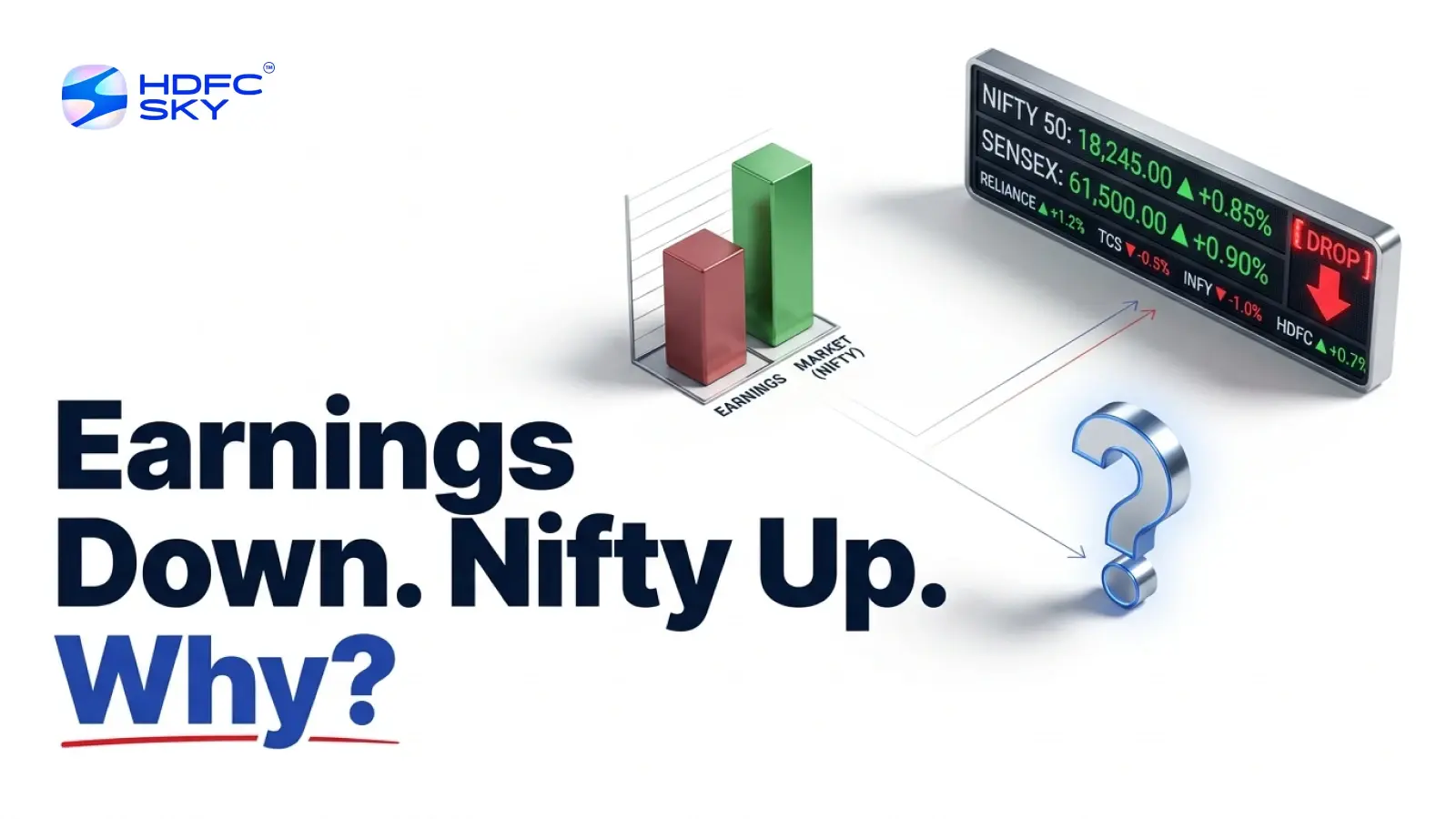
You check the news and see the Nifty 50 hitting a brand-new all-time high. Naturally, you feel good about your investments. Then you read the fine print. Many companies are reporting weaker profits. Some experts even say corporate earnings growth has slowed sharply.
That sounds confusing. If companies are earning less, shouldn’t stock prices fall? Not always. This situation often surprises first-time investors, but it is actually common in stock markets. The simple reason is this: stock markets do not move only on today’s earnings. They move on what investors believe will happen tomorrow.
Let’s break down why the Nifty kept rising even while corporate earnings looked weak.
The Stock Market Always Looks Ahead
The stock market always looks ahead. When investors buy shares, they do not pay for last quarter’s profits. They pay for future growth. They try to estimate what companies might earn over the next 12 to 18 months.
In 2025 and 2026, many companies faced pressure from slower demand, rising costs, and temporary business challenges. However, investors believed these problems would ease over time. They expected earnings to recover in the coming quarters, so they kept buying stocks.
But investors focused on what could happen next. Many analysts expected earnings to recover strongly in late 2025 and through 2026. Analysts projected Nifty earnings per share growth of around 9% in FY26 after a weak 1% growth in FY25, with profit growth expected at 8.2% in FY26 and accelerating further to 17.6% in FY27.
In simple words, the market ignored today’s slowdown because it believed better days were ahead.
Also Read: How RBI’s policy pause sent rate-sensitive stocks in two opposite directions on the same day
Strong Domestic Investors Kept the Market Rising
One of the biggest reasons the Nifty stayed strong was the surge in domestic money entering the market. In the past, Indian markets depended heavily on foreign investors. If Foreign Institutional Investors (FIIs) sold large amounts of stock, markets usually fell sharply.
That pattern has changed. In 2025, FIIs pulled out more than ₹1.66 lakh crore from Indian equities. Years ago, that kind of selling could have triggered a major market crash. But this time, domestic investors stepped in.
Domestic Institutional Investors (DIIs) invested a massive ₹7.44 lakh crore during the same period. Monthly SIP contributions crossed ₹32,000 crore consistently. Retail participation also exploded, with more than 10 crore SIP accounts now active across the country.
For the first time, DIIs even overtook FIIs in Nifty ownership, holding 24.8% of the index compared to FIIs at 24.3%. This steady stream of local money absorbed foreign selling and kept pushing stock prices higher.
The Heavyweights Lifted the Entire Index
Another reason lies in how the Nifty 50 works. The index does not treat every company equally. Larger companies carry more weight, which means their stock movements influence the index far more.
A few heavyweight companies performed especially well in 2025. HDFC Bank alone carries a weight of about 13% in the Nifty. Along with ICICI Bank and Reliance Industries, it played a major role in lifting the index.
When these giant stocks rise, the entire Nifty rises with them. At the same time, many smaller companies struggled. In fact, while the Nifty 50 gained more than 12%, the Nifty Small-cap index fell around 9%.
This explains why many investors felt confused. The headline index looked strong, but their personal portfolios may not have reflected the same success. This is called market polarization.
High Valuations Still Felt Acceptable
Even though earnings weakened, investors still found Indian stocks attractive. The Nifty traded at around 21 times forward earnings. That is expensive compared to historical averages, but not dangerously high in the eyes of many investors.
Why? Because investors still believed in India’s long-term growth story. Strong domestic demand, rising infrastructure spending, digital expansion, and a growing middle class all supported confidence in future growth.
Many investors viewed high valuations not as a warning sign, but as the price of investing in a fast-growing economy.
Global Winds Added More Support
Global and economic conditions also helped fuel the rally. The Reserve Bank of India cut interest rates by 125 basis points in 2025, bringing the repo rate down to 5.25%.
Lower interest rates reduce borrowing costs for businesses and make stocks more attractive than fixed deposits. The US Federal Reserve also signalled possible rate cuts, which improved global investor sentiment and encouraged more risk-taking.
India’s GDP growth remained strong at 7.6%, making it one of the fastest-growing major economies in the world. At the same time, softer crude oil prices eased inflation pressure and supported both businesses and consumers. All of this created a positive backdrop for equities.
Final Thoughts
The Nifty can rise even when company earnings fall because markets focus on the future, not just current profits. Strong domestic investing, confidence in India’s growth, and support from big companies can keep stock prices moving higher. As a new investor, stay patient and focus on long-term goals. Markets often recover before company earnings improve.



Open Free Demat Account
Open Free Demat Account
Popular Posts
- 10 Interesting Facts About NSE You Probably Didn’t KnowLast Updated: Sep 30, 2026
- 8-4-3 Rule of SIP - How Does That Work?Last Updated: Jul 30, 2025
- Let's view more exciting Post!
Popular Post from Market WTF by Sky
- Why Q4 Results "Beat Estimates" But Stocks FellLast Updated: May 27, 2026
- Why Oil Falling Is Sometimes Bad For Markets: The Counterintuitive Logic ExplainedLast Updated: May 27, 2026
- Why Did Adani Stocks Drop 60% After a 106-Page Research Report Nobody Paid for?Last Updated: May 27, 2026
- The VIX Spike Nobody Saw Coming: Decoding What Caused The 2024 India Volatility ShockLast Updated: May 27, 2026
- The F&O Expiry Rally: Why Markets Often Move Up on Thursdays and What Drives ItLast Updated: May 27, 2026
- Let's view more exciting Post!
Popular Post from Blogs
- “Bounce Back” Theme Gains Traction in 2026Last Updated: Apr 8, 2026
- 5 Takeaways for Tax Payers from the Budget 2025Last Updated: Jan 29, 2026
- Let’s view more exciting Posts


Invest Anytime, Anywhere


By signing up I certify terms, conditions & privacy policy