Nifty 50
- Bajaj Auto₹10,071293.00 (3.00%)
- Tech Mahindra₹1,468.90-45.20 (-2.99%)
- Dr. Reddy's Labs₹1,225.8028.80 (2.41%)
- ITC₹258.95-7.05 (-2.65%)
- BSE₹3,344.8057.60 (1.75%)
- Coal India₹403.20-8.35 (-2.03%)
- Bharat Electronics₹373.255.10 (1.39%)
- Bharti Airtel₹1,772.80-32.30 (-1.79%)
- Eicher Motors₹7,114.5064.50 (0.91%)
- SBI₹942.70-16.40 (-1.71%)
- Mahindra & Mahindra₹2,81720.80 (0.74%)
- L&T₹3,641-62.30 (-1.68%)
- HDFC Life Insurance ₹559.653.00 (0.54%)
- NTPC₹307.10-4.90 (-1.57%)
- Trent₹2,93112.80 (0.44%)
- Hindustan Unilever₹1,828.50-28.20 (-1.52%)
- Tata Consumer ₹9583.00 (0.31%)
- ICICI Bank₹1,339.10-15.90 (-1.17%)
- Adani Enterprises₹2,641.907.50 (0.28%)
- Reliance Industries₹1,157.90-12.40 (-1.06%)

- Offerings
- Tools & Platforms
Tools & Calculators
- Open API
- Calculators
- SIP Calculator
- CAGR Calculator
- Compound Interest Calculator
- FD Calculator
- RD Calculator
- EPF Calculator
- Retirement Calculator
- HDFC SIP Calculator
- Mutual Fund Return Calculator
- Lumpsum Calculator
- Step Up SIP Calculator
- ETF SIP Calculator
- Brokerage Calculator
- Equity Margin Calculator
- SWP Calculator
- EMI Calculator
- MTF Calculator
- Margin Pledge Calculator
- Algo Strategy
- Markets
Stocks
F&O
Mutual Funds
- More
Crude Oil Prices Today, August 10, 2026: Prices Rise as Hormuz Reopening Remains Uncertain; Brent Tops $84
Authored By HDFC SKY | Last Modified: Aug 10, 2026 10:09 AM IST

Open Free Demat Account
Open Free Demat Account
Mumbai, Aug 10: Crude oil prices climbed on Monday as uncertainty over the reopening of the Strait of Hormuz kept a risk premium in the market, with Iran saying an agreement with Oman on new shipping lanes was nearing completion but maintaining that the waterway would not reopen until the United States meets additional conditions. The latest rise comes after a sharp decline in oil prices last week, highlighting the market’s sensitivity to developments around the strategically important shipping route.

Brent, WTI Gain
Brent crude rose 0.7% to $84.2 a barrel, while U.S. West Texas Intermediate gained 0.5% to $78.6. Both benchmarks had fallen more than 7% in the previous week as expectations of a potential agreement between Iran and Oman raised hopes that shipping through the Strait of Hormuz could resume.
The latest rebound reflects renewed caution among traders, who remain reluctant to fully unwind the geopolitical risk premium until there is concrete evidence that the waterway is reopening. Market participants are looking for signs such as verified tanker movements or a formal agreement before assuming that energy flows will return to normal.
Hormuz Reopening Still Uncertain
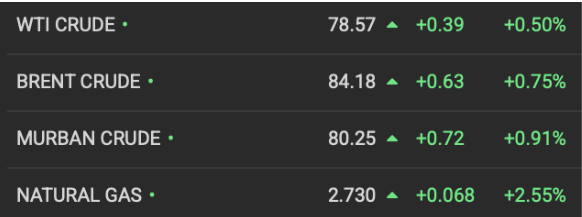
Both benchmarks advanced on Hormuz uncertainty. Source: oilprice.com
Iran said on Sunday that a deal with Oman defining new shipping lanes was in its final stages. However, Tehran reiterated that the Strait would only reopen after Washington meets additional conditions, including compensation to Iran for attacks during the conflict.
The Strait of Hormuz is critical to global energy markets, with roughly one-fifth of the world’s oil having moved through the waterway before the war. Any prolonged disruption therefore has the potential to tighten supplies and keep crude prices elevated, particularly if alternative shipping routes cannot fully compensate for the loss of normal traffic.
Iranian Foreign Minister Abbas Araqchi also said that Tehran and Washington were not engaged in negotiations and that Iran would not enter talks while the United States was viewed as violating an interim agreement signed in June. The lack of direct discussions adds another layer of uncertainty over when a broader resolution could emerge.
Also Read: How To Invest In Crude Oil
Fresh Supply Risks Add to Oil Concerns
The threat to energy infrastructure has also widened beyond the Strait. Iran-aligned Houthi forces said they had attacked Saudi Aramco’s Jazan refinery on Sunday, adding to concerns about the security of oil facilities in the region.
The development came shortly after Saudi Arabia signed a defence pact with Turkey and Pakistan amid heightened regional tensions. Separately, the United Arab Emirates’ ADNOC said 15 of its vessels had been attacked while transiting the Strait of Hormuz since the beginning of the conflict.
These developments could make traders more cautious about assuming a rapid return to normal supply conditions. Even if the Strait eventually reopens, the market could continue to price a geopolitical premium if attacks on energy infrastructure and commercial shipping persist.
What Higher Oil Prices Mean for India
The renewed rise in crude prices is particularly important for India, one of the world’s major oil importers. A prolonged increase in international crude prices could widen the country’s import bill and put pressure on the rupee, while also increasing input costs for businesses.
Oil-sensitive sectors could face pressure if elevated crude prices persist. Airlines, paints, chemicals and other industries that depend heavily on fuel or petroleum-linked inputs could see margins squeezed by higher costs. Rising crude could also complicate the inflation outlook by increasing transportation and production expenses.
On the other hand, upstream oil producers such as ONGC and Oil India could benefit from stronger crude realisations if prices remain elevated. The impact across Indian equities is therefore likely to remain uneven, with energy producers potentially gaining while fuel-intensive sectors face greater pressure.
Traders Await Clearer Signals
For now, the direction of crude prices is likely to remain closely tied to developments around the Strait of Hormuz. Last week’s sharp decline demonstrated how quickly prices can fall when markets anticipate a reopening, while Monday’s rebound showed that uncertainty can quickly restore the geopolitical premium.
A confirmed reopening accompanied by the resumption of tanker traffic could ease supply concerns and push crude lower. Conversely, delays, further attacks on energy infrastructure or an escalation in regional tensions could keep Brent elevated and increase pressure on oil-importing economies.
For Indian markets, the immediate focus will therefore remain on the trajectory of crude, the rupee and geopolitical developments. A sustained rise in oil could emerge as a headwind for equities, while any clear progress towards restoring normal shipping through Hormuz could provide relief to importers and broader risk sentiment.
Source
- oilprice.com
Disclaimer
If you have any concerns, questions, or wish to point out any discrepancies in our content, please feel free to write to us at content@hdfcsec.com.
Please Note: The information shared is intended solely for informational purposes and does not make any investment recommendations
Disclaimer
At HDFC SKY*, we take utmost care and due diligence in curating and presenting news and market-related content. However, inadvertent errors or omissions may occasionally occur.
If you have any concerns, questions, or wish to point out any discrepancies in our content, please feel free to write to us at content@hdfcsec.com.
Please Note: The information shared is intended solely for informational purposes and does not make any investment recommendations.
HDFC SKY from HDFC Securities, one of most trusted trading platforms in India, has been recognized with the *Next-Gen Digi Content Awards 2025-26.
 Join Us
 Add as preferred source on Google


More Business News









Open Free Demat Account
Open Free Demat Account












Invest Anytime, Anywhere


By signing up I certify terms, conditions & privacy policy