Nifty 50
- Coal India₹42813.30 (3.21%)
- Tata Consumer ₹984.10-16.50 (-1.65%)
- Eternal₹3426.10 (1.82%)
- Nestle₹1,363.90-21.10 (-1.52%)
- InterGlobe Aviation₹5,03089.00 (1.80%)
- Bajaj Finserv₹1,823.40-26.40 (-1.43%)
- Titan Company₹4,928.5053.50 (1.10%)
- Bajaj Finance₹1,008.80-12.50 (-1.22%)
- Dr. Reddy's Labs₹1,21112.70 (1.06%)
- Sun Pharmaceutical₹1,846.40-22.50 (-1.20%)
- Wipro₹1661.45 (0.88%)
- Grasim Industries₹3,128.20-37.80 (-1.19%)
- Tata Steel₹184.971.57 (0.86%)
- Trent₹2,782.90-32.60 (-1.16%)
- Adani Enterprises₹2,99722.00 (0.74%)
- Eicher Motors₹7,427-85.50 (-1.14%)
- Adani Ports₹1,7957.90 (0.44%)
- TCS₹2,105-23.70 (-1.11%)
- NTPC₹327.801.40 (0.43%)
- Apollo Hospitals₹8,822.50-89.50 (-1.00%)

- Offerings
- Tools & Platforms
Tools & Calculators
- Open API
- Calculators
- SIP Calculator
- CAGR Calculator
- Compound Interest Calculator
- FD Calculator
- RD Calculator
- EPF Calculator
- Retirement Calculator
- HDFC SIP Calculator
- Mutual Fund Return Calculator
- Lumpsum Calculator
- Step Up SIP Calculator
- ETF SIP Calculator
- Brokerage Calculator
- Equity Margin Calculator
- SWP Calculator
- EMI Calculator
- MTF Calculator
- Margin Pledge Calculator
- Algo Strategy
- Markets
Stocks
F&O
Mutual Funds
- More
Public Capex Spurs Private Investment, Pushes Capital Formation to 34% of GDP in Q1: FM Nirmala Sitharaman
Authored By PTI | Last Modified: Sep 22, 2026 04:09 PM IST
Open Free Demat Account
Open Free Demat Account
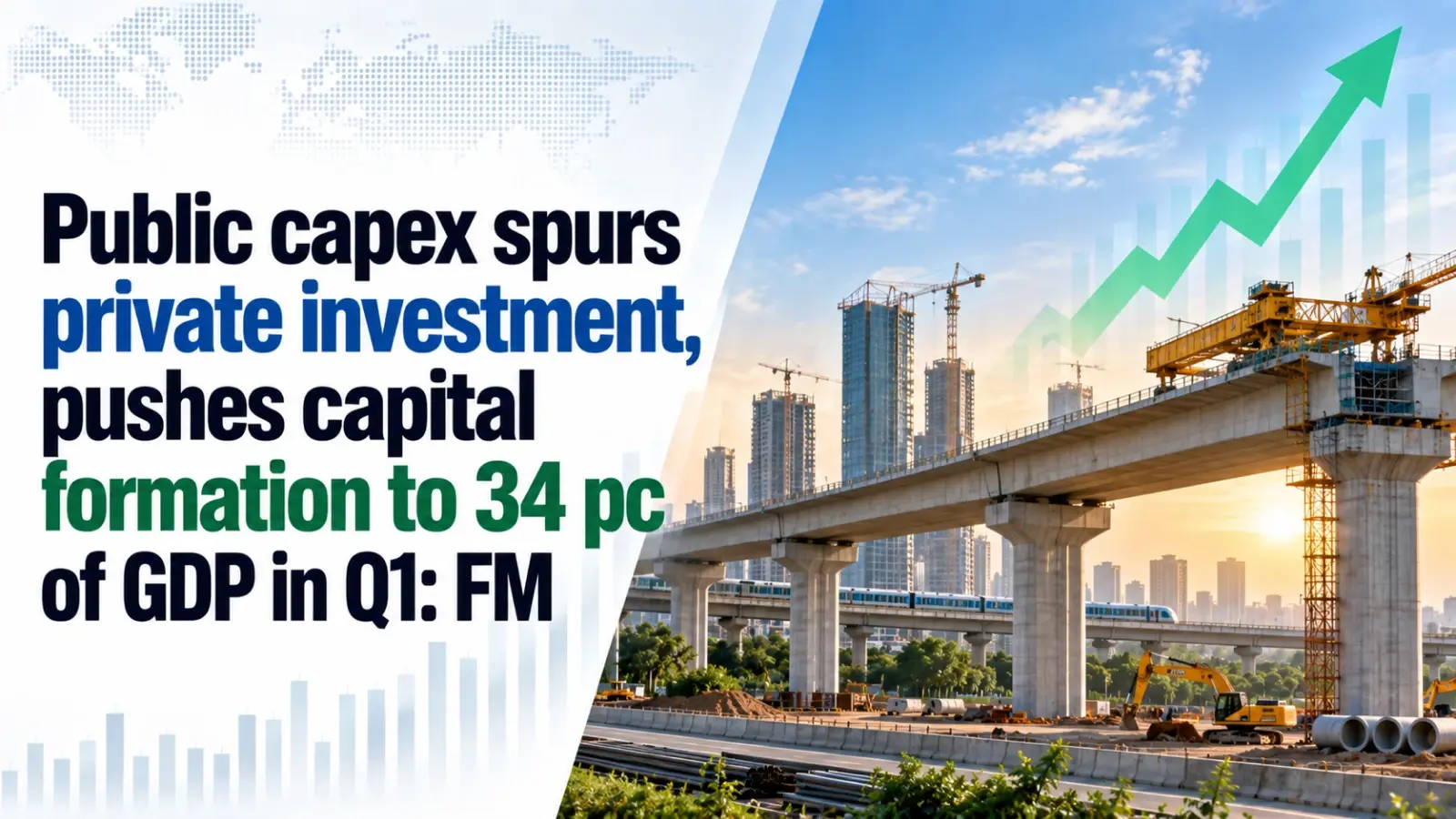
New Delhi: Public capital expenditure has deliberately been used to crowd in private investment, and the impact is now visible in higher capital formation, improved manufacturing capacity utilisation and stronger bank credit to industry, Finance Minister Nirmala Sitharaman said on Tuesday.
The government scaled up capital expenditure to more than Rs 12 lakh crore in 2026-27, while effective capital expenditure, including grants provided by the Centre to states for creation of capital assets, has crossed Rs 17 lakh crore.
Crowding-in is now visible as gross fixed capital formation rose to more than 34 per cent of GDP in Q1 of 2026-27, growing about 12 per cent in real terms, while manufacturing capacity utilisation has climbed to 75 per cent, she said at an event organised by AIMA here.
“This operational velocity has been unlocked by resolving the twin balance sheet crisis,” she said.
India now operates with a ‘twin balance sheet advantage’, Sitharaman said, under which commercial banks have the liquidity to lend while corporations have the solvency to invest.
Bank credit growth to industry also picked up, rising 19 per cent year-on-year in June 2026, she said.
Credit is reaching those who need it, and the government’s free trade agreements are opening doors for India’s labour-intensive goods and services, the finance minister said, urging the commercial sector to seize the opportunity.
Sitharaman also highlighted improvements in India’s infrastructure and logistics ecosystem, saying the country’s execution tempo had helped dismantle the earlier perception of chronic administrative delays.
Average turnaround time at major ports has nearly halved over the past decade, while the rail network is now almost fully electrified, she said, adding, the rail network is now almost fully electrified, and freight loading has reached a record 1,670 million tonnes.
She also emphasised the scale of India’s digital public infrastructure, saying it settled an average of about 79 crore transactions every day in August 2026.
The NDA government, in its first budget since it returned to office in July 2024, she said, made it all about reforms and encouraging economic activity, which ultimately lifts employment and livelihood opportunities.
This strategy has provided growth and resilience despite geopolitical challenges and weakening of global growth, she said.
“Reform and rising incomes are together reshaping demand. India stands at a structural inflection point: the next phase of consumption will be driven by upward mobility into brackets where discretionary spending accelerates,” she said.
While global momentum slows below 3 per cent, Indian GDP continues to expand close to 8 per cent, and the latest quarter came out stronger than most forecasts, she said, adding that this macro stability is prompting the world to re-rate India.
On September 2, the Japan Credit Rating Agency upgraded India’s long-term foreign currency and local currency issuer ratings from BBB+ to A- with a stable outlook, and raised the country ceiling to A.
This is India’s first A-category rating in over 35 years, she said.
(Disclaimer: Except for the headline, this article has not been edited by HDFC Sky editorial team and is auto-generated from PTI feed.)
Disclaimer
At HDFC SKY*, we take utmost care and due diligence in curating and presenting news and market-related content. However, inadvertent errors or omissions may occasionally occur.
If you have any concerns, questions, or wish to point out any discrepancies in our content, please feel free to write to us at content@hdfcsec.com.
Please Note: The information shared is intended solely for informational purposes and does not make any investment recommendations.
HDFC SKY from HDFC Securities, one of most trusted trading platforms in India, has been recognized with the *Next-Gen Digi Content Awards 2025-26.
 Join Us
 Add as preferred source on Google


More Business News









Open Free Demat Account
Open Free Demat Account










Invest Anytime, Anywhere


By signing up I certify terms, conditions & privacy policy