Nifty 50
- BSE₹3,966.40191.20 (5.06%)
- Asian Paints₹2,558.30-62.90 (-2.40%)
- Hindalco Industries₹917.4027.50 (3.09%)
- Eternal₹363.85-7.85 (-2.11%)
- Infosys₹1,164.3034.30 (3.04%)
- Shriram Finance₹970.80-19.15 (-1.93%)
- HDFC Bank₹869.7023.50 (2.78%)
- Nestle₹1,333.90-24.60 (-1.81%)
- HCL Technologies₹1,417.8037.80 (2.74%)
- Tata Consumer ₹1,166.40-19.40 (-1.64%)
- Tata Steel₹162.803.50 (2.20%)
- Bajaj Finserv₹1,899.20-25.80 (-1.34%)
- Cipla₹1,459.6026.40 (1.84%)
- InterGlobe Aviation₹5,648.10-71.90 (-1.26%)
- TCS₹2,556.8039.50 (1.57%)
- Trent₹3,279.10-40.50 (-1.22%)
- Jio Financial ₹225.452.60 (1.17%)
- Eicher Motors₹8,244-92.00 (-1.10%)
- SBI Life Insurance ₹1,842.6018.70 (1.03%)
- Bajaj Finance₹1,119.60-11.75 (-1.04%)

- Offerings
- Tools & Platforms
Tools & Calculators
- Open API
- Calculators
- SIP Calculator
- CAGR Calculator
- Compound Interest Calculator
- FD Calculator
- RD Calculator
- EPF Calculator
- Retirement Calculator
- HDFC SIP Calculator
- Mutual Fund Return Calculator
- Lumpsum Calculator
- Step Up SIP Calculator
- ETF SIP Calculator
- Brokerage Calculator
- Equity Margin Calculator
- SWP Calculator
- EMI Calculator
- MTF Calculator
- Margin Pledge Calculator
- Algo Strategy
- Markets
Stocks
F&O
Mutual Funds
- More
Dow Gains 424 Points as Nvidia Reversal and Inflation Data Drive Mixed US Closing Session
Authored By HDFC SKY | Last Modified: Nov 26, 2026 08:27 AM IST
Open Free Demat Account
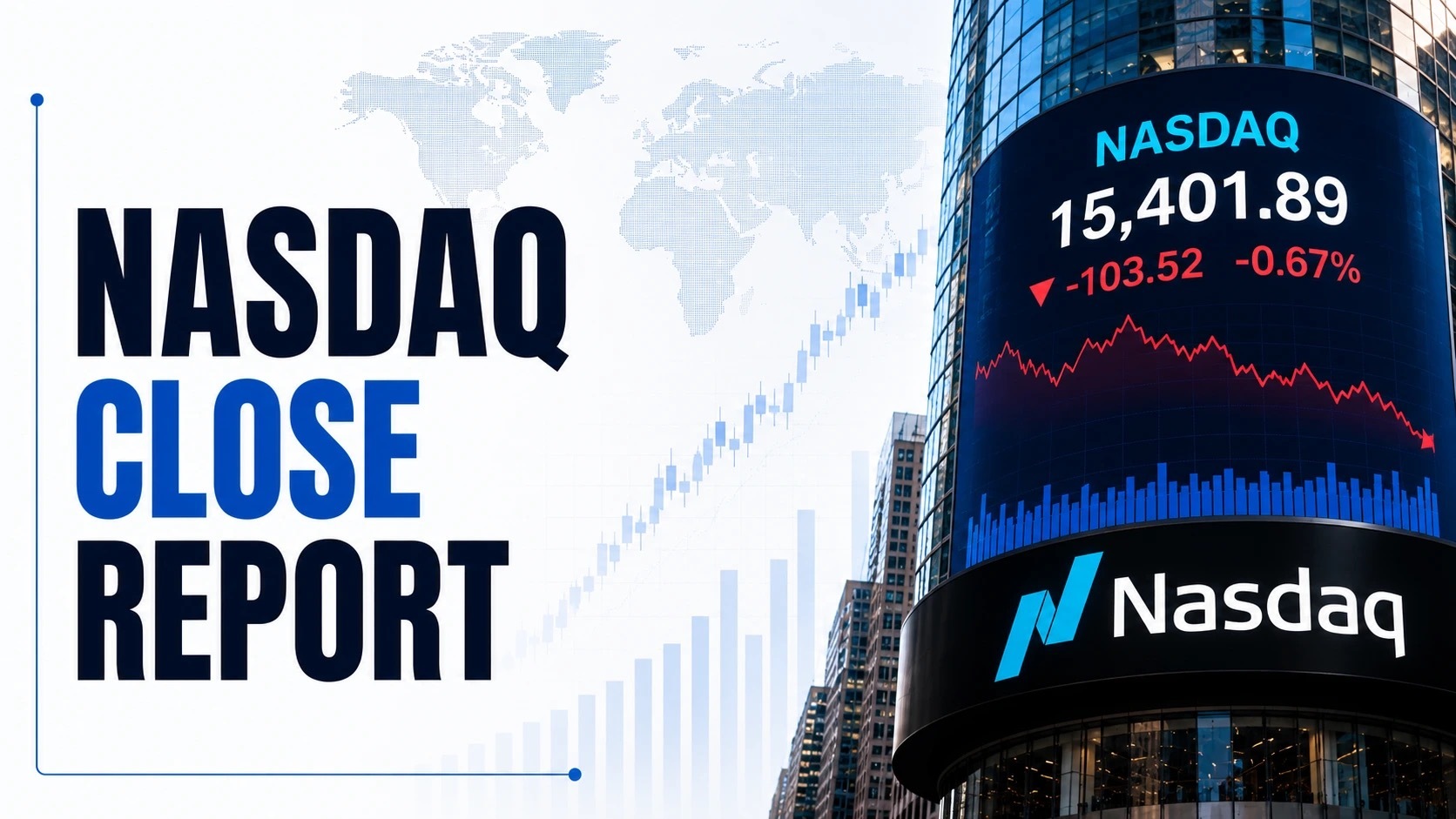
Mumbai, 26 November 2026: US equities finished mixed on Wednesday, with the Dow Jones Industrial Average advancing 424.52 points, or 0.86%, to 50,019.83, while the S&P 500 fell 0.50% to 7,201.18 and the Nasdaq Composite dropped 1.48% to 23,733.54.
The session followed a sharp reversal in Nvidia shares and the release of October’s personal consumption expenditures (PCE) inflation data, which kept expectations of a December Federal Reserve rate hike firmly in place. Trading reflected a rotation away from AI-linked technology shares towards healthcare, consumer staples and other defensive areas, leaving the major benchmarks with divergent closing outcomes.

Dow Jones Gains 424 Points as Healthcare Stocks Offset Broad Technology Weakness
The Dow Jones Industrial Average opened at 49,494.60 and closed at 50,019.83, gaining 424.52 points, or 0.86%. The index touched an intraday high of 50,075.12 and a low of 49,294.49, before settling near its session peak. The advance was supported by strong gains in healthcare constituents, with Amgen rising 5.65%, Merck adding 4.45% and Johnson & Johnson gaining 2.77%.
Retail and consumer-oriented names also contributed, as Nike climbed 5.63%, Home Depot advanced 2.20% and McDonald’s rose 1.56%. The index’s performance contrasted with the technology-heavy Nasdaq, as the Dow’s lower weighting in semiconductor shares limited the impact of Nvidia’s decline.
The Dow’s gain came despite a broadly weaker session for growth-oriented equities, reflecting the index’s price-weighted structure and its greater exposure to healthcare, consumer and financial stocks.
S&P 500 Falls 0.50% as Technology Decline Offsets Defensive Market Sector Strength
The S&P 500 opened at 7,172.33 and ended at 7,201.18, losing 36.08 points, or 0.50%. During the session, the benchmark reached a high of 7,223.95 and a low of 7,138.93. The index’s decline was driven primarily by a 2.77% drop in the technology sector, which was the weakest-performing of the eleven S&P 500 groups, while the industrials sector also slipped 0.51%.
These losses were partially offset by gains in healthcare, which rose 2.88%, and consumer staples, which added 1.73%. Within the index, Dollar Tree was among the strongest performers, rising more than 11%, while D.R. Horton and CoStar Group also recorded notable gains. On the downside, Analog Devices fell 17.70% and Hewlett Packard Enterprise dropped 17.16%, contributing to the technology sector’s weakness. The S&P 500’s closing performance came as investors rotated away from AI-related names following Monday’s sharp rally, with the index giving back a portion of the previous session’s 4.7% gain.
Nasdaq Falls 1.48% as Nvidia Reversal Drags Technology and Chip Stocks Lower
The Nasdaq Composite opened at 23,745.86 and closed at 23,733.54, marking a loss of 356.02 points, or 1.48%. Its intraday high stood at 23,884.74, while the low was 23,455.84. Technology and growth-oriented shares bore the brunt of the selling, with Nvidia falling 5.97% after surging 31% in the prior session. Micron Technology dropped 11.28%, Advanced Micro Devices lost 8.96% and Broadcom declined 4.19%.
Intel fell 8.02% and Applied Materials slipped 6.67%, while Analog Devices recorded a loss of 17.17%. Among the few gainers, Apple rose 1.36%, Microsoft added 0.66% and Amgen climbed 5.49%. The technology-heavy benchmark’s decline came as the semiconductor sector gave back a substantial portion of Monday’s gains, when the Philadelphia Semiconductor Index had surged more than 14% following Nvidia’s leadership change.
The Nasdaq’s pullback also coincided with a broader reassessment of AI valuations, as investors weighed the sustainability of the trade that had driven the index’s earlier rally.
Also Read: What Is the New York Stock Exchange (NYSE)?
Russell 2000 Gains 0.63% as Smaller Stocks Outperform Broader Technology-Heavy Benchmarks Today
The Russell 2000 opened at 2,659.67 and closed at 2,686.51, gaining 16.85 points, or 0.63%. It recorded an intraday high of 2,695.24 and a low of 2,655.32. Movements among smaller-cap companies reflected a rotation into areas less exposed to the AI and semiconductor trade, with healthcare and biotechnology names contributing to the benchmark’s advance.
Kymera Therapeutics surged 15.66%, Cogent Biosciences jumped 17.43% and Praxis Precision Medicines rose 12.21%. Cytokinetics gained 11.27% and Viridian Therapeutics added 11.95%, while IRON climbed 15.30%. On the downside, Dycom Industries fell 17.92% and HUT dropped 6.09%.
The Russell 2000’s gain came as selling pressure remained concentrated in large-cap AI-related names rather than spreading uniformly across the broader market, allowing smaller-cap benchmarks to close higher even as the Nasdaq declined.
S&P 100 Falls 0.73% as Large-Cap Technology Shares Retrace Monday’s Sharp Gains
The S&P 100 opened at 3,519.48 and finished at 3,529.92, recording a loss of 25.82 points, or 0.73%. The index traded between 3,546.39 and 3,500.75 during the session. Movements in major large-cap constituents reflected the divergence between technology and defensive sectors, with Nvidia falling 6.30% and Microsoft gaining 0.74%, while Apple rose 1.35%.
Amazon declined 1.30% and Alphabet slipped 1.13%, while JPMorgan Chase added 0.20% and Visa gained 1.61%. Walmart rose 1.95% and Coca-Cola added 1.95%, contributing to the defensive tilt within the large-cap benchmark. The index’s decline came as investors reduced exposure to the AI-linked names that had driven Monday’s advance, while retaining positions in healthcare and consumer staples that offered relative stability.
Dow Composite Gains 0.52% as Utility Strength Offsets Broad Transportation Sector Decline
The Dow Jones Composite Average opened at 15,791.40 and closed at 15,912.66, gaining 82.51 points, or 0.52%, after moving between a high of 15,933.01 and a low of 15,713.82. The Dow Jones Transportation Average ended at 19,974.53, compared with an opening level of 19,974.47, representing a decline of 80.02 points, or 0.40%.
The Dow Jones Utility Average closed at 1,105.05, changing 0.61% from its opening level of 1,096.75. Movements in relevant constituents reflected the session’s broader rotation, with utility shares benefiting from their defensive characteristics while transportation stocks faced pressure from industrial sector weakness.
The composite average’s gain was supported by healthcare and consumer names within the Dow, while the transportation average’s decline aligned with the 0.51% drop in the S&P 500 industrials sector.
SOX Plunges 7.88% as Chip Stocks Reverse Sharply After Monday’s Strong Rally
The Philadelphia Semiconductor Index (SOX) opened at 9,161.77 and closed at 8,832.50, losing 755.55 points, or 7.88%. Its intraday high was 9,197.56, while the low was 8,657.78.
Semiconductor-related constituents recorded substantial declines, with Micron Technology falling 11.28%, Advanced Micro Devices dropping 8.96%, Analog Devices losing 17.70% and Intel declining 8.02%. Broadcom slipped 4.19% and Applied Materials fell 6.67%.
The sector benchmark’s sharp reversal came after Monday’s 14% surge, which had been triggered by Nvidia’s reinstatement of Jensen Huang as chief executive. The SOX’s decline reflected renewed concerns over AI infrastructure financing, corporate governance and the sustainability of semiconductor demand at current valuations, as investors reassessed the sector’s outlook following its strongest one-day gain in months.
NYSE Composite Gains 0.47% as Defensive Rotation Offsets Broad Technology Sector Weakness
The NYSE Composite Index opened at 23,144.98 and closed at 23,359.85, recording a gain of 108.52 points, or 0.47%. The index traded between 23,405.68 and 23,120.54 during the session.
Movements across a broad range of market segments contributed to its performance, with advancing stocks outnumbering declining issues by a ratio of 1.29 to 1 on the NYSE. The composite’s advance reflected the session’s rotation into defensive and value-oriented sectors, which offset weakness in technology and semiconductor names.
Healthcare, consumer staples and utility shares provided support, while the technology sector’s 2.77% decline weighed on the index’s growth-oriented components. The NYSE Composite’s gain aligned with the Dow’s advance and stood in contrast to the Nasdaq’s decline, underscoring the dispersion in performance across US equity benchmarks during the closing session.
Also Read: How to invest in US stocks
S&P MidCap 400 Slips 0.23% While SmallCap 600 Edges Up 0.05% Today
The S&P MidCap 400 opened at 3,526.80 and closed at 3,533.77, moving down 8.02 points, or 0.23%, with an intraday range of 3,551.46 to 3,509.82. The S&P SmallCap 600 opened at 1,638.37 and ended at 1,644.66, gaining 0.86 points, or 0.05%, after trading between 1,653.59 and 1,632.54.
The two benchmarks reflected divergent movements among mid- and small-cap shares, with the small-cap gauge benefiting from its greater exposure to healthcare and biotechnology names that outperformed during the session.
The mid-cap index’s slight decline came as industrial and technology components faced pressure, while the small-cap benchmark’s marginal gain aligned with the Russell 2000’s 0.63% advance. The performance of both indices underscored the session’s selective selling pressure, which remained concentrated in large-cap AI and semiconductor shares rather than spreading across the broader market.
Nvidia Reversal and Rate-Hike Expectations Drive Mixed Closing Session Across US Markets
The principal market catalyst was the sharp reversal in Nvidia shares, which fell 5.97% after surging 31% in the prior session following Jensen Huang’s reinstatement as chief executive. The decline in Nvidia, which alone had accounted for more than a third of the S&P 500’s 4.7% gain on Monday, weighed heavily on technology and semiconductor indices.
Treasury yields were mixed, with the 2-year yield at 4.673%, the 5-year at 4.712% and the 10-year at 4.908%, while the 30-year stood at 5.296%. Interest rate futures indicated a 95% probability of a 25-basis-point rate hike at the Federal Reserve’s December meeting, with a 5% probability of a 50-basis-point increase, according to market pricing. The prospect of further monetary tightening added pressure on growth-oriented equities, particularly those with high valuations and dependence on external financing.
Reports that the administration was preparing additional tariffs on dozens of trading partners, including China, also contributed to the cautious tone, as did the below-IPO-price trading of AI laboratory Anthropic, which fell more than 6% and slipped below its $83 offering price.
VIX Falls 1.65% to 26.18 as Volatility Eases Despite Mixed Market Performance
The CBOE Volatility Index (VIX) changed -1.65% to 26.18, compared with its previous close of 26.62. The index, which measures expected volatility in the S&P 500 over the coming 30 days, traded between an intraday high of 32.38 and a low of 26.14. Its movement during the session coincided with the mixed performance across major US equity benchmarks, as the Dow advanced while the S&P 500 and Nasdaq declined.
The VIX remained above its 52-week low of 13.38 but below its 52-week high of 40.03, reflecting persistent uncertainty surrounding the AI trade, the Federal Reserve’s rate path and the potential impact of additional tariffs. The volatility gauge’s slight decline came even as the Nasdaq fell 1.48%, suggesting that the session’s selling pressure was concentrated in specific sectors rather than reflecting a broad deterioration in market expectations.
Healthcare Gains 2.88% as Eight S&P 500 Sectors Advance Across Mixed Session
Performance across the 11 S&P 500 sectors was broadly positive, with eight groups advancing and three declining. The healthcare sector recorded the strongest move at 2.88%, while technology declined 2.77% as the weakest-performing group.
The remaining sectors recorded the following moves: consumer staples rose 1.73%, communication services added 1.92%, real estate gained 1.69%, consumer discretionary advanced 1.56%, utilities added 0.61%, financials edged up 0.20%, materials gained 0.95%, energy rose 1.06%, and industrials slipped 0.51%. The sector movements followed the rotation away from AI-linked technology names towards defensive and value-oriented areas, as investors reassessed growth prospects amid persistent inflation and the prospect of further Federal Reserve tightening.
Magnificent Seven Mixed as Nvidia Falls 5.97% While Meta Gains Over 2%
Among the Magnificent Seven, Nvidia moved down 5.97%, Apple rose 1.36%, Microsoft gained 0.66%, Amazon declined 1.30%, Alphabet slipped 1.13%, Meta Platforms rose more than 2%, and Tesla lost ground. Their daily movements contributed to the performance of major US equity benchmarks, with the divergence between semiconductor-linked and consumer-facing technology names mirroring the broader market rotation.
The mixed performance within the group underscored the selective nature of the session’s selling pressure, which remained concentrated in AI and chip-related constituents while other large-cap technology shares attracted defensive buying.
Also Read: US Stock Market Timings
Semiconductor Stocks Plunge 7.88% as Financial and Energy Shares Move Mixed Daily
Semiconductor stocks were sharply lower, with the Philadelphia Semiconductor Index moving down 7.88%. Financial stocks recorded a modestly positive trend, with the financials sector edging up 0.20% as bank shares such as JPMorgan Chase added 0.20% and Visa gained 1.61%. Energy stocks moved higher alongside changes in crude oil prices, with the energy sector rising 1.06%.
AI and growth stocks were lower, with movements among relevant constituents contributing to the technology-heavy indices. The session reflected a clear rotation away from semiconductor and AI-linked names towards defensive sectors such as healthcare and consumer staples, which recorded gains of 2.88% and 1.73% respectively.
Core PCE Rises 3.3% as Inflation Persists, Keeping December Hike in Focus
The latest economic data showed the core personal consumption expenditures (PCE) price index rising 3.3% year over year in October, slightly above expectations of 3.2%, while the headline PCE index increased 3.8% annually. The third-quarter gross domestic product (GDP) was revised sharply higher to 4.3% from an initial estimate of 3.4%, and jobless claims dropped to 189,000.
Durable goods orders rose 0.2% in October. The releases provided the latest information on inflation, growth and employment during the session, reinforcing expectations that the Federal Reserve would maintain its tightening trajectory. The data underscored persistent price pressures and resilient economic activity, shaping the cautious tone across equity markets.
10-Year Treasury Yield at 4.908% as Rate Hike Expectations Weigh on Bonds
The Federal Reserve remained a key focus as markets assessed the likelihood of a December rate hike, with interest rate futures pricing a 95% probability of a 25-basis-point increase. The 2-year US Treasury yield stood at 4.673%, while the 5-year yield was 4.712%. The 10-year Treasury yield stood at 4.908%, and the 30-year yield was 5.296%.
The yield curve remained sensitive to inflation data and Fed expectations, with the 10-year yield reflecting the market’s assessment of longer-term growth and price pressures. Treasury trading during the session coincided with the equity market’s rotation away from growth-oriented shares, as investors sought clarity on the policy path ahead of the Federal Reserve’s final meeting of the year.
Brent Crude Falls 1.9% to $89.71 as Supply Fears Ease Across Energy
Brent crude traded at $89.71 per barrel, changing -1.9%, while WTI crude stood at $80.26, moving -2.2%. The decline partially reversed a Tuesday rebound driven by reports of fresh attacks on ships in and around the Strait of Hormuz, as attention returned to recovering exports from the Middle East and the prospect of an excess in supply.
The International Energy Agency expects global oil markets to return to surplus this quarter. Gold traded at $3,508.90 per troy ounce, changing -1.5%, after touching a session low of $3,425.2, the first move below $3,500 since the end of August 2025. Gold had fallen about 10% this month, pacing for a third straight monthly decline, and including November, the metal has recorded three double-digit monthly declines this year. Silver moved -0.4%, although the specific level was not provided.
Copper changed -0.7% to $11,745 per metric ton, having touched its weakest level since 18 December at $11,682; London Metal Exchange copper had slid 17% this month. Natural gas moved -2% to $3.272 per million British thermal units, with the December contract falling 5.1 cents ahead of expiration on forecasts for mild weather through mid-December and ample fuel in storage.
The commodity moves followed reports of recovering Middle East exports, the prospect of excess supply and weather-driven demand expectations for natural gas. In currencies, the US Dollar Index (DXY) moved 0.26% higher, with the specific index level not provided, reflecting safe-haven demand as technology stocks sold off.
The dollar’s advance coincided with lower Treasury yields and a risk-off tone across AI-linked equities, while commodity markets reflected the same reassessment of supply, demand and policy expectations. These developments formed part of the broader closing-session backdrop across US equities, bonds, commodities and currencies.
The closing session was shaped by Nvidia’s sharp reversal, persistent inflation data and expectations of a December Fed rate hike, alongside new tariff proposals. The Dow finished higher while the S&P 500 and Nasdaq declined, with healthcare and defensive sectors outperforming technology and semiconductor shares. These figures provide a factual summary of the session’s key market developments across indices, sectors, bonds, commodities and currencies.
Disclaimer
The information shared here is intended solely for informational and educational purposes and does not constitute investment recommendations. While we practice strict due diligence in curating daily market data, readers must perform independent research before trading. To flag any real-time data discrepancies or content concerns, please write to us at content@hdfcsec.com.
 Join Us
 Add as preferred source on Google


More International News
















Invest Anytime, Anywhere


By signing up I certify terms, conditions & privacy policy