Nifty 50
- Eternal₹317.4012.95 (4.25%)
- Shriram Finance₹865-35.90 (-3.98%)
- Apollo Hospitals₹7,730125.50 (1.65%)
- Adani Enterprises₹2,477-73.00 (-2.86%)
- ONGC₹227.502.50 (1.11%)
- JSW Steel₹1,185.50-34.50 (-2.83%)
- Asian Paints₹2,30722.20 (0.97%)
- Jio Financial ₹205.03-5.77 (-2.74%)
- TCS₹2,53023.10 (0.92%)
- Tata Steel₹167.67-4.66 (-2.70%)
- UltraTech Cement₹11,05092.00 (0.84%)
- Adani Ports₹1,702.70-47.30 (-2.70%)
- Maruti Suzuki₹11,23060.00 (0.54%)
- Tech Mahindra₹1,790-39.10 (-2.14%)
- Cipla₹1,3387.10 (0.53%)
- Tata Motors PV₹264.60-5.40 (-2.00%)
- Reliance Industries₹1,1905.50 (0.46%)
- Hindalco Industries₹869.85-15.75 (-1.78%)
- Axis Bank₹1,217.505.50 (0.45%)
- Trent₹2,727.50-48.30 (-1.74%)

- Offerings
- Tools & Platforms
Tools & Calculators
- Open API
- Calculators
- SIP Calculator
- CAGR Calculator
- Compound Interest Calculator
- FD Calculator
- RD Calculator
- EPF Calculator
- Retirement Calculator
- HDFC SIP Calculator
- Mutual Fund Return Calculator
- Lumpsum Calculator
- Step Up SIP Calculator
- ETF SIP Calculator
- Brokerage Calculator
- Equity Margin Calculator
- SWP Calculator
- EMI Calculator
- MTF Calculator
- Margin Pledge Calculator
- Algo Strategy
- Markets
Stocks
F&O
Mutual Funds
- More
India VIX Ends at 15.81 as NIFTY’s Third Straight Session of Losses Keeps Market Volatility in Focus
Authored By HDFC SKY | Published at: Oct 22, 2026 04:15 PM IST
Open Free Demat Account
Open Free Demat Account
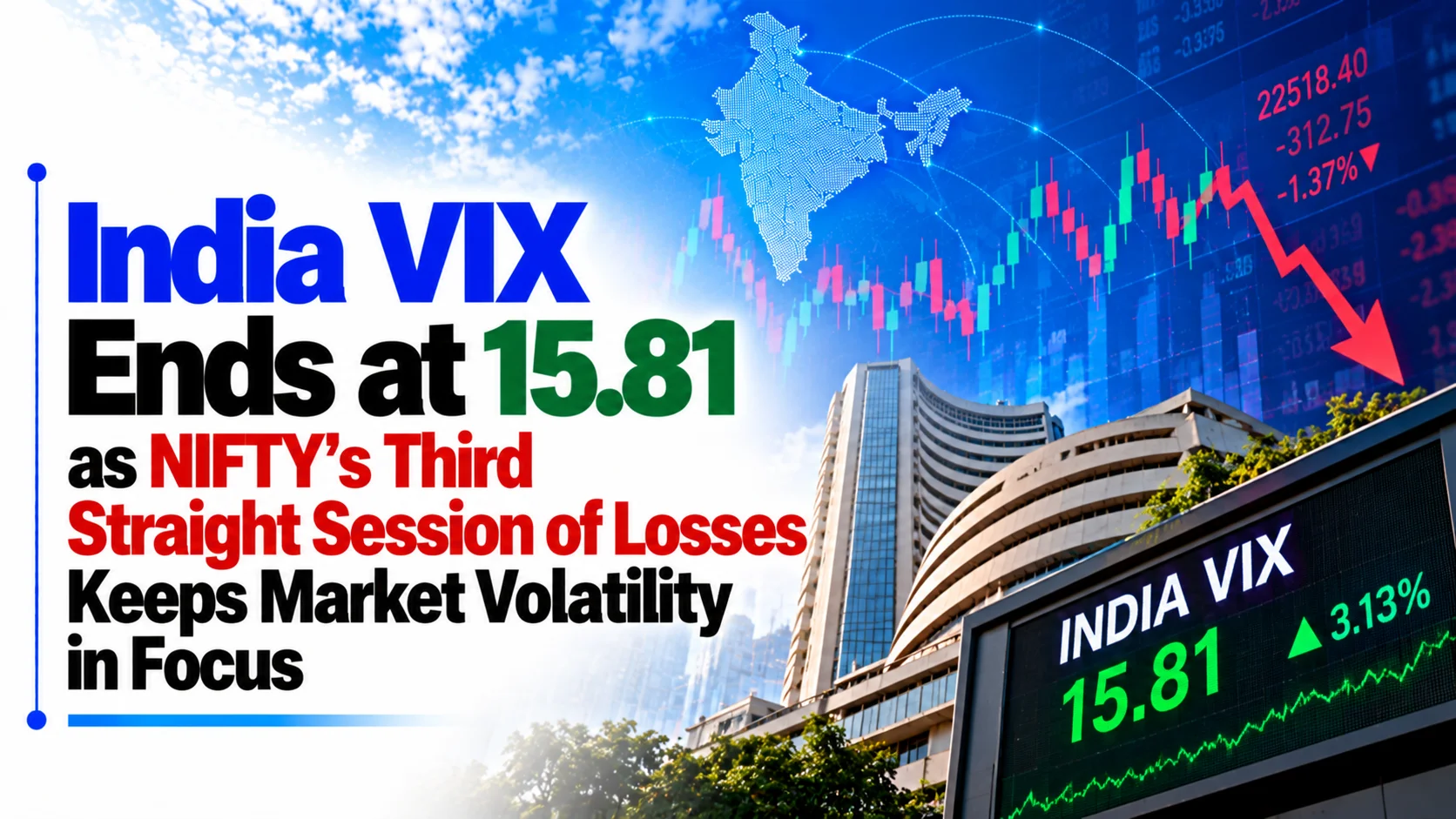
Mumbai, 22 October 2026: India VIX closed at 15.81, rising 0.08 points or 0.51% from the previous close of 15.68, as the NIFTY 50 recorded its third consecutive session of losses. The volatility index traded between 14.31 and 16.66 during the day, reflecting substantial intraday fluctuations before finishing marginally higher. The NIFTY 50 ended at 22,647.90, down 0.73%, while the Sensex declined 0.49% to 73,343.98. Broad-based equity weakness and continuing uncertainty around inflation and interest rates marked the closing session.

India VIX Gains 0.51% to 15.81 After Wide Intraday Swings
India VIX opened at 15.67, compared with its previous close of 15.68, before moving between an intraday low of 14.31 and a high of 16.66. It ultimately settled at 15.81, recording a modest gain despite the wider fluctuations seen during the session.
The index’s 52-week high stood at 28.90, while its 52-week low was 8.72. Its reported year-to-date return was 66.77%. These figures capture the index’s broader trading range and its movement during the latest session.
India VIX measures the expected volatility of the NIFTY 50 over the next 30 calendar days, using prices of NIFTY index options. It indicates the expected magnitude of market fluctuations rather than the direction of the underlying index. Its closing increase therefore records a change in expected volatility, without independently establishing the precise reason for that movement.
NIFTY 50 Extends Losses for Third Consecutive Session
The NIFTY 50 ended at 22,647.90, declining 0.73%, while the BSE Sensex closed at 73,343.98, down 0.49%, on 22 October. The latest declines extended the benchmark indices’ losing streak to three consecutive sessions.
The weakness was also visible across the broader market. Small-cap and mid-cap indices declined by approximately 1.2% each, while 15 of 16 major sectors recorded losses in the reported market snapshot.
Technology and other heavyweight shares contributed to the pressure during the session. HCL Technologies, Power Grid, Asian Paints and Tech Mahindra were among the reported laggards, with declines ranging from approximately 1.58% to 2.14% in the cited snapshot. Capital-goods and telecommunications shares provided some support during a partial recovery.
The combination of consecutive benchmark declines and weakness across multiple sectors formed the domestic equity backdrop as India VIX finished higher. However, the available figures do not quantify how much of the index’s closing movement was attributable to equity-market losses alone.
RBI Inflation Concerns Keep Interest-Rate Uncertainty in Focus
The Reserve Bank of India’s (RBI) latest Monetary Policy Committee (MPC) minutes, released on 21 October, remained relevant to the domestic economic environment during Thursday’s session. The RBI had raised the repo rate by 25 basis points to 5.50% earlier in October, with policymakers continuing to assess inflationary pressures and the implications of further monetary tightening.
The minutes indicated that additional tightening could be considered if inflation remained elevated, while also acknowledging the risk that excessive tightening could affect economic growth. September retail inflation stood at 5.54%, and the RBI’s projected average inflation for October–December was 6%.
These developments kept inflation and interest-rate considerations within the broader market context. Higher borrowing costs can affect corporate financing expenses and economic activity, while uncertainty about the future policy path can influence the range of outcomes considered in equity valuations. The available information does not establish a specific contribution from RBI expectations to the India VIX closing increase.
Rupee Near ₹94.35 and Jio IPO Inflows Shape Currency Developments
Currency movements presented a mixed picture on 22 October. One reported snapshot placed the Indian rupee at approximately ₹94.35 per US dollar, strengthening from ₹94.46, while another described early-session weakness towards ₹94.50. These observations relate to different points in the session and do not establish a consistent direction throughout the day.
The currency developments coincided with reports that Jio Platforms’ approximately $3.2 billion initial public offering (IPO) was fully subscribed within hours. Associated inflows were reported to have supported the rupee despite pressure from elevated crude oil prices.
A weaker rupee can increase the domestic cost of imported commodities, while foreign-exchange inflows can support currency availability. Nevertheless, IPO subscription figures do not establish an equivalent amount of immediate secondary-market purchases or confirm net foreign buying of NIFTY constituents during the session.
Global Markets and Energy Developments Add to Economic Uncertainty
International developments formed part of the wider economic backdrop on 22 October. Escalating Middle East tensions and concerns about energy infrastructure contributed to uncertainty around global oil supplies. Brent crude futures were reported at approximately $110.60–$110.70 per barrel during the morning, up around 1.6%–1.7%, with other updates indicating prices above $111 per barrel.
For India, higher oil prices can affect the import bill, inflation and operating costs across energy-sensitive industries. The developments also remained relevant to the assessment of external balances and the domestic inflation outlook.
European equity futures pointed lower amid energy-related concerns and wider political and sovereign-bond uncertainty. However, the available information does not establish a uniform decline across all major global indices throughout the day. Nor does it confirm a separate, major Federal Reserve announcement or a precisely timed US Treasury yield shock during India’s cash-market session.
India VIX Closes Above Previous Level Despite Intraday Retreat
The closing figures show that India VIX finished 0.13 points above its opening level of 15.67 and 0.13 points above its previous close of 15.68. Its intraday movement was considerably wider, spanning 2.35 points between the day’s low of 14.31 and high of 16.66.
The index’s technical rating was Neutral on the daily timeframe. Classic pivot levels placed the central pivot point at 15.34, with resistance levels at 16.51, 17.33 and 18.50 and support levels at 14.52, 13.35 and 12.53. These levels were calculated using the previous trading day’s price range.
Historical seasonality data showed that India VIX recorded positive October returns in 9 out of 18 years. October’s maximum positive change was 26.73% in 2020, while the maximum negative change was -30.99% in 2013. The average positive change was 12.51%, the average negative change was -13.66%, and the average overall change was -0.57%.
India VIX closed at 15.81, up 0.51%, as the NIFTY 50 recorded its third consecutive session of losses. The volatility index traded between 14.31 and 16.66. Domestic equity weakness, inflation-related policy concerns and currency developments characterised the session, while the closing data confirmed a modest increase in expected market volatility.
Disclaimer
 Join Us
 Add as preferred source on Google


More Markets News










Open Free Demat Account
Open Free Demat Account











Invest Anytime, Anywhere


By signing up I certify terms, conditions & privacy policy