Nifty 50
- HDFC Bank₹708.2514.45 (2.08%)
- Hindalco Industries₹981.50-32.50 (-3.21%)
- Dr. Reddy's Labs₹1,165.5022.50 (1.97%)
- JSW Steel₹1,265-39.00 (-2.99%)
- Tech Mahindra₹1,54115.20 (1.00%)
- Eicher Motors₹7,530-167.00 (-2.17%)
- HDFC Life Insurance ₹5303.85 (0.73%)
- Tata Steel₹183-3.78 (-2.02%)
- Wipro₹167.401.10 (0.66%)
- ONGC₹233.55-3.72 (-1.57%)
- Kotak Mahindra Bank₹4192.45 (0.59%)
- Maruti Suzuki₹12,400-190.00 (-1.51%)
- InterGlobe Aviation₹4,97328.00 (0.57%)
- Bajaj Finserv₹1,913.50-27.00 (-1.39%)
- Eternal₹323.501.40 (0.43%)
- SBI₹995.70-14.00 (-1.39%)
- ITC₹259.850.55 (0.21%)
- Coal India₹426.40-5.60 (-1.30%)
- Tata Motors PV₹301.100.60 (0.20%)
- Reliance Industries₹1,257.50-16.50 (-1.30%)

- Offerings
- Tools & Platforms
Tools & Calculators
- Open API
- Calculators
- SIP Calculator
- CAGR Calculator
- Compound Interest Calculator
- FD Calculator
- RD Calculator
- EPF Calculator
- Retirement Calculator
- HDFC SIP Calculator
- Mutual Fund Return Calculator
- Lumpsum Calculator
- Step Up SIP Calculator
- ETF SIP Calculator
- Brokerage Calculator
- Equity Margin Calculator
- SWP Calculator
- EMI Calculator
- MTF Calculator
- Margin Pledge Calculator
- Algo Strategy
- Markets
Stocks
F&O
Mutual Funds
- More
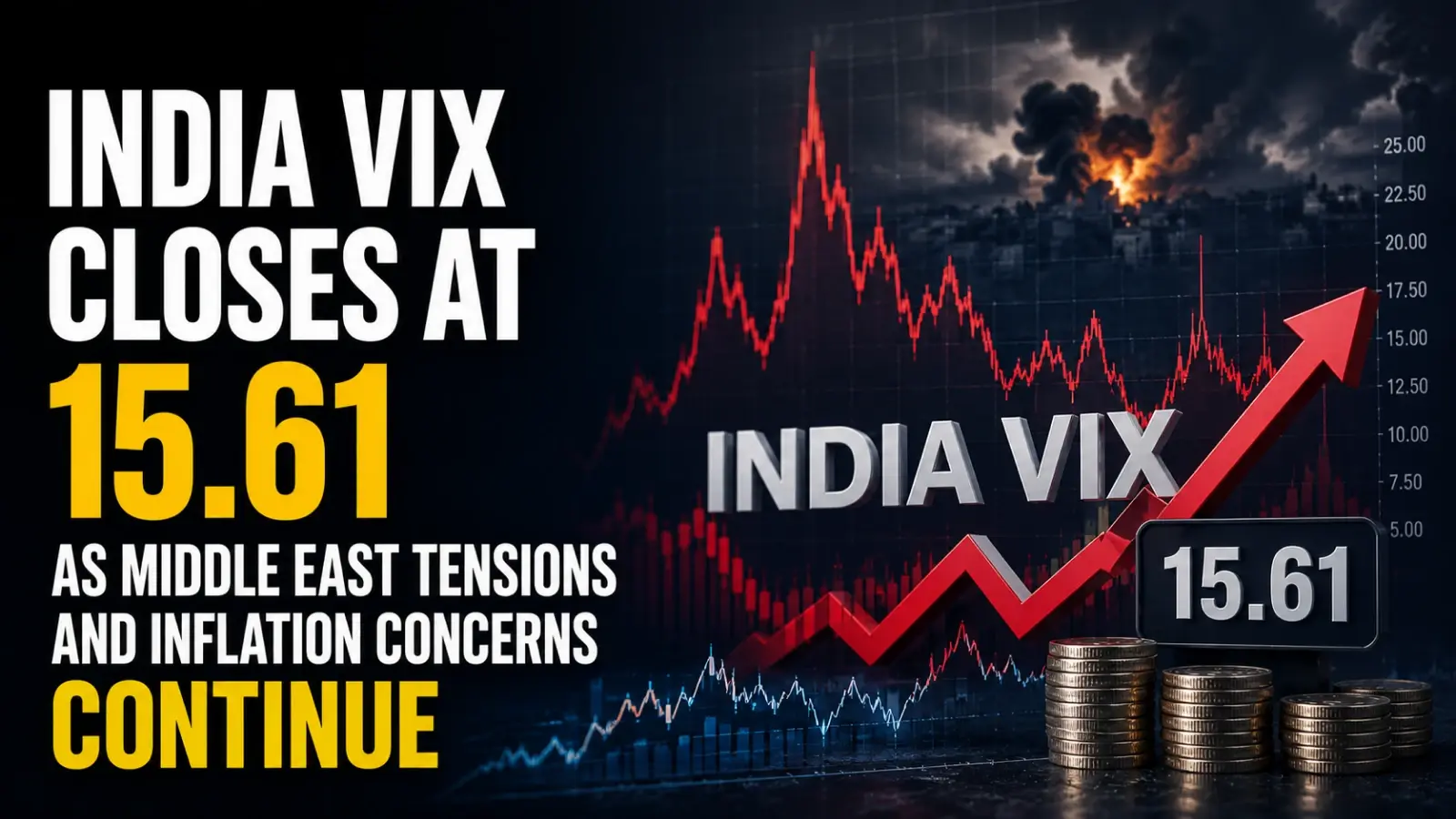
India VIX Closes at 15.61 As Middle East Tensions and Inflation Concerns Continue Keeping Volatility High
Authored By HDFC SKY | Published at: Jun 11, 2026 05:04 PM IST
Open Free Demat Account
Open Free Demat Account
Mumbai, June 11: India VIX ended lower on Thursday by 0.02 (at -0.13%), closing at 15.61, from its last closing value of 15.63. Even with the small decline in the closing session, the index was remained higher than its historical average due to the uncertainty surrounding geopolitical factors, oil price movements, inflation issues, and foreign portfolio investment outflows.
The volatility index moved in a range of 15.12-15.94 for the day, whereas its 52-week range varied between 8.72 and 28.90. The index has appreciated by 64.66% in the year so far, indicating the rising trend of market volatility.

Indian VIX Remains Above 15 Even After 0.13% Loss
India VIX opened at 15.63, the same as yesterday’s close, before touching an intraday high of 15.94 and a low of 15.12. The closing level at 15.61 was indicative of a range-bound session with market participants analysing developments in global markets.
Technical indicators showed a Neutral trend for the volatility index. Daily pivot calculations placed the classic pivot point at 15.46, with resistance levels at 16.01, 16.40 and 16.95, while support levels were identified at 15.07, 14.52 and 14.13.
The index’s ability to remain above the 15 mark throughout the session highlighted the persistence of elevated volatility expectations even as the benchmark equity indices witnessed mixed movements.
Middle East Risks and US Inflation Sustain Uncertainty
Market attention remained focused on escalating geopolitical tensions in the Middle East and stronger-than-expected inflation readings from the United States.
Reuters reported that Indian equities came under pressure as investors evaluated the implications of regional conflicts and inflationary risks on global growth. The developments contributed to a risk-off environment across several asset classes and kept volatility measures such as India VIX under close watch.
The uncertainty was further amplified by reports linking recent market caution to developments involving the United States and Iran. These events added to concerns regarding global stability and contributed to heightened monitoring of volatility indicators throughout the trading session.
Brent Crude Near $95 Keeps Risk Indicators Elevated
Crude oil prices remained another major focus area for markets. Brent crude reportedly approached $95 per barrel following developments in the Middle East before easing below $92 per barrel later in the session.
Higher oil prices have drawn attention because of their potential impact on inflation, trade balances and currency movements. Reports also indicated that the Indian rupee faced pressure amid rising crude prices, reviving concerns surrounding India’s external account position.
The continued movement in energy markets has remained one of the key themes influencing volatility discussions across financial markets, contributing to the elevated levels observed in India VIX during recent weeks.
Foreign Outflows Add to Market Volatility Watch
Foreign portfolio investment trends continued to feature prominently in market discussions. Reuters reported that foreign portfolio investors have sold approximately $30 billion worth of Indian equities during 2026 so far.
Persistent foreign selling activity has coincided with periods of increased volatility and has remained a closely monitored indicator for broader market conditions. While India VIX did not witness a sharp surge on Thursday, the elevated year-to-date performance of the index reflected the cumulative impact of global and domestic risk factors influencing market behaviour.
The combination of foreign fund outflows, geopolitical concerns and inflation-related uncertainty has contributed to the sustained focus on volatility metrics throughout the year.
June History Shows Average 6.61% Monthly Decline
Seasonality data for India VIX showed that June has historically been a challenging month for the volatility index.
Over the past 18 years, India VIX delivered negative returns in 11 years during June. Historical data indicated a maximum positive change of 9.45% in June 2011, while the sharpest decline of 43.90% occurred in June 2024.
The average positive June move stood at 5.58%, whereas the average negative change was 14.36%. Overall, the average June performance reflected a decline of 6.61%, underscoring the month’s historically mixed volatility trends.
These seasonal observations have continued to serve as reference points for tracking broader volatility patterns across different market cycles.
Recent Reports Highlight Earlier Volatility Surge
Several reports published over the past two weeks pointed to increased volatility levels earlier this month.
Market commentary highlighted that India VIX had climbed to the 16–16.2 range during periods of market weakness, while other reports discussed how volatility levels had moved into the 26–27 range during previous episodes of heightened global uncertainty.
Ahead of the Reserve Bank of India’s recent policy announcement, India VIX had also traded near 16.1, reflecting caution around interest rates, currency movements and foreign fund flows.
Recent market analyses suggested that June trading conditions remained influenced by geopolitical developments, energy prices and overseas capital movements, all of which continued to shape volatility expectations.
India VIX Remains Above 2025 Levels Despite Stability
Historical data shows India VIX traded significantly lower during much of 2025. Between June and September 2025, the index frequently moved within the 9.89 to 15.08 range, with several sessions recording levels close to 10.
Compared with those readings, the current level of 15.61 reflects a considerably higher volatility environment. The index’s year-to-date gain of 64.66% further illustrates the shift in market conditions over the past twelve months.
Although Thursday’s session ended with only a marginal decline, India VIX remained substantially above its 52-week low of 8.72, indicating that broader uncertainty continues to persist across markets.
India VIX closed at 15.61 on 11 June 2026, ending the session nearly unchanged but remaining well above historical lows. The day’s movement reflected the continued influence of geopolitical developments, crude oil price fluctuations, inflation concerns and foreign capital flows. While volatility remained contained within a narrow range during the closing session, the index continued to signal a market environment characterised by elevated uncertainty compared with much of the previous year.
Source
- https://www.nseindia.com/reports-indices-historical-vix
Disclaimer
If you have any concerns, questions, or wish to point out any discrepancies in our content, please feel free to write to us at content@hdfcsec.com.
Please Note: The information shared is intended solely for informational purposes and does not make any investment recommendations
Disclaimer
At HDFC SKY*, we take utmost care and due diligence in curating and presenting news and market-related content. However, inadvertent errors or omissions may occasionally occur.
If you have any concerns, questions, or wish to point out any discrepancies in our content, please feel free to write to us at content@hdfcsec.com.
Please Note: The information shared is intended solely for informational purposes and does not make any investment recommendations.
HDFC SKY from HDFC Securities, one of most trusted trading platforms in India, has been recognized with the *Next-Gen Digi Content Awards 2025-26.
 Join Us
 Add as preferred source on Google


More Markets News









Open Free Demat Account
Open Free Demat Account











Invest Anytime, Anywhere


By signing up I certify terms, conditions & privacy policy