Nifty 50
- HDFC Life Insurance ₹600.8025.85 (4.50%)
- Max Healthcare₹1,079.55-10.00 (-0.92%)
- Bajaj Finserv₹1,964.3084.20 (4.48%)
- Titan Company₹4,640.70-39.30 (-0.84%)
- Bajaj Finance₹1,143.2547.75 (4.36%)
- Hindalco Industries₹894.75-5.70 (-0.63%)
- Axis Bank₹1,444.6056.00 (4.03%)
- JSW Steel₹1,311.50-0.40 (-0.03%)
- ICICI Bank₹1,64761.50 (3.88%)
- HDFC Bank₹849.3031.50 (3.85%)
- Tata Consumer ₹1,176.1043.10 (3.80%)
- Hindustan Unilever₹2,095.7076.60 (3.79%)
- Eternal₹375.7513.65 (3.77%)
- Trent₹3,321.40113.40 (3.53%)

- Offerings
- Tools & Platforms
Tools & Calculators
- Open API
- Calculators
- SIP Calculator
- CAGR Calculator
- Compound Interest Calculator
- FD Calculator
- RD Calculator
- EPF Calculator
- Retirement Calculator
- HDFC SIP Calculator
- Mutual Fund Return Calculator
- Lumpsum Calculator
- Step Up SIP Calculator
- ETF SIP Calculator
- Brokerage Calculator
- Equity Margin Calculator
- SWP Calculator
- EMI Calculator
- MTF Calculator
- Margin Pledge Calculator
- Algo Strategy
- Markets
Stocks
F&O
Mutual Funds
- More
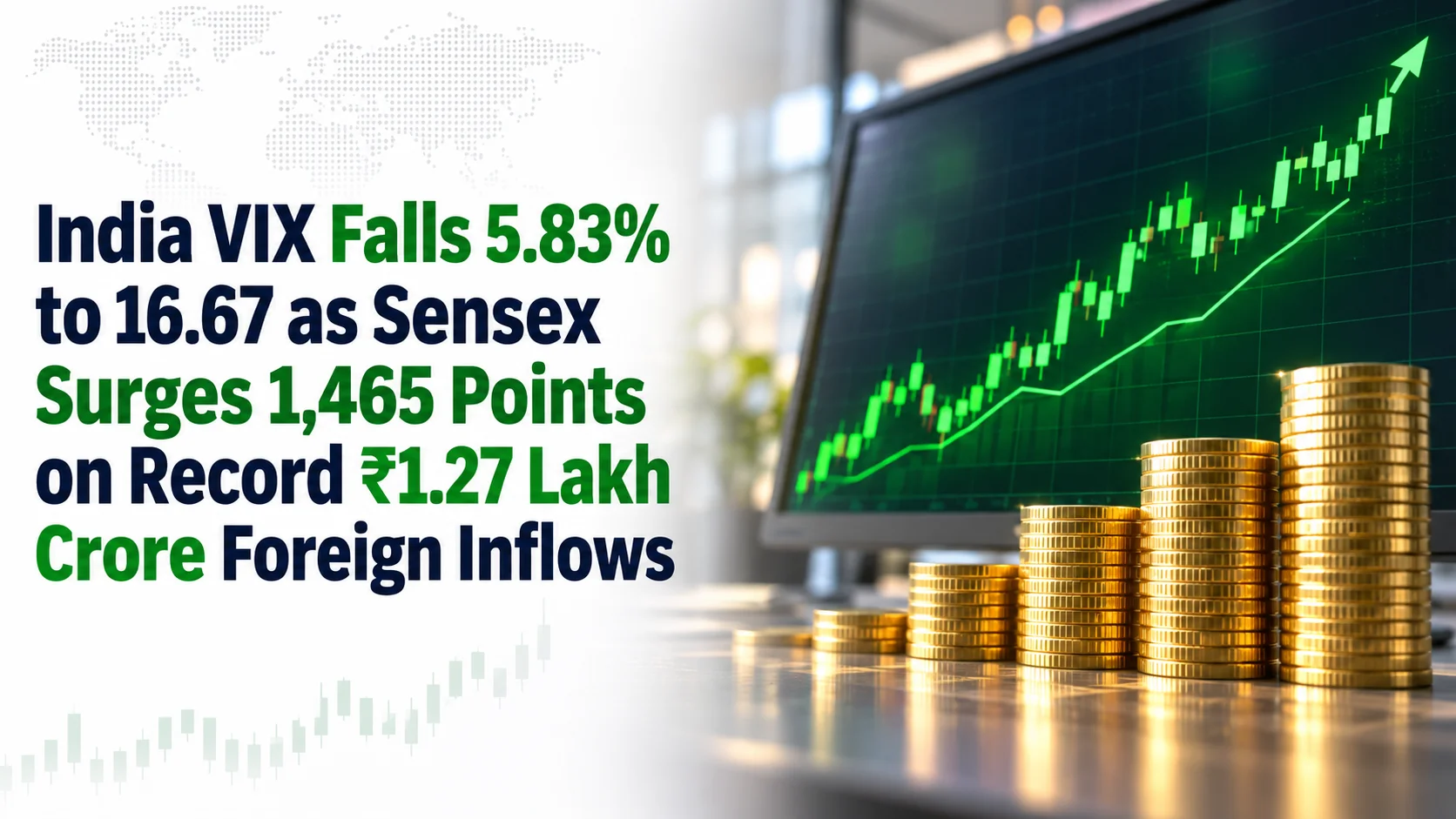
India VIX Falls 5.83% to 16.67 as Sensex Surges 1,465 Points on Record ₹1.27 Lakh Crore Foreign Inflows
Authored By HDFC SKY | Last Modified: Nov 25, 2026 10:30 AM IST
Open Free Demat Account
Mumbai, 25 November 2026: India VIX, the benchmark index measuring expected volatility in the Indian equity market, opened at 17.69 on Wednesday, against its previous close of 17.70. The volatility index declined to 16.42 during early trading before recovering to 17.55 at 10:00 AM IST, with a reported decline of 0.51%. Strong domestic equity market performance, sustained foreign institutional investment, healthy corporate earnings and declining crude oil prices contributed to easing volatility, despite weakness across Asian markets and renewed concerns surrounding US tariffs.

India VIX Falls 5.83% Before Recovering to 17.55
India VIX witnessed considerable fluctuations during Wednesday’s opening session, touching an intraday high of 18.23 and a low of 16.42. At around 9:33 AM, the volatility index was trading at 17.10, down over 3%, before declining further to 16.67, representing a fall of 5.83%, as reported at 9:40 AM.
The index subsequently recovered from its early-session lows. India VIX has recorded year-to-date returns of 85.34%, with its 52-week high and low standing at 28.90 and 8.72, respectively. Its previous trading session had recorded an increase of 2.18%.
Sensex Gains 1,465 Points as Domestic Buying Strengthens
Indian benchmark indices registered substantial gains after the National Stock Exchange (NSE) and Bombay Stock Exchange (BSE) resumed trading following the Guru Nanak Jayanti holiday.
At around 9:30 AM, the Sensex advanced 1.76% to 83,900.50, while the Nifty 50 gained 1.63% to 25,764, rising approximately 414 points. The domestic market recovery came despite significant selling pressure across major Asian equity markets.
The positive opening helped ease expected market volatility, with Indian equities demonstrating relative resilience against adverse international developments.
₹1.27 Lakh Crore Foreign Inflows Support Domestic Markets
Sustained foreign institutional investment remained a prominent factor supporting Indian equity markets during Wednesday’s opening session. Foreign institutional investor (FII) inflows during November reportedly reached a record ₹1.27 lakh crore.
During the previous trading session, FIIs recorded net purchases worth ₹5,673 crore, while domestic institutional investors (DIIs) registered net sales amounting to ₹2,760 crore.
International investment diversification away from artificial intelligence (AI)-related assets towards Indian equities also contributed to foreign inflows. These cumulative and previous-session investment figures supported Wednesday’s market opening, although fresh institutional transaction figures for the day were not yet available.
Financial Stocks Gain 2.5% as Heavyweights Lead Recovery
Banking and financial services stocks led the domestic market recovery, with the financial sector advancing approximately 2.5% during early trading. Information technology stocks also registered gains of around 2%.
Among heavyweight stocks, HDFC Bank gained 3.40%, ICICI Bank advanced 3.38%, Infosys rose 3.31%, Bajaj Finance climbed 2.93% and InterGlobe Aviation gained 2.59%.
Buying across banking and financial services stocks, which account for a substantial proportion of the Nifty 50, supported benchmark performance. Overall, 15 of the 16 major sectors registered gains, while metal stocks remained relatively weak.
Strong Corporate Earnings Support 0.82% Midcap Market Gains
Healthy second-quarter corporate earnings provided additional fundamental support to domestic equities. Resilient corporate profitability helped address concerns surrounding earnings uncertainty and economic growth, while providing some insulation against international technology market weakness.
The broader market also participated in Wednesday’s recovery, with the Nifty Midcap 100 advancing 0.82% and the Nifty Smallcap 100 gaining 0.28%.
India’s comparatively lower exposure to AI-driven investments, alongside resilient domestic economic conditions, further supported its relative performance against other Asian equity markets.
GIFT Nifty Jumps 281 Points Before Market Opening
Positive pre-market indications supported domestic benchmark performance on Wednesday. GIFT Nifty traded at 25,765 at 6:37 AM, before moving to 25,738 at 7:43 AM and 25,728 at 7:46 AM.
At approximately 8:25 AM, GIFT Nifty reached 25,777, trading around 281 points higher and indicating a strong opening for Indian equities.
The positive pre-market movement preceded the recovery in domestic benchmarks following the trading holiday, despite accumulated uncertainty surrounding international market developments.
Brent Crude Falls 1.4%, Easing Domestic Economic Pressures
Declining international crude oil prices provided additional support to Indian equities. Brent crude fell 1.4% to $90.10 per barrel during Wednesday’s morning trade amid increasing supplies and expectations of a global oil surplus.
The international oil benchmark has declined approximately 23% during November.
Given India’s dependence on imported crude oil, softer prices help ease oil import expenditure, imported inflationary pressures, input costs for oil-dependent industries and concerns surrounding the country’s current account deficit. The decline helped offset adverse international equity market developments.
KOSPI Falls 5.3% as AI Valuation Concerns Intensify
Asian equity markets witnessed significant selling pressure amid concerns surrounding elevated technology valuations and the sustainability of AI-related investments.
South Korea’s KOSPI declined 5.3%, Taiwan’s benchmark index fell 5.1%, Japan’s Nikkei 225 dropped 2.9%, and the MSCI Asia-Pacific excluding Japan index declined 2.3% during morning trading.
Concerns centred on whether substantial expenditure on AI infrastructure would generate sufficient financial returns to justify elevated valuations. Technology-heavy Asian markets remained particularly affected by the developments.
US Futures Fall 0.30% Amid Tariff and Inflation Concerns
Renewed US tariff concerns added to international market uncertainty, with the Trump administration reportedly preparing to release findings from a trade investigation that could result in additional tariff measures. However, no fresh tariff implementation was confirmed during the opening session.
Meanwhile, Nasdaq 100 futures declined 0.30%, S&P 500 futures fell 0.20%, and Dow Jones futures slipped 0.10%.
Market caution also persisted ahead of the scheduled release of US Consumer Price Index (CPI) data later today. US equity and gold futures weakened ahead of the announcement, while the US Dollar Index declined 0.01% to 103.86.
India VIX Remains Neutral With 17.80 Pivot Level
India VIX maintained a neutral technical rating, with its classic pivot level standing at 17.80. Classic support levels were placed at 16.94, 16.19 and 15.33, while resistance levels stood at 18.55, 19.41 and 20.16.
Historical seasonality data showed that India VIX recorded negative November returns in 10 out of 17 years. Its highest positive November return was 21.46% in 2021, while its steepest negative return was 19.92% in 2020.
India VIX’s opening-session performance reflects the combined influence of domestic equity gains, sustained foreign capital inflows, declining crude oil prices and international market uncertainty. Key developments for the remainder of the session include domestic benchmark performance, updated institutional investment figures, international crude oil movements and the scheduled US inflation data release.
Disclaimer
The information shared here is intended solely for informational and educational purposes and does not constitute investment recommendations. While we practice strict due diligence in curating daily market data, readers must perform independent research before trading. To flag any real-time data discrepancies or content concerns, please write to us at content@hdfcsec.com.
 Join Us
 Add as preferred source on Google


More INDIGO News






Open Free Demat Account
₹5,705.80












Invest Anytime, Anywhere


By signing up I certify terms, conditions & privacy policy