Nifty 50
- Apollo Hospitals₹8,027.50361.50 (4.72%)
- BSE₹3,287.20-47.60 (-1.43%)
- ITC₹26611.00 (4.31%)
- Reliance Industries₹1,170.30-7.70 (-0.65%)
- Eicher Motors₹7,050282.50 (4.17%)
- JSW Steel₹1,168-7.20 (-0.61%)
- TCS₹2,15680.00 (3.85%)
- Cipla₹1,301-5.80 (-0.44%)
- HCL Technologies₹1,216.7039.80 (3.38%)
- Adani Ports₹1,76153.00 (3.10%)
- Infosys₹1,023.4026.40 (2.65%)
- Shriram Finance₹940.4523.20 (2.53%)
- Tata Motors PV₹279.906.90 (2.53%)
- UltraTech Cement₹10,675249.00 (2.39%)

- Offerings
- Tools & Platforms
Tools & Calculators
- Open API
- Calculators
- SIP Calculator
- CAGR Calculator
- Compound Interest Calculator
- FD Calculator
- RD Calculator
- EPF Calculator
- Retirement Calculator
- HDFC SIP Calculator
- Mutual Fund Return Calculator
- Lumpsum Calculator
- Step Up SIP Calculator
- ETF SIP Calculator
- Brokerage Calculator
- Equity Margin Calculator
- SWP Calculator
- EMI Calculator
- MTF Calculator
- Margin Pledge Calculator
- Algo Strategy
- Markets
Stocks
F&O
Mutual Funds
- More
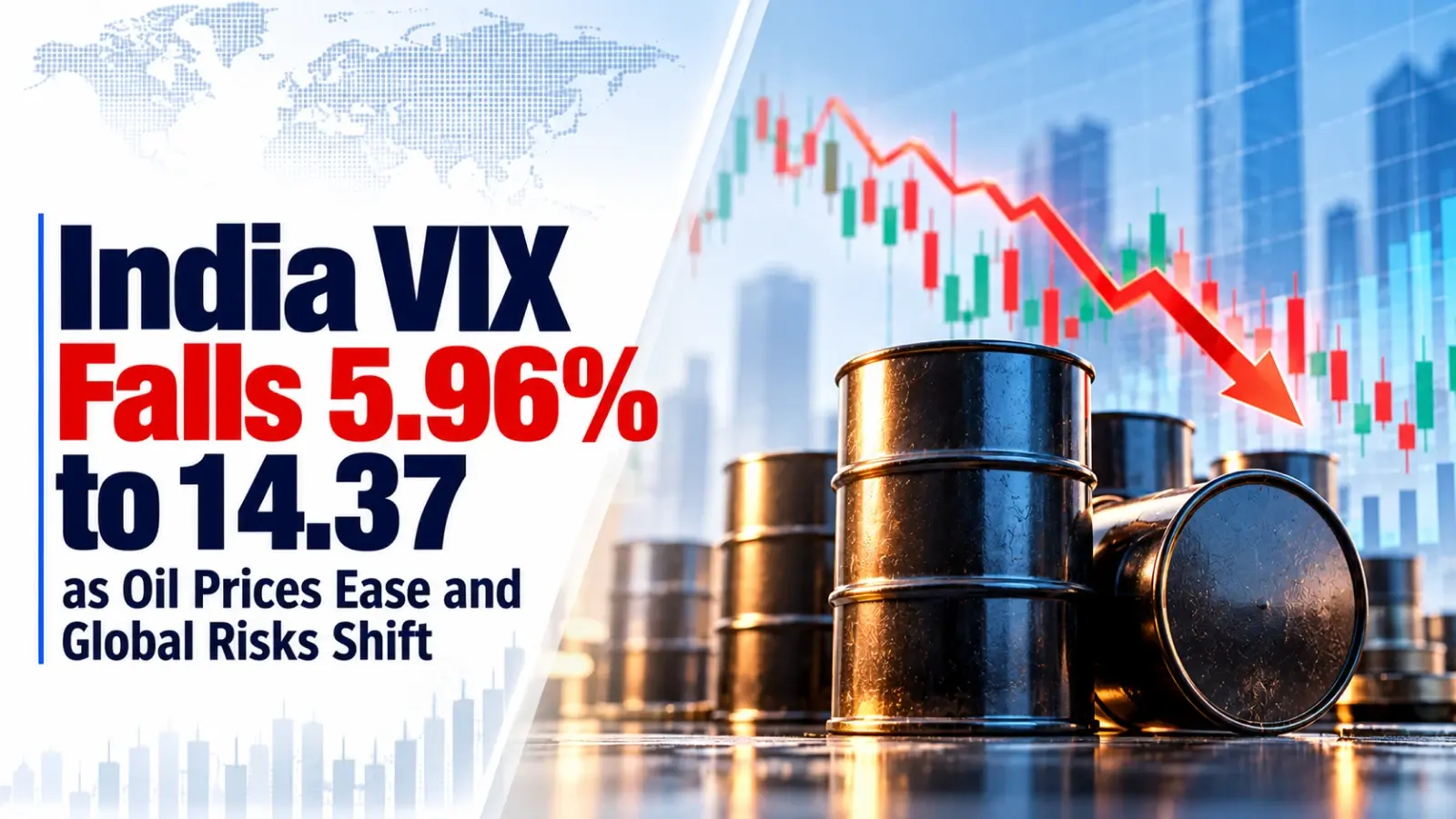
India VIX Falls 5.96% to 14.37 as Oil Prices Ease and Global Risks Shift
Authored By HDFC SKY | Published at: Oct 9, 2026 04:21 PM IST
Open Free Demat Account
Open Free Demat Account
Mumbai, 9 October 2026: India VIX fell by 0.91 points, or 5.96%, to 14.37 at the close of trading on Friday, 9 October 2026, as crude oil prices retreated from the previous session’s elevated levels and Indian benchmark indices recovered from Thursday’s sell-off. The decline followed developments surrounding US-Iran relations, movements in global equity markets and reported Reserve Bank of India (RBI) intervention to support the rupee. India VIX opened at 15.27, compared with the previous close of 15.28, and traded between 13.66 and 15.27 during the session.

India VIX Falls 5.96% to 14.37 as Market Conditions Change
India VIX closed at 14.37, down 0.91 points, on 9 October. The index opened at 15.27, recorded a high of 15.27 and touched an intraday low of 13.66. Its previous close stood at 15.28, placing the opening level just below the previous session’s closing value.
The session’s decline reflected a reduction in the volatility implied by Nifty 50 options prices. India VIX measures the options market’s expected volatility for the Nifty 50 over the next 30 calendar days. It indicates the anticipated scale of market fluctuations rather than the direction of the underlying index.
The index’s 52-week range stood between 8.72 and 28.90, while its year-to-date return was 51.58%. Despite Friday’s decline, the year-to-date figure remained positive, indicating that India VIX was higher than its level at the beginning of the year.
US-Iran Developments Ease Immediate Concerns Over Oil Supply
Developments surrounding US-Iran relations formed a key part of the global backdrop on 9 October. Reports indicated that US President Donald Trump would not attack Iran before the November midterm elections, alongside comments about productive discussions. These developments reduced immediate concerns about a military escalation.
However, the situation remained unresolved, with Iran’s position on uranium enrichment continuing to present a sticking point. The diplomatic signals therefore eased immediate concerns without eliminating uncertainty surrounding the region.
The developments were relevant to Indian markets because tensions involving Iran and the wider Middle East had contributed to concerns about oil supplies and shipping through the Strait of Hormuz. Any disruption to these routes could affect crude availability and prices, with implications for India’s import bill, inflation and currency conditions.
Crude Oil Retreats From Elevated Levels After Diplomatic Signals
Crude oil prices declined on Friday after rising sharply during the previous session. Brent crude traded at approximately US$103–104 per barrel in early reports, while West Texas Intermediate (WTI) also recorded a decline.
The retreat followed the easing of immediate concerns about military action involving Iran. Nevertheless, Brent remained above US$100 per barrel, leaving oil prices elevated despite the latest reduction.
For India, crude oil movements are relevant because the country depends heavily on imported energy. Higher prices can increase the import bill and place pressure on inflation, the rupee and corporate input costs. Friday’s decline provided relief from the previous session’s surge, although the underlying uncertainty surrounding Middle Eastern supply risks persisted.
Nifty and Sensex Recover After Thursday’s Sharp Sell-Off
Indian benchmark indices opened higher on 9 October, recovering part of the losses recorded during Thursday’s sell-off. Early reports indicated gains of approximately 0.5% to 0.7% in the Nifty 50 and Sensex.
The recovery coincided with lower crude prices and improved global market cues. Technology shares also contributed to the early market backdrop, while developments surrounding the opening of the quarterly earnings season remained relevant to domestic equity trading.
The relationship between the benchmark indices and India VIX is linked to options pricing. Changes in market conditions can affect the demand for protective options and the premiums attached to them. Friday’s decline in India VIX occurred alongside the recovery in equities, although the available figures do not quantify the separate contribution of each factor.
RBI Intervention Supports Rupee Near ₹96.61 Per Dollar
The Indian rupee strengthened by approximately 0.2% to ₹96.61 per US dollar on Friday, according to the reported market developments. RBI intervention near ₹96.80 per dollar, together with lower crude oil prices, supported the currency.
The rupee’s movement formed another part of the domestic macroeconomic backdrop. Currency weakness can increase the domestic cost of imported commodities and affect the value of foreign investors’ returns when measured in their home currencies. A recovery in the rupee can ease some of these pressures.
The currency development occurred against the background of the earlier rise in oil prices and concerns about foreign capital flows. It was a relevant domestic development during Friday’s session, although the reported figures do not establish how much of India VIX’s decline was attributable specifically to currency movements.
Mixed Global Markets Keep Bond and Technology Risks In Focus
Global markets presented a mixed picture on 9 October. Hong Kong shares advanced, while Japan’s Nikkei weakened amid concerns about artificial intelligence valuations and global bond-market conditions. US stock futures moved higher following Thursday’s technology-led decline, and European equities opened stronger.
The previous session’s weakness in US technology shares had been associated with concerns about artificial intelligence investment returns and the funding required for infrastructure expansion. Friday’s improvement in US futures offered a partial recovery in the global backdrop, but those valuation concerns remained unresolved.
Bond-market developments also remained relevant. Elevated US Treasury yields can affect global financial conditions and the relative attractiveness of dollar-denominated assets. For emerging markets such as India, movements in US yields can influence currency conditions and cross-border capital flows. These factors provided a counterweight to the relief from lower oil prices and the recovery in Indian equities.
FII Selling and Earlier RBI Policy Remain Relevant Background
Foreign institutional investors (FIIs) sold approximately ₹12,944 crore of Indian equities on 8 October, while domestic institutional investors (DIIs) purchased approximately ₹10,703 crore, according to the figures reported for that session. These transactions preceded Friday’s trading and should not be treated as confirmed flows for 9 October.
The earlier selling formed part of the background to Thursday’s equity-market weakness. Domestic institutional purchases, meanwhile, represented buying during the previous session. The figures provide context for the market conditions entering Friday but do not establish the direction or scale of institutional flows on 9 October.
The RBI’s earlier rate decision also preceded Friday’s session. It remained part of the wider monetary-policy backdrop rather than a new policy announcement on 9 October. Friday’s reported currency intervention was a separate development.
India VIX Technical Levels Show Support Near 13.00
The technical levels supplied for India VIX placed the classic pivot point at 14.24, with resistance levels at 16.52, 17.76 and 20.04. The corresponding support levels were 13.00, 10.72 and 9.48.
Under the Fibonacci calculation, the pivot point was 14.24, with resistance at 15.58, 16.42 and 17.76, and support at 12.90, 12.06 and 10.72. The Camarilla calculation placed resistance at 15.60, 15.93 and 16.25, while the listed support levels were 14.96, 14.63 and 14.31.
The technical rating was Neutral. These levels were calculated using the previous trading day’s price range and represent reference points within the supplied technical data.
October Seasonality Shows Mixed Historical Performance
The seasonality data indicated that India VIX recorded positive returns in October in 9 out of 18 years. The maximum positive change was 26.73% in 2020, while the maximum negative change was −30.99% in 2013.
The average positive change was 11.34%, compared with an average negative change of −13.66%. The overall average change for October was −1.16%.
These figures describe historical monthly performance rather than the outcome of Friday’s session. They also show that October’s historical movements have varied considerably, with both substantial increases and decreases recorded across the period.
India VIX closed at 14.37, down 5.96%, on 9 October 2026. Lower crude oil prices, US-Iran diplomatic developments, a recovery in Indian benchmark indices and reported RBI support for the rupee formed the principal developments surrounding the session. Global bond-market concerns, technology-sector weakness and unresolved geopolitical risks remained part of the broader market backdrop.
Disclaimer
The information shared here is intended solely for informational and educational purposes and does not constitute investment recommendations. While we practice strict due diligence in curating daily market data, readers must perform independent research before trading. To flag any real-time data discrepancies or content concerns, please write to us at content@hdfcsec.com.
 Join Us
 Add as preferred source on Google


More Business News








Open Free Demat Account
Open Free Demat Account












Invest Anytime, Anywhere


By signing up I certify terms, conditions & privacy policy