Nifty 50
- Eternal₹317.4012.95 (4.25%)
- Shriram Finance₹865-35.90 (-3.98%)
- Apollo Hospitals₹7,730125.50 (1.65%)
- Adani Enterprises₹2,477-73.00 (-2.86%)
- ONGC₹227.502.50 (1.11%)
- JSW Steel₹1,185.50-34.50 (-2.83%)
- Asian Paints₹2,30722.20 (0.97%)
- Jio Financial ₹205.03-5.77 (-2.74%)
- TCS₹2,53023.10 (0.92%)
- Tata Steel₹167.67-4.66 (-2.70%)
- UltraTech Cement₹11,05092.00 (0.84%)
- Adani Ports₹1,702.70-47.30 (-2.70%)
- Maruti Suzuki₹11,23060.00 (0.54%)
- Tech Mahindra₹1,790-39.10 (-2.14%)
- Cipla₹1,3387.10 (0.53%)
- Tata Motors PV₹264.60-5.40 (-2.00%)
- Reliance Industries₹1,1905.50 (0.46%)
- Hindalco Industries₹869.85-15.75 (-1.78%)
- Axis Bank₹1,217.505.50 (0.45%)
- Trent₹2,727.50-48.30 (-1.74%)

- Offerings
- Tools & Platforms
Tools & Calculators
- Open API
- Calculators
- SIP Calculator
- CAGR Calculator
- Compound Interest Calculator
- FD Calculator
- RD Calculator
- EPF Calculator
- Retirement Calculator
- HDFC SIP Calculator
- Mutual Fund Return Calculator
- Lumpsum Calculator
- Step Up SIP Calculator
- ETF SIP Calculator
- Brokerage Calculator
- Equity Margin Calculator
- SWP Calculator
- EMI Calculator
- MTF Calculator
- Margin Pledge Calculator
- Algo Strategy
- Markets
Stocks
F&O
Mutual Funds
- More
India VIX Falls 8.99% to 13.36 After 26% Spike as Oil Risks Ease and Markets Recover
Authored By HDFC SKY | Published at: Jul 9, 2026 04:20 PM IST
Open Free Demat Account
Open Free Demat Account
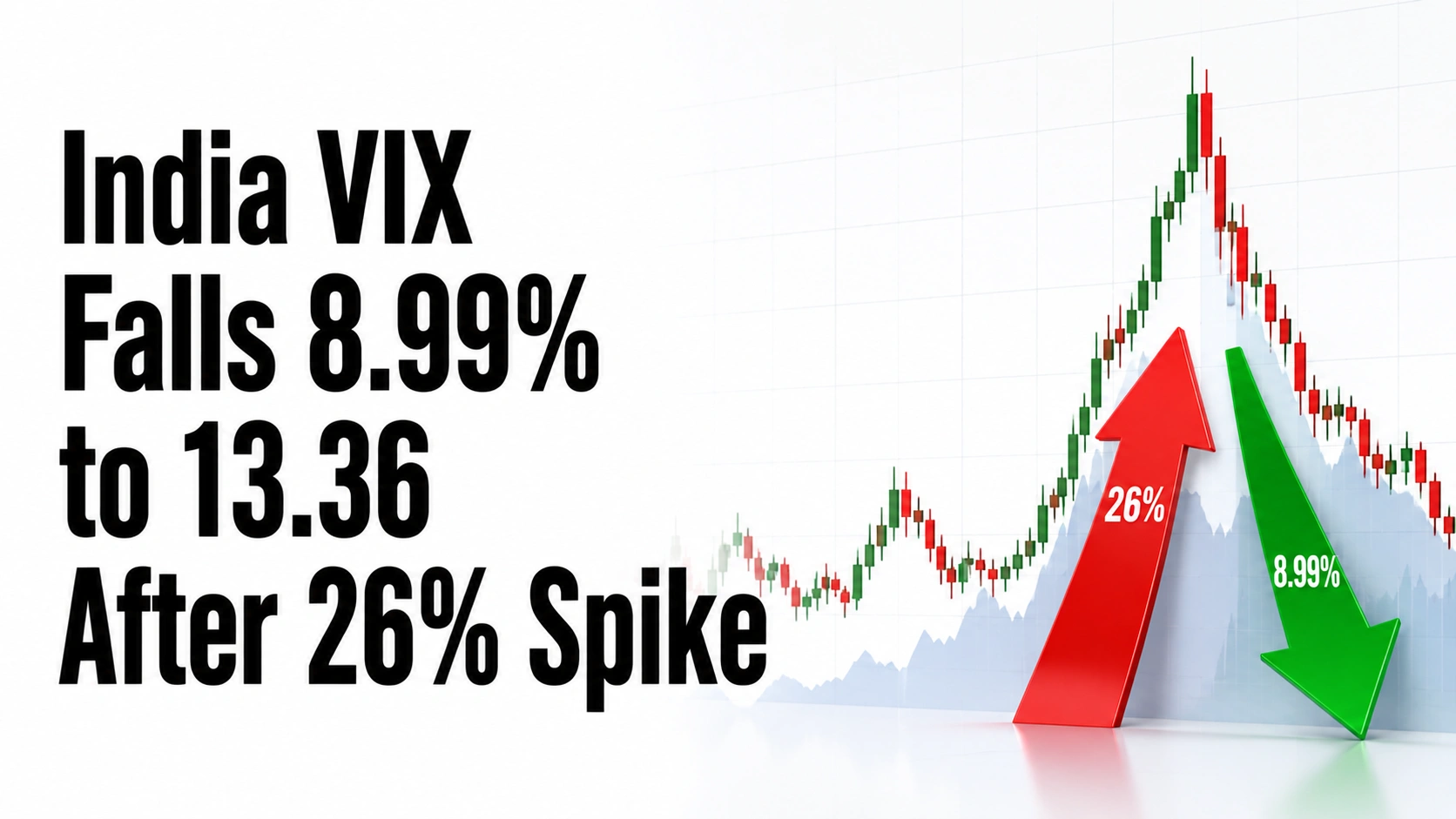
Mumbai, July 9: India VIX, widely tracked as the market’s volatility gauge, declined sharply in Thursday’s closing session after witnessing its biggest single-day jump in more than a year during the previous trading day.
The index settled at 13.36, down 1.32 points (8.99%) from the previous close of 14.68, reflecting easing volatility expectations after Wednesday’s sharp market-wide sell-off triggered by geopolitical developments and higher crude oil prices.
While the pullback indicated calmer trading conditions compared with the previous session, India VIX continued to remain above the levels seen earlier this week, suggesting that uncertainty had not fully receded.

India VIX Ends at 13.36 After Trading Between 13.06 And 14.68
India VIX opened at 14.68, the same as its previous close, before declining steadily through the session to an intraday low of 13.06. It eventually settled at 13.36, marking an 8.99% fall for the day. The index traded within a 52-week range of 8.72 to 28.90, while its year-to-date return remained at 40.93% despite Thursday’s decline.
Technical indicators continued to classify the index under a Neutral trend, with the day’s pivot point at 13.72, resistance levels placed at 16.12, 17.55 and 19.95, and support levels at 12.29, 9.89 and 8.46 under the classic pivot calculation.
Wednesday’s 26% Surge Set the Stage for Thursday’s Decline
The decline in India VIX followed an exceptional surge during the previous trading session, when the volatility gauge climbed approximately 26% to close at 14.68, recording its steepest single-day increase in around 16 months. The spike coincided with heightened geopolitical tensions involving the United States and Iran, renewed concerns over shipping activity through the Strait of Hormuz, and a sharp rise in global crude oil prices.
Brent crude advanced 6.24% to US$78.79 per barrel, while the Indian rupee weakened by 59 paise to 95.55 against the US dollar. These developments contributed to broad-based weakness across domestic equities, with the Sensex falling 1,677 points (2.15%) to 76,503.60 and the Nifty declining 516.65 points (2.12%) to 23,882.05, making it the sharpest single-session decline since late March.
Oil Prices Ease as Markets Regain Stability
Thursday’s moderation in volatility came as crude oil prices retreated from the previous day’s highs. Brent crude futures for September delivery slipped around 1% to US$77.24 per barrel after production-related developments eased immediate supply concerns. With no fresh overnight escalation in geopolitical tensions reported, market volatility moderated during the session. Analysts noted that derivatives pricing reflected expectations of lower near-term volatility compared with Wednesday, contributing to the decline in India VIX.
Market Recovery Reduced Demand for Protective Hedging
The easing in India VIX also coincided with a broad recovery across Indian equity markets. The Sensex gained more than 635 points to 77,139, while the Nifty advanced around 195 points to 24,077, recovering a significant portion of the previous day’s losses. As benchmark indices stabilised, demand for protective options moderated, resulting in lower implied volatility. Analysts said the recovery reflected normalisation following Wednesday’s sharp correction rather than the complete disappearance of uncertainty.
Institutional Buying and Earnings Season Supported Market Activity
Institutional participation remained another important feature of Thursday’s session. Foreign Institutional Investors (FIIs) continued their buying trend for the sixth consecutive session, having recorded net purchases worth ₹1,962.80 crore on 8 July despite the previous day’s market decline.
Domestic Institutional Investors (DIIs) also returned as net buyers after a brief pause, purchasing equities worth ₹790 crore. At the same time, market attention shifted towards the beginning of the Q1 FY27 earnings season, with the financial results of Tata Consultancy Services (TCS) scheduled later in the day. The commencement of quarterly earnings added another significant event for market participants after a volatile trading week.
Broad-Based Gains Offset Previous Session’s Weakness
Thursday’s recovery extended across several segments of the market. On the BSE, advancing stocks numbered 2,878, comfortably exceeding the 1,086 declining shares, indicating broader participation in the rebound. The Nifty Midcap 100 advanced 1.12%, while the Nifty Smallcap 100 gained 1.48%.
Among sectoral indices, Nifty Consumer Durables led the gains with a rise of 2.01%, followed by Nifty Realty, which climbed up to 2%, while Nifty Pharma and Nifty PSU Bank also recorded gains of between 1% and 2%. In contrast, the Nifty IT index declined by around 2% as information technology stocks witnessed profit booking ahead of key quarterly earnings announcements.
Historical July Pattern Continues To Highlight Volatility
Seasonality data continued to underline July’s historical tendency towards elevated volatility. Over the past 18 years, India VIX has delivered negative returns during July in 15 instances. The month’s maximum positive change stands at 7.39% recorded in 2011, while the maximum negative change reached 24.22% in 2022. Average positive movement for July remains 4.47%, whereas the average negative movement is 10.79%, resulting in an overall average monthly decline of 8.25%. Thursday’s fall therefore aligned with the broader historical pattern even though the index remained considerably above the levels recorded before Wednesday’s spike.
Volatility Remains Elevated Despite Sharp Daily Correction
Although India VIX recorded a significant one-day decline, the index remained above the calmer levels seen earlier this week. Market participants continued to monitor developments surrounding global geopolitical tensions, movements in crude oil prices, quarterly corporate earnings, foreign institutional activity, the US dollar and bond yields. Analysts noted that these factors remained key variables influencing short-term market volatility even after Thursday’s moderation in the volatility index.
India VIX closed at 13.36, down 8.99%, after surging 26% in the previous session, reflecting easing volatility expectations as equity markets recovered and crude oil prices moderated. Even after Thursday’s decline, the volatility gauge remained above earlier weekly levels, with geopolitical developments, oil prices and the ongoing earnings season continuing to remain closely monitored by market participants.
Source
- https://www.nseindia.com/reports-indices-historical-vix
Disclaimer
If you have any concerns, questions, or wish to point out any discrepancies in our content, please feel free to write to us at content@hdfcsec.com.
Please Note: The information shared is intended solely for informational purposes and does not make any investment recommendations
Disclaimer
At HDFC SKY*, we take utmost care and due diligence in curating and presenting news and market-related content. However, inadvertent errors or omissions may occasionally occur.
If you have any concerns, questions, or wish to point out any discrepancies in our content, please feel free to write to us at content@hdfcsec.com.
Please Note: The information shared is intended solely for informational purposes and does not make any investment recommendations.
HDFC SKY from HDFC Securities, one of most trusted trading platforms in India, has been recognized with the *Next-Gen Digi Content Awards 2025-26.
 Join Us
 Add as preferred source on Google


More Markets News









Open Free Demat Account
Open Free Demat Account










Invest Anytime, Anywhere


By signing up I certify terms, conditions & privacy policy