Nifty 50
- Bajaj Auto₹10,090312.00 (3.19%)
- Tech Mahindra₹1,460.30-53.80 (-3.55%)
- Tata Steel₹176.943.14 (1.81%)
- Bharti Airtel₹1,767-38.10 (-2.11%)
- Dr. Reddy's Labs₹1,217.5020.50 (1.71%)
- ITC₹262.40-3.60 (-1.35%)
- Bharat Electronics₹374.306.15 (1.67%)
- SBI₹948.90-10.20 (-1.06%)
- JSW Steel₹1,185.7017.70 (1.52%)
- Axis Bank₹1,251.10-8.00 (-0.64%)
- Trent₹2,960.6042.40 (1.45%)
- ICICI Bank₹1,348.60-6.40 (-0.47%)
- Eicher Motors₹7,14999.00 (1.40%)
- NTPC₹310.90-1.10 (-0.35%)
- Mahindra & Mahindra₹2,832.4036.20 (1.29%)
- Hindustan Unilever₹1,851.30-5.40 (-0.29%)
- HDFC Life Insurance ₹563.556.90 (1.24%)
- Infosys₹1,022.10-1.30 (-0.13%)
- BSE₹3,326.4039.20 (1.19%)
- Coal India₹411.20-0.35 (-0.09%)

- Offerings
- Tools & Platforms
Tools & Calculators
- Open API
- Calculators
- SIP Calculator
- CAGR Calculator
- Compound Interest Calculator
- FD Calculator
- RD Calculator
- EPF Calculator
- Retirement Calculator
- HDFC SIP Calculator
- Mutual Fund Return Calculator
- Lumpsum Calculator
- Step Up SIP Calculator
- ETF SIP Calculator
- Brokerage Calculator
- Equity Margin Calculator
- SWP Calculator
- EMI Calculator
- MTF Calculator
- Margin Pledge Calculator
- Algo Strategy
- Markets
Stocks
F&O
Mutual Funds
- More
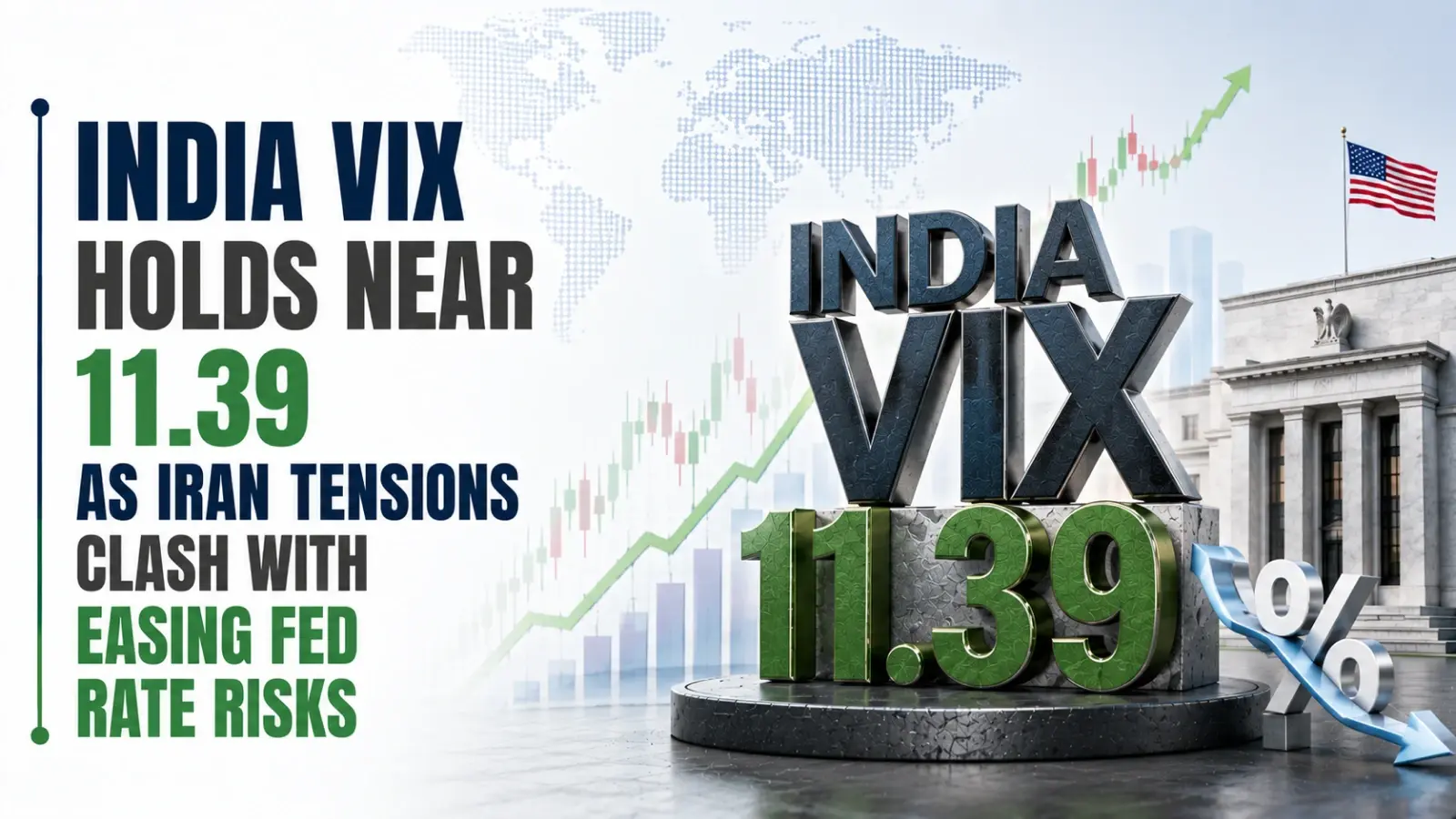
India VIX Holds Near 11.39 as Iran Tensions Clash with Easing Fed Rate Risks
Authored By HDFC SKY | Last Modified: Aug 14, 2026 11:25 AM IST
Open Free Demat Account
Open Free Demat Account
Mumbai, Aug 14: India VIX remained largely stable in Friday’s opening session despite geopolitical tensions, elevated crude oil prices and a weaker start for Indian equities. At 10:13 IST, India VIX stood at 11.39, up 0.01 points or 0.09%, after opening at 11.41 against the previous close of 11.42. The index touched an early high of 11.56 and a low of 10.82, keeping volatility expectations contained.

India VIX At 11.39 As Markets Open Lower
The muted movement in India VIX came as domestic equities opened under pressure. Nifty futures had indicated a subdued start, with GIFT Nifty around 24,441, down approximately 27 points or 0.11%. On Thursday, Nifty ended at 24,395.85, down 0.16%, while the Sensex closed at 78,079.96, down 0.15%.
The limited rise in India VIX indicates that the weaker opening has not translated into a sharp volatility spike. India VIX had closed Thursday at 11.42, following a derivatives-expiry session that also contributed to intraday market movements.
US-Iran Blockade Threat Keeps Volatility Risks Elevated
The strongest upward pressure on India VIX is coming from renewed geopolitical uncertainty after the United States threatened an indefinite naval blockade of Iran, while negotiations to end the conflict stalled. Concerns have also intensified around the Strait of Hormuz, which previously handled about 20% of global oil trade.
Reports of attacks on two tankers belonging to Abu Dhabi’s national oil company while transiting the Strait have added to concerns over energy supplies. The developments create a direct risk channel for Indian markets through crude prices, inflation, the rupee and the trade deficit.
Brent At $87 Adds Another Volatility Pressure
Crude oil remained another important factor during Friday’s opening session. Brent was around $87.08 a barrel, while WTI stood at approximately $81.31, with both benchmarks heading towards weekly gains of about 4%.
Although crude had fallen sharply in the previous session before stabilising, geopolitical supply concerns continue to keep prices elevated. Higher oil prices are relevant for India because they can affect inflation, the trade deficit, the rupee, fuel costs, corporate margins and monetary-policy expectations.
At the same time, demand concerns and rising US inventories have limited the extent of the geopolitical oil premium, preventing crude from behaving like a full-scale supply shock.
US Inflation Eases Fed Pressure and Limits VIX Rise
A major counterweight to geopolitical concerns has come from US inflation data. July headline CPI increased 0.1% month-on-month, while annual headline inflation stood at 3.4% and core CPI at 2.5% year-on-year. The monthly increase was in line with expectations.
The data reduced immediate concerns about another Federal Reserve rate increase. Markets subsequently cut the probability of a September rate hike to around 35%, from approximately 55% a week earlier. Lower rate-hike expectations have supported global equities and reduced pressure from US yields, helping contain India VIX.
Record US Markets Provide a Volatility Buffer
US equities supplied another stabilising global cue before Friday’s Indian opening. On 13 August, the S&P 500 rose 0.7% to a record close of 7,798.99, while the Nasdaq gained 0.8% and the Dow Jones Industrial Average rose 0.1%.
The gains followed easing concerns over US inflation and Federal Reserve policy. Stronger Wall Street performance provided a counterbalance to Middle East uncertainty and helped prevent a sharper increase in Indian volatility expectations.
Asian Equities Rise as Rate-Hike Bets Decline
Asian markets also provided a supportive external backdrop. The MSCI Asia-Pacific ex-Japan index rose 0.28%, while Japan’s Nikkei gained approximately 1.5%. Asian markets were heading towards their strongest weekly performance in around two months.
The broader regional strength was linked to declining expectations of a US rate increase following the inflation data. This positive global equity backdrop contrasts with the weaker Indian opening and helps explain why India VIX has remained close to its previous close.
FII Selling Meets Strong DII Buying In India
Domestic market flows presented mixed signals. On 13 August, Foreign Institutional Investors and Foreign Portfolio Investors recorded purchases of ₹14,492.46 crore and sales of ₹15,003.15 crore, resulting in net selling of ₹510.69 crore.
Domestic Institutional Investors, however, purchased ₹16,565.14 crore and sold ₹12,212.05 crore, resulting in net buying of ₹4,353.09 crore. The contrasting flows provide two opposing forces for domestic market volatility, with foreign selling adding pressure while domestic institutional buying provides a counterweight.
Rupee At ₹95.40 Adds to External-Market Risks
The rupee weakened to approximately ₹95.40 against the US dollar on Thursday from ₹95.33, with foreign selling, higher crude prices and geopolitical uncertainty contributing to the move.
The combination of elevated crude and a weaker rupee adds another layer to India’s external-sector risk because higher energy costs can affect inflation and the trade balance. However, the currency movement has not been described as disorderly enough to create a separate volatility shock.
Tata Uncertainty Adds a Stock-Specific Volatility Factor
Domestic uncertainty also emerged around N. Chandrasekaran’s future as Tata Sons chairman. The announcement triggered a significant sell-off across Tata Group companies on Wednesday, with several Tata stocks collectively losing approximately $4.6 billion in market value, according to the supplied reference.
Tata stocks stabilised somewhat by Thursday. The development therefore remained primarily a stock-specific factor rather than a broad systemic trigger for India VIX.
RBI Risk Fades After August Policy Decision
RBI-related policy uncertainty has also eased. India VIX had risen to approximately 12.19 on 4 August as Indian equities weakened ahead of the Reserve Bank of India’s 6 August monetary-policy announcement.
With the policy event now completed, that immediate source of domestic uncertainty has passed. The current volatility picture is therefore being driven more by international developments, crude prices, currency movements and market flows.
August Seasonality Shows A 10.22% Average Gain
India VIX’s historical August pattern also remains notable. Over the available 18-year period, the index has recorded positive returns in 12 years. August’s maximum positive change was 68.84% in 2015, while the maximum negative change was -11.26% in 2016.
The average positive change for August is 18.10%, the average negative change is -5.54%, and the overall average change is 10.22%.
India VIX Remains Within A Broad 52-Week Range
India VIX currently has a 52-week low of 8.72 and a 52-week high of 28.90. Its technical rating is Neutral. The Classic pivot levels are 12.19 for R1, 12.96 for R2, 13.73 for R3, 11.42 for the pivot point, 10.65 for S1, 9.88 for S2 and 9.11 for S3.
The current level of 11.39 therefore remains close to the day’s pivot reference of 11.42.
India VIX Faces Opposing Global and Domestic Forces
Friday’s opening session shows a clear contrast between volatility-raising and volatility-limiting factors. US-Iran tensions, the threatened Iran blockade, Strait of Hormuz uncertainty, Brent near $87, FII selling and rupee weakness are adding pressure. Against these factors, softer US inflation, reduced September Fed rate-hike expectations, record US equities, positive Asian markets, strong DII buying and the completion of the RBI policy event are helping contain the move.
India VIX stood at 11.39 at 10:13 IST on 14 August, compared with 11.42 at Thursday’s close. The opening session reflects competing influences from geopolitical tensions, crude prices, currency movements and institutional flows, while softer US inflation and stronger global equities have limited the rise in volatility so far.
Source
- https://www.nseindia.com/reports-indices-historical-vix
Disclaimer
If you have any concerns, questions, or wish to point out any discrepancies in our content, please feel free to write to us at content@hdfcsec.com.
Please Note: The information shared is intended solely for informational purposes and does not make any investment recommendations
Disclaimer
At HDFC SKY*, we take utmost care and due diligence in curating and presenting news and market-related content. However, inadvertent errors or omissions may occasionally occur.
If you have any concerns, questions, or wish to point out any discrepancies in our content, please feel free to write to us at content@hdfcsec.com.
Please Note: The information shared is intended solely for informational purposes and does not make any investment recommendations.
HDFC SKY from HDFC Securities, one of most trusted trading platforms in India, has been recognized with the *Next-Gen Digi Content Awards 2025-26.
 Join Us
 Add as preferred source on Google


More Business News








Open Free Demat Account
Open Free Demat Account












Invest Anytime, Anywhere


By signing up I certify terms, conditions & privacy policy