Nifty 50
- BSE₹3,665.70175.70 (5.03%)
- Power Grid Corp₹259.55-8.15 (-3.04%)
- Nestle₹1,248.4053.40 (4.47%)
- SBI₹970.25-16.75 (-1.70%)
- Tata Consumer ₹1,07344.10 (4.29%)
- ONGC₹232.17-2.66 (-1.13%)
- Asian Paints₹2,437.8093.50 (3.99%)
- Infosys₹1,148.10-12.90 (-1.11%)
- Bharti Airtel₹2,06575.10 (3.77%)
- Adani Enterprises₹2,593.30-22.10 (-0.84%)
- HDFC Bank₹725.5025.50 (3.64%)
- Tata Steel₹176.50-0.87 (-0.49%)
- Hindustan Unilever₹1,962.8064.50 (3.40%)
- NTPC₹321.55-1.45 (-0.45%)
- ITC₹273.907.50 (2.82%)
- Trent₹3,036.50-9.90 (-0.32%)
- UltraTech Cement₹11,700313.00 (2.75%)
- Apollo Hospitals₹8,440-19.00 (-0.22%)
- ICICI Bank₹1,424.5037.10 (2.67%)
- TCS₹2,499.10-2.60 (-0.10%)

- Offerings
- Tools & Platforms
Tools & Calculators
- Open API
- Calculators
- SIP Calculator
- CAGR Calculator
- Compound Interest Calculator
- FD Calculator
- RD Calculator
- EPF Calculator
- Retirement Calculator
- HDFC SIP Calculator
- Mutual Fund Return Calculator
- Lumpsum Calculator
- Step Up SIP Calculator
- ETF SIP Calculator
- Brokerage Calculator
- Equity Margin Calculator
- SWP Calculator
- EMI Calculator
- MTF Calculator
- Margin Pledge Calculator
- Algo Strategy
- Markets
Stocks
F&O
Mutual Funds
- More
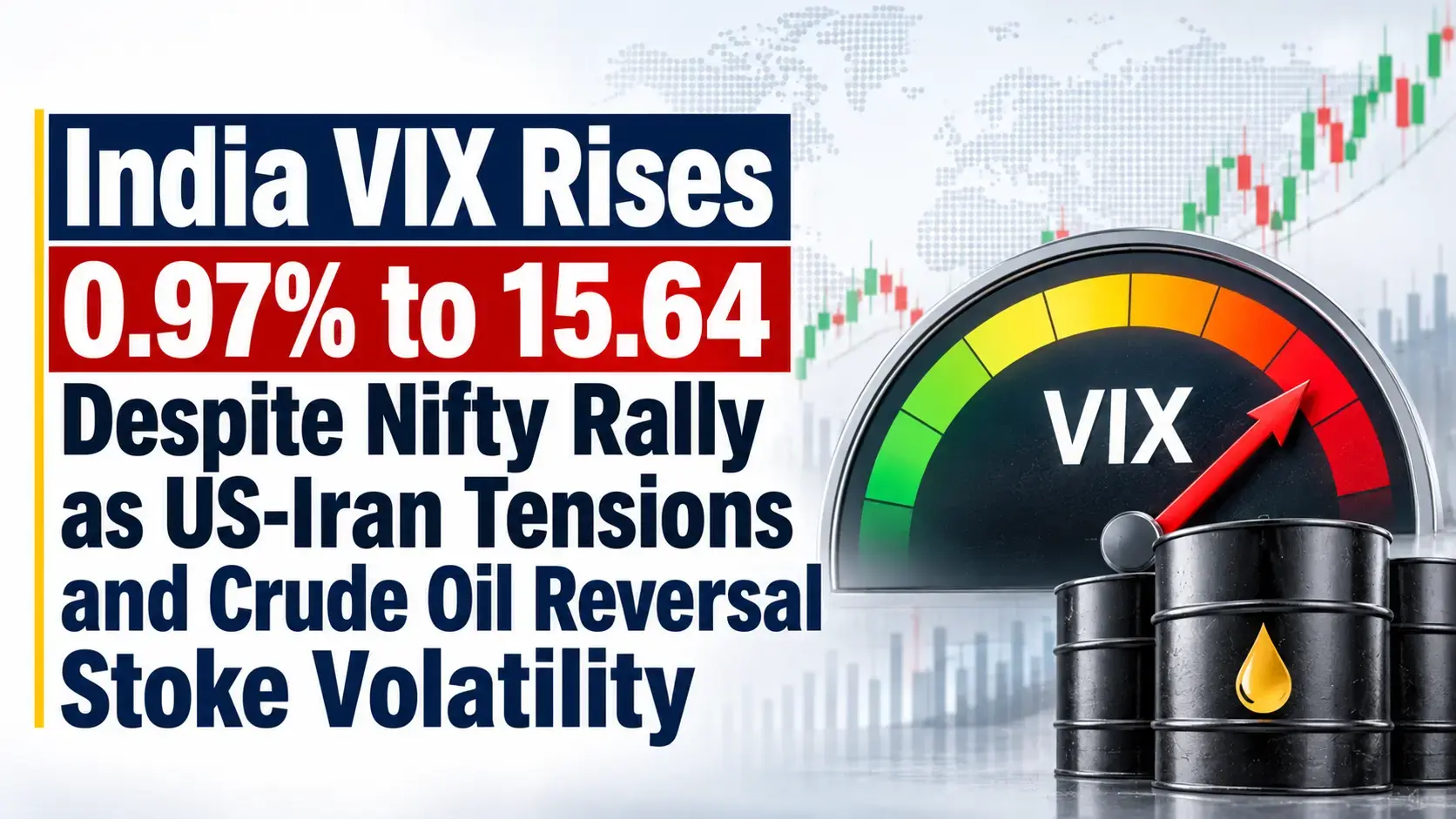
India VIX Rises 0.97% to 15.64 Despite Nifty Rally as US-Iran Tensions and Crude Oil Reversal Stoke Volatility
Authored By HDFC SKY | Published at: Nov 3, 2026 04:16 PM IST
Open Free Demat Account
Open Free Demat Account
Mumbai, 3 November 2026: India’s volatility gauge, the India VIX, settled at 15.64, up 0.15 points or 0.97%, on Tuesday even as the benchmark Nifty 50 and BSE Sensex extended gains, underscoring a striking divergence between bullish equity price action and persistent demand for derivatives protection.
The index, which opened at 15.50, touched an intraday high of 16.22 and a low of 14.25 before closing near the upper end of its range, according to data available at 15:38 IST. The rise in implied volatility came despite Indian equities opening substantially higher, with the Nifty up 0.76% at 23,622.25 and the Sensex up 0.92% at 76,385.48 in early trade, according to Reuters.

India VIX Up 65.40% YTD as 52-Week Range Spans 8.72 to 28.90
The India VIX has recorded a year-to-date return of 65.40%, reflecting heightened uncertainty through 2026. The index’s 52-week high stands at 28.90, while the 52-week low is 8.72, indicating significant swings in expected volatility over the past year. On the technical front, the daily rating is neutral, with pivot levels placing classic resistance at 16.10, 16.70 and 17.48, and support at 14.72, 13.94 and 13.34.
Seasonality data shows that in 10 out of 18 years, India VIX has delivered negative returns in November, with the average change for the month at 0.53%. The maximum positive November change was 21.46% in 2021, while the maximum negative was -19.92% in 2020.
US-Iran Strikes on Qeshm Island Revive Hormuz Supply Fears, Lifting India VIX
The most significant international driver of volatility was the reporting of US strikes on Iran’s Qeshm Island, which revived concerns about escalation in the eight-month US-Israel-Iran conflict and potential disruption to energy supplies through the Strait of Hormuz. Reuters reported that the strikes occurred on Monday, with the market reaction becoming a major factor during Tuesday’s Asian trading.
US officials described the action as limited or defensive, targeting Iranian forces using surface-to-air missiles against US assets. For India, which is heavily dependent on imported crude, this development increased uncertainty around inflation, the current-account deficit and the rupee, potentially driving demand for Nifty options protection.
Crude Oil Rebounds 2% Towards $107 After 7.63% Slide, Inflating Volatility Risk
Crude oil prices experienced a sharp reversal around the start of the Indian trading day. Brent crude had declined 7.63% on Monday, 2 November, settling around $104.77 per barrel, reflecting optimism over diplomatic contacts between Iran and Qatar. However, reports of US strikes on Qeshm Island on Tuesday revived supply-disruption concerns, and Brent rebounded approximately 2% towards $107 per barrel, according to Reuters. This reversal introduced fresh uncertainty into India’s inflation and macroeconomic outlook, making the sustainability of the equity rally less certain and providing one of the strongest explanations for why India VIX rose even as the Nifty advanced.
US Midterm Elections Begin, Asian Tech Sell-Off Adds to Global Risk-Off Sentiment
Voting began in the US midterm elections on 3 November, a major event risk that investors were monitoring for its potential impact on control of the House of Representatives and Senate, the legislative agenda, fiscal policy, technology-sector regulation and US policy towards Iran. Markets were cautious about taking large positions ahead of the outcome.
Simultaneously, Asian equity markets showed considerable weakness, with South Korea’s KOSPI down approximately 2.7% to 4%, Taiwan’s Taiex down 1.9% to 3.8%, and the MSCI Asia-Pacific ex-Japan index down 0.9% to 1.13%. Japan was closed for Culture Day. The technology and semiconductor sectors led the declines amid concerns about elevated artificial-intelligence investment and corporate capital expenditure.
Rupee Reverses Early Gains, Bond Yields Wipe Out Decline on Oil Rebound
The Indian rupee briefly appreciated to 94.62 against the US dollar, its strongest level in approximately 10 days, before surrendering those gains to trade around 94.87 per dollar. The reversal followed renewed concerns about crude oil prices and the Middle East conflict.
Separately, the benchmark 10-year government bond yield initially declined by approximately four basis points before reversing its early gains, with the benchmark 6.94% 2036 bond yield around 7.3220% by noon, according to Reuters. Investors were also awaiting a ₹29,900 crore state debt auction. Rising bond yields can affect equity valuations and financial-sector sentiment, contributing to the cautious backdrop.
Foreign Buying and Strong Earnings Support Equities Even as Hedging Demand Persists
On the domestic side, provisional figures available during the morning showed foreign portfolio investors (FPIs) net purchases of approximately ₹3,115 crore on Monday, 2 November, while domestic institutional investors (DIIs) recorded net sales of approximately ₹392 crore.
The September-quarter earnings season provided positive cues, with Marico beating profit expectations, KRBL reporting a 51% year-on-year rise in September-quarter profit, Trident posting higher second-quarter profit and VRL Logistics nearly doubling quarterly profit year-on-year.
KEC International reported a sharp decline in quarterly profit. The market was also watching scheduled results from SBI, Bajaj Finserv, Bajaj Holdings, Lupin and Bata India. Fourteen of the 16 major sectors advanced at the opening, with small-cap and mid-cap indices also recording gains.
Finance Minister Flags Foreign Capital Outflows as IPO Activity Picks Up Pace
Finance Minister Nirmala Sitharaman, speaking at the Financial Express Leadership Awards, acknowledged concerns about foreign portfolio investor outflows and the importance of attracting capital to sustain India’s growth. Her comments underscored the market’s focus on foreign investor participation and the sustainability of equity inflows.
In the primary market, Maxwell Engineering Solutions, Vectras Enprocon and Johnsoncab Electricals opened public issues, while BLS Polymers, SFC Environmental Technologies and Wiscon Industries were among companies scheduled for listing. These were secondary market factors rather than direct drivers of India VIX.
US Treasury Yields Near 4.91% and RBA Rate Hike to 4.85% Add to Global Caution
The US 10-year Treasury yield was reported around 4.913% to 4.9145%, rising during Tuesday’s Asian trading after declining in the preceding session, with investors awaiting the US Treasury’s quarterly refunding announcement expected on 4 November. Higher US yields can make dollar-denominated assets relatively attractive, influencing foreign portfolio flows into emerging markets and affecting the rupee.
Additionally, the Reserve Bank of Australia announced a 25-basis-point increase in its benchmark interest rate to 4.85% on 3 November, its fifth rate increase during the year, signalling continued inflation and interest-rate concerns in a developed-market economy. This contributed to the assessment of international monetary conditions.
India VIX closed at 15.64, up 0.97%, with a day range of 14.25 to 16.22, as geopolitical tensions, crude oil volatility and US election uncertainty offset strong domestic equity gains and positive earnings. The index’s 52-week range of 8.72 to 28.90 and YTD rise of 65.40% reflect sustained uncertainty. Market participants may monitor upcoming US Treasury refunding announcements, state debt auctions and corporate earnings for further volatility cues.
Disclaimer
The information shared here is intended solely for informational and educational purposes and does not constitute investment recommendations. While we practice strict due diligence in curating daily market data, readers must perform independent research before trading. To flag any real-time data discrepancies or content concerns, please write to us at content@hdfcsec.com.
 Join Us
 Add as preferred source on Google


More Markets News










Open Free Demat Account
Open Free Demat Account











Invest Anytime, Anywhere


By signing up I certify terms, conditions & privacy policy