Nifty 50
- Bajaj Auto₹10,071293.00 (3.00%)
- Tech Mahindra₹1,464.10-50.00 (-3.30%)
- Dr. Reddy's Labs₹1,226.2029.20 (2.44%)
- ITC₹258.55-7.45 (-2.80%)
- BSE₹3,34153.80 (1.64%)
- Coal India₹403.30-8.25 (-2.00%)
- Bharat Electronics₹372.854.70 (1.28%)
- SBI₹941.30-17.80 (-1.86%)
- Mahindra & Mahindra₹2,828.4032.20 (1.15%)
- Bharti Airtel₹1,773.80-31.30 (-1.73%)
- Eicher Motors₹7,12575.00 (1.06%)
- L&T₹3,640.30-63.00 (-1.70%)
- HDFC Life Insurance ₹558.852.20 (0.40%)
- NTPC₹306.90-5.10 (-1.63%)
- HCL Technologies₹1,219.903.20 (0.26%)
- Hindustan Unilever₹1,827.60-29.10 (-1.57%)
- Max Healthcare₹8862.20 (0.25%)
- ICICI Bank₹1,338-17.00 (-1.25%)
- Trent₹2,924.606.40 (0.22%)
- Reliance Industries₹1,158-12.30 (-1.05%)

- Offerings
- Tools & Platforms
Tools & Calculators
- Open API
- Calculators
- SIP Calculator
- CAGR Calculator
- Compound Interest Calculator
- FD Calculator
- RD Calculator
- EPF Calculator
- Retirement Calculator
- HDFC SIP Calculator
- Mutual Fund Return Calculator
- Lumpsum Calculator
- Step Up SIP Calculator
- ETF SIP Calculator
- Brokerage Calculator
- Equity Margin Calculator
- SWP Calculator
- EMI Calculator
- MTF Calculator
- Margin Pledge Calculator
- Algo Strategy
- Markets
Stocks
F&O
Mutual Funds
- More
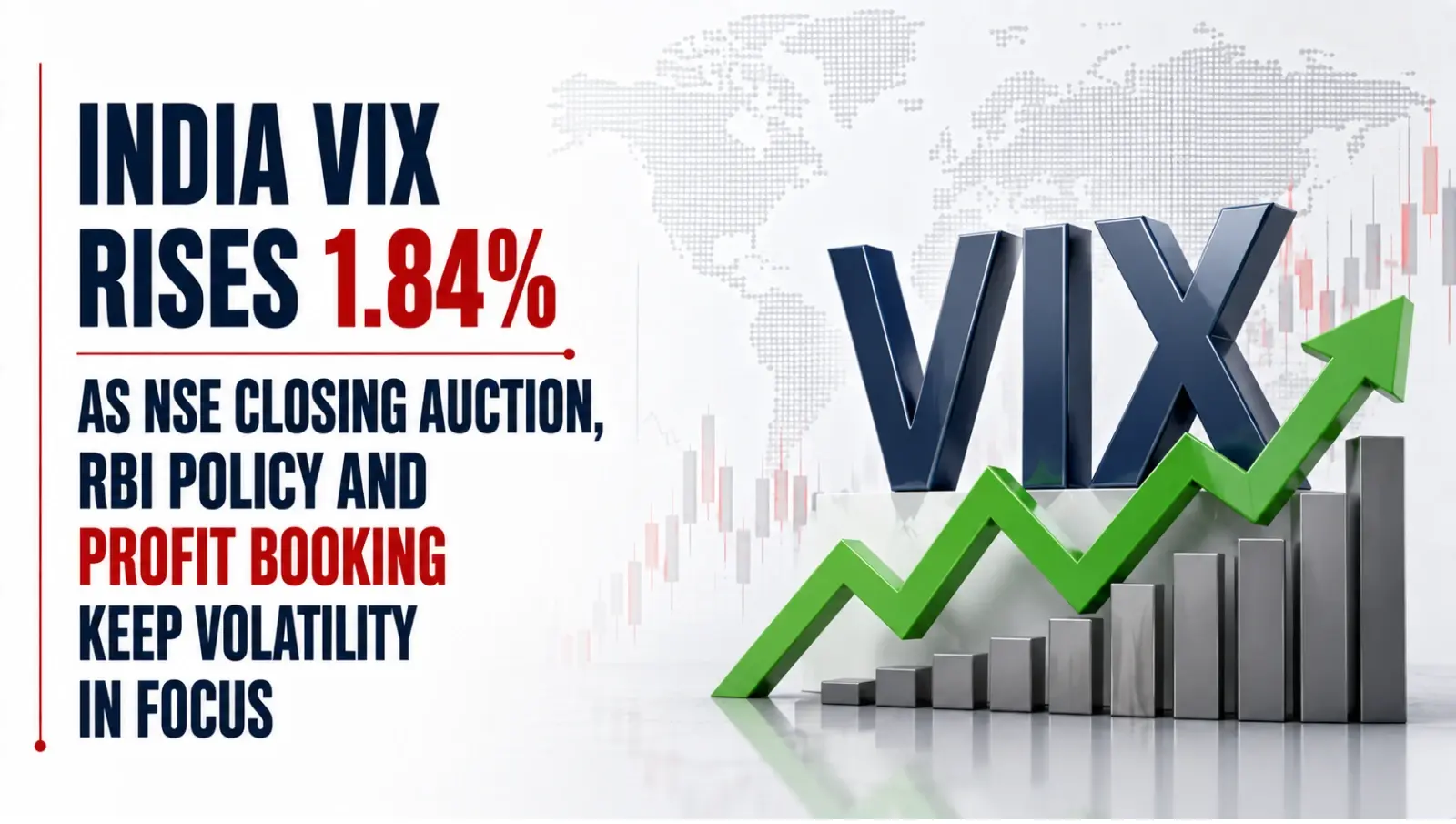
India VIX Rises 1.84% as NSE Closing Auction, RBI Policy and Profit Booking Keep Volatility in Focus
Authored By HDFC SKY | Last Modified: Aug 4, 2026 04:21 PM IST
Open Free Demat Account
Open Free Demat Account
Mumbai, Aug 4: India VIX edged higher during Tuesday’s closing session, reflecting increased caution in the derivatives market as traders navigated multiple domestic triggers, including the National Stock Exchange’s (NSE) newly introduced Closing Auction Session (CAS), the Reserve Bank of India’s (RBI) ongoing monetary policy meeting and broad-based profit booking across equities. The volatility gauge settled at 12.13, up 0.22 points (1.84%), remaining well below the elevated levels recorded during the sharp volatility spike in July despite intraday fluctuations.

India VIX Ends at 12.13 as Markets Absorb Multiple Risk Events
India VIX opened at 11.92, compared with the previous close of 11.93, before moving between an intraday low of 11.42 and a high of 12.54. Although volatility firmed during the session, the index continued to trade comfortably below its 52-week high of 28.90, while remaining above the 52-week low of 8.72.
On a year-to-date basis, India VIX has delivered returns of 28.27%. The latest movement came as benchmark indices surrendered early gains amid profit booking, with the Sensex retreating by nearly 750 points from its intraday high and the Nifty slipping below the 24,500 mark during the session.
NSE Closing Auction Mechanism Adds Fresh Uncertainty Before Weekly Expiry
The introduction of the NSE’s new Closing Auction Session (CAS) emerged as the most significant structural development influencing Tuesday’s trading activity. Under the revised framework, the exchange now determines official closing prices through a 20-minute auction beginning at 3:15 p.m. IST, replacing the earlier methodology based on the volume-weighted average price of trades executed during the final 30 minutes of the session.
The new process gained immediate attention after its first implementation on 3 August, when the Nifty advanced by nearly 200 points during the closing auction, resulting in sizeable end-of-day adjustments across several large-cap stocks. With Nifty 50 weekly options expiring on 4 August, the revised settlement mechanism remained under close scrutiny because the final closing level directly determines the settlement value of derivatives contracts.
Options Settlement Concerns Lift Volatility Despite Calm Overall Conditions
The revised closing framework prompted heightened caution in the options market as participants assessed the possibility of differences between option premiums prevailing before the auction window and the eventual settlement price. Analysts noted that until trading volumes and market behaviour stabilise under the revised system, uncertainty surrounding settlement calculations is likely to remain a key operational consideration. The Association of NSE Members of India also stated that it is engaging with exchanges and the market regulator to provide industry feedback and practical suggestions aimed at strengthening the implementation of the new framework. Despite these developments, India VIX remained near the 12 level, signalling measured volatility rather than the elevated uncertainty witnessed during the previous month.
RBI Policy Meeting Keeps Markets Focused on 5 August Decision
Another major factor supporting higher volatility was the Reserve Bank of India’s three-day Monetary Policy Committee (MPC) meeting, which entered its second day on Tuesday. Market participants continued monitoring developments ahead of the policy announcement scheduled for 5 August, when RBI Governor Sanjay Malhotra is expected to present the central bank’s decision alongside its assessment of inflation, economic growth, liquidity conditions and the broader interest-rate outlook. Ahead of the announcement, derivatives activity reflected increased positioning around the event, contributing to the gradual rise in India VIX without triggering the sharp spike typically associated with periods of market stress.
Softer Crude Prices and Technical Support Limit Larger VIX Spike
While domestic developments supported a modest increase in volatility, easing international crude oil prices helped prevent a sharper rise in India VIX. Lower crude prices reduced immediate concerns surrounding imported inflation, fiscal pressures, the current account deficit and monetary policy risks, providing a degree of stability to broader market conditions. At the same time, technical indicators continued to suggest that the Nifty remained above major moving averages, with immediate support identified in the 24,500-24,600 zone. As these technical levels remained intact during the session, volatility stayed within a relatively moderate range instead of revisiting the elevated readings recorded in July.
July’s 26% Surge Remains a Sharp Contrast
Tuesday’s movement also highlighted the significant moderation in market volatility compared with conditions seen just weeks earlier. On 8 July 2026, India VIX surged by more than 26% in a single trading session, climbing to 14.68 after opening near 11.64, while touching an intraday high of 15.16. That sharp rise coincided with geopolitical uncertainty, increased institutional selling, stronger demand for protective put options and heightened earnings-season uncertainty, all of which contributed to substantial declines in the Sensex and Nifty. By comparison, the current reading near 12 indicates that volatility has eased considerably, even as traders continue monitoring domestic policy events and evolving market structure changes.
Technical Levels Show Neutral Trend Around 12 Mark
Technical indicators continued to classify India VIX in a Neutral trend. The day’s classical pivot point stood at 11.89, with resistance levels placed at 12.10, 12.26 and 12.47, while support levels were identified at 11.73, 11.52 and 11.36. The technical assessment aligned with broader market conditions, where volatility remained contained despite multiple event-driven triggers. Historical seasonality data also shows that 13 out of the past 18 years have delivered positive returns for India VIX during August, with an average monthly gain of 10.56%, a maximum positive change of 68.84% recorded in 2015, and a maximum decline of 11.26% in 2016.
India VIX continued to reflect moderate market caution rather than heightened stress during Tuesday’s closing session. The index remained below levels generally associated with elevated uncertainty even as profit booking, the implementation of the NSE’s revised closing auction process and the ongoing RBI policy meeting collectively influenced trading activity across the cash and derivatives segments.
India VIX closed at 12.13, indicating that market volatility remained moderate despite multiple event-driven developments. Tuesday’s session was shaped by the NSE’s revised Closing Auction Session mechanism, the ongoing RBI monetary policy meeting, broad-based profit booking and softer crude oil prices, while technical indicators continued to classify the volatility index in a Neutral trend.
Source
- https://www.nseindia.com/reports-indices-historical-vix
Disclaimer
If you have any concerns, questions, or wish to point out any discrepancies in our content, please feel free to write to us at content@hdfcsec.com.
Please Note: The information shared is intended solely for informational purposes and does not make any investment recommendations
Disclaimer
At HDFC SKY*, we take utmost care and due diligence in curating and presenting news and market-related content. However, inadvertent errors or omissions may occasionally occur.
If you have any concerns, questions, or wish to point out any discrepancies in our content, please feel free to write to us at content@hdfcsec.com.
Please Note: The information shared is intended solely for informational purposes and does not make any investment recommendations.
HDFC SKY from HDFC Securities, one of most trusted trading platforms in India, has been recognized with the *Next-Gen Digi Content Awards 2025-26.
 Join Us
 Add as preferred source on Google


More Business News







Open Free Demat Account
Open Free Demat Account












Invest Anytime, Anywhere


By signing up I certify terms, conditions & privacy policy