Nifty 50
- Bajaj Finance₹982.0518.95 (1.97%)
- Titan Company₹4,387.10-162.90 (-3.58%)
- Kotak Mahindra Bank₹439.657.75 (1.79%)
- Bajaj Auto₹9,769-248.00 (-2.48%)
- Dr. Reddy's Labs₹1,217.309.30 (0.77%)
- Hindalco Industries₹920.85-19.65 (-2.09%)
- Axis Bank₹1,254.706.70 (0.54%)
- Bharat Electronics₹381.10-6.30 (-1.63%)
- ICICI Bank₹1,348.605.80 (0.43%)
- Shriram Finance₹949.85-15.20 (-1.58%)
- Tech Mahindra₹1,510.205.70 (0.38%)
- JSW Steel₹1,240.40-19.20 (-1.52%)
- Bharti Airtel₹1,816.405.90 (0.33%)
- Asian Paints₹2,388-36.20 (-1.49%)
- Bajaj Finserv₹1,757.304.90 (0.28%)
- SBI Life Insurance ₹1,726.10-23.90 (-1.37%)
- Coal India₹412.801.15 (0.28%)
- ONGC₹221.28-2.92 (-1.30%)
- HDFC Life Insurance ₹545.201.25 (0.23%)
- BSE₹3,262.60-42.40 (-1.28%)

- Offerings
- Tools & Platforms
Tools & Calculators
- Open API
- Calculators
- SIP Calculator
- CAGR Calculator
- Compound Interest Calculator
- FD Calculator
- RD Calculator
- EPF Calculator
- Retirement Calculator
- HDFC SIP Calculator
- Mutual Fund Return Calculator
- Lumpsum Calculator
- Step Up SIP Calculator
- ETF SIP Calculator
- Brokerage Calculator
- Equity Margin Calculator
- SWP Calculator
- EMI Calculator
- MTF Calculator
- Margin Pledge Calculator
- Algo Strategy
- Markets
Stocks
F&O
Mutual Funds
- More
India VIX Rises 3.89% as RBI Policy, Crude and Global Risks Lift Opening-Session Volatility
Authored By HDFC SKY | Published at: Oct 7, 2026 10:18 AM IST
Open Free Demat Account
Open Free Demat Account
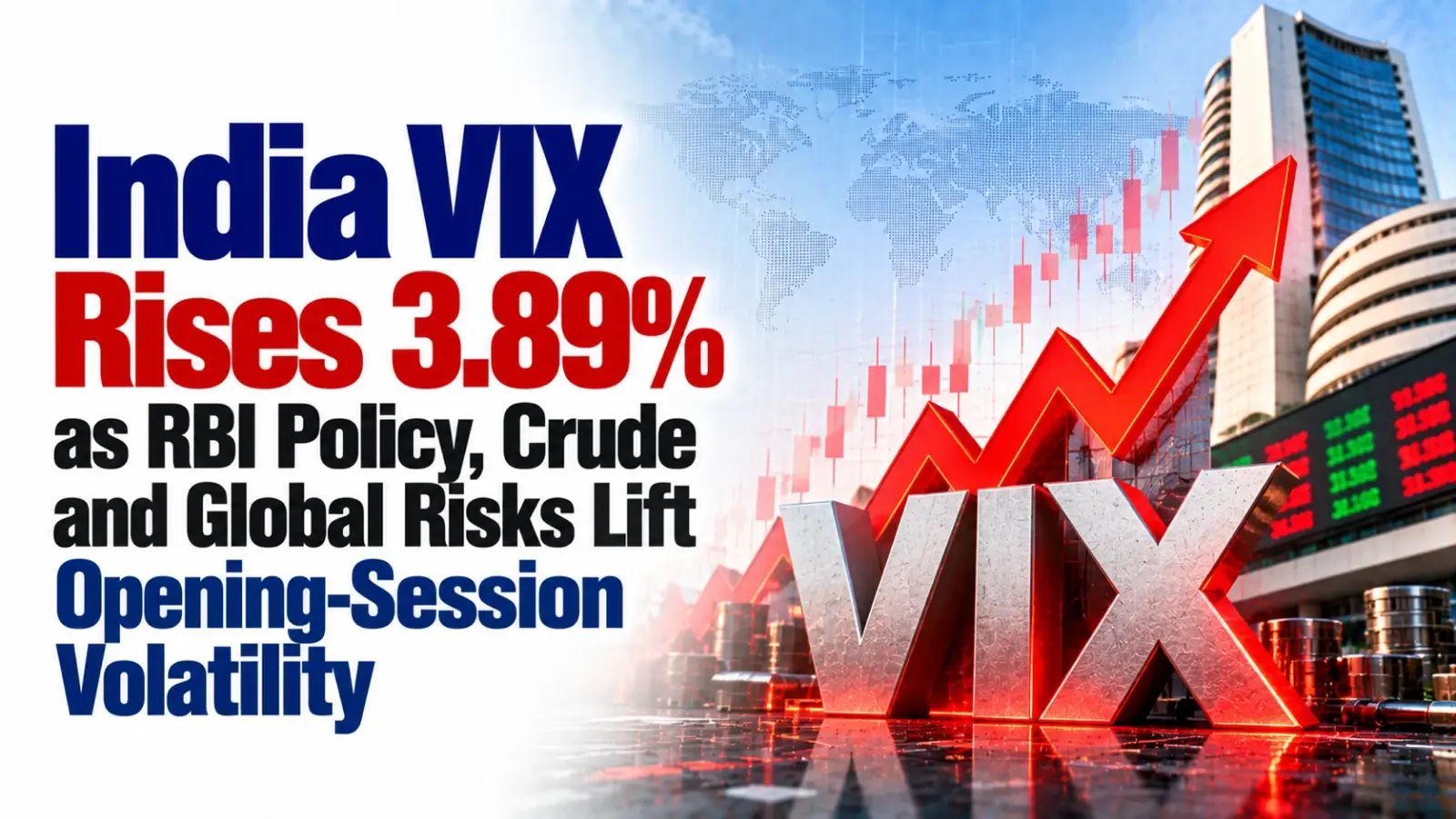
Mumbai, 7 October 2026: India VIX rose 0.53 points, or 3.89%, to 14.11 by 9:56 a.m. IST on Wednesday, after opening at 13.60, as heightened uncertainty ahead of the Reserve Bank of India’s (RBI) monetary policy decision combined with higher crude oil prices, weaker Asian markets, currency pressure and elevated global bond yields. The index had closed at 13.61 on Tuesday after falling sharply, leaving the opening session exposed to a fresh repricing of expected market volatility.

India VIX Climbs 3.89% as Nifty Reverses After Tuesday’s Rally
India VIX stood at 14.11 at 9:56 a.m., compared with its previous close of 13.61. It opened at 13.60, touched an intraday high of 14.31 and recorded a low of 13.60. The index was therefore trading 0.53 points higher from the previous close during the early session.
The move came after India VIX had declined by approximately 8% to 13.59 on Tuesday, while the Nifty had gained about 1% to 22,776. The Sensex, Bank Nifty, Midcap 100 and Smallcap 100 also advanced on Tuesday, rising 0.95%, 0.76%, 1.08% and 1.56%, respectively.
The tone changed at Wednesday’s opening. By 9:17 a.m., the Nifty was down 0.74% at 22,614.25, while the Sensex declined 0.60% to 72,627.95. All 16 major sectors were lower, with mid-cap and small-cap stocks also declining.
India VIX measures the market’s expected 30-day volatility based on Nifty option prices. Its early-session rise therefore reflected increased pricing of uncertainty surrounding the market following Tuesday’s sharp decline in volatility.
RBI Policy at 10 A.M. Raises Immediate Rate Uncertainty
The RBI’s monetary policy decision, scheduled for 10:00 a.m. IST, emerged as the most immediate domestic event affecting the opening-session volatility environment. The decision was particularly significant because it could represent the central bank’s first repo-rate increase since February 2023.
The policy expectations remained divided. Of 61 economists, 35 expected a 25-basis-point rate increase, while 26 expected no change. Market swaps had already priced a 25-basis-point increase, although pricing also left room for a 50-basis-point hike.
The uncertainty extended beyond the repo rate itself. Market participants were also awaiting the RBI’s guidance on inflation, economic growth and liquidity management, alongside Governor Sanjay Malhotra’s forward guidance.
This combination meant the opening session was taking place immediately before a potentially market-moving policy announcement, keeping expected Nifty volatility elevated.
Crude Above $101 Adds Inflation and Policy Pressure
Crude oil prices provided another important source of uncertainty during the early Indian session. Brent crude moved back above $101 a barrel, rising approximately 1.1% to $101.65-$101.70 during early Asian trading.
Oil prices were supported by renewed concerns over Saudi-Houthi tensions and the possibility of supply disruption. Separately, storm-related risks in the Gulf of Mexico added another potential constraint to US oil production.
The rise in crude was particularly relevant for India because it coincided with the RBI’s policy decision. Higher oil prices can affect inflation and the country’s external balance, making the relationship between crude prices, monetary policy and currency conditions particularly important during Wednesday’s session.
With Brent again above $100, the oil market added another layer of uncertainty immediately before the RBI announcement.
Rupee Near ₹96.5 Keeps Currency Risk In Focus
The Indian rupee remained close to ₹96.4-₹96.5 against the US dollar, with traders expecting an opening around ₹96.44-₹96.46, compared with the previous close of ₹96.42.
The currency was therefore operating near historically weak levels as the domestic market approached the RBI decision. The combination of higher crude prices, dollar strength and foreign outflows remained relevant to currency conditions.
The rupee also formed part of the wider policy backdrop because currency pressure and inflation concerns were developing alongside elevated crude prices. This made the RBI’s assessment of monetary conditions and liquidity particularly important during the opening session.
Record US Stocks Fail to Offset Asia’s Weaker Opening
Global equity markets presented a mixed signal rather than a broad-based risk-off move. US markets remained strong overnight, with the S&P 500 rising about 0.6%, the Nasdaq gaining approximately 0.45% and the Dow increasing about 0.5%. Both the S&P 500 and Nasdaq reached fresh records.
However, Asian markets opened lower on Wednesday. The MSCI Asia-Pacific index excluding Japan declined about 0.3%, while the Nikkei fell 0.86% and the Hang Seng declined 0.63%. Australia was broadly flat.
The contrasting regional signals meant that strong US equity performance did not translate into a uniformly positive global backdrop for Indian equities. Higher crude, elevated Treasury yields, weaker Asian markets and the impending RBI decision remained prominent factors during India’s opening trade.
US Treasury Yields Add Another Global Risk Factor
US Treasury yields also remained elevated, with yields approaching a 24-year high during the overnight Asian session. Higher US yields can affect global financial conditions by making dollar-denominated assets more attractive and increasing pressure on emerging-market currencies.
For Indian markets, the elevated yield environment coincided with weakness in the rupee and continued foreign selling. The combination provided an additional global backdrop to the domestic volatility already surrounding the RBI policy announcement.
At the same time, the strength of US equities meant that the global picture was not uniformly negative. Instead, Indian markets were opening amid competing signals from equities, bonds, currencies and commodities.
GIFT Nifty Signalled Weakness Before The 9:15 Open
GIFT Nifty was trading around 22,743-22,760 before the Indian market opened, signalling a weaker start after Tuesday’s broad-based rally.
The Nifty subsequently opened around the 22,600 level and was down approximately 0.7% shortly after the start of trading. The weaker opening came immediately ahead of the RBI’s 10 a.m. policy decision, reinforcing the significance of the event for near-term market volatility.
The early decline also contrasted with Tuesday’s strong performance, when the Nifty had gained 0.98% and India VIX had fallen sharply.
FII Selling Adds To The Volatility Backdrop
Foreign institutional investors (FIIs) remained a background factor entering Wednesday’s session. FIIs sold ₹2,961 crore of Indian equities on 6 October, while domestic institutional investors (DIIs) purchased ₹5,089 crore.
FIIs had also remained net sellers during the first three trading sessions of October, with cumulative selling of approximately ₹17,145 crore. These figures were not new transactions during Wednesday’s opening session, but they formed part of the market backdrop as the RBI decision approached.
The previous session’s strong DII buying provided a counterpoint to continued foreign selling, while the combination of domestic policy uncertainty and global market pressures remained relevant to India VIX.
RBI Liquidity Measures Could Shape The Policy Reaction
The RBI’s approach to liquidity was another area under focus ahead of the announcement. The central bank had been using variable-rate reverse repos, sell-buy foreign exchange swaps and open-market bond sales to manage excess liquidity.
Core liquidity, however, remained high. Consequently, the policy announcement was expected to provide information not only about interest rates but also about the central bank’s approach to managing liquidity and broader financial conditions.
These factors are relevant to banks, bond yields, non-banking financial companies, the rupee and broader market conditions, adding another dimension to the volatility surrounding the policy event.
Titan Falls 3.4% As Weak Updates Hit Opening Breadth
Stock-specific weakness also contributed to the softer opening. Titan declined about 3.4% after weaker-than-expected jewellery business updates.
Although the movement was company-specific, it occurred against a broader decline in market breadth. By 9:17 a.m., all 16 major sectors were lower.
The breadth of the decline was therefore an additional feature of the opening session, alongside the Nifty’s fall and the rise in India VIX.
India VIX Seasonality Shows Mixed October Performance
India VIX’s seasonal data also point to a mixed historical pattern for October. The index has recorded positive returns in 9 of 18 years during the month.
For October, the maximum positive change was 26.73% in 2020, while the average positive change was 11.15%. The maximum negative change was -30.99% in 2013, with an average negative change of -13.66%. The average change for October stands at -1.25%.
The index’s technical rating was Neutral on the daily timeframe. Its stated pivot levels included a classic pivot point of 13.97, with resistance at 14.41, 15.22 and 15.66, while support levels stood at 13.16, 12.72 and 11.91.
India VIX Remains 48.84% Higher Year-to-Date
Despite Wednesday’s early rise, India VIX remained well below its 52-week high of 28.90. The index’s 52-week low stood at 8.72, while its year-to-date return was 48.84%.
The early-session level of 14.11 therefore remained within a considerably wider annual trading range. Wednesday’s immediate movement was centred on the RBI policy event, crude oil, currency conditions and global market cues rather than a single isolated market development.
India VIX stood at 14.11, up 3.89%, by 9:56 a.m. on 7 October, with the RBI decision at 10:00 a.m., Brent crude above $101, the rupee near ₹96.5, weaker Asian markets and elevated US Treasury yields shaping the opening-session volatility backdrop. The index had closed at 13.61 on Tuesday after an approximately 8% decline.
Disclaimer
At HDFC SKY*, we take utmost care and due diligence in curating and presenting news and market-related content. However, inadvertent errors or omissions may occasionally occur.
If you have any concerns, questions, or wish to point out any discrepancies in our content, please feel free to write to us at content@hdfcsec.com.
Please Note: The information shared is intended solely for informational purposes and does not make any investment recommendations.
HDFC SKY from HDFC Securities, one of most trusted trading platforms in India, has been recognized with the *Next-Gen Digi Content Awards 2025-26.
 Join Us
 Add as preferred source on Google


More Business News









Open Free Demat Account
Open Free Demat Account











Invest Anytime, Anywhere


By signing up I certify terms, conditions & privacy policy