Nifty 50
- Apollo Hospitals₹9,200462.00 (5.29%)
- Titan Company₹4,620-80.00 (-1.70%)
- Axis Bank₹1,44665.20 (4.72%)
- Tata Steel₹178-2.89 (-1.60%)
- Max Healthcare₹1,08140.35 (3.88%)
- NTPC₹321.50-3.50 (-1.08%)
- Maruti Suzuki₹14,011422.00 (3.11%)
- Hindustan Unilever₹2,052.50-21.70 (-1.05%)
- UltraTech Cement₹12,939379.00 (3.02%)
- Jio Financial ₹224.97-1.83 (-0.81%)
- HDFC Bank₹84624.20 (2.94%)
- Sun Pharmaceutical₹1,884.90-15.10 (-0.79%)
- Bajaj Finance₹1,12229.15 (2.67%)
- Eternal₹364-2.85 (-0.78%)
- Kotak Mahindra Bank₹515.8012.80 (2.54%)
- Dr. Reddy's Labs₹1,390.20-10.70 (-0.76%)
- Hindalco Industries₹929.5019.50 (2.14%)
- ITC₹299.10-1.90 (-0.63%)
- InterGlobe Aviation₹5,587.60112.60 (2.06%)
- Bharat Electronics₹402-2.20 (-0.54%)

- Offerings
- Tools & Platforms
Tools & Calculators
- Open API
- Calculators
- SIP Calculator
- CAGR Calculator
- Compound Interest Calculator
- FD Calculator
- RD Calculator
- EPF Calculator
- Retirement Calculator
- HDFC SIP Calculator
- Mutual Fund Return Calculator
- Lumpsum Calculator
- Step Up SIP Calculator
- ETF SIP Calculator
- Brokerage Calculator
- Equity Margin Calculator
- SWP Calculator
- EMI Calculator
- MTF Calculator
- Margin Pledge Calculator
- Algo Strategy
- Markets
Stocks
F&O
Mutual Funds
- More
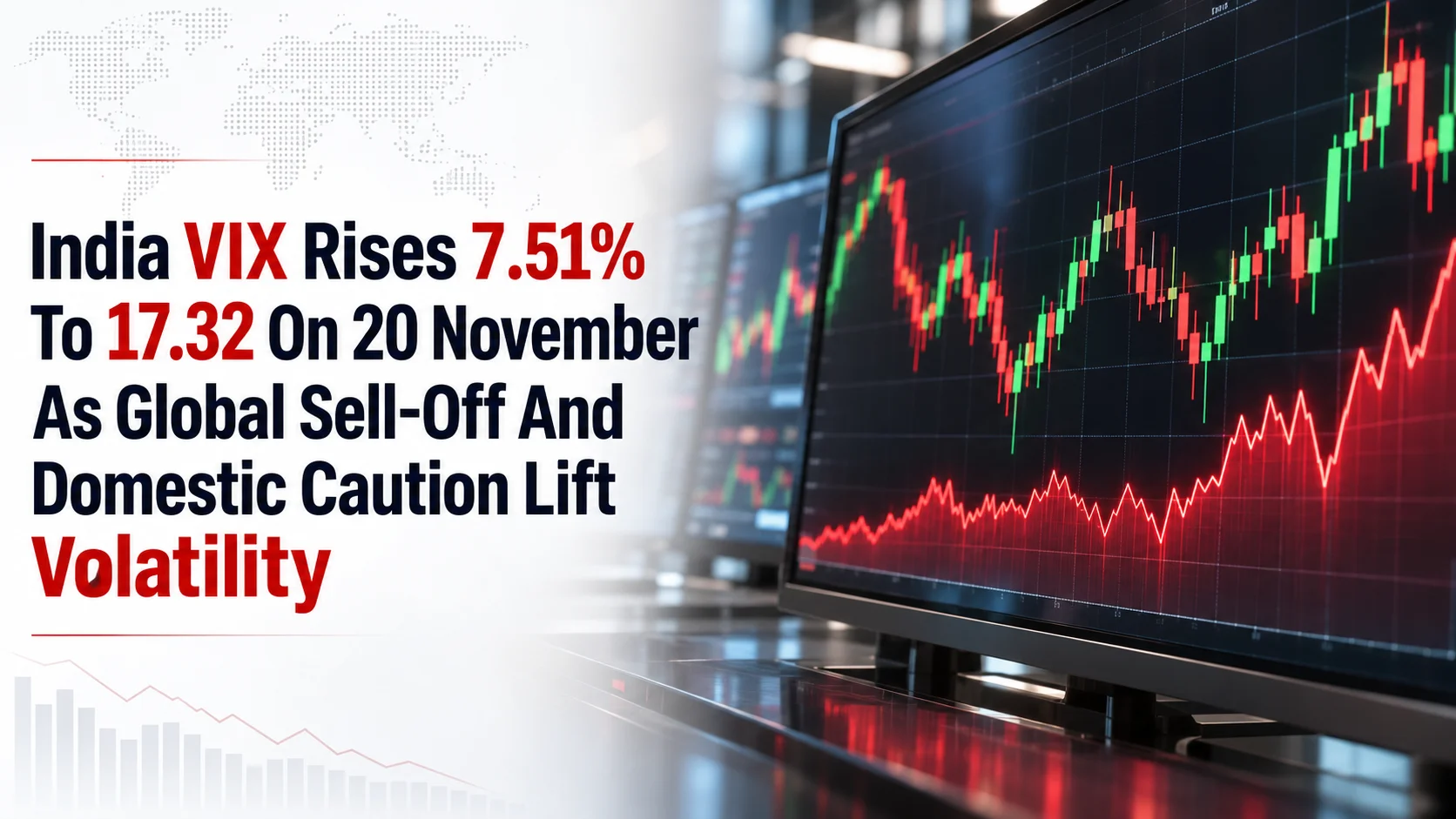
India VIX Rises 7.51% To 17.32 On 20 November As Global Sell-Off And Domestic Caution Lift Volatility
Authored By HDFC SKY | Published at: Nov 20, 2026 04:16 PM IST
Open Free Demat Account
Mumbai, 20 November 2026: India VIX rose 1.21 points, or 7.51%, to 17.32 on Friday, 20 November 2026, as uncertainty across global equity markets and domestic market weakness increased volatility during the trading session. The index opened at 16.11, touched an intraday high of 17.56 and a low of 15.03, against its previous close of 16.11. The increase came as sharp declines across Asian markets, concerns over artificial intelligence (AI) valuations and profit-booking in Indian equities influenced market activity.

India VIX Rises 7.51% as Profit-Booking Follows 10.7% Rally, Weak Breadth Persists
Mumbai, 20 November 2026: India VIX, which measures the market’s expectation of near-term volatility based on Nifty options prices, advanced 7.51% during Friday’s session. The index’s previous close and opening level stood at 16.11, before moving between 15.03 and 17.56 during the day. Its 52-week range remained between 8.72 and 28.90, while its year-to-date return stood at 82.70%.
The increase reflected heightened uncertainty surrounding the direction of Indian equities amid contrasting domestic and international developments. While Indian benchmark indices displayed relative resilience against the sharp correction across Asian markets, weakness in several sectors and concerns about global technology valuations contributed to volatility. The index’s technical rating remained Neutral, indicating no directional technical rating change in the available session data.
November Rally of 10.7% Triggers Profit-Booking in Indian Equities
Profit-booking following the recent recovery in Indian equities contributed to cautious trading on 20 November. During the previous session, on 19 November, the Sensex gained 989.94 points, or 1.21%, to 83,021.75, while the Nifty 50 advanced 286.35 points, or 1.14%, to 25,514.30. The Nifty Auto index also gained approximately 4.4%, with most major sectoral indices closing higher.
However, the recovery was followed by selling pressure at Friday’s opening. The Sensex initially declined approximately 248 points, while the Nifty opened 69.50 points lower at 25,444.80. The Nifty had advanced approximately 10.7% over 13 trading sessions in November, making profit-booking a notable development during the session. The resulting uncertainty over the sustainability of the rally coincided with the increase in India VIX.
Weak Market Breadth and 1,601 Declining Shares Add Pressure
Uneven market participation remained another domestic development during Friday’s session. At approximately 9:20 a.m., around 1,601 shares declined against 980 advancing shares, indicating broader selling pressure despite the relative resilience of benchmark indices. Nine of the 16 major sectors were also trading lower during the morning session.
Small-cap stocks declined approximately 0.4%, while mid-cap stocks remained largely flat. The Nifty Metal index fell approximately 1.8%, whereas information technology (IT) stocks recovered approximately 2%. This divergence highlighted differences in sectoral performance during the session.
Selling pressure was visible in Tata Steel, JSW Steel, Titan Company, Larsen & Toubro and Shriram Finance. In contrast, Max Healthcare and Apollo Hospitals gained approximately 4% following analyst upgrades. The contrasting movements across sectors coincided with heightened uncertainty in the broader market.
Rupee Crosses 93 Against Dollar as Foreign Inflows Support Markets
The Indian rupee appreciated beyond 93 against the US dollar on 20 November, reaching its strongest level since April 2026. The movement came amid substantial foreign portfolio inflows, reduced bearish positioning by overseas hedge funds and the impact of earlier Reserve Bank of India (RBI) measures to curb speculative dollar demand.
Foreign investors had brought more than $12 billion into Indian equities during November. Separately, foreign investment in Indian equities reached ₹84,291 crore during the first half of November, with more than half of the inflows directed towards banking and financial stocks. The rupee’s year-to-date losses also narrowed to approximately 3.5%, compared with nearly 8% at its weakest point in May.
The currency appreciation provided a supportive development for domestic markets amid international weakness. However, the strong foreign inflows were cumulative November figures and did not represent purchases made exclusively on 20 November.
Brent Crude Trades Near $92.58 Amid Energy Market Uncertainty
Crude oil remained an important macroeconomic development during Friday’s session, with Brent crude trading around $92.50–$92.58 per barrel. Higher oil prices remained relevant for India because of the country’s dependence on imported crude and the implications for its import bill, current account deficit, inflation and currency stability.
Energy-intensive industries, including aviation, paints, chemicals and logistics, also remained exposed to changes in crude oil prices. However, international benchmarks were heading towards weekly declines, with Brent crude facing an estimated 3.5% fall and West Texas Intermediate (WTI) approximately 6%. This provided some counterbalancing relief amid concerns over energy costs.
US Markets Fall Over 2% As AI Valuation Concerns Intensify
Global equity weakness remained a major development influencing Indian market conditions on 20 November. During Thursday’s session, 19 November, the Dow Jones Industrial Average declined 2.19%, the S&P 500 fell 2.02%, and the Nasdaq Composite lost 2.25%. The correction followed concerns about elevated valuations of artificial intelligence-related companies and the sustainability of anticipated growth across the technology sector.
Anthropic’s Nasdaq debut on 19 November also failed to restore broader confidence in AI-related stocks. Its shares opened at $111.50, against an IPO price of $83, initially gaining more than 30%. However, they subsequently closed at $97.17, approximately 17% above the issue price. Concerns about technology valuations continued despite the company’s positive listing performance.
Asian Markets Decline Over 4% as Global Selling Spreads
The weakness in US equities extended across Asian markets on Friday, 20 November. Japan’s Nikkei, South Korea’s Kospi and Taiwan’s equity market each declined more than 4% during the session. Hong Kong’s Hang Seng fell approximately 1.98%, while the Shanghai Composite declined around 1.96%.
The MSCI Asia-Pacific index also declined approximately 2.5%, with the region heading towards its worst weekly performance since 2020. The broad correction reflected continuing concerns about AI-related valuations and international equity-market conditions. Despite the substantial weakness across Asia, Indian benchmark indices remained comparatively resilient, while India VIX recorded a significant increase.
Dollar Strength and West Asia Tensions Add Global Uncertainty
A stronger US dollar and uncertainty surrounding international monetary policy remained additional developments during the session. Expectations of a potentially hawkish US Federal Reserve outlook continued to influence concerns over global bond yields, currency movements, equity valuations and foreign investment flows. However, no new Federal Reserve announcement during India’s trading hours was established as a direct trigger for Friday’s movement.
Geopolitical developments in West Asia also remained relevant. Reports highlighted tensions involving Saudi Arabia and Yemen’s Houthi movement, including claims of attacks on infrastructure that were not independently confirmed by the Saudi side. The developments added uncertainty around regional stability and potential energy supply disruptions.
India VIX closed at 17.32, up 7.51%, on 20 November 2026, after moving between 15.03 and 17.56. Domestic profit-booking, uneven market breadth, foreign portfolio inflows, rupee appreciation and crude oil movements shaped the session. Global developments included US technology-stock losses, Asian market declines, AI valuation concerns and geopolitical uncertainty.
Disclaimer
The information shared here is intended solely for informational and educational purposes and does not constitute investment recommendations. While we practice strict due diligence in curating daily market data, readers must perform independent research before trading. To flag any real-time data discrepancies or content concerns, please write to us at content@hdfcsec.com.
 Join Us
 Add as preferred source on Google


More TATASTEEL News







Open Free Demat Account
₹178










Invest Anytime, Anywhere


By signing up I certify terms, conditions & privacy policy