Nifty 50
- Eternal₹317.4012.95 (4.25%)
- Shriram Finance₹865-35.90 (-3.98%)
- Apollo Hospitals₹7,730125.50 (1.65%)
- Adani Enterprises₹2,477-73.00 (-2.86%)
- ONGC₹227.502.50 (1.11%)
- JSW Steel₹1,185.50-34.50 (-2.83%)
- Asian Paints₹2,30722.20 (0.97%)
- Jio Financial ₹205.03-5.77 (-2.74%)
- TCS₹2,53023.10 (0.92%)
- Tata Steel₹167.67-4.66 (-2.70%)
- UltraTech Cement₹11,05092.00 (0.84%)
- Adani Ports₹1,702.70-47.30 (-2.70%)
- Maruti Suzuki₹11,23060.00 (0.54%)
- Tech Mahindra₹1,790-39.10 (-2.14%)
- Cipla₹1,3387.10 (0.53%)
- Tata Motors PV₹264.60-5.40 (-2.00%)
- Reliance Industries₹1,1905.50 (0.46%)
- Hindalco Industries₹869.85-15.75 (-1.78%)
- Axis Bank₹1,217.505.50 (0.45%)
- Trent₹2,727.50-48.30 (-1.74%)

- Offerings
- Tools & Platforms
Tools & Calculators
- Open API
- Calculators
- SIP Calculator
- CAGR Calculator
- Compound Interest Calculator
- FD Calculator
- RD Calculator
- EPF Calculator
- Retirement Calculator
- HDFC SIP Calculator
- Mutual Fund Return Calculator
- Lumpsum Calculator
- Step Up SIP Calculator
- ETF SIP Calculator
- Brokerage Calculator
- Equity Margin Calculator
- SWP Calculator
- EMI Calculator
- MTF Calculator
- Margin Pledge Calculator
- Algo Strategy
- Markets
Stocks
F&O
Mutual Funds
- More
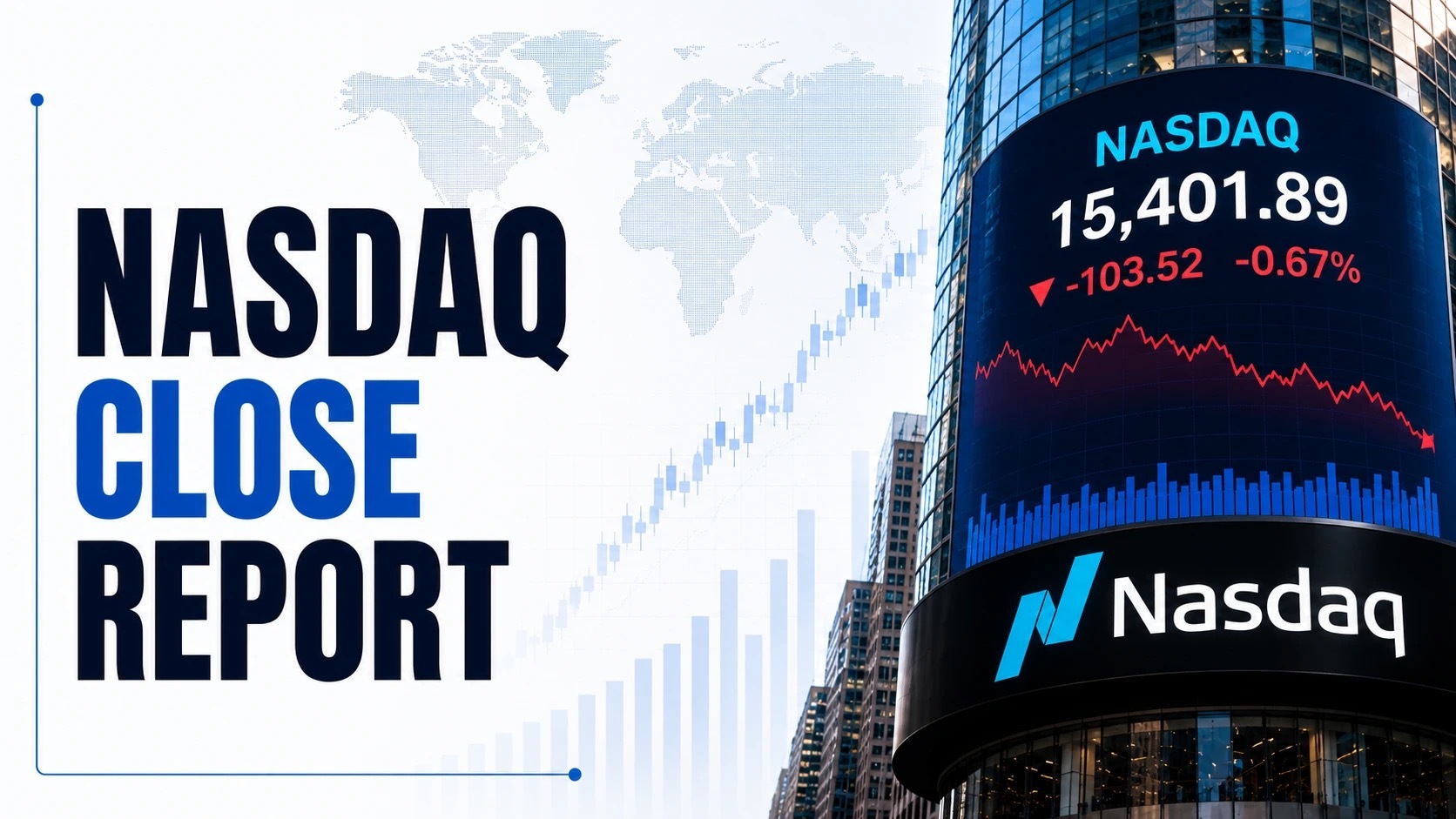
Nasdaq Plunges 1.55% to 25,873 as Oil Surges 9% on Hormuz Blockade; Chip Stocks Tumble Led by SK Hynix
Authored By HDFC SKY | Published at: Jul 14, 2026 08:25 AM IST
Open Free Demat Account
Open Free Demat Account
Mumbai, July 14: US stock markets closed sharply lower on Monday as renewed geopolitical tensions in the Middle East sent oil prices soaring and triggered a broad-based sell-off in technology and semiconductor shares. The tech-heavy Nasdaq Composite bore the brunt of the selling pressure, tumbling 408.43 points (1.55%) to settle at 25,873.18, while the benchmark S&P 500 dropped 60.05 points (0.79%) to end at 7,515.34. The blue-chip Dow Jones Industrial Average showed relative resilience, declining 138.37 points (0.26%) to close at 52,498.64.
The market rout was precipitated by President Donald Trump’s announcement that the United States would reinstate a naval blockade on Iranian shipping through the strategic Strait of Hormuz, escalating tensions that had briefly eased following last month’s ceasefire agreement. The development sent Brent crude futures surging 9.6% to above $83 per barrel, while West Texas Intermediate jumped 9.4% to top $78 per barrel, marking the sharpest single-day gains for oil prices since May 2020.

Nasdaq Sheds 408 Points as Chip Stocks Lead Tech Sell-Off
The technology sector faced significant headwinds as semiconductor stocks suffered their worst session in weeks, with the Nasdaq 100 declining 1.6% amid concerns over stretched valuations and profit-taking in the artificial intelligence trade. The PHLX Semiconductor Index fell more than 3%, extending its pullback from recent highs.
SK Hynix, the South Korean memory chip giant that made its Nasdaq debut on Friday with a spectacular 13% rally, saw its US-listed shares tumble 9.3% to close at $152.35. The stock’s decline came as its Korean-listed shares plummeted 15% in Seoul trading, marking the company’s steepest single-day drop on record and weighing heavily on South Korea’s KOSPI index, which tumbled 9%.
Other memory chipmakers followed suit, with SanDisk plunging 12.63% to $1,673.97, Marvell Technology dropping 7.74%, Seagate Technology falling 5.46%, and Western Digital declining 4.66%. Micron Technology shed 4.30%, while Intel fell 6.12% and Advanced Micro Devices dropped 4.23%. The Roundhill Memory ETF, which tracks companies involved in memory chips and storage, plummeted approximately 9% on the session.
Nvidia, the AI chip leader, declined 3.50% despite trading at its lowest forward price-to-earnings ratio since 2015, according to FactSet data. Applied Materials fell 4.52%, Lam Research dropped 5.78%, and KLA Corporation declined 3.98%. The broader weakness in semiconductor names comes as investors question whether the AI trade that has powered markets this year has more room to run, though analysts at JPMorgan maintained that the artificial intelligence investment cycle remains “intact” and that the recent dip reflects crowded positions rather than weakening demand.
Magnificent Seven Stocks Trade Mixed as Apple Hits Record High
The Magnificent Seven mega-cap technology stocks delivered a mixed performance as investors rotated away from semiconductor names while showing selective interest in other tech leaders.
Apple shares climbed 0.69% to reach a fresh all-time high above $323, extending the company’s 18% year-to-date rally. The move came after Citi analysts raised their price target on the iPhone maker to $365 from $315, citing the company’s ability to gain market share despite a slowing market. “We believe Apple’s ability to implement selective price increases will help offset margin pressures, while its premium brand and loyal customer base should limit demand weakness,” analyst Asiya Merchant wrote in a note to clients.
Microsoft rose 1.57%, while Amazon added 0.82% and Netflix gained 0.67%. However, Meta Platforms fell 1.84% after soaring 6% on Friday, and Tesla declined 3.17% following reports that the electric vehicle maker was facing increased competition in China. Alphabet shares dropped approximately 1.3%.
Elsewhere, Shopify received an upgrade from Jefferies to buy from hold, with the brokerage raising its price target to $160 from $140, implying 31% upside from Friday’s close. Analyst Samad Samana noted the e-commerce platform is well positioned to capture the emerging “agentic commerce” market, where AI-powered tools find and purchase goods on behalf of consumers.
Also Read: How to invest in US stocks
AppLovin Plunges 13%, Leads S&P 500 Losers as Software Stocks Pressure
AppLovin emerged as the worst-performing stock in the S&P 500, tumbling 12.62% to $442.85, putting the software company on track for its sixth daily loss in seven sessions. The decline wiped more than $30 billion from the company’s market capitalisation as investors continued to unwind positions following the stock’s blistering rally that saw shares rise eightfold last year. AppLovin shed approximately $64.13 per share, making it the standout decliner among major US indices.
Other notable losers included Sandisk, which fell 12.63% following its spin-off from Western Digital, and Astera Labs, which plunged 12.33% to $362.05. Maase Inc. declined 14.36%, while Regencell Bioscience Holdings dropped 14.12%. Braiin bucked the trend, surging 62% after the AI platform company launched its Aria AI agent designed for the real estate industry.
Biogen shares added nearly 2% after Truist upgraded the biotechnology company to buy from hold, citing potential upside following the release of latest data from investigational drug trials.
Trump Announces Hormuz Blockade, Oil Prices Surge 9% to One-Month High
The primary catalyst for Monday’s market decline was President Trump’s announcement on his Truth Social platform that the United States would reinstate what he termed the “Iranian Blockade” on shipping through the Strait of Hormuz. The president declared that the US would become the “Guardian of the Hormuz Strait” and would impose a 20% fee on all cargo shipped through the vital waterway, which accounts for approximately one-fifth of the world’s oil supply.
“The U.S.A. will be, from this point forward, known as ‘THE GUARDIAN OF THE HORMUZ STRAIT,’ but as such, and as a matter of FAIRNESS, will be reimbursed, at the rate of 20% on all cargo shipped, for any and all costs necessary to do the job of providing safety and security to this very volatile section of the World,” Trump wrote.
The blockade will take effect from 2000 GMT on Tuesday, 14 July, according to the US Navy-led Joint Maritime Information Center, and will cover all Iranian ports, oil terminals, and coastal areas. Vessels entering or leaving without authorisation may face interception or capture, though neutral transit through the strait will remain unaffected.
The announcement came after the US and Iran exchanged airstrikes over the weekend, with Tehran targeting US facilities in several Gulf countries and declaring the strait closed. The Pentagon confirmed that US forces had used armed sea drones for the first time in combat, targeting a submarine and ship maintenance facility at Iran’s Bandar Abbas naval base.
Brent crude surged 9.6% to settle at $83.30 per barrel, while US crude closed at $78.14, marking the largest daily gains for both benchmarks since April amid renewed geopolitical risk. The spike in oil prices revived inflation concerns just as markets prepared for key economic data releases later in the week.
Energy Sector Rallies 3.5% as Safe-Haven Assets Decline
The energy sector emerged as the top performer in the S&P 500, rallying 3.5% on the session as oil prices surged. Valero Energy and Diamondback Energy led the sector with gains of more than 5% apiece, while Exxon Mobil jumped 4.09% and Chevron advanced 3.25%. CVR Energy gained 8.01%, Par Pacific Holdings rose 7.82%, and PBF Energy climbed 8.02%.
Conversely, safe-haven assets faced pressure as rising oil prices heightened concerns over inflation and interest rates. Gold futures declined 2.7% to approximately $4,000 per ounce, while Bitcoin traded around $62,100, down from overnight highs above $64,300.
The US Dollar Index, which tracks the greenback against a basket of foreign currencies, rose 0.3% to 101.28. Apollo Global Management’s chief economist Torsten Sløk noted that net foreign inflows into US equities have surged as international investors seek exposure to the AI trade, supporting the dollar’s strength. However, Sløk warned that if AI enthusiasm fades, a pullback in these inflows would pose a significant downside risk to the US currency.
Treasury Yields Climb as Rate-Hike Odds Jump to 41%
US Treasury yields moved higher as rising oil prices fuelled inflation concerns and increased expectations of Federal Reserve rate hikes. The 2-year Treasury yield, which often moves with interest rate expectations, rose more than 6 basis points to 4.271%, its highest level since early 2025. The 10-year Treasury yield added more than 4 basis points to 4.614%, while the 30-year bond yield traded up more than 2 basis points at 5.097%.
CME’s FedWatch tool showed odds of a rate hike at the Fed’s July meeting rising to more than 41%, up from 34% on Sunday. On the prediction market platform Kalshi, speculators placed a 36% chance of a 25 basis point hike at the conclusion of the July 29 meeting.
Federal Reserve Governor Christopher Waller signalled the possibility of near-term rate increases if inflation data remains elevated above the 2% target, warning that another hot core inflation reading could prompt tightening. Waller described monetary policy as being at a “crossroads,” with upcoming data set to guide the path ahead.
Also Read: US Stock market timings
Wall Street Eyes CPI Data, Bank Earnings Amid Inflation Worries
Investors are now turning their attention to a critical week of economic data and corporate earnings releases that could provide further direction for markets. The June Consumer Price Index report is due on Tuesday morning, with economists polled by Dow Jones expecting the headline reading to show a 0.2% decline on the month but a year-over-year increase of 3.8%. The core CPI, which excludes volatile food and energy prices, is expected to show a 2.8% annual increase, down from May’s 2.9%.
The Producer Price Index is scheduled for Wednesday, while retail sales data will be released on Thursday. Federal Reserve Chairman Kevin Warsh is also slated to appear before the House Financial Services Committee on Tuesday, offering testimony on the central bank’s semi-annual monetary policy report.
The second-quarter earnings season kicks off on Tuesday with results from five major US banks: JPMorgan Chase, Goldman Sachs, Bank of America, Wells Fargo, and Citigroup. Morgan Stanley reports on Wednesday, followed by Netflix, Johnson & Johnson, and UnitedHealth later in the week.
On average, analysts estimate that second-quarter S&P 500 profits grew by more than 23% year-over-year, according to FactSet. CFRA Research’s chief investment strategist Sam Stovall noted that earnings per share for the second quarter are expected to show a year-over-year increase of 20.9%, exceeding the average quarterly rise of 11.6% since 2009.
With oil prices surging on renewed US-Iran tensions and chip stocks facing significant selling pressure, market participants are closely monitoring Tuesday’s CPI data and bank earnings for direction. The 2-year Treasury yield’s climb to 4.27% reflects rising expectations of Fed rate hikes, while the energy sector’s 3.5% rally highlights the impact of geopolitical risk on commodity prices. The Nasdaq’s 1.55% decline underscores the technology sector’s vulnerability to both inflation concerns and profit-taking after a strong run.
Source
- https://www.nasdaq.com/
- spglobal.com/spdji/en/indices/equity/sp-500/
- https://www.dowjones.com/
Disclaimer
If you have any concerns, questions, or wish to point out any discrepancies in our content, please feel free to write to us at content@hdfcsec.com.
Please Note: The information shared is intended solely for informational purposes and does not make any investment recommendations
Disclaimer
At HDFC SKY*, we take utmost care and due diligence in curating and presenting news and market-related content. However, inadvertent errors or omissions may occasionally occur.
If you have any concerns, questions, or wish to point out any discrepancies in our content, please feel free to write to us at content@hdfcsec.com.
Please Note: The information shared is intended solely for informational purposes and does not make any investment recommendations.
HDFC SKY from HDFC Securities, one of most trusted trading platforms in India, has been recognized with the *Next-Gen Digi Content Awards 2025-26.
 Join Us
 Add as preferred source on Google


More Business News







Open Free Demat Account
Open Free Demat Account








Invest Anytime, Anywhere


By signing up I certify terms, conditions & privacy policy