Nifty 50
- Bajaj Finance₹1,043.2034.40 (3.41%)
- HCL Technologies₹1,256.70-13.70 (-1.08%)
- Hindalco Industries₹1,003.8030.80 (3.17%)
- Titan Company₹4,880-48.50 (-0.98%)
- Tata Steel₹190.825.85 (3.16%)
- Infosys₹1,020.50-8.90 (-0.86%)
- Apollo Hospitals₹9,056220.50 (2.50%)
- Coal India₹424.55-3.45 (-0.81%)
- JSW Steel₹1,297.8030.80 (2.43%)
- TCS₹2,089.60-15.40 (-0.73%)
- Grasim Industries₹3,188.5060.30 (1.93%)
- Wipro₹164.90-1.10 (-0.66%)
- Nestle₹1,387.2023.30 (1.71%)
- NTPC₹326-1.80 (-0.55%)
- L&T₹3,929.9063.50 (1.64%)
- Bharat Electronics₹396.05-1.85 (-0.46%)
- ITC₹270.154.35 (1.64%)
- Trent₹2,774-8.90 (-0.32%)
- Power Grid Corp₹270.204.25 (1.60%)
- Mahindra & Mahindra₹3,035-9.50 (-0.31%)

- Offerings
- Tools & Platforms
Tools & Calculators
- Open API
- Calculators
- SIP Calculator
- CAGR Calculator
- Compound Interest Calculator
- FD Calculator
- RD Calculator
- EPF Calculator
- Retirement Calculator
- HDFC SIP Calculator
- Mutual Fund Return Calculator
- Lumpsum Calculator
- Step Up SIP Calculator
- ETF SIP Calculator
- Brokerage Calculator
- Equity Margin Calculator
- SWP Calculator
- EMI Calculator
- MTF Calculator
- Margin Pledge Calculator
- Algo Strategy
- Markets
Stocks
F&O
Mutual Funds
- More
US Stocks Slip as Nasdaq Falls 0.49%, Oil Nears $100 and Yields Reach 4.99%
Authored By HDFC SKY | Last Modified: Sep 24, 2026 08:35 AM IST
Open Free Demat Account
Open Free Demat Account
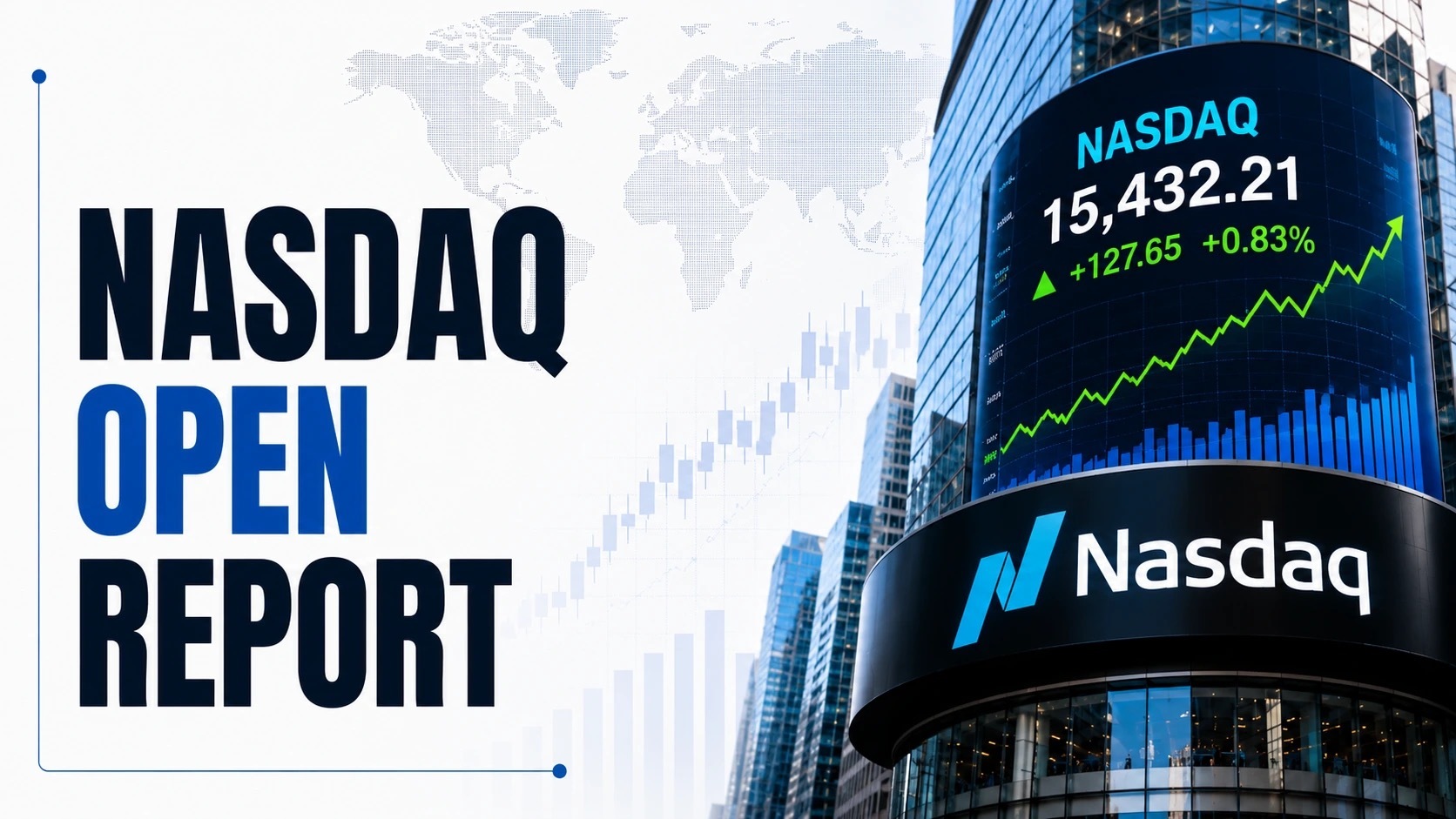
Mumbai, Sept 23: US stocks opened lower on Wednesday after the Nasdaq Composite ended the previous session at another record high. Rising crude oil prices and Treasury yields put pressure on equities, while investors also watched developments in US-Iran relations and preparations for a meeting between US President Donald Trump and Chinese President Xi Jinping.
At 9:52 a.m. EDT, the Nasdaq Composite was at 27,109.51, down 134.77 points or 0.49%. The Dow Jones Industrial Average stood at 51,713.55, lower by 150.14 points or 0.29%, while the S&P 500 was at 7,737.96, down 26.68 points or 0.34%.
The weaker opening came immediately after Tuesday’s technology-led rally. The Nasdaq had reached an intraday record before closing at 27,244.28, extending its recent strength. Wednesday’s move was therefore a pullback from elevated levels rather than a continuation of a prolonged sell-off.
Higher oil prices added another source of concern for investors because sustained energy costs can feed into inflation expectations. At the same time, the 10-year Treasury yield moved close to the psychologically important 5% mark, keeping interest-rate expectations firmly in focus.

Nasdaq Falls 0.49% After Record Close as Technology Shares Turn Mixed
The Nasdaq Composite fell 0.49% to 27,109.51 in early trading. It opened at 27,213.52, compared with Tuesday’s record close of 27,244.28. During the early session, the index reached 27,217.33 before slipping to 27,115.73.
Despite the opening decline, the Nasdaq remained close to its recent peak. The index was up 4.38% over five days, 3.58% over one month, 23.56% over six months, 16.67% year to date and 20.13% over one year. Its five-year gain stood at 80.15%.
The index’s 52-week range was 20,690.25 to 27,288.79, placing Wednesday’s level near the upper end of that range. Volume was quoted at 1.62 billion shares around 9:52 a.m. EDT, against an average volume of 8.46 billion.
Technology stocks were not moving in one direction. Several semiconductor names came under pressure, including Broadcom, down 1.74%, Micron Technology, down 0.92%, Advanced Micro Devices, down 1.04%, ASML, down 2.14%, and Intel, down 2.18%.
Other chip-related stocks were also weaker. Lam Research fell 3.43%, Applied Materials declined 2.00%, KLA dropped 3.14%, Marvell Technology slipped 0.50%, Qualcomm fell 1.01%, and Western Digital declined 2.65%.
However, several major technology and communication companies moved higher. Microsoft gained 1.29%, Palantir Technologies rose 4.27%, Palo Alto Networks advanced 1.42%, CrowdStrike increased 2.03%, and Datadog added 2.85%. Meta Platforms gained 2.80%, while Tesla rose 1.56%.
The mixed performance suggests that Wednesday’s Nasdaq decline was not the result of a broad retreat from technology. Instead, investors appeared to be rotating between individual companies and subsectors after the index’s strong run.
Dow Slips 0.29% as Financial and Consumer Stocks Weigh
The Dow Jones Industrial Average fell 150.14 points, or 0.29%, to 51,713.55 shortly after the opening. The index started at 51,771.41, compared with Tuesday’s close of 51,863.69. Its early high was 51,843.15, while the low was 51,658.13.
The Dow’s recent performance remained mixed. It had gained 0.49% over five days, but was down 2.93% over one month. Over six months, it had risen 11.91%, while its year-to-date gain stood at 7.59%. The index was up 11.71% over one year and 48.75% over five years.
Its 52-week range was 45,057.28 to 54,744.33, leaving the index below its annual high but well above its low.
Several major constituents gained despite the broader decline. Microsoft and International Business Machines each rose 1.29%, while Salesforce advanced 2.24%, Visa increased 0.67%, and Walmart gained 0.61%. Boeing rose 1.24%, while Chevron added 1.78%.
Other large companies moved lower. Apple fell 0.43%, Amazon declined 1.46%, JPMorgan Chase slipped 0.55%, and Goldman Sachs fell 0.79%. McDonald’s dropped 3.69%, while UnitedHealth Group declined 1.17%.
Energy stocks provided some support as crude prices recovered from their recent slide. Chevron’s gain stood out against weakness in consumer and financial companies.
The Dow had already fallen around 0.4% during the previous session, meaning Wednesday’s opening weakness extended some of that pressure. Still, the performance of individual constituents remained uneven.
Also Read: What Is the New York Stock Exchange (NYSE)?
S&P 500 Drops 0.34% as Oil and Bond Yields Add Pressure
The S&P 500 declined 26.68 points, or 0.34%, to 7,737.96 in early trading. It opened at 7,761.94, compared with Tuesday’s close of 7,764.64. The index recorded an early high of 7,761.94 and a low of 7,737.85.
The broader benchmark remained firmly positive over longer periods. It was up 2.46% over five days, 0.83% over one month, 17.58% over six months, 13.04% year to date and 16.24% over one year. Its five-year gain stood at 73.93%.
The index’s 52-week range was 6,316.91 to 7,816.70, putting the early Wednesday reading close to the top of its annual range.
Semiconductor stocks were among the notable sources of weakness. Broadcom fell 1.79%, Lam Research declined 3.61%, Applied Materials dropped 2.15%, KLA fell 3.27%, Micron Technology declined 1.01%, and Advanced Micro Devices slipped 1.30%.
Financial stocks also faced selling pressure. JPMorgan Chase fell 0.46%, Goldman Sachs declined 0.56%, Wells Fargo slipped 0.36%, Capital One dropped 1.20%, and BlackRock fell 0.32%.
Not every financial or payment company declined. Mastercard gained 1.36%, Visa rose 0.57%, and S&P Global advanced 1.50%.
Energy shares moved higher as crude prices strengthened. Exxon Mobil rose 1.80%, Chevron gained 1.78%, ConocoPhillips increased 1.80%, Marathon Petroleum rose 1.78%, and Valero Energy advanced 2.49%.
The S&P 500’s opening performance consequently reflected a tug-of-war between technology and selected financial stocks on one side and energy companies on the other.
Russell 2000 Falls 0.75% as Small-Cap Stocks Lose Ground
The Russell 2000 declined 21.71 points, or 0.75%, to 2,868.21 in early trading. It opened at 2,884.49, compared with the previous close of 2,889.92, before touching a high of 2,884.49 and a low of 2,867.85.
The small-cap index was up 0.33% over five days, although it had fallen 4.96% over one month. Its six-month gain stood at 14.99%, while it was up 15.57% year to date. Over one year, the index had gained 16.71%, with a five-year increase of 26.97%.
The 52-week range was 2,303.46 to 3,069.71, leaving the index comfortably above its annual low despite the morning decline.
Some of the sharpest losses came from individual companies. Voyager Technologies fell 12.06%, Endeavour Silver declined 11.14%, Paychex dropped 8.48%, Sibanye Stillwater fell 7.68%, and Aurora Innovation declined 7.66%.
Mining stocks were particularly weak. Aya Gold & Silver fell 6.92%, Aura Minerals declined 6.51%, First Majestic Silver dropped 6.48%, Gold Fields fell 6.08%, Skeena Resources declined 6.05%, Equinox Gold dropped 5.99%, and Coeur Mining fell 5.76%.
Technology names also faced pressure, with Aehr Test Systems down 6.81%, SiTime down 4.91%, MXL down 6.05%, and Roadzen down 5.39%.
There were notable gainers as well. IonQ gained 4.23%, AtriCure rose 4.10%, PBF Energy advanced 2.82%, and Magnolia Oil & Gas increased 2.62%.
Oil Moves Towards $100 as 10-Year Treasury Yield Hits 4.99%
Higher oil prices and Treasury yields added pressure to US equities on Wednesday. The 10-year US Treasury yield rose to 4.99%, around two basis points above Tuesday’s close, while the 2-year yield climbed to 4.81%. The move kept inflation and Federal Reserve rate expectations in focus, with the average 30-year fixed mortgage rate quoted at 7.12%.
Crude prices also recovered after five consecutive sessions of declines. Brent crude traded around $100 a barrel, while WTI was near $91. One update placed Brent at $101.24, up 2.01%. Earlier declines had reflected expectations of improved supplies and developments around the Strait of Hormuz. Renewed uncertainty over US-Iran discussions helped push prices higher.
For stocks, the combination of higher energy costs and borrowing yields created a less supportive environment.
AI Stocks Diverge as Meta Gains While AppLovin Falls
AI-related stocks moved in different directions despite remaining central to market activity. Meta Platforms gained 2.80%, Palantir rose more than 4%, CrowdStrike gained over 2%, and Datadog advanced nearly 3%.
In contrast, AppLovin fell 5.87%, while Lam Research, KLA and Applied Materials declined more than 2%. The divergence followed Tuesday’s Nasdaq record and reflected greater selectivity around AI valuations, infrastructure spending and the potential impact of AI on established business models.
Also Read: How to invest in US stocks
IonQ Gains 4.42% After Quantum Computing Development
IonQ rose 4.42% to $42.54 during early trading after the quantum computing company announced that it had successfully tested what it described as the industry’s first real-time quantum error decoder.
According to the supplied company information, the technology is designed to support error correction during quantum-computing operations without slowing execution. The system is intended to provide real-time decoding across hundreds of logical qubits and millions of logical operations.
IonQ was quoted at $42.53, up 4.39% at one point, before another market reading placed it at $42.54, a gain of $1.80 or 4.42%.
The move followed a reported pre-market gain of more than 10%, highlighting the strong investor response to the announcement. IonQ said its decoder runs on a single central processing unit.
Quantum computing remained an active area within the small-cap market, with other companies in the sector also attracting attention. IonQ’s rise stood out against the broader weakness in the Russell 2000.
Securitize Leads Gainers With 8.86% Rise
The strongest early movers included companies from technology, healthcare, communications and energy.
Securitize Corp. rose 8.86% to $14.14, with volume of 979,878 shares compared with its three-month average volume of 2.31 million. Its market capitalisation was listed at $2.319 billion.
Lakefront Biotherapeutics NV gained 6.99% to $32.30, while Bandwidth Inc. advanced 6.11% to $61.99. Quantinuum rose 4.22% to $53.56, and NICE gained 4.83% to $124.00.
Venture Global increased 4.57% to $13.50, while Palantir Technologies gained 3.68% to $191.79. IonQ rose 4.39%, and Moderna advanced 4.16% to $190.15.
Other notable gainers included Klaviyo, up 4.10%, AtriCure, up 4.10%, Atlassian, up 3.70%, YPF, up 3.68%, Veeva Systems, up 3.79%, and iRhythm Holdings, up 3.93%.
Twilio rose 3.35%, Caris Life Sciences gained 4.00%, Graphic Packaging Holding advanced 3.13%, Antero Resources increased 3.47%, and ServiceNow gained 2.50%.
These moves underline the stock-specific nature of Wednesday’s market. Even while the main benchmarks were lower, individual companies continued to record significant gains.
Voyager Technologies Leads Decliners With 12.06% Fall
The biggest early decline among the supplied stock data came from Voyager Technologies, which fell 12.06% to $33.00.
Endeavour Silver declined 11.14% to $9.34, while Paychex fell 8.48% to $104.82. Sibanye Stillwater declined 7.68%, SharonAI Holdings fell 7.63%, and Aurora Innovation dropped 7.66%.
Mining companies accounted for many of the other large declines. Aya Gold & Silver fell 6.92%, Aura Minerals declined 6.51%, First Majestic Silver dropped 6.48%, and AngloGold Ashanti fell 6.21%.
Gold Fields declined 6.08%, Skeena Resources fell 6.05%, Hecla Mining dropped 5.99%, Equinox Gold declined 5.99%, and Coeur Mining fell 5.76%.
Technology and consumer names also featured among the decliners. AppLovin fell 6.30%, Five Below declined 6.10%, and SiTime dropped 4.91%.
The weakness across several commodity-linked companies came despite higher crude prices, showing that individual stock performance was being influenced by company-specific developments as well as broader commodity movements.
Cracker Barrel Gains Around 7% After Earnings Beat Estimates
Cracker Barrel Old Country Store rose around 7% after reporting stronger-than-expected fiscal fourth-quarter results and issuing its fiscal 2027 outlook. Adjusted earnings came in at $0.99 per share, well above the cited $0.17 consensus estimate, while revenue reached $849.3 million. For fiscal 2027, the company expects adjusted EBITDA of $180 million to $200 million, with the midpoint above the $184.1 million consensus. Its shares were already up around 80% this year.
Elsewhere, General Mills gained around 1%, while Paychex fell about 5% after its results. KB Home declined more than 1% as its fourth-quarter delivery outlook disappointed, with expected gross margins of 16% to 16.6%, below the 17.2% analyst expectation.
Also Read: US Stock Market Timings
Trump-Xi Meeting Keeps Trade, AI and Taiwan on Investor Radar
US-China relations remained in focus as Chinese President Xi Jinping was expected to visit Washington for his first state visit to the US capital in 11 years. His meeting with President Trump was expected to cover trade, the Iran war, rare earths, artificial intelligence and Taiwan. Markets were also monitoring the previous year’s trade truce and potential AI-related policy changes.
AI spending was a major market theme, with Alphabet, Amazon, Meta and Microsoft expected to spend about $800 billion on capital expenditure in 2026, compared with roughly one-tenth of that in 2019. The companies could also issue around $250 billion in investment-grade debt to fund AI investment, affecting technology stocks, bond markets and data-centre suppliers.
US-Iran Developments Keep Oil Prices in Focus
Oil markets remained sensitive to US-Iran developments. Trump said US and Iranian officials had held three-hour talks. Iran reportedly offered to reopen the Strait of Hormuz within seven days if military pressure and the blockade were eased.
Brent crude moved towards $100 a barrel, while WTI traded around $90-$91. Saudi Arabia was also preparing to restart exports through its East-West pipeline, potentially reducing reliance on Hormuz. Rising oil prices and Treasury yields contributed to a cautious US equity opening.
Dollar Gains 0.4% as Federal Reserve Expectations Return
The US dollar strengthened for a fourth consecutive session, rising 0.4% as investors continued to reassess the Federal Reserve’s interest-rate outlook.
The dollar index, which measures the US currency against six major currencies, was around 100.91-100.92, up approximately 0.3%-0.36% in the supplied early-session data.
The euro fell 0.37% to $1.1405, while sterling declined by as much as 0.5% to $1.3273, its weakest level since early July.
The currency moves came as markets continued to weigh comments from Federal Reserve officials. The supplied information indicated that traders were pricing a 50% chance of at least a 25-basis-point rate increase in October.
Boston Federal Reserve President Susan Collins also warned that inflation could remain notably above the central bank’s 2% target, while supporting a more restrictive federal funds rate.
Higher Treasury yields, a stronger dollar and rising oil prices therefore combined to create a challenging macroeconomic backdrop for US equities.
Bitcoin Holds Above $85,000 as Gold Slides 0.7%
Financial markets outside equities also showed notable movements. Bitcoin traded around $85,300-$86,251, depending on the timing of the quoted update, after reaching approximately $86,349.90 during the previous session.
One early reading showed Bitcoin down around 0.2%, while another placed it near $85,300, slightly lower over 24 hours.
Ether traded around $2,748, also down approximately 0.2%, while Ripple gained 1.7% to $1.61.
Gold moved in the opposite direction, with futures falling 0.7% to around $4,345 an ounce in the supplied market data.
The moves came as the dollar strengthened and Treasury yields increased. Investors continued to assess how interest-rate expectations, oil prices and geopolitical developments could affect demand for both traditional and alternative assets.
Also Read: What Are Fractional Shares?
US Stocks Open Lower as Oil, Yields and Geopolitics Shape Trading
Wednesday’s opening session brought several competing forces into the US market. The Nasdaq had just recorded another closing high, technology stocks remained active, crude oil had reversed its recent decline and the 10-year Treasury yield had moved close to 5%.
At the quoted early-session levels, the Nasdaq Composite fell 0.49%, the Dow declined 0.29%, the S&P 500 slipped 0.34%, and the Russell 2000 dropped 0.75%.
The weakness was not uniform across individual companies. Meta, Palantir, Microsoft, Datadog and IonQ moved higher, while AppLovin, Lam Research, KLA and several semiconductor stocks declined.
Energy companies including Chevron, Exxon Mobil and ConocoPhillips gained as crude prices moved towards $100 a barrel. Meanwhile, mining companies accounted for several of the sharpest falls among individual stocks.
Corporate earnings added another layer to the session, with Cracker Barrel gaining after its results beat expectations, while developments around the US-China meeting and US-Iran discussions kept trade, AI, oil supplies and geopolitical risks on investors’ radar.
For the broader market, the key theme was therefore not simply a fall in the major indexes. Instead, Wednesday’s opening reflected a combination of elevated equity levels, higher borrowing costs, rising energy prices, shifting rate expectations, company-specific earnings and geopolitical uncertainty.
Source
- https://www.nasdaq.com/
- spglobal.com/spdji/en/indices/equity/sp-500/
- https://www.dowjones.com/
- https://www.spglobal.com/spdji/en/indices/equity/dow-jones-industrial-average/
- https://www.spglobal.com/spdji/en/indices/equity/sp-500/
- https://www.nasdaq.com/market-activity/index/comp
- https://www.nasdaq.com/market-activity/quotes/nasdaq-ndx-index
- https://www.spglobal.com/spdji/en/indices/equity/sp-100/
- https://www.lseg.com/en/ftse-russell/indices/russell-us
- https://www.nyse.com/index
- https://www.nyse.com/index
- https://www.spglobal.com/spdji/en/indices/equity/dow-jones-transportation-average/
- https://www.spglobal.com/spdji/en/indices/equity/dow-jones-utility-average/
- https://www.spglobal.com/spdji/en/indices/equity/dow-jones-composite-average/
- https://www.nasdaq.com/market-activity/index/sox
- https://www.cboe.com/tradable_products/vix/
Disclaimer
At HDFC SKY*, we take utmost care and due diligence in curating and presenting news and market-related content. However, inadvertent errors or omissions may occasionally occur.
If you have any concerns, questions, or wish to point out any discrepancies in our content, please feel free to write to us at content@hdfcsec.com.
Please Note: The information shared is intended solely for informational purposes and does not make any investment recommendations.
HDFC SKY from HDFC Securities, one of most trusted trading platforms in India, has been recognized with the *Next-Gen Digi Content Awards 2025-26.
 Join Us
 Add as preferred source on Google


More International News




Open Free Demat Account
Open Free Demat Account












Invest Anytime, Anywhere


By signing up I certify terms, conditions & privacy policy