Nifty 50
- Bajaj Finance₹1,043.2034.40 (3.41%)
- HCL Technologies₹1,256.70-13.70 (-1.08%)
- Hindalco Industries₹1,003.8030.80 (3.17%)
- Titan Company₹4,880-48.50 (-0.98%)
- Tata Steel₹190.825.85 (3.16%)
- Infosys₹1,020.50-8.90 (-0.86%)
- Apollo Hospitals₹9,056220.50 (2.50%)
- Coal India₹424.55-3.45 (-0.81%)
- JSW Steel₹1,297.8030.80 (2.43%)
- TCS₹2,089.60-15.40 (-0.73%)
- Grasim Industries₹3,188.5060.30 (1.93%)
- Wipro₹164.90-1.10 (-0.66%)
- Nestle₹1,387.2023.30 (1.71%)
- NTPC₹326-1.80 (-0.55%)
- L&T₹3,929.9063.50 (1.64%)
- Bharat Electronics₹396.05-1.85 (-0.46%)
- ITC₹270.154.35 (1.64%)
- Trent₹2,774-8.90 (-0.32%)
- Power Grid Corp₹270.204.25 (1.60%)
- Mahindra & Mahindra₹3,035-9.50 (-0.31%)

- Offerings
- Tools & Platforms
Tools & Calculators
- Open API
- Calculators
- SIP Calculator
- CAGR Calculator
- Compound Interest Calculator
- FD Calculator
- RD Calculator
- EPF Calculator
- Retirement Calculator
- HDFC SIP Calculator
- Mutual Fund Return Calculator
- Lumpsum Calculator
- Step Up SIP Calculator
- ETF SIP Calculator
- Brokerage Calculator
- Equity Margin Calculator
- SWP Calculator
- EMI Calculator
- MTF Calculator
- Margin Pledge Calculator
- Algo Strategy
- Markets
Stocks
F&O
Mutual Funds
- More
Nasdaq Composite Falls 1.13% as 10-Year Treasury Yield Hits 5.135%, Dragging US Stocks Lower
Authored By HDFC SKY | Last Modified: Sep 24, 2026 08:44 AM IST
Open Free Demat Account
Open Free Demat Account
Mumbai, Sept 24: US equities closed lower on Wednesday as Treasury yields surged to a 19-year high, oil prices rose and markets monitored US diplomatic efforts with Iran and China. The Dow Jones Industrial Average fell 352.10 points, or 0.68%, to 51,511.59. The S&P 500 dropped 58.61 points, or 0.75%, to 7,706.03, while the Nasdaq Composite declined 308.24 points, or 1.13%, to 26,936.04. The Russell 2000 fell 48.33 points, or 1.67%, to 2,841.59.

Dow Jones Falls 352 Points as Treasury Yields Surge, Pressuring US Equities
The Dow Jones Industrial Average opened at 51,771.41 and closed at 51,511.59, losing 352.10 points, or 0.68%. The index touched an intraday high of 51,846.81 and a low of 51,477.53, compared with its previous close of 51,863.69. Trading volume stood at 424,320,736, while the average volume was 486,457,936. The index’s 52-week high stood at 54,744.33, while the 52-week low was 45,057.28.
Within the Dow, shares of Salesforce (CRM) rose 1.81%, Chevron (CVX) gained 1.55%, Boeing (BA) added 1.06%, IBM (IBM) advanced 0.63%, Caterpillar (CAT) moved up 0.43% and Walmart (WMT) gained 0.37%. On the downside, McDonald’s (MCD) fell 4.82%, Alphabet (GOOGL) dropped 3.80%, Home Depot (HD) declined 2.82%, Amazon (AMZN) lost 2.18%, Merck (MRK) slipped 1.80%, Goldman Sachs (GS) fell 1.42% and American Express (AXP) declined 1.07%.
The session followed the broad move higher in Treasury yields, which affected trading across major US equities. The Dow’s decline came as investors assessed the implications of stronger-than-expected business activity data and firmer oil prices.
S&P 500 Drops 58.61 Points as Hot PMI Data Lifts Bond Yields
The S&P 500 opened at 7,761.94 and ended at 7,706.03, losing 58.61 points, or 0.75%. During the session, the index reached a high of 7,761.94 and a low of 7,694.89, against its previous close of 7,764.64. Volume was 2,948,703,000, while average volume stood at 5,138,686,666. The index remained about 0.8% below its all-time high.
Among S&P 500 constituents, Palo Alto Networks (PANW) rose 5.00%, CrowdStrike (CRWD) gained 4.97%, Palantir (PLTR) added 3.68%, ConocoPhillips (COP) advanced 2.23%, Exxon Mobil (XOM) moved up 1.42%, Chevron (CVX) gained 1.55% and Mastercard (MA) rose 0.79%.
Decliners included Booking Holdings (BKNG) at -5.08%, Alphabet (GOOGL) at -3.80%, SanDisk (SNDK) at -3.55%, Oracle (ORCL) at -3.12%, Home Depot (HD) at -2.82%, Broadcom (AVGO) at -2.62%, Micron (MU) at -2.23% and Amazon (AMZN) at -2.18%. The benchmark’s move came as stronger-than-expected business activity data pushed bond yields higher.
Nasdaq Composite Falls 308.24 Points as Technology Shares Retreat From Record Highs
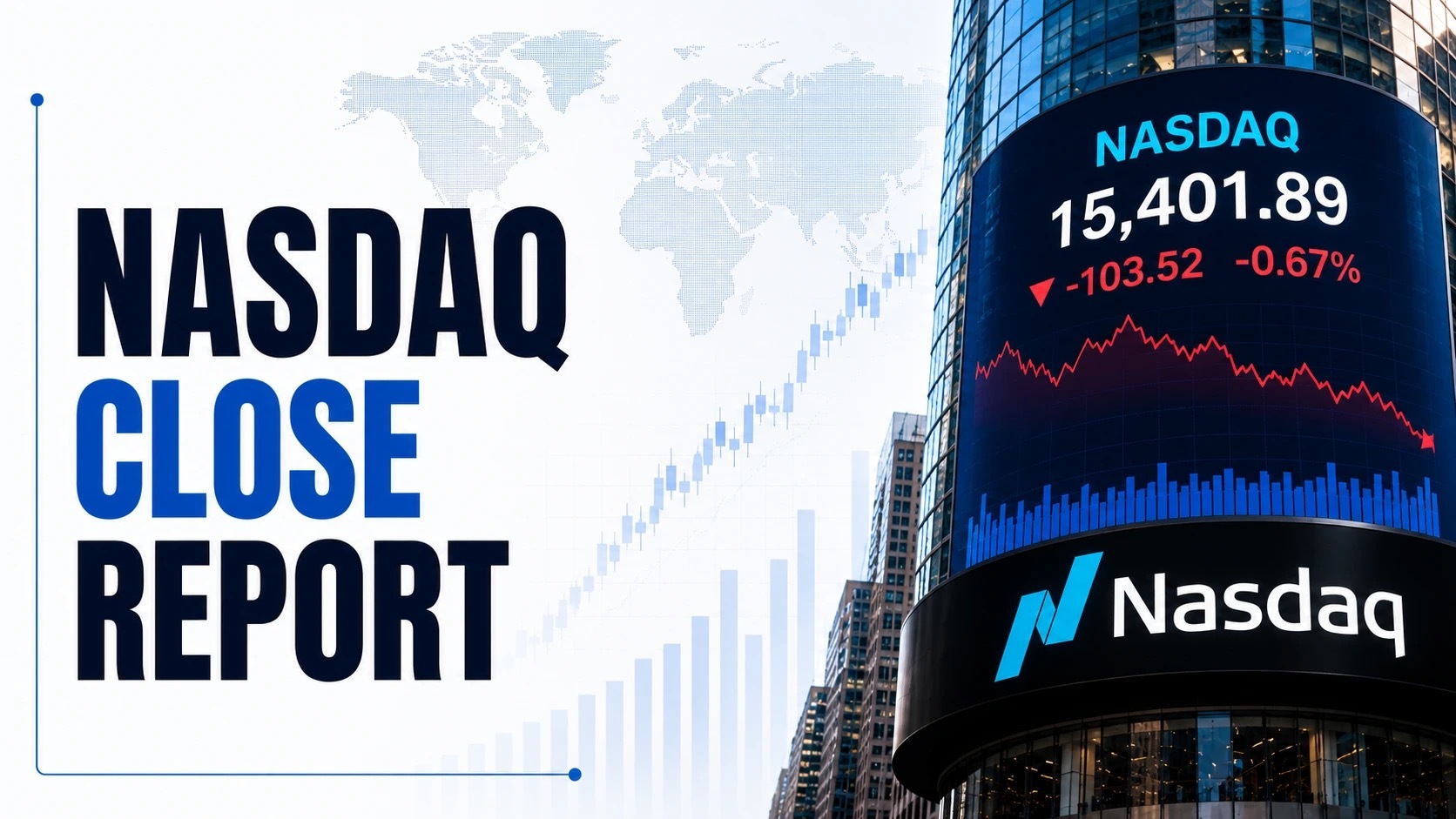
The Nasdaq Composite opened at 27,213.52 and closed at 26,936.04, marking a loss of 308.24 points, or 1.13%. Its intraday high stood at 27,217.33, while the low was 26,873.54, compared with the previous close of 27,244.28. Volume was 7,322,231,000, below the average volume of 8,462,670,158. The index had posted back-to-back record highs earlier in the week.
Technology and growth-oriented shares recorded mixed daily moves. Palo Alto Networks (PANW) gained 5.00%, CrowdStrike (CRWD) rose 4.97%, Palantir (PLTR) added 3.68%, Fortinet (FTNT) advanced 2.53%, T-Mobile US (TMUS) gained 2.00%, Autodesk (ADSK) moved up 1.97%, Cadence Design Systems (CDNS) rose 1.97%, DoorDash (DASH) gained 1.72%, Datadog (DDOG) added 1.72% and Adobe (ADBE) rose 1.02%.
Decliners included Booking Holdings (BKNG) at -5.08%, Alphabet (GOOGL) at -3.80%, Shopify (SHOP) at -3.66%, Alphabet Class C (GOOG) at -3.58%, AstraZeneca (AZN) at -2.98%, MicroStrategy (MSTR) at -2.83%, Broadcom (AVGO) at -2.62%, Micron (MU) at -2.23% and Amazon (AMZN) at -2.18%. The technology-heavy benchmark responded to the rise in Treasury yields and the broader market decline.
Also Read: What Is the New York Stock Exchange (NYSE)?
Russell 2000 Falls 48.33 Points as Small-Cap Shares Track Higher Treasury Yields
The Russell 2000 opened at 2,884.49 and closed at 2,841.59, losing 48.33 points, or 1.67%. It recorded an intraday high of 2,884.49 and a low of 2,840.65, against its previous close of 2,889.92. The index remained below its 52-week high of 3,069.71 and above its 52-week low of 2,303.46. Volume data was unavailable, while the average volume stood at 5,138,686,666.
Smaller-cap gainers included Fastly (FSLY) at 13.69%, ACM Research (ACMR) at 6.42%, Vicor (VICR) at 5.52%, Beta Technologies (BETA) at 4.60%, IonQ (IONQ) at 4.40%, Life Time Group (LTH) at 3.90%, Sanmina (SANM) at 2.84%, Freshworks (FRSH) at 3.62% and Veeco Instruments (VECO) at 3.52%.
Losers included Parabilis Medicines (PBLS) at -12.73%, Endeavour Silver (EXK) at -11.94%, Erasca (ERAS) at -10.32%, Sarepta Therapeutics (SRPT) at -8.94%, Vera Therapeutics (VERA) at -8.85%, Paychex (PAYX) at -8.77%, SharonAI Holdings (SHAZ) at -8.67%, Mineralys Therapeutics (MLYS) at -8.54% and Aura Minerals (AUGO) at -8.01%. The small-cap benchmark’s decline coincided with the rise in Treasury yields.
S&P 100 Slips 36.08 Points as Large-Cap Shares Follow Broader Market Lower
The S&P 100 opened at 3,875.63 and finished at 3,839.58, recording a loss of 36.08 points, or 0.93%. The index traded between 3,877.16 and 3,835.32 during the session, compared with its previous close of 3,875.66. Its 52-week high stood at 3,888.97, while the 52-week low was 3,074.00.
Large-cap constituents reflected the broader market pullback, with several major technology, consumer discretionary and communication services names finishing lower. The index’s daily performance tracked the same yield-driven move that affected the S&P 500 and Nasdaq Composite. Movements in large-cap shares remained aligned with the session’s broader risk-off tone across US equity benchmarks.
Dow Composite, Transport And Utility Indices Fall With Higher Treasury Yields Today
The Dow Jones Composite Average opened at 16,129.20 and closed at 16,030.47, losing 129.79 points, or 0.80%, after moving between 16,141.72 and 16,021.14. Its previous close was 16,160.26, with a 52-week high of 17,246.95 and a 52-week low of 14,090.12.
The Dow Jones Transportation Average ended at 19,739.91, compared with an opening level of 19,851.84, representing a decline of 147.88 points, or 0.74%. It traded between 19,970.36 and 19,725.76, against a previous close of 19,887.79. Its 52-week high was 24,825.70, while the 52-week low was 15,064.48.
The Dow Jones Utility Average closed at 1,015.54, changing -17.93 points, or -1.73%, from its opening level of 1,030.27. It moved between 1,030.27 and 1,014.78, compared with a previous close of 1,033.47. The utility average touched its 52-week low of 1,014.78 during the session. Movements in relevant constituents reflected the rise in Treasury yields.
Philadelphia Semiconductor Index Falls 155.55 Points as Chip Stocks Decline Sharply Today
The Philadelphia Semiconductor Index (SOX) opened at 12,659.08 and closed at 12,534.27, losing 155.55 points, or 1.23%. Its intraday high was 12,660.91, while the low was 12,371.37, compared with the previous close of 12,689.82. The index’s 52-week high stood at 14,655.29, and the 52-week low was 6,125.00.
Semiconductor-related constituents recorded mixed moves. Nvidia (NVDA) fell 1.46%, Broadcom (AVGO) dropped 2.62%, Micron (MU) declined 2.23%, AMD lost 1.49%, Intel (INTC) slipped 1.23%, Lam Research (LRCX) fell 1.04%, Qualcomm (QCOM) declined 0.51%, KLA (KLAC) slipped 0.24%, Marvell Technology (MRVL) fell 0.56% and ASML (ASML) declined 0.34%.
Among gainers, Applied Materials (AMAT) rose 0.41%, Texas Instruments (TXN) added 0.45% and Analog Devices (ADI) fell 1.32%. The sector benchmark’s decline came amid the broader technology retreat and the rise in Treasury yields.
Also Read: How to invest in US stocks
NYSE Composite Falls 175.33 Points as Broad Market Tracks Higher Treasury Yields
The NYSE Composite Index opened at 24,029.06 and closed at 23,853.74, recording a loss of 175.33 points, or 0.73%. The index traded between 24,029.06 and 23,844.68 during the session, against its previous close of 24,029.06. Its 52-week high was 24,866.75, while the 52-week low was 20,906.44.
Movements across large-cap and broad-market segments contributed to the index’s performance as Treasury yields rose. The NYSE Composite reflected the same closing-session trend seen across the Dow Jones, S&P 500 and Nasdaq Composite. The benchmark’s decline was part of the wider US equity pullback.
S&P Midcap 400 And SmallCap 600 Fall as Treasury Yields Rise Today
The S&P MidCap 400 opened at 3,675.10 and closed at 3,652.74, moving -22.36 points, or -0.61%, with an intraday range of 3,681.99 to 3,651.46. Its previous close was 3,675.10, while the 52-week high stood at 3,928.98 and the 52-week low was 3,107.41.
The S&P SmallCap 600 opened at 1,697.63 and ended at 1,681.85, losing 18.48 points, or 1.09%, after trading between 1,697.63 and 1,681.30. Its previous close was 1,700.33, with a 52-week high of 1,832.20 and a 52-week low of 1,364.16. The two benchmarks reflected movements among mid- and small-cap shares as higher Treasury yields affected the wider market.
10-Year Treasury Yield Hits 5.135% as Hot PMI Data Raises Fed Bets
The principal market catalyst was the surge in US Treasury yields after stronger-than-expected business activity data. The 10-year Treasury yield climbed as high as 5.135%, its highest level since July 2007, and stood near 5.11%, up about 14 basis points from the previous close. The 2-year Treasury note yield reached 4.947%, its highest since May 2024, while the 5-year yield touched 5.018%. The 30-year Treasury yield stood at 5.37%. The jump was on pace to be the benchmark yield’s biggest daily move since April 7, 2025.
Federal Reserve Governor Michael Barr said further policy adjustments are likely to be needed to bring inflation down. Traders priced the odds of another 25 basis point rate hike at the October meeting at about 71%, according to the CME FedWatch Tool, up from 55.4% a day earlier and just 8.8% one month ago.
The yield move followed S&P Global’s flash readings, which showed manufacturing activity at 57, services at 58.7 and the composite at 58.4. These developments coincided with the day’s movement across the major US equity benchmarks.
VIX Jumps 7.39% to 15.26 as Market Volatility Increases During US Session
The CBOE Volatility Index (VIX) changed 7.39% to 15.26, compared with its previous close of 14.21. The index opened at 14.16, touched a high of 15.45 and a low of 14.12 during the session. Its 52-week high was 35.30, while the 52-week low was 13.38. The VIX measures expected volatility in the S&P 500 over the coming 30 days. Its movement during the session coincided with the rise in Treasury yields and the decline across major US equity indices.
S&P 500 Sectors Fall Broadly as Energy Gains 1.1% While Utilities Decline
Performance across the 11 S&P 500 sectors was broadly lower. Energy was the best-performing group, rising about 1.1%, while industrials added about 0.2%. Utilities was the biggest laggard, dropping 1.7%, followed by consumer discretionary at -1.5% and communication services at -1.4%. The remaining sectors, including information technology, financials, health care, consumer staples, real estate and materials, also finished lower. The sector movements followed the rise in Treasury yields and the firmer oil prices during the session.
Also Read: US Stock Market Timings
Magnificent Seven Mixed as Meta Gains 1.02% While Alphabet Falls 3.80% Today
Among the Magnificent Seven, Meta Platforms (META) moved 1.02%, while Microsoft (MSFT) changed 0.43% and Tesla (TSLA) recorded 0.25%. Nvidia (NVDA) fell 1.46%, Apple (AAPL) declined 0.80%, Amazon (AMZN) dropped 2.18% and Alphabet (GOOGL) lost 3.80%. Their daily movements contributed to the performance of the major US equity benchmarks. Meta shares reached a 52-week high during the session.
Semiconductor, Financial and Energy Stocks Show Mixed Moves Across Broader US Market
Semiconductor stocks were mostly lower, with the Philadelphia Semiconductor Index moving -1.23%. Financial stocks recorded mixed moves, as JPMorgan Chase (JPM) fell 0.70%, Visa (V) declined 0.17%, Mastercard (MA) rose 0.79%, Bank of America (BAC) fell 0.44%, Morgan Stanley (MS) lost 0.91%, Goldman Sachs (GS) dropped 1.42%, Wells Fargo (WFC) fell 1.49%, Charles Schwab (SCHW) declined 0.87%, Citigroup (C) fell 0.37% and BlackRock (BLK) declined 0.51%.
Energy stocks moved higher alongside crude oil prices, with Exxon Mobil (XOM) up 1.42%, Chevron (CVX) up 1.55%, ConocoPhillips (COP) up 2.23%, Devon Energy (DVN) up 3.5% and APA (APA) up 4%. AI and growth stocks were mixed, with Palantir (PLTR) up 3.68%, Palo Alto Networks (PANW) up 5.00% and CrowdStrike (CRWD) up 4.97%. Quantum computing stocks including IonQ (IONQ) rose 4.40% and D-Wave Quantum (QBTS) declined 4.21%.
US Business Activity Expands as Manufacturing PMI Hits 57 in September Today
The latest economic data showed US business activity expanded at a stronger pace than expected in September. The S&P Global manufacturing PMI came in at 57, compared with expectations of 53.7 and the previous month’s 53.9. The services sector PMI read 58.7, against expectations of 55.8 and the previous month’s 56.5. The composite reading, which combines manufacturing and services, stood at 58.4, compared with expectations of 55.3.
Readings above 50 indicate expansion, while those below 50 indicate contraction. Price pressures posted their highest readings since October 2022. The releases provided the latest information on US business activity during the session.
Fed Governor Barr Signals More Rate Hikes as Inflation Stays Above Target
The Federal Reserve remained a key focus as markets assessed policy comments and rate expectations. Federal Reserve Governor Michael Barr said in a speech in Chicago that “further policy adjustments are likely to be needed to ensure inflation comes down to target in a timely fashion.”
He noted that inflation is above the Fed’s 2% target and not clearly trending toward it in a timely way, while risks to the inflation target have increased and risks to the labour market have receded. The 2-year US Treasury yield stood at 4.947%, the 5-year yield was 5.018%, the 10-year yield stood near 5.11% and the 30-year yield was 5.37%. The yield curve moved as rate-hike expectations affected Treasury trading.
Also Read: What Are Fractional Shares?
Brent Crude Rises 3.23% as Oil Prices Stay Near $98 A Barrel
Brent crude traded at $98.49, changing 3.23%, while West Texas Intermediate (WTI) crude stood at $92. The moves followed uncertainty around US-Iran relations and comments from President Donald Trump that US and Iranian officials met for several hours at the UN Assembly in New York. Brent crude futures for November delivery traded around $100 per barrel during the session.
Gold traded at $4,282.53, changing -1.7%, while US gold futures settled 1.3% lower at $4,318.40. Natural gas rose 2.0% to $3.041 per million British thermal units, its highest close since July 8. US crude inventories rose by 3 million barrels to 426.4 million barrels in the week ended September 18. The commodity moves followed supply, demand and geopolitical developments during the session.
US Dollar Index Rises 0.54% as Fed Rate Hike Bets Strengthen Today
The US Dollar Index (DXY) moved 0.54% to 101.09, its highest since July 29. EUR/USD stood at $1.1405, while GBP/USD traded at $1.3273. The euro fell to its lowest since late July, and sterling weakened to its lowest since early July. Bitcoin traded around $84,200, down from overnight highs around $87,300. Currency movements followed the rise in Treasury yields and the firmer rate-hike expectations during the session.
The closing session was shaped by a 10-year Treasury yield above 5%, hotter-than-expected PMI data and firmer oil prices. The Dow Jones, S&P 500 and Nasdaq Composite all finished lower, while energy was the sole major sector gainer and utilities led declines.
Source
- https://www.nasdaq.com/
- spglobal.com/spdji/en/indices/equity/sp-500/
- https://www.dowjones.com/
- https://www.spglobal.com/spdji/en/indices/equity/dow-jones-industrial-average/
- https://www.spglobal.com/spdji/en/indices/equity/sp-500/
- https://www.nasdaq.com/market-activity/index/comp
- https://www.nasdaq.com/market-activity/quotes/nasdaq-ndx-index
- https://www.spglobal.com/spdji/en/indices/equity/sp-100/
- https://www.lseg.com/en/ftse-russell/indices/russell-us
- https://www.nyse.com/index
- https://www.nyse.com/index
- https://www.spglobal.com/spdji/en/indices/equity/dow-jones-transportation-average/
- https://www.spglobal.com/spdji/en/indices/equity/dow-jones-utility-average/
- https://www.spglobal.com/spdji/en/indices/equity/dow-jones-composite-average/
- https://www.nasdaq.com/market-activity/index/sox
- https://www.cboe.com/tradable_products/vix/
Disclaimer
At HDFC SKY*, we take utmost care and due diligence in curating and presenting news and market-related content. However, inadvertent errors or omissions may occasionally occur.
If you have any concerns, questions, or wish to point out any discrepancies in our content, please feel free to write to us at content@hdfcsec.com.
Please Note: The information shared is intended solely for informational purposes and does not make any investment recommendations.
HDFC SKY from HDFC Securities, one of most trusted trading platforms in India, has been recognized with the *Next-Gen Digi Content Awards 2025-26.
 Join Us
 Add as preferred source on Google


More International News








Open Free Demat Account
Open Free Demat Account












Invest Anytime, Anywhere


By signing up I certify terms, conditions & privacy policy