Nifty 50
- Bharti Airtel₹1,90917.30 (0.91%)
- Nestle₹1,187.40-36.50 (-2.98%)
- Bajaj Finance₹934.458.45 (0.91%)
- HDFC Life Insurance ₹525.05-14.60 (-2.71%)
- UltraTech Cement₹10,92778.00 (0.72%)
- Coal India₹397.50-10.00 (-2.45%)
- ICICI Bank₹1,393.308.30 (0.60%)
- Tata Motors PV₹269.15-6.55 (-2.38%)
- Bajaj Auto₹10,13058.00 (0.58%)
- Eternal₹305.30-7.05 (-2.26%)
- Cipla₹1,319.605.60 (0.43%)
- Tech Mahindra₹1,794.30-40.40 (-2.20%)
- L&T₹3,649.8013.80 (0.38%)
- Trent₹2,765.60-56.40 (-2.00%)
- SBI₹965.652.65 (0.28%)
- Power Grid Corp₹247.15-5.00 (-1.98%)
- BSE₹3,254.506.20 (0.19%)
- HDFC Bank₹693.45-13.50 (-1.91%)
- Hindustan Unilever₹1,816.20-34.00 (-1.84%)

- Offerings
- Tools & Platforms
Tools & Calculators
- Open API
- Calculators
- SIP Calculator
- CAGR Calculator
- Compound Interest Calculator
- FD Calculator
- RD Calculator
- EPF Calculator
- Retirement Calculator
- HDFC SIP Calculator
- Mutual Fund Return Calculator
- Lumpsum Calculator
- Step Up SIP Calculator
- ETF SIP Calculator
- Brokerage Calculator
- Equity Margin Calculator
- SWP Calculator
- EMI Calculator
- MTF Calculator
- Margin Pledge Calculator
- Algo Strategy
- Markets
Stocks
F&O
Mutual Funds
- More
- What Is a GTDt Order?
- How Does GTDt Work for NSE F&O?
- GTDt vs Day Orders: What Is the Difference?
- What Are the Key Benefits of GTDt Orders?
- What Should You Know Before Placing a GTDt Order?
- How to Place a GTDt Order on HDFC SKY
- A Simple Example of a GTDt Order
- Why Can GTDt Be Useful for F&O Traders?
- GTDt Gives Traders More Flexibility with Limit Orders
- Conclusion
Introducing GTDt (Good till Date) Orders for NSE F&O on HDFC SKY
By HDFC SKY | Updated at: Oct 22, 2026 01:40 PM IST
Open Free Demat Account
Open Free Demat Account
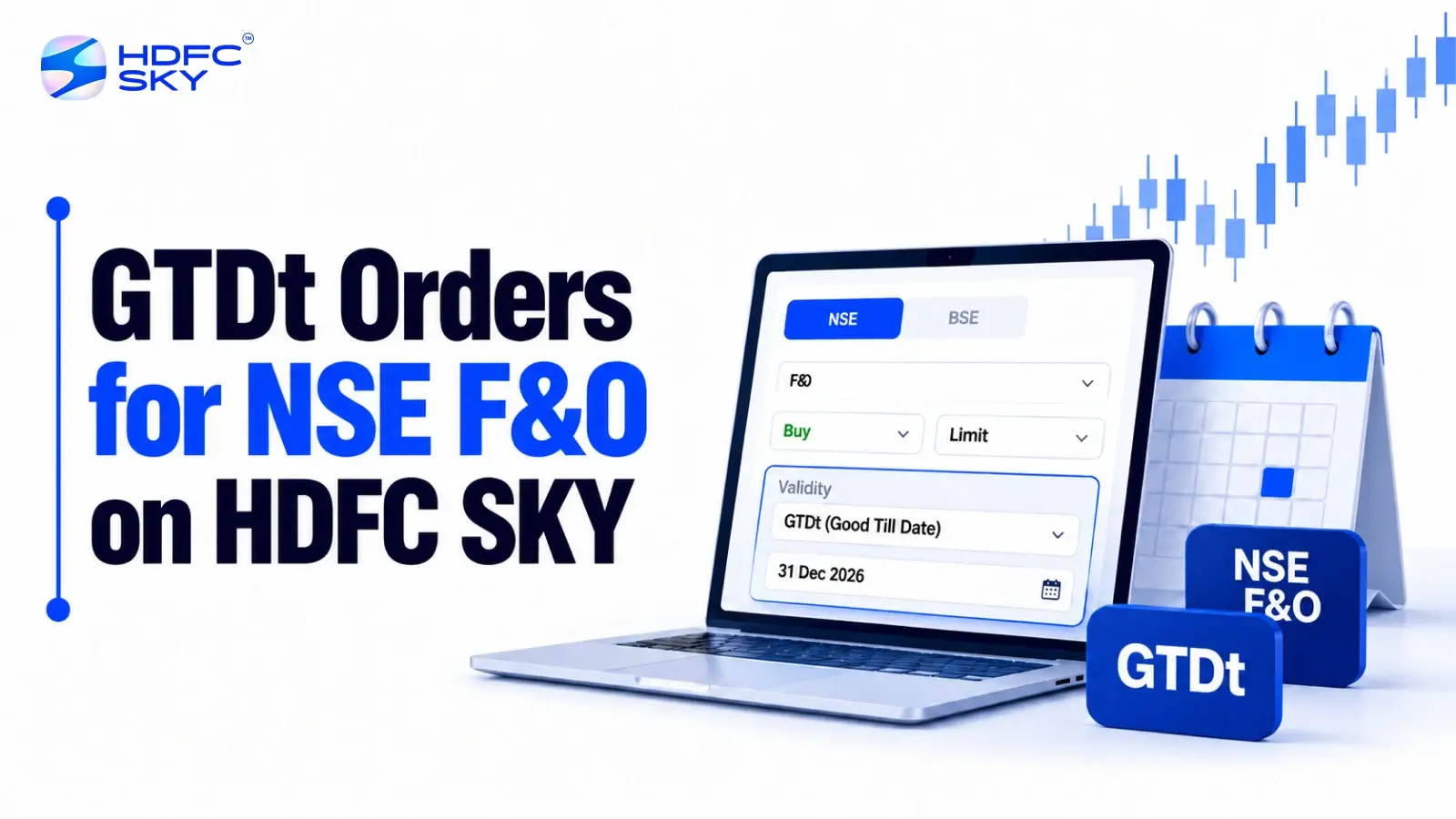
F&O traders often wait for a specific price before placing a trade. However, the market may not reach that price during the same trading session. HDFC SKY offers the Good Till Date (GTDt) facility for eligible NSE index futures and index options. It lets traders keep a limit order active beyond one trading day. Traders can choose a validity date of up to 40 calendar days, subject to the applicable rules and contract expiry.
What Is a GTDt Order?
GTDt stands for Good Till Date. It is a facility that lets you place a buy or sell limit order at a specified price and keep the order instruction valid until a chosen date.
A regular Day order remains valid only for the trading day. If the order does not get matched during that session, it gets cancelled at the end of the trading day. A GTDt order gives you a longer validity period. It can remain active until the order gets executed, the validity period ends, or you cancel it.
For F&O trading, HDFC SKY offers GTDt for index futures and index options. The current maximum validity is 40 calendar days. Importantly, GTDt is an additional facility offered by HDFC SKY. It is not an order type provided by the exchange itself.
How Does GTDt Work for NSE F&O?
GTDt helps you keep a price-based order active across multiple trading sessions. You choose the eligible contract, specify the price and quantity, and select the validity date.
The process works as follows:
- Select an eligible NSE index future or index option.
- Choose the Buy or Sell option.
- Select a Limit order.
- Choose GTDt as the order validity.
- Enter your preferred price and quantity.
- Select a validity date within the permitted period.
- Review the order details and place the order.
If the order does not execute for the full quantity on a trading day, HDFC SKY can place fresh orders for the unexecuted quantity on subsequent trading days during the validity period. This continues until the full quantity gets executed or the validity expires, whichever comes first.
GTDt vs Day Orders: What Is the Difference?
Day, GTDt, and GTT orders differ mainly in how long they remain active and when they are executed. The table below explains these differences:
| Feature | Day Order | GTDt Order | GTT Order |
| Meaning | An order valid for one trading day | An order that remains valid until a chosen date | An order that activates when a specified trigger condition is met |
| Validity | Valid for the current trading day | Up to 40 calendar days, subject to applicable conditions | Remains active until the trigger is reached or the applicable validity ends |
| How it works | The order remains active during the trading session. If it does not get matched, it expires at the end of the day. | You select a future validity date. The order can remain active during the selected period if it does not execute earlier. | You set a trigger condition. When the trigger is reached, the system places the associated order according to the applicable conditions. |
| Price | You can place a limit order at your preferred price | You can place a limit order at your preferred price | Uses a trigger condition to initiate the associated order |
| Best suited for | Traders who want an order to remain active only for the current session | Traders who want to keep a limit order active across multiple trading sessions | Traders who want an order to act after a specified trigger condition |
| Need to place the order again each day? | Yes, if you want to continue the order after it expires | No, during the selected validity period, subject to applicable conditions | No, while the GTT instruction remains active under its applicable conditions |
What Are the Key Benefits of GTDt Orders?
GTDt can offer more flexibility when you have a specific price in mind but do not expect the market to reach it immediately.
Here are the key benefits:
- Longer validity:
HDFC SKY currently allows GTDt orders to remain valid for up to 40 calendar days. - Less repetition:
You do not need to place the same limit order again every trading day. - Specified price:
You can set the price at which you want the order to execute. - Defined validity date:
You can select the date until which you want the order instruction to remain valid. - Convenient order management:
You can monitor, modify, or cancel eligible GTDt orders through your trading account, subject to the applicable order status and conditions.
These features can make it easier to manage a price-based trading plan across multiple trading sessions.
Also Read: The Basics: Why Call Options Deserve Your Attention
What Should You Know Before Placing a GTDt Order?
A longer validity period does not guarantee that your order will execute. The market must provide a suitable match for your limit order.
Keep these points in mind:
- Execution is not guaranteed:
Your order may remain unexecuted if the market does not reach your specified price or if a suitable match is not available. - GTDt orders use a limit price:
You cannot place a GTDt order at the market price. - Validity is limited:
The order remains valid only until the selected validity date. - Funds or margin are required:
You must maintain the necessary funds or margin for HDFC SKY to place orders for the unexecuted quantity during the validity period. - Market conditions can change:
Price and liquidity can change during the validity period. - Order limits apply:
HDFC SKY’ FAQ currently states that clients can place up to five GTDt orders for a particular scrip and up to 30 GTDt orders across eligible scrips. - Review active orders:
If your trading plan changes, review the order and cancel it if required.
These checks can help you manage your active orders more effectively.
How to Place a GTDt Order on HDFC SKY
You can place a GTDt order through the HDFC SKY trading platform by following these steps.
- Select an Eligible NSE F&O Contract
Open HDFC SKY and select the eligible NSE index future or index option that you want to trade. - Choose Buy or Sell
Select Buy if you want to buy the contract. Select Sell if you want to sell it. - Select a Limit Order
Choose the Limit order type and enter the price at which you want the order to execute. - Select GTDt
Go to the order validity option and select GTDt (Good Till Date). - Select the Validity Date
Choose the date until which you want the order to remain valid. The current maximum validity for GTDt orders is 40 calendar days. - Enter the Quantity and Review the Details
Enter the required quantity. Then check the price, quantity, validity date, and applicable margin before placing the order. - Confirm the Order
Review the details and confirm the order. If the order does not execute fully, HDFC SKY can place fresh orders for the unexecuted quantity on subsequent trading days during the validity period, subject to the applicable conditions.
A Simple Example of a GTDt Order
Suppose you want to buy an index option only if it reaches a specific price. The current market price remains above your preferred price, so your limit order does not execute today.
If you place a regular Day order, the unexecuted order expires at the end of the trading day. With a GTDt order, you can select a future validity date. If the order remains unexecuted, HDFC SKY can place fresh orders for the unexecuted quantity on subsequent trading days during the validity period.
If the market reaches your specified price and a suitable match is available, the order can execute. If the order remains unexecuted until the validity period ends, it expires. This gives you more time to wait for your chosen price without placing the same order again each trading day.
Why Can GTDt Be Useful for F&O Traders?
GTDt can be useful when your trading plan depends on a specific price. For example, you may identify a price level that you want to trade but do not want to monitor the market throughout every session. Instead of placing a Day order and entering it again on the next trading day, you can use GTDt and select an appropriate validity date.
The facility can, therefore, help you manage a limit order across multiple trading sessions. However, you should still monitor active orders. Market conditions can change, and an order that suited your plan earlier may no longer suit it later.
GTDt Gives Traders More Flexibility with Limit Orders
GTDt gives eligible NSE F&O traders on HDFC SKY another way to keep a limit order active for longer. Instead of limiting the order to one trading day, you can select a future validity date. HDFC SKY currently allows GTDt orders to remain valid for up to 40 calendar days.
The facility also reduces the need to place the same order repeatedly when your preferred price has not been reached. At the same time, a longer validity period does not guarantee execution. You should check the contract, price, quantity, validity date, and available funds or margin before placing a GTDt order.
Conclusion
GTDt orders give eligible NSE F&O traders on HDFC SKY more flexibility when they want to trade at a specific price across multiple sessions. The facility allows a validity period of up to 40 calendar days. Traders can set a price and validity date without repeating the same order each day. However, execution depends on market conditions and applicable order rules.



Open Free Demat Account
Open Free Demat Account
Popular Posts
- 10 Interesting Facts About NSE You Probably Didn’t KnowLast Updated: Sep 30, 2026
- 8-4-3 Rule of SIP - How Does That Work?Last Updated: Jul 30, 2025
- Let's view more exciting Post!
Popular Post from Derivatives
- Option Chain Basket Orders on the HDFC Sky App: Build Multi-Leg Strategies in One GoLast Updated: Oct 22, 2026
- How to Place a GTDt Order for NSE F&O: Step-by-Step on HDFC Sky App & WebLast Updated: Oct 22, 2026
- Celebrating Innovation: HDFC SKY Shares Perspectives on India’s F&O Market Growth on National Technology DayLast Updated: May 11, 2026
- The Basics: Why Call Options Deserve Your AttentionLast Updated: Jan 30, 2026
- Understandin͏g Moneyness: The Path ͏to Smarter Option Trading͏Last Updated: Jan 30, 2026
- Let's view more exciting Post!
Popular Post from Blogs
- “Bounce Back” Theme Gains Traction in 2026Last Updated: Apr 8, 2026
- 5 Takeaways for Tax Payers from the Budget 2025Last Updated: Jan 29, 2026
- Let’s view more exciting Posts


Invest Anytime, Anywhere


By signing up I certify terms, conditions & privacy policy