Nifty 50
- Tech Mahindra₹1,790140.00 (8.48%)
- InterGlobe Aviation₹4,686.90-91.40 (-1.91%)
- TCS₹2,465115.00 (4.89%)
- BSE₹3,363-65.00 (-1.90%)
- Infosys₹1,161.2051.20 (4.61%)
- Max Healthcare₹846-12.00 (-1.40%)
- Bharti Airtel₹1,90551.00 (2.75%)
- Tata Consumer ₹978.90-12.55 (-1.27%)
- Mahindra & Mahindra₹2,920.9059.20 (2.07%)
- Jio Financial ₹216.25-2.76 (-1.26%)
- Bajaj Finance₹98115.75 (1.63%)
- ONGC₹222-2.64 (-1.18%)
- Hindalco Industries₹90814.15 (1.58%)
- Bharat Electronics₹376.85-3.55 (-0.93%)
- HCL Technologies₹1,38020.00 (1.47%)
- Nestle₹1,265.50-10.30 (-0.81%)
- JSW Steel₹1,216.4016.00 (1.33%)
- Adani Enterprises₹2,680.90-19.10 (-0.71%)
- Grasim Industries₹2,92034.10 (1.18%)
- Bajaj Finserv₹1,720-12.00 (-0.69%)

- Offerings
- Tools & Platforms
Tools & Calculators
- Open API
- Calculators
- SIP Calculator
- CAGR Calculator
- Compound Interest Calculator
- FD Calculator
- RD Calculator
- EPF Calculator
- Retirement Calculator
- HDFC SIP Calculator
- Mutual Fund Return Calculator
- Lumpsum Calculator
- Step Up SIP Calculator
- ETF SIP Calculator
- Brokerage Calculator
- Equity Margin Calculator
- SWP Calculator
- EMI Calculator
- MTF Calculator
- Margin Pledge Calculator
- Algo Strategy
- Markets
Stocks
F&O
Mutual Funds
- More
Why Institutional Investors Quietly Added PSU Bank Exposure Before the Q4 Rally: What the 2026 Data Shows
By Aseem Shrivastava | Published at: Jun 4, 2026 12:47 PM IST
Open Free Demat Account
Open Free Demat Account
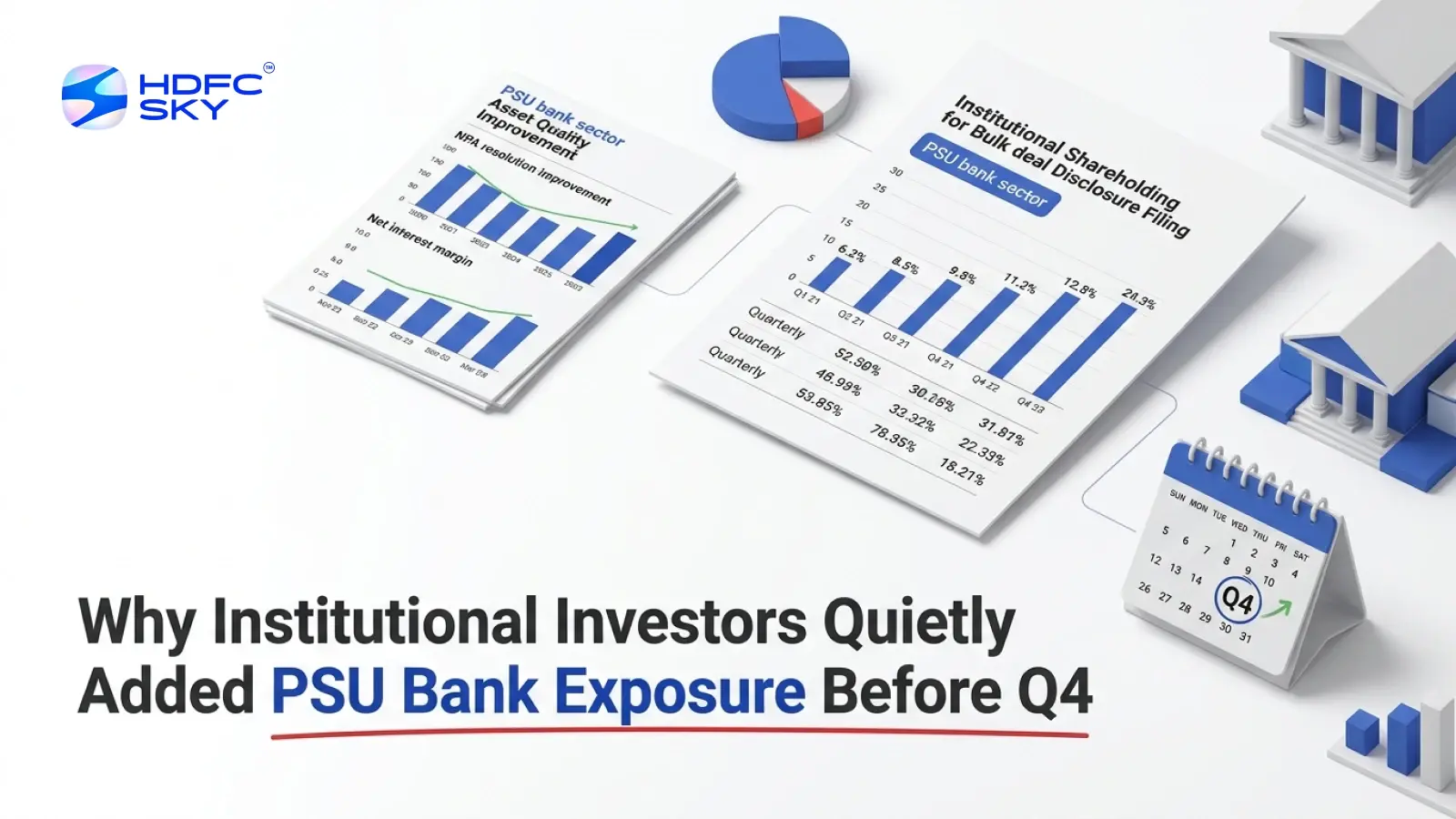
PSU banks delivered one of the strongest sector performances in FY26, but the real story is not the Q4 rally itself. It is that institutional investors were already building exposure before earnings confirmed the trend. Market data suggests the rally was less a sudden move and more a continuation of earlier positioning.
PSU Banks’ Strength in FY26 Set the Base
PSU banks emerged as one of the best-performing sectors in FY26, significantly outperforming broader markets, with returns as high as 57% in the financial year ending March 2026. This performance was driven by improving asset quality, strong credit growth, and expectations that PSU bank profits could cross ₹2 lakh crore.
This improving fundamental backdrop created the base for institutional interest well before Q4 results.
Also Read: Rising NPAs in a bank’s quarterly disclosure: how to detect stress before the stock reacts
Institutional Investors Were Already Positioned
FIIs showed selective but consistent accumulation in PSU banking stocks during FY26, increasing holdings across a large portion of lenders over multiple quarters.
Several PSU banks saw FIIs raise stakes across earlier shareholding cycles, indicating broad-based accumulation rather than isolated buying.
At the same time, DIIs provided steady inflows, helping absorb volatility.
What the Flow Data Reveals
Even when overall FII positioning remained cautious in broader markets, capital rotated into financials and PSU banks specifically.
This pattern reflects a classic “smart money accumulation” phase:
- Gradual entry during low-attention periods
- Continued buying on dips
- Positioning before earnings confirmation
The flow data indicates a clear phase of smart money accumulation, where institutional capital rotated into PSU banks.
Why Q4 Became a Trigger, Not the Starting Point
Q4 FY26 results acted as a validation event, not the beginning of the move.
- Earnings strength indicated improving business performance and profitability.
- Stable asset quality reflected controlled risk and healthy loan performance.
- Strong credit growth signaled sustained demand and business expansion.
- Together, these factors confirmed the positive trend already indicated by institutional flows.
By the time results were announced, much of the institutional positioning was already in place, leading to an accelerated price reaction rather than a fresh trend formation.
What Investors Should Learn
Retail investors usually end up reacting after the results are already out. Institutions don’t really work that way. They tend to build positions quietly, often well before the earnings are announced. The PSU bank move in 2026 shows this gap quite clearly. The money started flowing in earlier, and when the results came, they mostly just confirmed what was already happening in the market. This pattern is worth noting because it changes how investors should think about timing in the market. It is usually more helpful to pay attention to how money is moving and which sectors are quietly getting interest, instead of only reacting to quarterly results after they are published. Platforms like HDFC SKY can help with this by keeping market data, stock trends, and sector movements in one place, so it becomes easier to notice where institutional interest may be building before the broader market catches on.



Open Free Demat Account
Open Free Demat Account
Popular Posts
- 10 Interesting Facts About NSE You Probably Didn’t KnowLast Updated: Sep 30, 2026
- 8-4-3 Rule of SIP - How Does That Work?Last Updated: Jul 30, 2025
- Let's view more exciting Post!
Popular Post from Smart Money Moves
- How Smart Investors Use Debt Funds While Waiting for Market DipsLast Updated: Jun 4, 2026
- The Contrarian Trade: FIIs Are Buying Indian IT While Retail Investors Are SellingLast Updated: Jun 4, 2026
- The Portfolio Rebalancing Strategy That Systematically Forces You to Buy Low and Sell HighLast Updated: Jun 4, 2026
- The 3-Bucket Portfolio Strategy That Wealthy Indian Families Use to Manage Generational WealthLast Updated: Jun 4, 2026
- Why seasoned investors increase SIP amounts during corrections instead of pausing themLast Updated: Jun 4, 2026
- Let's view more exciting Post!
Popular Post from Blogs
- “Bounce Back” Theme Gains Traction in 2026Last Updated: Apr 8, 2026
- 5 Takeaways for Tax Payers from the Budget 2025Last Updated: Jan 29, 2026
- Let’s view more exciting Posts


Invest Anytime, Anywhere


By signing up I certify terms, conditions & privacy policy