Nifty 50
- Sun Pharmaceutical₹1,911.5026.50 (1.41%)
- Shriram Finance₹978.70-25.10 (-2.50%)
- Apollo Hospitals₹8,621106.00 (1.24%)
- SBI Life Insurance ₹1,789.90-29.60 (-1.63%)
- HCL Technologies₹1,396.3015.50 (1.12%)
- HDFC Bank₹801.05-11.25 (-1.38%)
- Dr. Reddy's Labs₹1,39811.40 (0.82%)
- Titan Company₹4,858.40-63.50 (-1.29%)
- Tech Mahindra₹1,787.5013.50 (0.76%)
- Bajaj Finserv₹1,864.50-22.60 (-1.20%)
- Hindustan Unilever₹1,988.9014.90 (0.75%)
- Mahindra & Mahindra₹3,360.20-38.80 (-1.14%)
- Eicher Motors₹7,60556.00 (0.74%)
- Jio Financial ₹228.85-2.35 (-1.02%)
- ONGC₹225.991.49 (0.66%)
- Tata Motors PV₹294.25-3.00 (-1.01%)
- Eternal₹365.901.55 (0.43%)
- Hindalco Industries₹954.50-9.50 (-0.99%)
- BSE₹3,922.1013.00 (0.33%)
- Bajaj Finance₹1,104.35-10.65 (-0.96%)

- Offerings
- Tools & Platforms
Tools & Calculators
- Open API
- Calculators
- SIP Calculator
- CAGR Calculator
- Compound Interest Calculator
- FD Calculator
- RD Calculator
- EPF Calculator
- Retirement Calculator
- HDFC SIP Calculator
- Mutual Fund Return Calculator
- Lumpsum Calculator
- Step Up SIP Calculator
- ETF SIP Calculator
- Brokerage Calculator
- Equity Margin Calculator
- SWP Calculator
- EMI Calculator
- MTF Calculator
- Margin Pledge Calculator
- Algo Strategy
- Markets
Stocks
F&O
Mutual Funds
- More
Oil Prices Today, November 13, 2026: Brent Slips 0.3% To $95.5 Per Barrel As Oil Heads For Second Weekly Decline
Authored By HDFC SKY | Published at: Nov 13, 2026 10:04 AM IST

Open Free Demat Account
Mumbai, November 13: International crude oil prices edged lower on Friday, November 13, with Brent and US West Texas Intermediate (WTI) heading for a second consecutive weekly decline as markets weighed the prospect of prolonged US restrictions on Iranian oil shipments against persistent threats to energy infrastructure and shipping in the Middle East.
Brent crude futures were down 0.3% at $95.5 per barrel, while US WTI crude declined 0.5% to $88.3 per barrel. Both benchmarks have surrendered some of their recent gains as expectations of a prolonged blockade, rather than renewed large-scale military action against Iran, have eased immediate concerns over a wider disruption to global oil supplies.
The decline comes after a volatile week in which diplomatic signals from Washington and attacks on energy infrastructure in Saudi Arabia repeatedly shifted market sentiment. Despite the latest weakness, the security of crude shipments through the Strait of Hormuz remains a major concern for traders.

Why are crude oil prices falling?
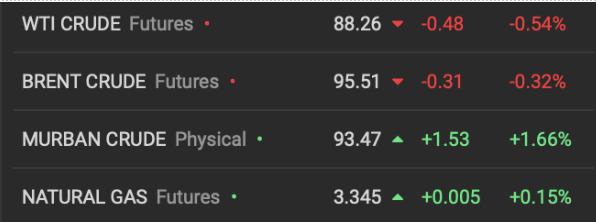
Both contracts slipped as US President Donald Trump indicated that Washington would maintain its blockade of Iranian oil shipments. Source: Oilprice.com
Oil prices came under renewed pressure after US President Donald Trump indicated that Washington would maintain its blockade of Iranian oil shipments, alongside trade and economic sanctions, even as he suggested that a deal with Tehran was not necessary to end the conflict.
The stance has reduced expectations of an immediate escalation into renewed large-scale military operations, easing some concerns over further supply disruptions. However, it also leaves the possibility of a prolonged confrontation, with restrictions on Iranian exports and threats to regional shipping continuing to influence prices.
Brent crude was on course to register a weekly decline of around 2.4%, while WTI was headed for a 2.5% loss. This follows a sharp sell-off in the previous week, when Brent plunged 16% and WTI shed 13%.
The sustained weakness suggests that traders are increasingly factoring in the possibility that the conflict may not lead to a prolonged interruption of global oil supplies, even as geopolitical uncertainty remains elevated.
Also Read: How To Invest In Crude Oil
Strait of Hormuz, Saudi attacks keep supply risks alive
The decline in crude prices has come despite fresh developments threatening energy infrastructure and shipping routes across the Middle East.
Iran’s military said on Thursday that four oil tankers had been hit by explosions in the Strait of Hormuz after allegedly ignoring warnings. Reuters said it could not independently verify the Iranian account.
Separately, Yemen’s Iran-aligned Houthi group claimed attacks on a pumping station along Saudi Arabia’s East-West oil pipeline, an oil facility in the Red Sea port city of Yanbu and an Aramco building in Riyadh.
The Strait of Hormuz is particularly important to global energy markets as it serves as a critical export route for crude produced by major Middle Eastern suppliers. Any prolonged disruption to shipping through the waterway could constrain supplies and push international benchmarks higher.
Saudi Arabia’s East-West pipeline provides an alternative route for transporting crude towards the Red Sea, making its infrastructure strategically important when shipments through the Gulf face disruption.
The latest attacks have therefore prevented oil prices from declining more sharply, with traders balancing expectations of reduced military escalation against the possibility of further interruptions to regional energy flows.
US crude inventories add to downward pressure
Rising US crude inventories have provided another reason for the recent weakness in oil prices.
According to the US Energy Information Administration (EIA), crude oil inventories increased by 4.7 million barrels to 414.4 million barrels in the week ended November 6. This was significantly higher than expectations of a decline of 1.1 million barrels in a Reuters poll of analysts.
The inventory build-up was driven by softer demand for refined petroleum products and an increase in oil imports. Higher stockpiles indicate that near-term supply availability in the world’s largest oil-consuming economy remains comfortable, adding to the pressure on benchmark prices.
The increase also contrasts with concerns over potential supply disruptions in the Middle East, highlighting the competing forces currently influencing the global oil market.
What does the crude oil price movement mean for India?
The correction in international crude oil prices could offer some relief to India, which relies heavily on imported crude to meet its domestic energy requirements.
Lower oil prices can reduce the country’s import bill, ease pressure on the current account deficit and support the rupee by limiting demand for foreign currency to finance energy purchases. They can also help contain domestic inflation, particularly through their influence on transportation, logistics and manufacturing costs.
For Indian equity markets, a sustained decline in crude prices could be positive for oil marketing companies, aviation, paints, chemicals and other industries with significant exposure to petroleum-based inputs. Lower input costs can improve margins, while reduced inflationary pressure could give the Reserve Bank of India greater flexibility in managing monetary policy.
However, the outlook remains sensitive to developments in the US-Iran conflict. Any escalation involving attacks on tankers, Saudi energy infrastructure or shipping through the Strait of Hormuz could quickly reverse the recent correction.
For now, traders are weighing the possibility of prolonged restrictions without a wider military escalation against the continuing threat to Middle Eastern oil supplies. This leaves crude prices vulnerable to sharp swings as geopolitical developments unfold.
Source:
- oilprice.com
Disclaimer
The information shared here is intended solely for informational and educational purposes and does not constitute investment recommendations. While we practice strict due diligence in curating daily market data, readers must perform independent research before trading. To flag any real-time data discrepancies or content concerns, please write to us at content@hdfcsec.com.
 Join Us
 Add as preferred source on Google


More Business News










Open Free Demat Account











Invest Anytime, Anywhere


By signing up I certify terms, conditions & privacy policy