Nifty 50
- InterGlobe Aviation₹5,097177.10 (3.60%)
- ONGC₹231.77-3.06 (-1.30%)
- Shriram Finance₹888.1524.80 (2.87%)
- Apollo Hospitals₹8,365-94.00 (-1.11%)
- HDFC Bank₹717.4017.40 (2.49%)
- Sun Pharmaceutical₹1,751.40-18.60 (-1.05%)
- UltraTech Cement₹11,628241.00 (2.12%)
- Power Grid Corp₹265.25-2.45 (-0.92%)
- Asian Paints₹2,391.2046.90 (2.00%)
- Cipla₹1,377.20-9.80 (-0.71%)
- Nestle₹1,217.8022.80 (1.91%)
- Reliance Industries₹1,291-9.00 (-0.69%)
- Tata Consumer ₹1,046.9018.00 (1.75%)
- Trent₹3,030.20-16.20 (-0.53%)
- Hindustan Unilever₹1,929.5031.20 (1.64%)
- Infosys₹1,155-6.00 (-0.52%)
- Grasim Industries₹3,10749.90 (1.63%)
- Kotak Mahindra Bank₹456.70-1.65 (-0.36%)
- Bajaj Finserv₹1,71725.50 (1.51%)
- Titan Company₹4,462.30-14.00 (-0.31%)

- Offerings
- Tools & Platforms
Tools & Calculators
- Open API
- Calculators
- SIP Calculator
- CAGR Calculator
- Compound Interest Calculator
- FD Calculator
- RD Calculator
- EPF Calculator
- Retirement Calculator
- HDFC SIP Calculator
- Mutual Fund Return Calculator
- Lumpsum Calculator
- Step Up SIP Calculator
- ETF SIP Calculator
- Brokerage Calculator
- Equity Margin Calculator
- SWP Calculator
- EMI Calculator
- MTF Calculator
- Margin Pledge Calculator
- Algo Strategy
- Markets
Stocks
F&O
Mutual Funds
- More
Dow Gains 310 Points as Oil Slumps 8% While Tech Losses Pull S&P 500 Lower
Authored By HDFC SKY | Last Modified: Nov 3, 2026 08:47 AM IST

Open Free Demat Account
Open Free Demat Account
Mumbai, 3 November 2026: US equities closed mixed on Monday as a sharp retreat in crude oil prices competed with renewed selling in technology shares, leaving the Dow Jones Industrial Average higher while the S&P 500 and Nasdaq Composite finished in negative territory. The Dow added 310 points, or 0.6%, the S&P 500 slipped 0.2%, and the Nasdaq Composite fell 0.6%, with the session shaped by hopes of a US-Iran diplomatic opening and continued scrutiny of artificial-intelligence spending.

Dow Jones Gains 310 Points as Oil Slide Supports Cyclical Rotation
The Dow Jones Industrial Average opened at 52,080.50 and closed at the same level, gaining 310.19 points, or 0.60%. The index touched an intraday high of 52,389.11 and a low of 51,770.31. The session followed a 7.6% drop in Brent crude after reports that Iran’s leadership had authorised diplomatic engagement, which supported cyclical constituents and offset weakness elsewhere.
Consumer-facing and financial names contributed to the advance, with Sherwin-Williams rising nearly 6% and Amazon gaining almost 4% inside the blue-chip benchmark. Chevron lagged, falling more than 3%, as lower crude prices weighed on energy constituents. The index’s gain came even as the broader S&P 500 and Nasdaq turned lower, reflecting a rotation into value and cyclical shares.
Among Dow components, Apple dropped more than 2% ahead of its quarterly report, while Nvidia and Alphabet posted modest gains of 0.7% and 0.8% respectively in early trade. The divergence between the Dow and the technology-heavy benchmarks defined the closing session, with the blue-chip average benefiting from its lighter concentration in AI-linked growth names.
S&P 500 Slips 0.2% as Technology Reversal Erases Early 1.1% Gain
The S&P 500 opened higher but ended 0.2% lower, having risen as much as 1.1% at its intraday peak. The benchmark’s reversal came as technology stocks resumed their decline, outweighing support from consumer discretionary, materials and financial sectors. At the session high, the index reflected optimism over falling oil prices, but the advance faded as semiconductor and hardware shares sold off.
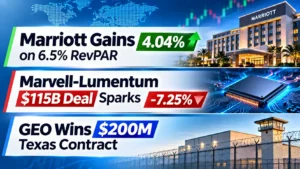
Within the benchmark, Marvell Technology plunged about 12% and Lumentum shed 18% after the companies announced a $115 billion all-stock merger, while Oracle declined 8% following a $20 billion equity and debt offering to fund AI infrastructure. These moves pulled the information technology sector lower and neutralised gains in cyclical areas.
Consumer discretionary led sector performance with a gain of about 3%, while financials and industrials each added more than 1%, and materials advanced 2%. The index’s closing performance came as the tech-heavy Nasdaq also reversed early gains, underscoring the market’s continued sensitivity to AI-related capital spending and valuation concerns.
Nasdaq Composite Falls 0.6% as AI-Linked Shares Reverse Early Advance
The Nasdaq Composite opened at 25,682.28 and closed 0.6% lower, marking a loss of roughly 154 points from its opening level. The index had climbed as much as 1.4% in morning trading before the technology sector pulled back further. Its intraday high stood near 25,799, while the low was around 25,437.
Technology and growth-oriented shares including Marvell Technology, Lumentum and Oracle recorded declines of 12%, 18% and 8% respectively, contributing heavily to the index’s daily underperformance. Apple fell more than 2% ahead of its earnings release, while Meta Platforms and Microsoft posted only marginal moves.
The technology-heavy benchmark responded to the combination of falling oil prices, which initially supported risk appetite, and renewed selling in AI infrastructure names, which ultimately drove the index into negative territory by the close. The session extended a pattern of tech underperformance that had defined the prior week, when the Nasdaq logged its worst single-day performance since June.
Also Read: What Is the New York Stock Exchange (NYSE)?
Russell 2000 Gains 1% as Smaller Stocks Outperform on Cyclical Rotation
The Russell 2000 opened at 2,833.13 and closed at 2,841.03, gaining 1.04% or about 29 points. It recorded an intraday high of 2,847.70 and a low of 2,810.48. Movements among smaller-cap companies benefited from the rotation into consumer discretionary, financials and industrials, which are more heavily represented in the small-cap benchmark than in the technology-dominated indices.
The Russell 2000’s gain came even as the S&P 500 and Nasdaq declined, reflecting the day’s broader preference for cyclical exposure over growth and AI-linked shares. The index’s advance was supported by the drop in crude oil prices, which eased cost pressures for small-cap transport, retail and industrial companies. The session marked a continuation of the small-cap outperformance seen in the prior week, when both the Russell 2000 and S&P MidCap 400 gained 1.3%.
S&P 100 Falls 0.2% as Large-Cap Technology Weakness Offsets Cyclical Gains
The S&P 100 opened at 3,754.42 and finished at 3,728.92, recording a loss of 8.48 points, or 0.23%. The index traded between 3,718.12 and 3,777.82 during the session. Movements in major large-cap constituents were mixed, with Amazon gaining 4.7% and Sherwin-Williams rising nearly 6%, while Apple fell more than 2% and Oracle dropped 8%.
The large-cap benchmark’s decline reflected the same technology reversal that pulled the S&P 500 and Nasdaq lower, with the index’s heavier weighting in mega-cap growth names outweighing strength in consumer and industrial shares. The S&P 100’s closing level remained below its 52-week high of 3,914.19, as the session’s technology selling pressure offset the support from falling oil prices and cyclical rotation.
Dow Composite Rises 0.95% as Transport and Utility Averages Advance
The Dow Jones Composite Average opened at 16,421.39 and closed at 16,506.56, gaining 154.86 points, or 0.95%, after moving between a high of 16,564.47 and a low of 16,421.39. The Dow Jones Transportation Average ended at 20,684.09, compared with an opening level of 20,456.35, representing a 1.75% gain of 354.76 points.
The Dow Jones Utility Average closed at 1,117.78, changing 0.57% from its opening level of 1,111.50. Movements in transport constituents reflected the benefit of lower jet fuel costs following the drop in crude oil, while utility shares tracked the decline in Treasury yields. The composite’s advance stood in contrast to the technology-driven weakness in the S&P 500 and Nasdaq, reinforcing the session’s cyclical and defensive rotation theme.
Also Read: How to invest in US stocks
SOX Plunges 2.63% as Marvell And Lumentum Merger Triggers Chip Sell-Off
The Philadelphia Semiconductor Index (SOX) opened at 10,762.48 and closed at 10,407.32, losing 281.48 points, or 2.63%. Its intraday high was 10,890.94, while the low was 10,330.08. Semiconductor-related constituents Marvell Technology and Lumentum moved -12% and -18% respectively after the announcement of their $115 billion all-stock combination, contributing heavily to the sector benchmark’s decline.
Nvidia managed a gain of 0.7%, but this was insufficient to offset the broader selling pressure across chip and optical-component shares. The SOX’s decline came amid continued scrutiny of AI infrastructure spending and followed a prior week in which semiconductor stocks had led the market lower.
NYSE Composite Gains 0.46% as Broader Shares Track Cyclical Rotation
The NYSE Composite Index opened at 24,293.09 and closed at 24,404.30, recording a gain of 111.20 points, or 0.46%. The index traded between 24,293.09 and 24,516.63 during the session. Movements across consumer discretionary, financials, industrials and materials contributed to its performance, while energy and technology-related segments lagged.
The NYSE Composite’s advance reflected the day’s broader rotation away from AI-linked growth shares and towards cyclical and value-oriented segments of the market. The index’s gain came even as the S&P 500 and Nasdaq declined, highlighting the divergence between the technology-heavy benchmarks and the broader US equity market on Monday.
S&P MidCap 400 And SmallCap 600 Advance as Cyclical Sectors Lead
The S&P MidCap 400 opened at 3,675.29 and closed at 3,696.93, moving 34.71 points or 0.95%, with an intraday range of 3,675.29–3,725.05. The S&P SmallCap 600 opened at 1,720.60 and ended at 1,706.25, gaining 1.46%, after trading between 1,692.72 and 1,720.60. The two benchmarks reflected movements among mid- and small-cap shares as the rotation into consumer discretionary, financials and industrials supported smaller companies more than the mega-cap technology names that dominate the S&P 500 and Nasdaq. The mid-cap and small-cap indices benefited from the same cyclical tailwinds that lifted the Russell 2000, while avoiding the AI-related selling pressure that weighed on large-cap growth shares.
Oil’s 7.6% Slide and Iran Diplomacy Hopes Drive The Session’s Direction
The principal market catalyst was the 7.6% decline in Brent crude to $104.82 per barrel and a 7.1% drop in West Texas Intermediate to $96.72, following reports that Iran’s Supreme Leader had granted the government authority to pursue peace negotiations. US Secretary of State Marco Rubio said President Donald Trump “hasn’t made a decision” to attack Iran and that Washington would prefer a peaceful resolution, while Iranian officials indicated talks through Qatari and Pakistani mediators were intensifying.
Treasury yields fell alongside oil, with the 10-year yield dropping 5 basis points to 4.89% and the 30-year yield slipping 6 basis points to 5.25%. The dollar weakened, and gold rallied. These developments coincided with the day’s movement across the major US equity benchmarks, supporting cyclical sectors while weighing on energy shares.
A second catalyst was the continued scrutiny of AI-related capital spending, which drove Marvell Technology and Lumentum sharply lower and pulled the technology sector down, offsetting the support that lower oil prices provided to consumer and industrial shares.
Also Read: US Stock Market Timings
VIX Jumps 12.91% to 19.42 as Technology Selling Lifts Volatility
The CBOE Volatility Index (VIX) changed 12.91% to 19.42, compared with its previous close of 17.20. The index measures expected volatility in the S&P 500 over the coming 30 days. Its movement during the session coincided with the technology-led reversal in the S&P 500 and Nasdaq, which erased early gains and closed lower.
The VIX’s advance reflected higher demand for downside protection as AI-linked shares sold off, even as the Dow and small-cap benchmarks remained positive. The CBOE Nasdaq Volatility Index (VXN) and the CBOE S&P 500 3-Month Volatility Index (VIX3M) were not separately reported in the available session data.
Consumer Discretionary Gains 3% as Energy Falls 3% Across Eleven Sectors
Performance across the 11 S&P 500 sectors was mixed. Consumer discretionary recorded the strongest move at 3.2%, while energy declined 3% as crude oil prices tumbled. The remaining sectors recorded the following moves: Information Technology -2.4%, Communication Services -0.6%, Consumer Staples +0.9%, Financials +1.8%, Health Care -0.3%, Industrials +2.1%, Materials +2.3%, Utilities +0.6% and Real Estate +0.9%. The sector movements followed the drop in oil prices, which supported consumer-facing and transport-related groups while weighing on energy producers, and the renewed selling in technology and semiconductor shares, which pulled the growth-oriented sectors lower.
Magnificent Seven Diverge as Amazon Gains 4.7% And Apple Falls 2%
Among the Magnificent Seven, Amazon moved +4.7%, Apple changed -2.0%, Nvidia recorded +0.7%, Alphabet moved +0.8%, Microsoft changed +0.3%, Meta Platforms recorded -0.5% and Tesla moved +2.9%. Their daily movements contributed to the performance of major US equity benchmarks, with Amazon’s gain supporting the Dow and consumer discretionary sector, while Apple’s decline weighed on the S&P 500 and Nasdaq. The divergence within the group reflected the session’s broader rotation away from AI-linked hardware and towards consumer and cyclical exposure.
Semiconductor, Financial and Energy Stocks Show Mixed Daily Moves
Semiconductor stocks were lower, with the Philadelphia Semiconductor Index moving -2.63%. Financial stocks recorded gains, with the financial sector adding 1.8% as lower Treasury yields supported bank shares. Energy stocks moved lower alongside changes in crude oil prices, with the energy sector falling 3%. AI and growth stocks were mixed, with Marvell Technology and Lumentum posting sharp declines while Amazon and Tesla advanced. The movements among relevant constituents contributed to the technology-heavy indices’ underperformance and the Dow’s relative strength.
Also Read: What Are Fractional Shares?
ISM Manufacturing Rises To 55.5 as Construction Spending Falls 1.9%
The latest economic data showed the ISM manufacturing index at 55.5, compared with 54.5 in September and above the 54.6 consensus estimate. The prices index slipped to 75.2, down 2.7 points, while the production index rose to 59.0, up 2.3 points. Separately, construction spending fell 1.9% in September, the biggest monthly decline since April 2020, with residential spending down 5.5%. The releases provided the latest information on manufacturing activity and construction during the session, with the manufacturing expansion contrasting with the weakness in residential construction.
Fed Rate Expectations and Falling Treasury Yields Set the Backdrop
The Federal Reserve remained a key focus as markets assessed the path of interest rates ahead of the midterm elections and the upcoming jobs report. The 2-year US Treasury yield stood at 4.579%, while the 10-year yield was 4.89% and the 30-year yield was 5.252%. The yield curve steepened as falling oil prices reduced immediate inflation concerns, supporting longer-dated bonds. The decline in yields came despite the stronger-than-expected ISM manufacturing reading, as traders focused on the disinflationary impact of lower energy costs.
Brent Crude Falls 7.6% as Gold Rises 1.8% And Dollar Weakens Today
Brent crude traded at $104.82 per barrel, changing -7.6%, while West Texas Intermediate (WTI) crude stood at $96.72, moving -7.1%, as reports of potential US-Iran diplomatic progress eased immediate supply concerns. The decline followed indications that Iran’s Supreme Leader had granted the government authority to pursue peace negotiations, and that discussions through Qatari and Pakistani mediators were intensifying.
US Secretary of State Marco Rubio said President Donald Trump “hasn’t made a decision” to attack Iran and that Washington would prefer a peaceful resolution. Brent fell to a near two-week low, and WTI dropped below $100 per barrel. The sell-off coincided with a drop in Treasury yields and a softer dollar. Gold traded at $3,956.90, changing +1.83%, while silver moved +3.7% to $51.01. Copper changed +0.7% to $14,246 a ton, following a 1.4% decline on Friday that capped its third consecutive weekly loss, with support also stemming from tightening mine supply after Chilean production dropped to its lowest level in over two decades. Nickel and zinc posted slight gains while aluminium edged lower.
Natural gas moved +0.7% to $2.903 per million British thermal units, aided by short covering and forecasts of colder weather. US production dipped slightly to 111.0 billion cubic feet per day in early November from October’s record highs. Seasonal forecasts project overall US demand to climb to 116.7 billion cubic feet per day next week as colder weather settles in. The US Strategic Petroleum Reserve inventory fell to 282.2 million barrels, its lowest level since 1982. The commodity moves followed the diplomatic developments and the resulting decline in yields, which supported precious metals while weighing on energy prices.
Dollar Index Falls 0.35% as Euro and Sterling Advance Against Greenback Today
The US Dollar Index (DXY) moved -0.35% to 101.44, posting its sharpest daily decline in over two weeks, as falling crude oil prices and climbing stock markets curbed safe-haven demand for the greenback. EUR/USD stood at 1.1194, USD/JPY traded at 157.91, and GBP/USD was at 1.3410.
The dollar lost ground against major rivals including the euro and British sterling, though it managed a slight 0.08% gain against the Japanese yen. Currency movements followed the decline in crude oil prices and the drop in Treasury yields, which reduced demand for the dollar as a safe-haven asset and supported the euro and sterling. Investors trimmed positions ahead of a dense week of catalysts, including Tuesday’s US midterm elections, critical labour market data, and rate decisions from multiple central banks.
The greenback’s retreat came even as US manufacturing data showed steady output, with the ISM manufacturing index rising to 55.5 in October from 54.5 in September, above the 54.6 consensus estimate. The dollar index’s decline occurred alongside a drop in the 10-year Treasury yield to 4.89% and the 30-year yield to 5.252%, while the 2-year yield edged down less than a basis point to 4.579%. The euro and sterling advanced as the decline in oil prices eased immediate inflation concerns and reduced the appeal of dollar-denominated assets.
The dollar’s loss against the yen was limited, with USD/JPY trading at 157.91. The dollar’s decline came as crude oil prices fell more than 7% and equity benchmarks including the Dow Jones Industrial Average gained 0.6%. Currency markets remained focused on the midterm elections and the upcoming jobs report, the key scheduled events for the session.
The closing session was shaped by a 7.6% drop in Brent crude on US-Iran diplomatic hopes, which lifted the Dow and small-cap benchmarks while technology shares reversed early gains. The S&P 500 and Nasdaq finished lower as AI-linked selling pressure persisted. Treasury yields, the dollar and gold all reflected the session’s oil-driven move, providing a factual summary of Monday’s mixed market outcome.
Disclaimer
The information shared here is intended solely for informational and educational purposes and does not constitute investment recommendations. While we practice strict due diligence in curating daily market data, readers must perform independent research before trading. To flag any real-time data discrepancies or content concerns, please write to us at content@hdfcsec.com.
 Join Us
 Add as preferred source on Google


More International News






Open Free Demat Account
Open Free Demat Account











Invest Anytime, Anywhere


By signing up I certify terms, conditions & privacy policy